United Earth initiative
Earth democracy
Why it is needed, what it is, and how we build it
This document contains the theoretical foundation of the UE initiative.
We invite everyone to an open discussion on how governance structures can evolve to address global challenges while safeguarding cultural identities within a shared democratic framework.
Claim your Earth Citizenship (EC) and influence at agora.united.earth
PLEASE MAKE SURE YOU HAVE THE LATEST VERSION OF ANY DOWNLOADED DOCUMENTS!
After major upgrades, the web version is compiled into downloadable documents (DOCX/ODT/PDF/MD) available at united.earth/en/documents
This is done for transparency and to preserve a record of its development.
Preface
The first versions of this material were drafted by a small group of engaged individuals calling themselves Worried Earthlings (WE). They have chosen to remain anonymous, partly due to security concerns because of the controversial character of their ideas, but mostly to foster a culture focused on our shared planet and the global society, rather than on individuals.
The name Worried Earthlings — WE — reflects the perspective from which the initiative emerged. Its participants share a strongly developed global awareness and sense of identity as Earthlings. Earth and humanity became the primary political frame through which they approached the problems addressed here, without requiring the abandonment of other personal identities.
WE do not assume that others will share this global identity with the same intensity. Their proposal instead asks whether enough people can develop a global perspective strong enough to recognise humanity as a political community where genuinely global problems require shared democratic action.
WE are convinced that dominant individualism, together with obsolete forms of tribalism, obscures the fact that many of the forces shaping individual and local life now operate globally without democratic control.
Global democratic governance is necessary precisely to protect individual freedom, diverse identities and local societies against these forces.
A fundamental hypothesis coming out of their ideas is that the principle of the sovereign nation-state, or more precisely the connection between cultural identity and governance, is the major obstacle to solving global existential threats.
WE and the United Earth initiative understand how sensitive this issue is, and urge all fellow Earth citizens to join this critical and challenging discussion with mutual respect and solidarity.
The proposal is no threat to cultural identity, like ethnicity, nation, religion, and ideology. It is, though, a rejection of the idea of using identity to exclude others by dominating governance.
The inclusive nature of this project seeks only to promote cooperation and bold thinking in the face of shared global problems threatening us all.
A geopolitical visualisation tool
The earthwheel is both a symbol and an analytical tool. It is designed to make visible a structural feature of today’s geopolitical condition that is difficult to see in conventional hierarchical diagrams: that the hierarchy of governance is incomplete as a whole, and that this incompleteness appears most clearly as a missing global centre.
The combined illustration below brings together three views of the same problem: the populated earthwheel, the empty five-level schema, and the linearised hierarchy. Read together, they show both why the conventional linear form remains useful and why the earthwheel was needed as a complementary model.
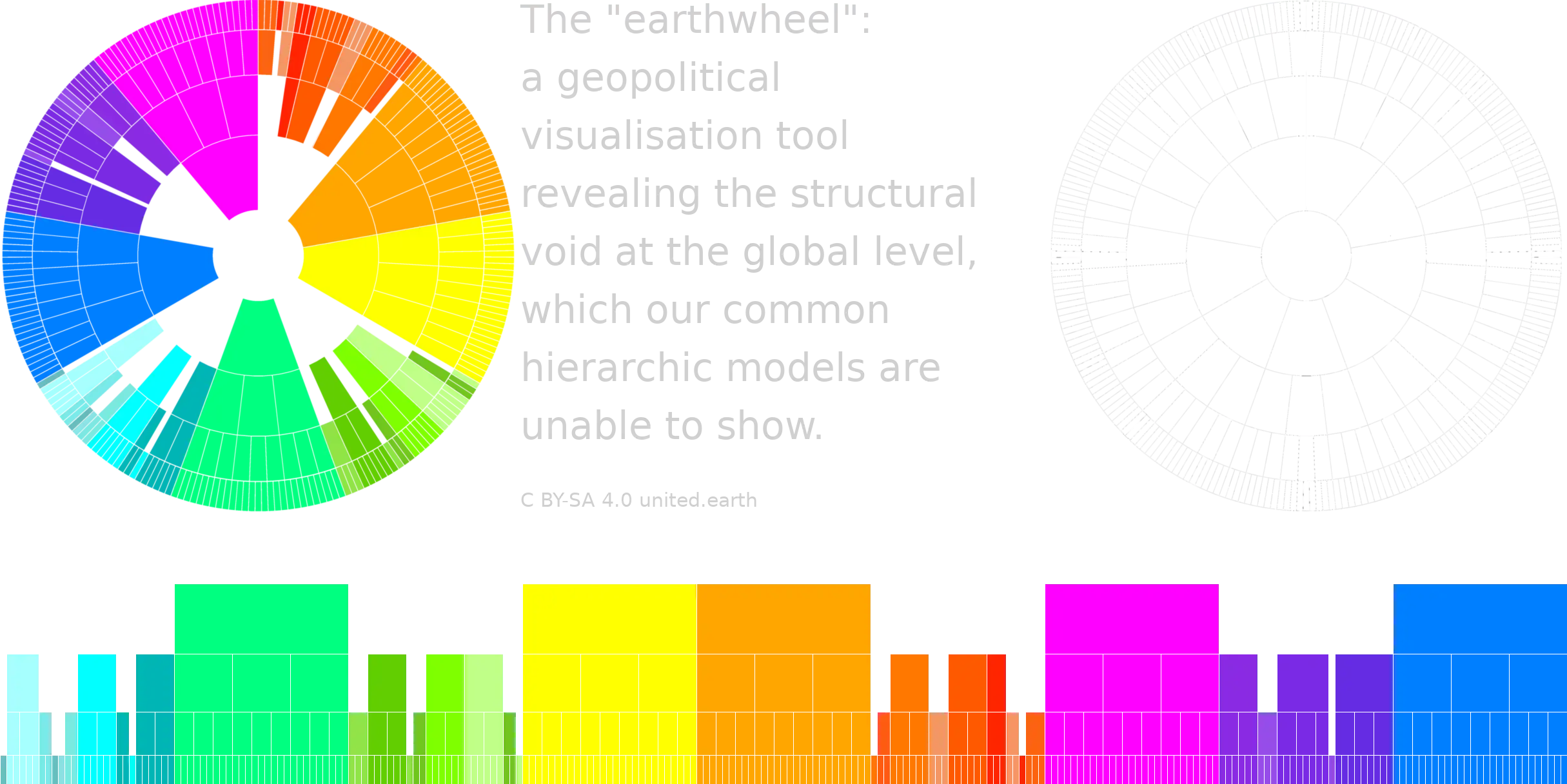
The linear hierarchy is the familiar way of representing nested political levels. It has real strengths. It is immediately legible, it can be extended horizontally with little loss of readability, and it can in principle scale toward a far more empirically complete representation of the world’s nearly 200 sovereign states. In that sense, it is well suited for enumeration and for showing large numbers of distinct units within a vertical hierarchy.
Its weakness is more structural. Once the same geopolitical condition is unfolded into a linear arrangement, what is missing no longer appears as a single absence. The gaps are dispersed between columns, and attention is drawn mainly toward the individual units and their separate heights. This makes the form analytically weaker at revealing a central fact of the present world order: that the global level is absent as such, and that the broader hierarchy therefore remains incomplete.
The empty five-level schema shows the same model in its most reduced form: global, bloc, sub-bloc, regional, and local. It presents the intended geometry of a complete hierarchy before empirical irregularities are introduced. Read alongside the populated earthwheel, it clarifies that the present geopolitical condition is defined not only by the entities that exist, but also by the levels that are absent, fragmented, or unevenly developed.
The earthwheel can be used to analyse geopolitical systems across several dimensions, including:
- Completeness – the degree of organisational development at each level, including whether hierarchical relations exist or are absent
- Balance – proportionality in geographic size, population, military power, economic strength, or other relevant variables
- Sovereignty vs. subsidiarity – how authority and responsibility are distributed between levels
- Identity and legitimacy – how cultural identity relates to political legitimacy, function and democratic authority within each governance entity
The model is deliberately highly abstract. To make the structural point visible, the number of units shown at each level is sharply reduced. The earthwheel is therefore not a literal cartographic rendering of the world’s sovereign states, but a conceptual compression. Its purpose is not to enumerate everything, but to show something that enumeration tends to obscure: where the hierarchy is complete, where it is incomplete, and how that incompleteness defines the geopolitical system as a whole.
Why global democracy?
Why can’t we act rationally as a global society: stop wars, control climate change, solve other global threats, and create a peaceful and sustainable society for future generations?
Why is the current stage in our geopolitical evolution outdated, and why is global democracy our only chance of survival?
Why do you need it, and why do we need your participation?
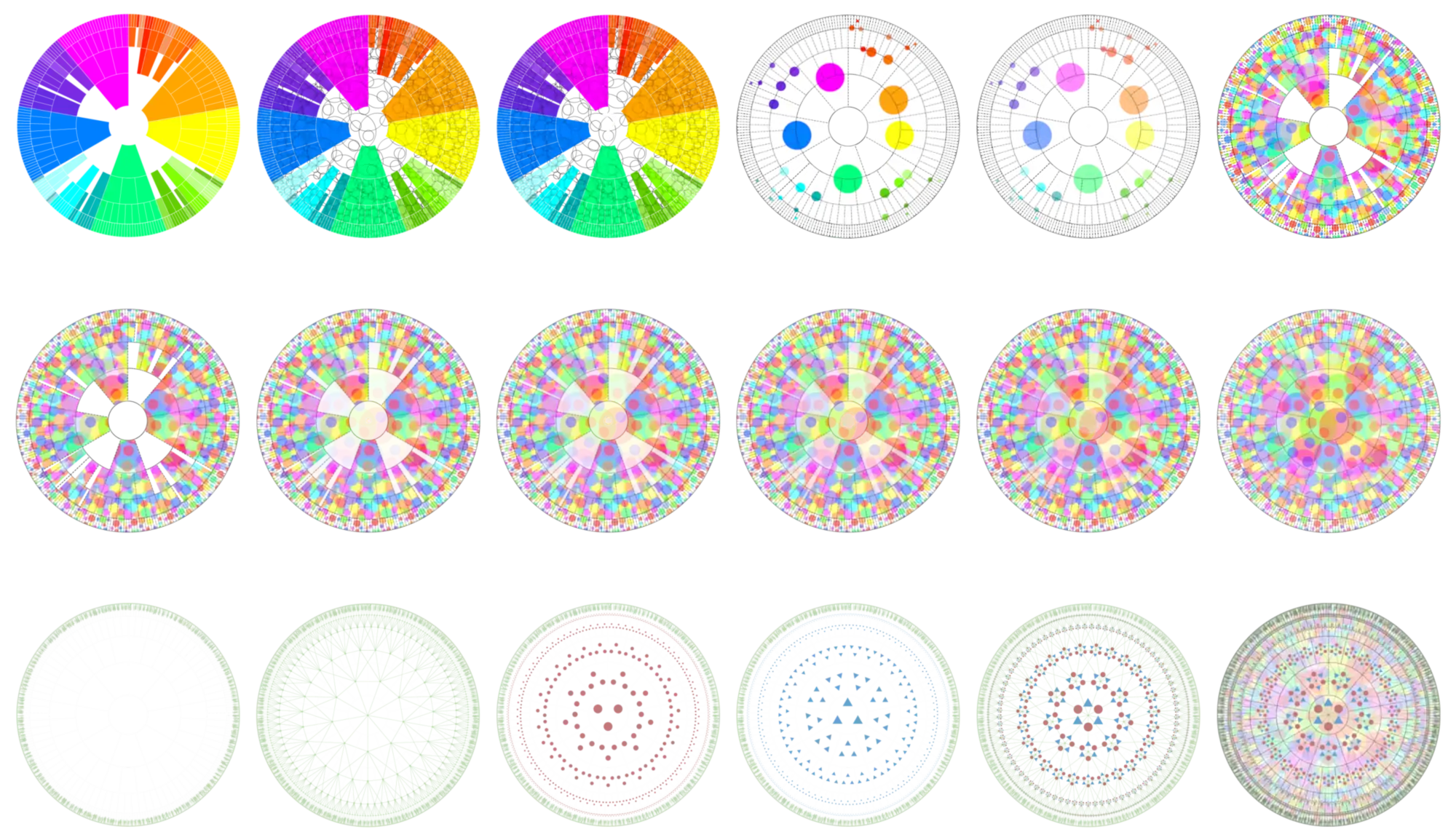
Overview (Earthwheels):
Summary
Our geopolitical anarchy is a condition, not a system. Decades of scientific progress, political effort and international cooperation have produced important results, but they remain far from sufficient to prevent global catastrophe. The fundamental obstacle is structural: humanity lacks the legitimate global authority needed to coordinate and implement solutions at the scale and speed required.
We are approaching a critical bottleneck with three possible global outcomes: collapse, autocracy or democracy. To avert catastrophe while preserving human freedom, we must establish democratic global governance before escalating crises favour the concentration of power in authoritarian hands.
Preventing catastrophe is the goal. Global democratic governance is the necessary means. Building this capacity offers a credible path from persistent alarm and political powerlessness to effective collective action — and therefore a rational basis for hope.
The questions are: What does global democracy look like, and how do we build it in time?
1. Geopolitical anarchy
We sometimes hear people talk about a “new world order”, mostly as something they do not want. But the truth is this: we have never had any “old world order” either. All we have had, and still have, is an accidental result of history: a condition, not a system at all. The global level of political decision-making is largely absent from this condition; therefore, it is rightly described as geopolitical anarchy.
This condition is unsustainable and must be replaced by a real geopolitical system capable of resolving two structural failures: paralysis in global crises, leaving global threats unresolved, and the widespread oppression of stateless nations and other identity groups, generating conflict and war, further distracting us away from the global threats.
1.1 The geopolitical void
WHEEL < 1/18 >
A historic result and not a system
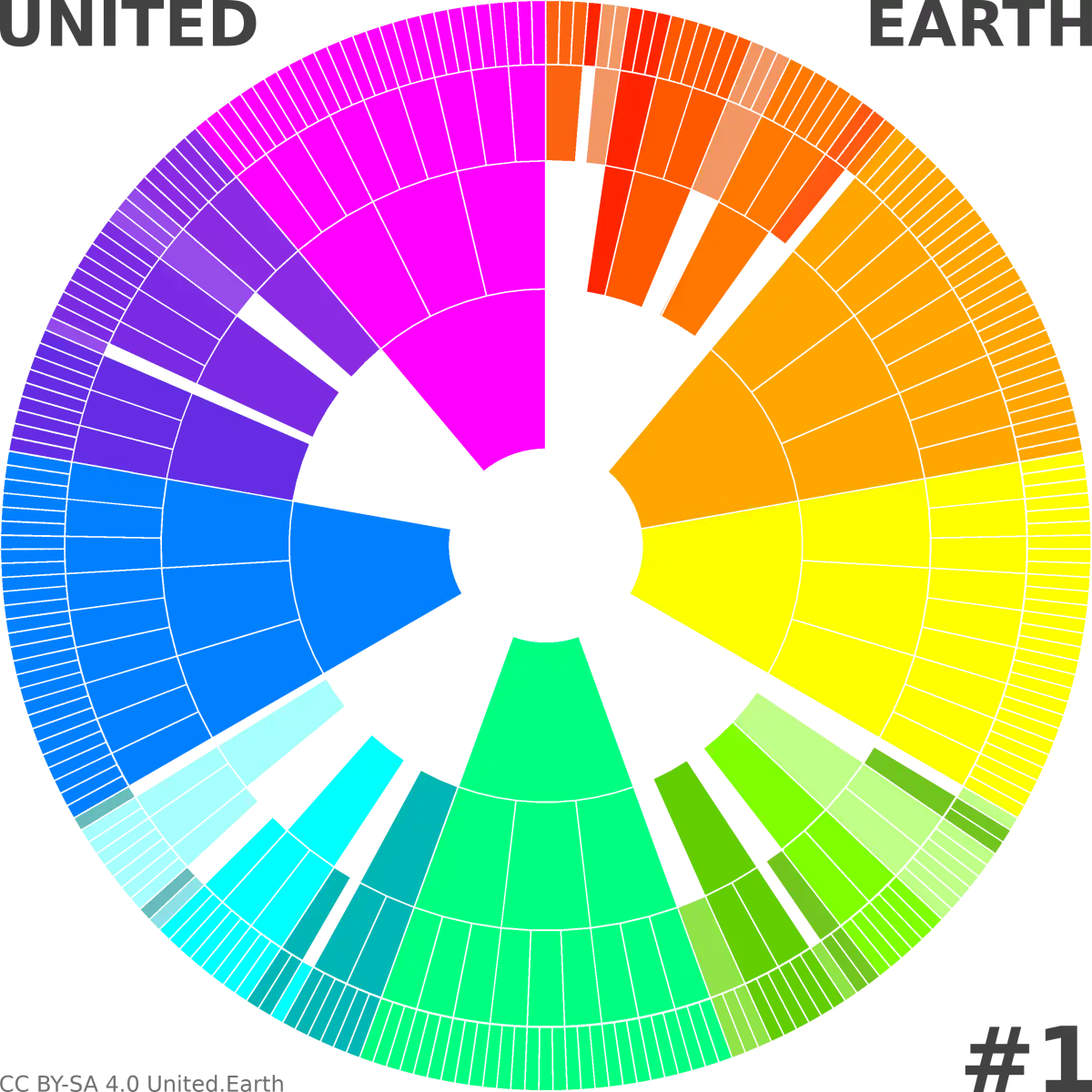
The first “earthwheel” illustrates our current geopolitical condition: separate political units of very different sizes, all sovereign nation-states separated by hard borders, and only connected by a fragile set of agreements and institutions at the global level. Without those, we would probably have been in a much worse situation, but they are far from what we need to tackle the global threats adequately.
The empty centre represents the geopolitical void: a missing level where coordinated authority should exist. The void has an irregular shape since many parts of the world have yet to form blocs.
Read more about the earthwheels here.
Throughout history, the global arena has been shaped by shifting balances of power rather than by a shared political system. Empires, alliances, and spheres of influence have come and gone, but there has never been a democratic framework representing humanity as a whole.
In the second half of the 20th century, the so-called “Pax Americana” created a degree of stability for some parts of the world, but at the cost of proxy wars, military interventions, and an economic order that has disproportionately favoured a small global elite.
The UN system performs indispensable humanitarian, diplomatic, normative, and technical work. Yet it remains constitutionally dependent on its sovereign member states and lacks independent democratic authority over them. The arrangement with five permanent veto powers—a historical compromise frozen since WW2—illustrates how limited and imbalanced the institution is when facing today’s global challenges.
The limitation is structural rather than accidental. A genuine global constitutional order would have to limit, redistribute and partly supersede the sovereignty of the very states on which the UN system depends. Those states cannot be expected to create, through the same intergovernmental chain of authority, an independent democratic authority above themselves.
The result is what the first “wheel” shows: a world full of powerful actors and institutions, but no centre—no legitimate place where pressing global existential problems can be solved.
1.2 Structural fragmentation
Fragmented sovereignty
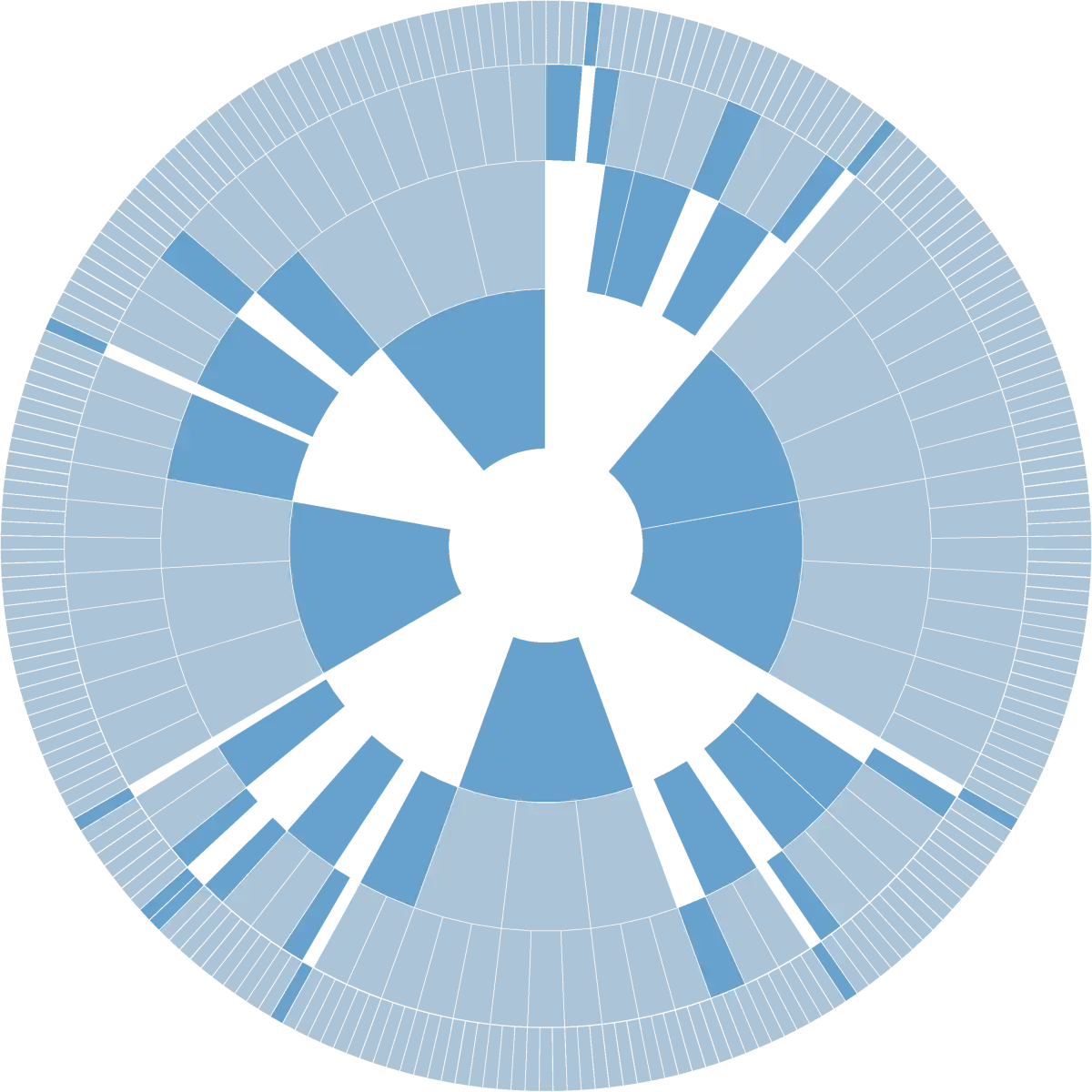
Here, our “earthwheel”, with its five levels, is used to illustrate how sovereign nation-states today vary in size and population.
The giants, Brazil, China, India, the USA, Russia, and others, are units at the bloc level.
Medium-sized nation-states, the largest group, are at the sub-bloc level. They are comparable in size to provinces in Canada, China or India, oblasts in Russia, or states in Brazil or the USA.
The smallest ones are comparable to regional or even local units within the sub-blocs, including island nations formed through decolonisation, and European microstates.
Image: CC BY-SA 4.0 United.Earth Initiative
Fragmented allocation of authority
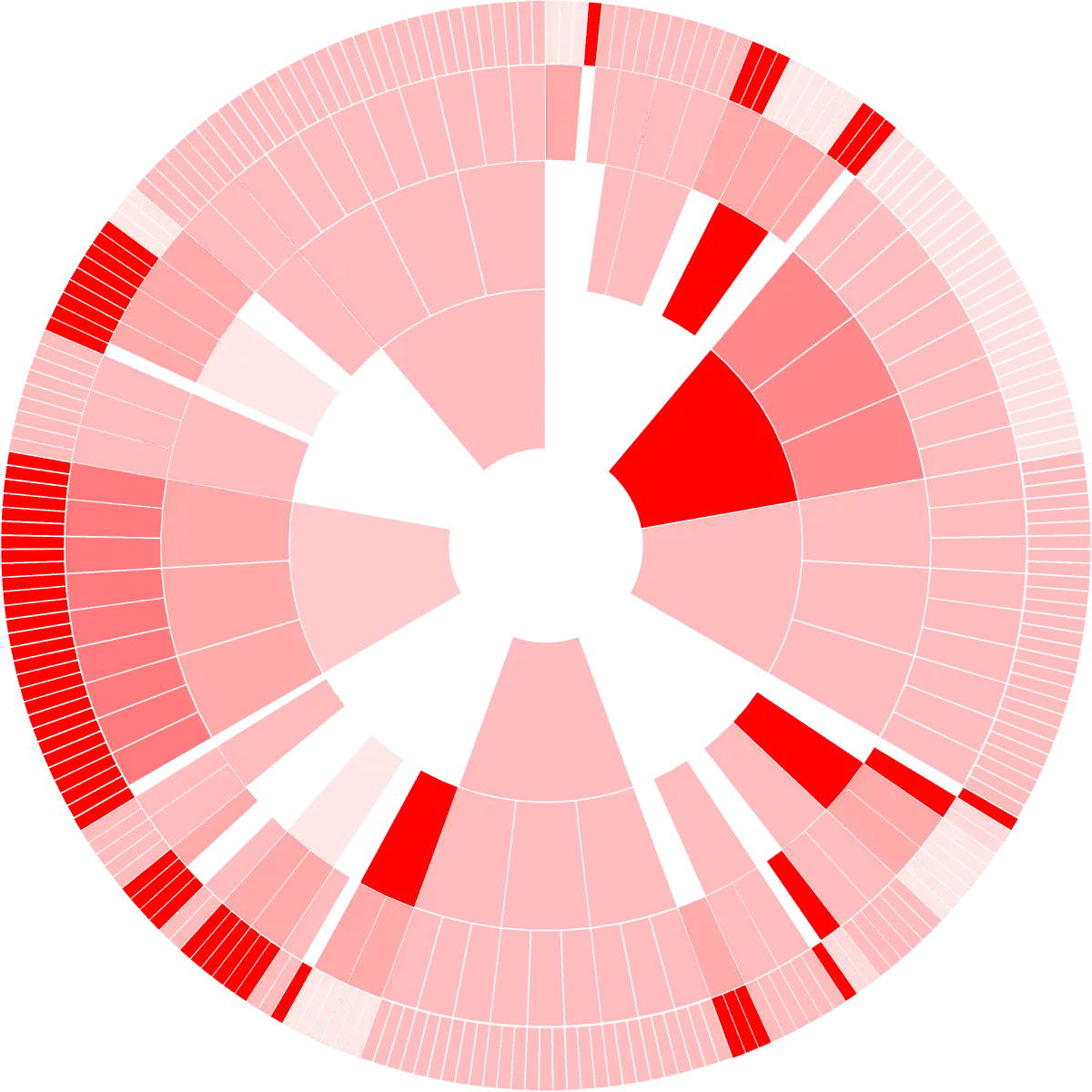
Today, political systems distribute authority according to widely different and often incompatible principles. Some concentrate most power at the top, while others restrict collective authority so strongly that shared problems remain unmanaged.
The resulting pattern reflects political history, ideology, conflict, and institutional habit rather than a coherent relationship between the scale of a task and the level responsible for it.
Image: CC BY-SA 4.0 United.Earth Initiative
Political authority today is distributed unevenly across the planet. Some nation-states are continent-sized, others smaller than medium-sized cities, yet all are treated as equally “sovereign” in international law. This randomness in size is not only a historical accident — it produces real distortions. Fair representation becomes very difficult to design at the global level, power imbalances become extreme, and large states can use economic or political leverage to secure support from very small ones. Under these conditions, global democracy risks becoming a theatre rather than a meaningful system.
Tuvalu, with fewer than 12,000 inhabitants, and India, with more than 100,000 times that population, both count as fully sovereign nation-states in international law, holding the same formal status and equal voting rights in the UN General Assembly despite their vastly different scale, capacity, and global impact.
On its own, this randomness would be a practical challenge — but not an impossible one. The deeper structural problem is that sovereignty and cultural identity are fused. Political authority is commonly justified through identity—national, ethnic, religious, ideological, or a combination of these—and the dominant identity in turn depends on sovereignty to maintain its political position and territorial claim. We introduce new tools to discuss this feature further down.
As a result, sovereignty becomes extremely difficult to redistribute or reorganise. Any shift toward shared governance can be experienced as a threat to the dominant identity. Sovereignty becomes a shield—held tightly not only for effective governance, but to preserve identity-based control. This stops political evolution at the nation-state level and blocks the development of higher-order structures.
The result is the pattern shown in the earthwheel image: sovereignty exists on local, regional, sub-bloc, and bloc levels, but the global level remains empty. As long as sovereignty cannot move upward, coordinated planetary governance remains structurally impossible.
The current pattern of sovereignty is therefore random, rigid, and incomplete. We need to redesign this pattern based on new first principles.
1.3 Paralysis in global crises
CC BY-SA 4.0 United.Earth Initiative
A systemic failure on display
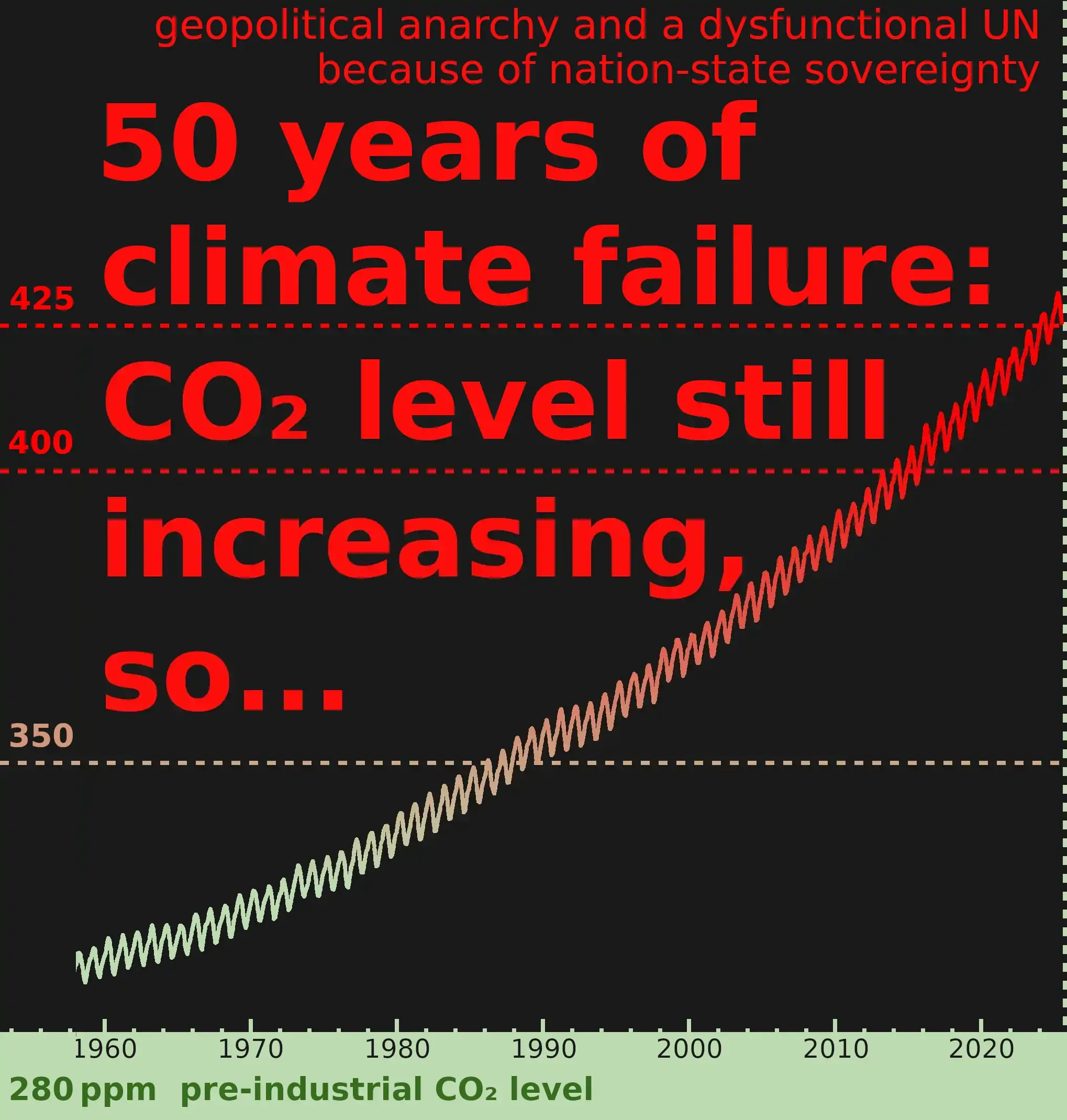
The Keeling curve shows what happens when global crises encounter a system without global authority. For more than 50 years, atmospheric concentrations of CO₂ and other greenhouse gases have increased despite countless summits and agreements, because the nation-state anarchic condition has failed to produce binding coordination capable of overcoming the political and economic forces driving them. Our overall attempt at coordinated global climate action has been a tragic failure, despite all the honourable efforts of millions of committed individuals. We’ve even reached such a low point that many world leaders dare to lie publicly, claiming that the problem doesn’t even exist. It may get them votes from the many who share that denial as a temporary comfort strategy, but the result is obvious: this shameless populism only makes the problem worse for us all.
It’s time to face the simple fact: Without a real geopolitical structure of governance, we cannot stop climate destruction at the speed and scale required.

– Have you seen any humans lately?
– No. There’s a rumour they’ve recently gone extinct, for some reason.
Reference: Rachel Carson Silent Spring (1962) Wikipedia
CC BY-SA 4.0 United.Earth Initiative
Toward another kind of silent spring
For years, leading AI researchers have warned that increasingly powerful systems may outrun our ability to control them. In 2023, hundreds of AI researchers and industry leaders publicly stated that mitigating the risk of extinction from AI should be a global priority alongside pandemics and nuclear war. Yet the response has not been coordinated restraint, but accelerating competition.
At first, this was mainly a race between companies. No company wanted to slow down while its competitors continued, and some of the leading developers themselves called for common rules capable of constraining everyone together.
Now the same dilemma is moving to a more dangerous level. Nation-states increasingly treat advanced AI and superintelligence as strategic capabilities they cannot risk allowing rivals to develop first. The corporate race-to-the-bottom is becoming a geopolitical one — defended in the name of national sovereignty and security.
It’s time to face the simple fact: No participant can safely stop this race alone. We need binding global coordination that makes restraint simultaneous, verifiable and enforceable.
The climate crisis and the accelerating race toward superintelligence expose the same structural failure on radically different timescales. Climate shows what happens when humanity has known about a global threat for more than half a century, yet remains unable to coordinate strongly enough to reverse it. Advanced AI may confront us with the same problem much faster: warnings can be widely understood while competition continues because no participant can safely assume that others will stop.
In both cases, the problem is not ignorance, indifference, or a lack of possible solutions alone. It is also a basic coordination dilemma. Governments know that coordinated climate action would benefit all, but acting alone carries economic and political costs if others do not follow. Companies and governments may likewise recognise the risks of increasingly powerful AI while fearing that unilateral restraint would leave competitors with a decisive technological, economic or strategic advantage. In the absence of an authority capable of aligning action across borders, delay becomes rational in one crisis while acceleration becomes rational in another.
The same pattern appears elsewhere. Biodiversity loss, ocean degradation, unmanaged pandemic risks and other global threats unfold in a world where responsibility is global, but authority remains fragmented.
These crises are therefore handled primarily as negotiations between competing interests rather than as shared responsibilities subject to legitimate binding coordination.
The conclusion is not that humanity lacks concern, knowledge or capability. It is that it lacks legitimate democratic authority at the global level. Such authority would not need direct executive control over people’s daily lives or general territorial executive control over all inhabited territory. It would need the legitimate capacity to establish and enforce common rules where individual, national or voluntary action is structurally insufficient.
As long as this level is absent, global crises will continue to be managed below the scale at which they occur. That is why we conclude:
Sub-global authority cannot solve global problems
Our political toolkit was designed for a world of mostly separate societies. The scale of our problems has become global, while the scale of our governance has remained largely sub-global. When a problem spans the entire planet, no city, nation-state, company or alliance can coordinate a complete solution on its own.
Our current international treaties and frameworks remain trapped by a fundamental limitation: they ultimately depend on the consent and compliance of sovereign states. Climate action can be weakened by free-riding and conflicting national interests; an agreement to restrain high-risk AI development can fail if major actors believe that others may continue in secret or gain strategic advantage by remaining outside it.
Consequently, even when the danger is widely recognised, no institution possesses the legitimate authority to make and enforce the collective decisions required at the global level. This is not primarily a moral failure of world leaders, scientists or technology developers; it is a fundamental design flaw in our global architecture.
Global anarchy makes global sustainability impossible.
Why we focus on structure
Most of us are already acutely aware that we live in a time of severe, compounding risks. We do not need to list or describe these crises in exhaustive, terrifying detail here. Each specific problem already has dedicated communities working across every aspect of it, from science to politics. Climate change and the race toward superintelligence are used above because they expose the same structural barrier in particularly clear, but very different, ways.
This initiative focuses on that shared, high-level structural barrier that prevents adequate solutions from being implemented at the scale required, and on building the geopolitical system capable of removing it.
1.4 Oppression of stateless nations
WHEEL < 2/18 >
A perpetual cause of conflict and war
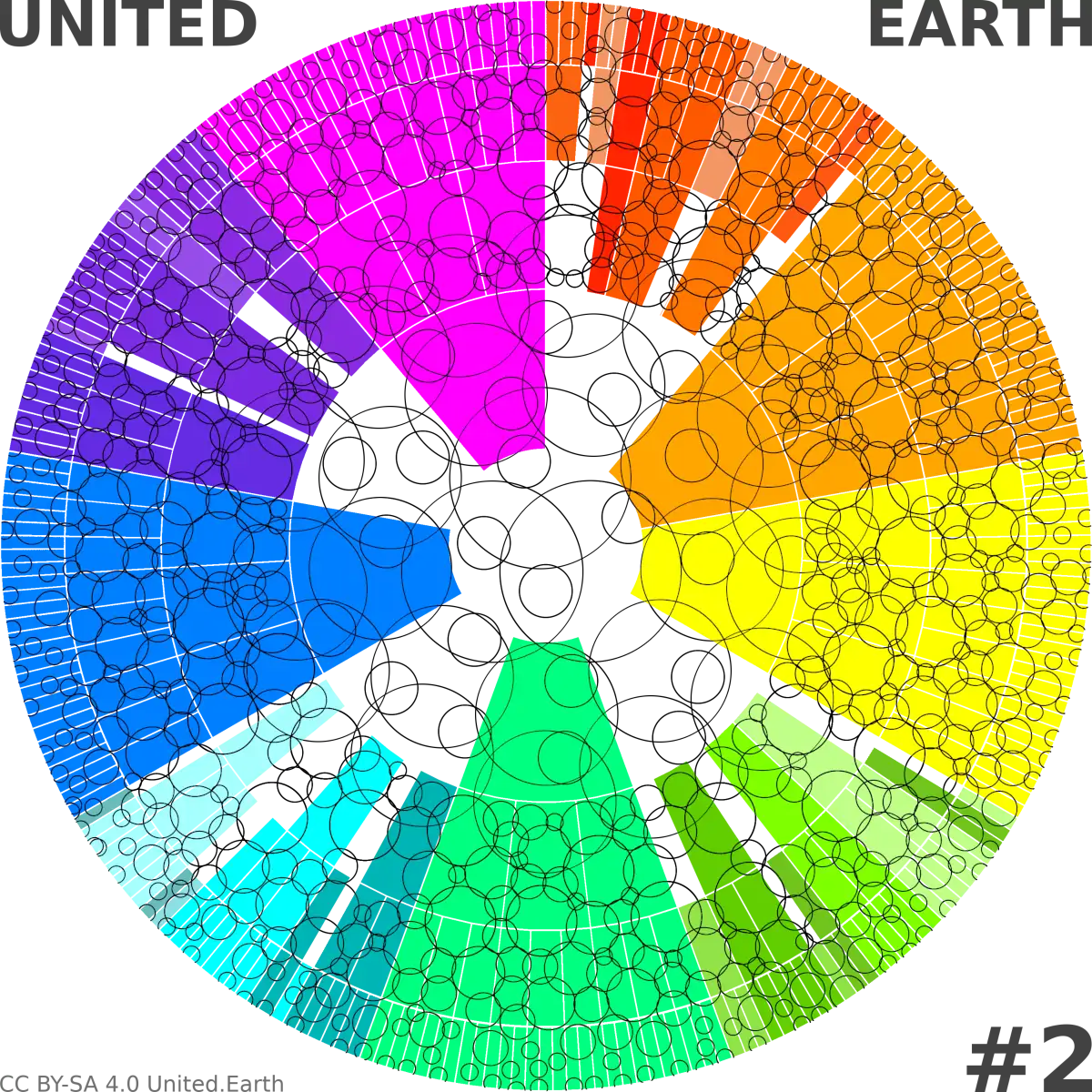
There are thousands of cultural identities without sovereign territorial recognition, including many groups commonly called “stateless nations”, which may span borders or be dispersed across the globe. By some estimates, those who define themselves as belonging to stateless nations or comparable identities could constitute as much as 20% of humanity, including most indigenous peoples, estimated to constitute 4–7% of us.
The overlapping circles illustrate how cultural identities cross territorial borders and may lack equal political recognition within the fewer than 200 sovereign nation-states.
In an identity-based state system, each territory is commonly formally linked to one dominant identity: a nation (ethnic and/or civic), a religion, an ideology, or usually a mix of these. People who define themselves through other identities may then be pressured to assimilate, accept permanent minority status, or resist.
This is a huge issue, which is often minimised by those who happened to win statehood through the result of events like wars, royal marriages, or colonialism. By some estimates, up to one-fifth of humanity belongs to communities that see themselves as nations, peoples, or cultures without their own recognised territory; the “stateless nations”. Most Indigenous peoples are in this situation. Many more live as minorities inside states that officially represent another national, ethnic, religious, or ideological identity.
These groups are not only underrepresented; they are often treated as security problems, internal enemies, or bargaining chips in regional conflicts. Demands for recognition can trigger repression, secession wars, forced assimilation, population transfers, even genocide or ethnic cleansing. The result is a permanent source of instability built into the system itself.
To base geopolitical order on such historically arbitrary events is absurd, and trying to untangle such causalities can never lead to anything but discontent: everyone wants it all for themselves, which is impossible.
The conclusion should be obvious by now: a geopolitical order that ties political authority to a single cultural identity will, by design, keep producing recurring conflicts. This is a core flaw of our geopolitical condition.
Could recognition, security, and political inclusion be ensured without making them depend on exclusive territorial control by a single identity group? Could a different relationship between cultural identity and governance help realise humanity’s potential for peaceful and sustainable coexistence with one another and with the biosphere?
2. Conceptual obstacles and their alternatives
Recognising the need for global governance is only the first step. How we understand governance, sovereignty, nations and cultural identity shapes what we consider politically possible. Some inherited concepts and assumptions make it difficult even to imagine a different geopolitical structure. To move beyond the limits of the present condition, we must also reconsider the ways we think about it.
2.1 Governance is coordination at the right level

The crowded bus paradox
We’ve all experienced it: the front of the bus is crowded, people outside can’t get in, and yet there’s space in the back. No one acts until the driver speaks. Why? Because the collective need for coordination and individual awareness rarely aligns spontaneously.
Individualistic reasons: People are distracted, exhausted, or focused on their immediate journey. Some hesitate because they are travelling a short distance or carrying heavy bags; others assume someone else will act first.
Systemic reasons: People fear social friction. It is not their designated job to direct the crowd. Even those eager to move are physically blocked by the passive majority. When people see that no one else is moving, they conclude that trying is futile.
The paradox illustrates a fundamental truth: the shared needs of a collective cannot be met by individual goodwill alone. Cooperation remains paralysed until the system introduces a recognised coordinating role with a clear mandate to act.
Image: CC BY-SA 4.0 United.Earth Initiative
The question of what governance is may seem overwhelmingly complex, but the answer can be quite simple: it is the basic act of enabling a group to solve a shared problem together. When a situation requires collective action and no one has the mandate to coordinate, even obvious solutions fail. People hesitate, wait for others, or assume someone else will act.
Today, humanity shares one interconnected reality: ecological, economic, and digital. Managing this complexity effectively and sustainably requires governance at the same scales on which these systems operate.
As with any shared framework, people naturally comply when coordination is reasonable, applies equally to all, and serves a clear collective purpose.
Under these conditions, governance is experienced not as top-down domination, but as system facilitation. Earth society has reached a level of interdependence where such facilitation has become a matter of survival.
Yet scale is not the only question. Can governance apply equally to all when it is tied to a particular cultural identity? In the existing geopolitical condition, political authority is often coupled with particular cultural identities — a relationship that lies behind the oppression of stateless nations described earlier. Understanding this relationship, and how it might be changed, requires a new set of concepts.
2.2 A new geopolitical toolset: ID=GOV and GOV//ID
Political language has many names for particular ways of linking cultural identity and governance — nation-state, theocracy and others — but lacks a principled vocabulary for the underlying identity–governance dimension. Here is an attempt to create exactly that: a set of concepts, or memes, using illustrations and standard letters and signs from the Latin alphabet:
- ID: collective sociocultural identity, such as ethnicity, nation, religion, and ideology, or combinations of those
- GOV: a territorial entity of public governance
=: direct coupling and congruence//: parallel coexistence
These elements are then used in two different combinations to describe two fundamentally opposite types of relationship between governance and identity (with suggested pronunciations):
ID=GOV (idgov) and GOV//ID (govid)
These mark opposite endpoints of what might be called the identity–governance dimension. Existing societies may contain different degrees and combinations of both.
The squares in the illustrations below represent units of governance, defined by identity(left), or not defined by identity,(right), and the circles represent groups only defined by ID.
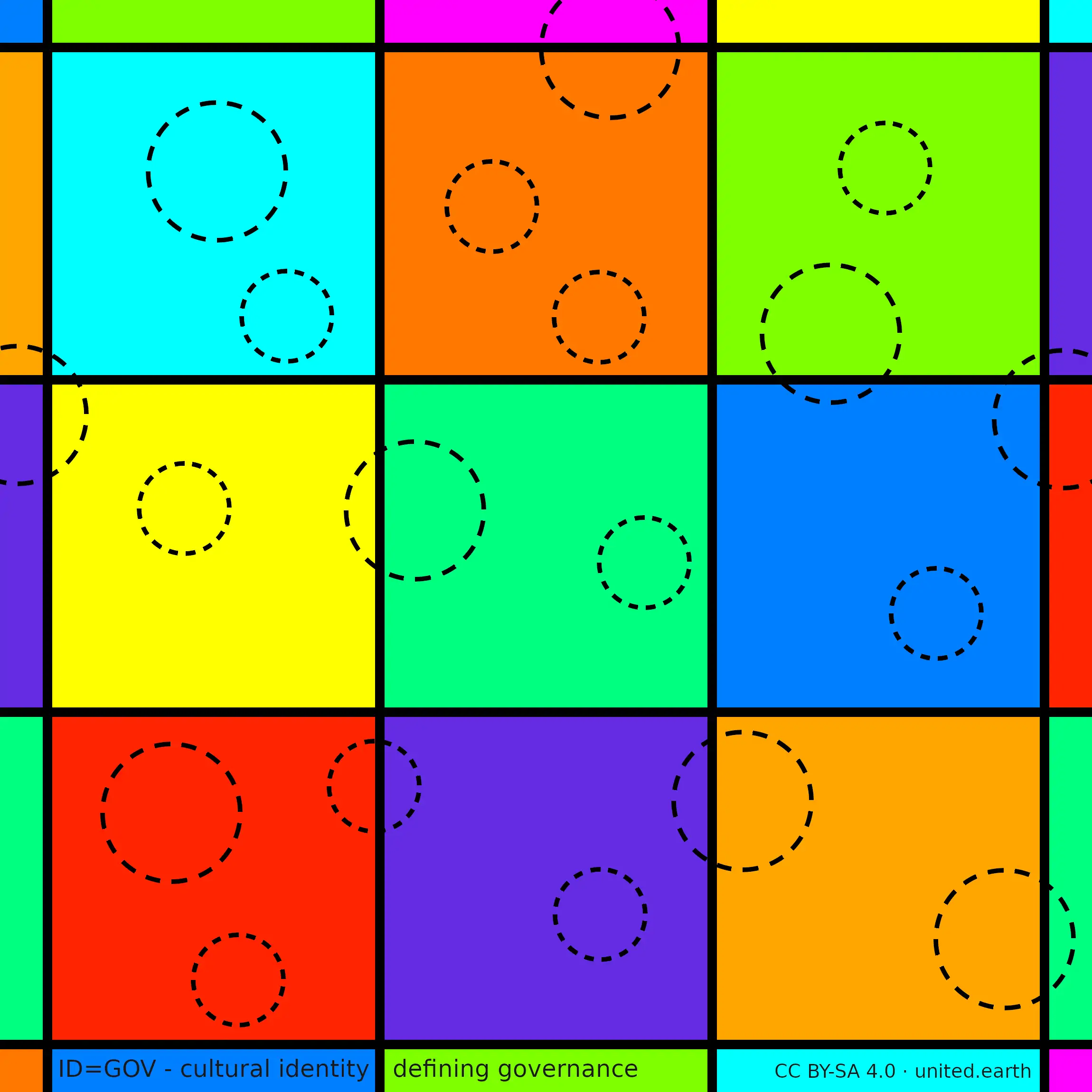
ID=GOV describes arrangements in which one identity, or a defined set of identities, constitutes or holds a privileged relationship to governance.
The straight continuous lines represent their “hard” borders, and the black dashed circles represent stateless nations and other identities that may be marginalised within states whose dominant identities won statehood in “history’s lottery”.
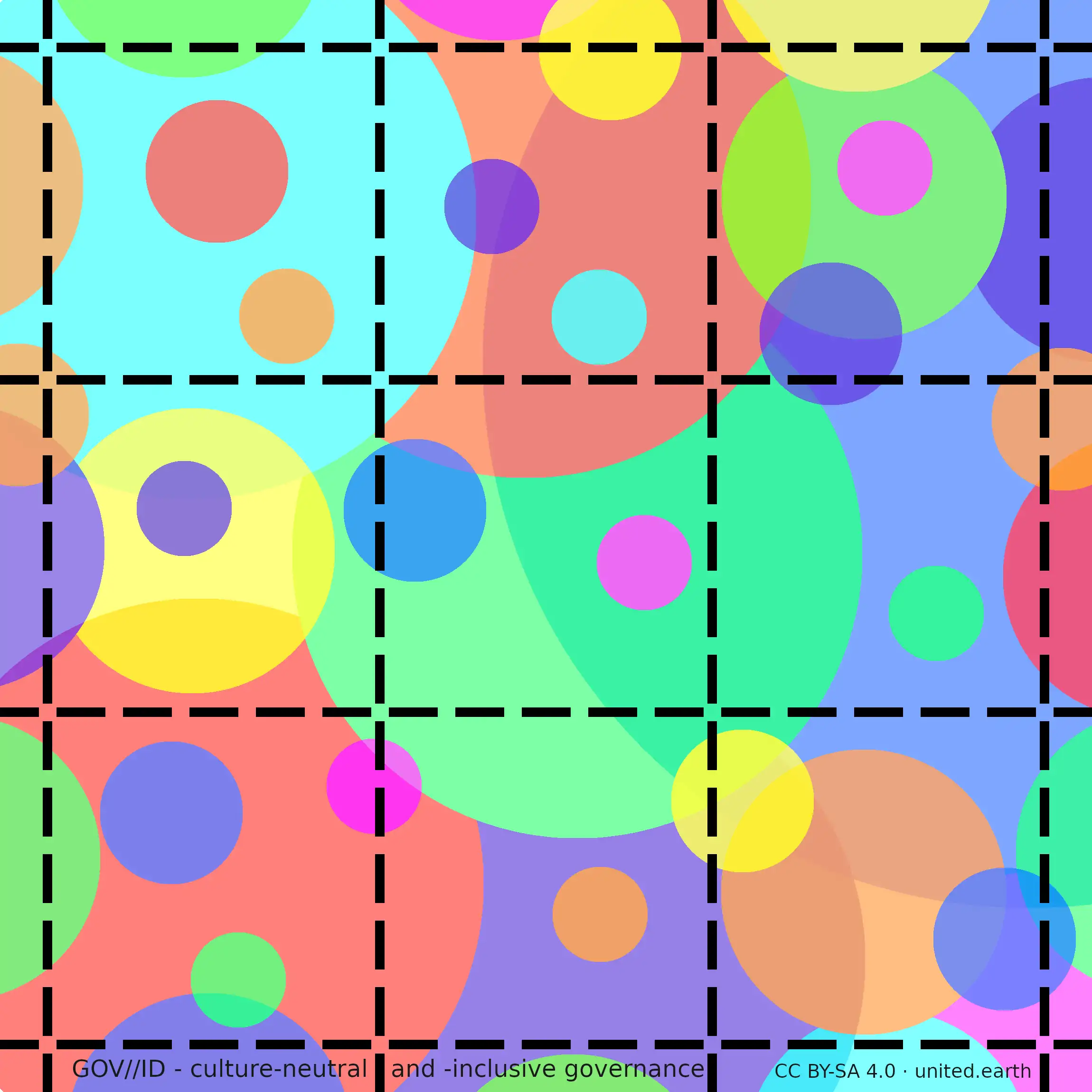
GOV//ID describes the contrasting principle: governance and identity remain distinct constitutional structures. Identities may coexist, overlap, organise and influence political life, while none constitutes or owns governance. Thus, all IDs share the same condition and must respect each other’s equal right to exist.
The straight lines are now dashed to indicate that the borders have become “soft”: administrative boundaries between governance units within the same wider political, constitutional, and legal system.
The importance of this distinction is that it separates two questions that are often treated as one: which cultural identities exist in a society, and what constitutes its public governance.
Once these questions are separated, cultural identity no longer has to map directly onto territorial governance. Nations, religions, ethnicities, ideologies and other identities can persist, overlap and organise across boundaries, while governance can instead be structured according to population, function, subsidiarity and the scale of the problems it must solve.
ID=GOV is therefore not one particular political ideology or institutional form. Nation-states, theocracies, ethnically defined states and ideological states may look very different, but they can share the same underlying constitutional relationship: a particular identity, or defined set of identities, holds a privileged relationship to public authority, territory or political membership.
GOV//ID changes that relationship rather than eliminating identity from political life. People remain free to belong, organise, advocate and vote from their convictions. What changes is the constitutional position of collective identity: no identity constitutes or owns public governance.
This move, made possible by the ID and GOV symbology, first names the most widespread feature of the existing geopolitical condition as ID=GOV. Once that relationship’s underlying pattern is made abstract and explicit, the same symbolic framework enables the formulation of its conceptual opposite, GOV//ID.
This opens a different way of understanding many territorial and political conflicts. What appears to be a conflict between identities may also be a conflict over which identity is entitled to define the state, control its territory, or claim sovereignty through it. Once that connection becomes visible, it also becomes possible to ask whether cultural security and continuity really require separate sovereign states.
One of the clearest formulations of the specifically national form of the ID=GOV relationship comes from the influential social anthropologist and political scientist Ernest Gellner. In Nations and Nationalism (1983), he famously defined nationalism as:
“Nationalism is primarily a political principle, which holds that the political and the national unit should be congruent.”
2.3 New structure is not a new ideology
The large blocs currently dominating the geopolitical condition may be convinced of the supremacy of their respective ID-basis, but one fact is certain: none of them will be able to force the rest of humanity to accept their particular ID as the basis for the whole geopolitical system. To create a real geopolitical system, which we must do to survive as a species, it follows automatically that this must be based on something other than the ID=GOV principle.
The United Earth initiative does not ask the world to adopt a new, all-encompassing political ideology. Instead, it recognises a mechanical fact: the scale of our shared problems has simply outgrown the scale of our governance tools.
This is not a matter of “the West” versus “the East”, or the global North versus the global South. Nor does it require humanity to dissolve its rich cultural identities into a homogenised global monoculture. It is a strictly practical mission: building the democratic, constitutional architecture that today’s interconnected world requires to function safely.
The distinction introduced above is crucial here. GOV//ID is not a new identity seeking to replace existing identities, nor a new ideology claiming ownership of governance. It is a constitutional principle governing the relationship between identity and public authority.
Under GOV//ID, people remain free to be nationalists, socialists, conservatives, liberals, Christians, Muslims, atheists, environmentalists, or to identify in countless other ways and combinations. They remain free to organise, express their convictions, advocate political positions inspired by them, and vote according to their own judgement.
When justifying common public decisions, however, the reasons offered must be open to examination without requiring acceptance of a collective identity’s claimed truth, authority or universal validity. No such identity or ideology acquires a privileged constitutional claim to the state, its territory, or its public institutions.
This is therefore not a transition from one ID=GOV arrangement to another. The purpose is to end the constitutional coupling itself.
The same applies to United Earth and to any emerging global identity connected to it. Neither “United Earth” nor an “Earthling” identity should acquire the privileged constitutional position that nations, religions, ideologies, or other collective identities have held in ID=GOV systems. The global political system must belong equally to its citizens as a public constitutional order.
That leaves the full field of political disagreement open. Citizens may continue to disagree profoundly about economics, culture, ethics, religion, technology, environmental policy, and virtually every other political question. GOV//ID does not settle those disputes. It changes the constitutional arena in which they are conducted.
2.4 ‘Nation’ is not a synonym for ‘nation-state’
A central reason why the current geopolitical order persists despite its growing dysfunction lies not only in power structures, but in language itself.
In political discourse, media, education, and much academic writing, the terms nation, nation-state, state, and country are routinely used as if they were interchangeable. This practice collapses fundamentally different phenomena into a single, seemingly self-evident concept.
This is not a neutral linguistic shortcut. It has decisive structural consequences. By collapsing cultural identity and systems of territorial governance into one concept, public discourse consistently obscures the fact that the nation-state is nothing but one of several possible choices for governance design, historically produced and contingently maintained, rather than an inevitable feature of political life.
This semantic fusion functions as a form of structural propaganda without a propagandist. No coordinated effort is required to defend the nation-state model; its assumptions are continuously reproduced through habitual language use. Over time, this creates a cognitive taboo: the nation-state is treated as the unquestionable unit of political reality, while alternative structures become difficult even to articulate.
As a result, political debate is overwhelmingly confined to questions of policy within the nation-state framework, while the framework itself is rarely subjected to structural scrutiny. Questioning the nation-state is easily perceived as questioning identity, belonging, or legitimacy itself, even though these are conceptually distinct.
The consequence is a form of intellectual paralysis. Global crises are analysed in detail and their urgency widely acknowledged, yet the structural conditions that prevent effective global coordination remain largely unexamined. The nation-state persists not because it works, but because public discourse consistently closes the conceptual space required to question and redesign it.
This semantic lock-in helps explain why proposals for global governance are so often dismissed as unrealistic, dangerous, or utopian, while a status quo demonstrably failing at the global level is treated as inevitable. It also helps explain the recurring academic tendency to treat global anarchy as inevitable, which is addressed in the following section.
2.5 Academic deadlock: the nation-state paradigm
A further obstacle to geopolitical evolution is intellectual rather than structural. For decades, perhaps the most dominant school within International Relations (IR), the so-called realism, and especially structural realism, has treated international anarchy as a persistent defining condition of world politics. This tradition sees global anarchy as an unchangeable condition.
This framework describes many of the incentives and power dynamics created by the present geopolitical structure well. The problem begins when this conditional description is treated as evidence that global anarchy is permanent, or that a democratic global political system cannot be built.
The fact that the nation-state system has dominated the past does not prove that humanity cannot evolve beyond it. Structural realism explains how states behave under anarchy; it does not by itself prove that anarchy cannot be constitutionally replaced. When the present structure is treated as inevitable, a historical arrangement becomes a practical limit on political evolution.
Such intellectual resignation is harmful. When global anarchy is presented as permanent, it can legitimise a system that is already failing in the face of climate change, biodiversity loss, pandemics, technological risks, and escalating conflicts. It narrows imagination at exactly the moment when humanity needs new thinking.
In an interdependent world, treating democratic global governance as impossible is not a neutral conclusion. It can help preserve a failing status quo by preventing structural alternatives from being seriously considered, such as constructivism. A descriptive theory becomes politically conservative when its account of existing incentives is used to rule out institutional transformation.
This section may seem somewhat off topic, but it isn’t. How we frame the debate, especially at the most theoretical level on any topic, is crucial. It’s the horizon within which this discourse exists, which again sets the limits for most other arenas, like the press and public debate. See our proposed way forward in Academic lock-up: from international to global.
3. Our possible scenarios – all global
Humanity now shares a single global destiny. What happens next no longer depends on decisions made by individual nation-states, but on whether we actively choose to shape power at the planetary level or allow it to form blindly in a panic. We are rapidly approaching a bottleneck with only three possible paths forward.
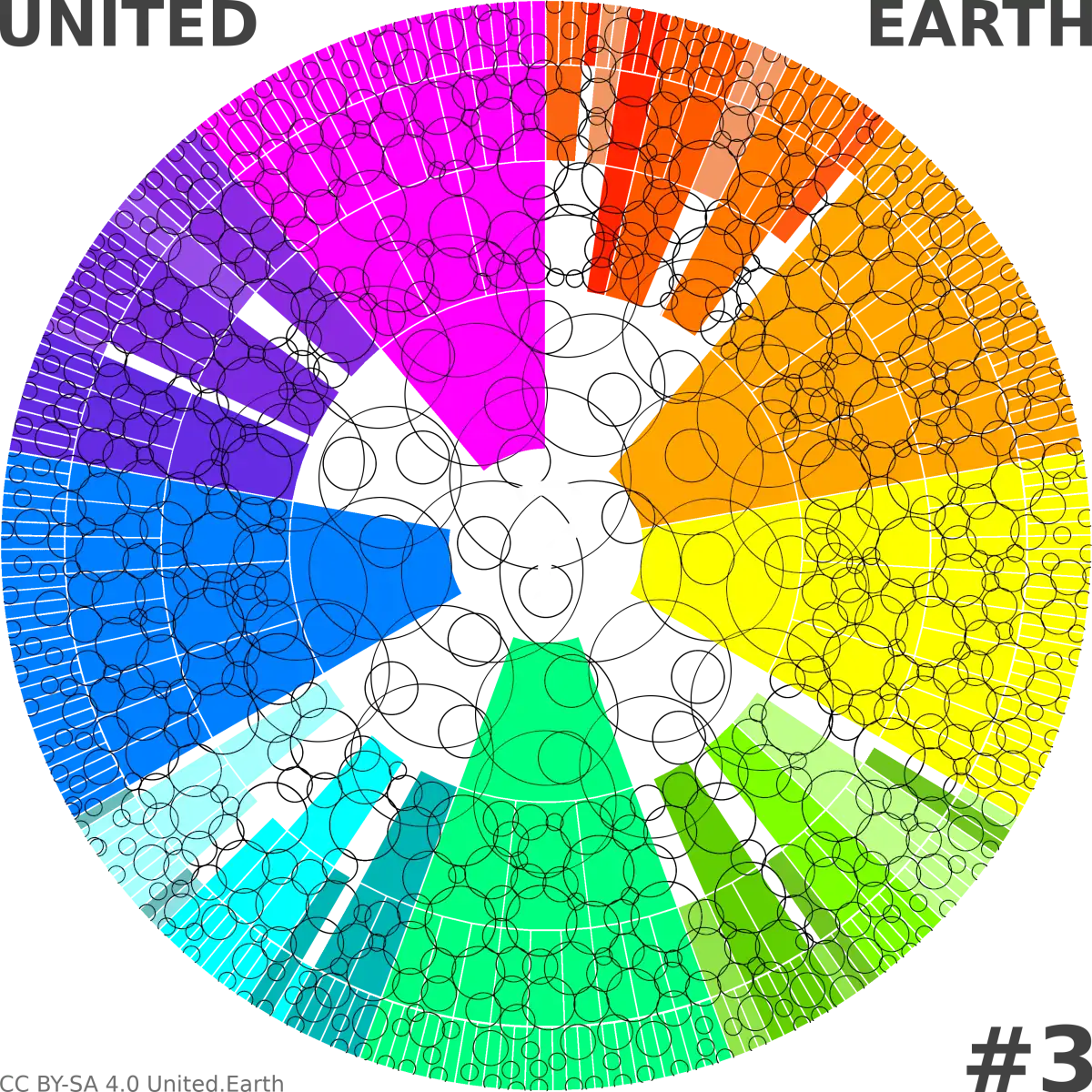
WHEEL < 3/18 >
Where can we go from here?
Business as usual (whatever that is anymore)?
Trusting nationalistic protectionist populism?
Betting on a big-tech global takeover?
Hoping for a theocratic solution?
Or…
… build a fair and inclusive global democracy for all ethnicities, nations, religions, ideologies, and other socio-cultural identities, protecting them all, while governing pragmatically for the optimal living conditions within sustainable boundaries?
3.1 Global collapse
When we speak of collapse, we mean a trajectory in which ecosystems are severely damaged or destroyed, large regions of the Earth become uninhabitable, sea levels continue rising for centuries as ice sheets melt, and global temperatures increase far beyond levels compatible with organised society. Such pressures will fuel famine, mass displacement, widespread conflict, and probably the use of nuclear or other weapons of mass destruction. Other global risks exist as well, such as asteroid impacts, supervolcano eruptions, or extreme solar storms, but the most immediate danger comes from our inability to coordinate at the global level to prevent the collapse we can already foresee.
This is the path we are already drifting toward. Climate impacts worsen, ecosystems weaken, and societies become more polarised and fragile. As pressures rise, states turn inward, cooperation breaks down, and essential systems fail in sequence: food, economy, security, and governance. Once key tipping points are crossed, no emergency measures can restore stability.
Collapse is not a choice. It is what happens if we do nothing about the core problem: the lack of global governance.
3.2 Global autocracy
Where cooperation fails, power concentrates. Around the world, democracy is retreating, and authoritarian leaders gain influence by exploiting crises and weakening institutions.
A global autocracy could emerge via different paths: through coalitions of authoritarian blocs, tech-driven systems of behavioural control, or militarised alliances consolidating power in the name of stability. As global crises deepen, the need for coordinated action will only increase, and the likelihood of these forces fusing into a global system will be high.
Yet such a system can only postpone collapse, not create long-term sustainability. A global tyranny would depend on coercion, surveillance, and the suppression of dissent. This would weaken the open information, criticism, trust, and voluntary cooperation needed to detect errors, correct policy, and mobilise humanity for sustained collective action. It would also concentrate the consequences of misjudgement and institutional capture within a system with no external corrective power.
Under the combined pressure of repression, inequality, internal rivalry, and a deteriorating biosphere, such a system would eventually fracture or lose the capacity to govern the crisis. An authoritarian world order may impose temporary stability and preserve pockets of luxury for the few, but it cannot resolve the underlying crisis. It leaves humanity on a slower and more oppressive path toward collapse.
The development of AI is emerging as a new and main component in this picture. Not only are AI systems being embedded in surveillance and military systems, which increases the power of elites tremendously. But AI systems are on the verge of creating their own agencies, which could very well lead to a world ruled by them. This threat is increasingly being warned about by many of the people who are central in the development of this technology. There is a real chance that autocratic AI will rule humanity…
… or simply kill us all as the useless stewards of Earth we so far have proven to be.
3.3 Global democracy
Global democracy means placing only those policy areas that genuinely require global coordination under binding global authority. It does not mean cultural homogenisation, as many fear; it can and must be constructed to safeguard the dignity and continuity of all identities while ensuring that governance itself remains impartial. It requires a political culture that looks beyond identity conflict toward shared responsibility for life on Earth.
Humanity has already agreed on the foundational principles of the Universal Declaration of Human Rights. Now we simply must build upon that foundation to include all life and the entire climate and biosphere. Global democracy is not an ideology; it is a pragmatic response to our interdependence. It offers what no other system can:
- The ability to prevent war through legitimate cooperation
- The coordination needed for climate and ecosystem restoration
- The safe governance of digital and orbital infrastructures
- The protection of basic rights across borders
Global democracy is the only scenario capable of long-term stability because it combines binding common law with constitutional protection against domination. Societies must enter the emerging order democratically, while the order itself must protect the rights, identities and local autonomy of those who opposed that decision as fully as those who supported it.
Most importantly, a democratic global system provides a framework where everyone can contribute freely, creatively, and without fear. Without harvesting this shared potential, humanity will not get through the coming turmoil.
For both practical and ethical reasons, global tyranny cannot be the path forward. Only a democratic global system has the legitimacy, adaptability, and resilience needed to avert collapse in the long run.
Global democracy does not assume that human aggression, tribalism, short-termism, or struggles for power will disappear. Its purpose is to limit and distribute power, expose conflict to law and public scrutiny, and prevent any single institutional or political failure from becoming planetary collapse.
3.4 Why only these three attractors and paths?
Our mixed world is not a stable model for the future. It is a temporary state, sustained only because global pressures have not yet crossed the threshold that enforces binding planetary coordination.
Today, modern civilisation relies on tightly coupled systems: climate, ecosystems, finance, and security. Under rising stress, these systems do not fail in isolation; they compound. Ecological degradation triggers resource scarcity, scarcity ignites global conflict, and war destroys the very capacity for international cooperation. In this multicrisis, fragmented authority is fatal. Delayed decisions, vetoes, and free-riding stop being political friction; they become direct triggers for cascading global failure. At this threshold, binding coordination is forced upon us by the physics of survival.
For planetary coordination to work, it must operate within a coherent political and constitutional structure. At the highest level, this structure must rest on a coherent principle of legitimacy, because the final authority to make and enforce binding decisions cannot rest indefinitely on both consent and control. Democracy and autocracy are mutually exclusive foundations of final authority: one governs by consent, the other by control.
A hybrid global order is therefore not a durable, integrated endpoint. It is either the continuation of the current fractured world or a transitional arrangement awaiting the final crisis.
Under existential pressure, this middle ground dissolves. The global system will be driven toward one of three broad attractors:
- Collapse: Coordination fails, resource wars escalate, and the biosphere and human civilisation undergo a cascading breakdown.
- Authoritarian consolidation: Global order and resource rationing are imposed through concentrated, top-down power.
- Democratic integration: Binding planetary coordination is established through shared, legitimate governance and enforceable universal laws.
At the level of final authority, a global system must rest on the same constitutional foundation throughout. An authoritarian world order cannot allow democratic enclaves to retain sovereign authority indefinitely, because they challenge centralised control. A democratic world order may temporarily include non-democratic units during a transition, but their populations cannot be denied democratic rights and participation indefinitely without undermining the legitimacy of the system as a whole.
There is no durable hybrid future at the level of final global authority. Faced with a destabilised biosphere and the threat of total war, humanity will either fail to establish sufficient coordination and collapse, or establish a binding global order. If we succeed, that order will ultimately derive its legitimacy from either control or consent: autocracy or democracy.
The question is not simply whether global governance will emerge, but whether coordination fails, or which form of global governance prevails.
3.5 Democracy must exist before the crisis
Democratic global governance cannot be improvised once an existential crisis already demands immediate coordination and execution. It requires a global political community, a functioning public sphere, democratic procedures, legal principles, institutional checks on power, a resilient knowledge infrastructure, and a foundational trust developed through actual practice.
If these pillars do not exist when the need for binding global authority becomes unavoidable, the immediate advantage will belong to the institutions and actors that already control capital, technology, data, security systems, and physical force.
Global autocracy does not need to begin with a single, coordinated seizure of power. It can emerge organically as emergency governance that gradually becomes permanent.
The democratic alternative must therefore be developed, tested, and socially rooted before the crisis makes the choice acute.
Humanity must build the democratic global system before the world is forced to choose a global system in panic.
4. What kind of democracy?
Global democracy can take different institutional forms. If humanity is to build democracy at the global level, we must examine which democratic principles are fundamental and which familiar institutions are historical design choices that can be improved or even abolished.
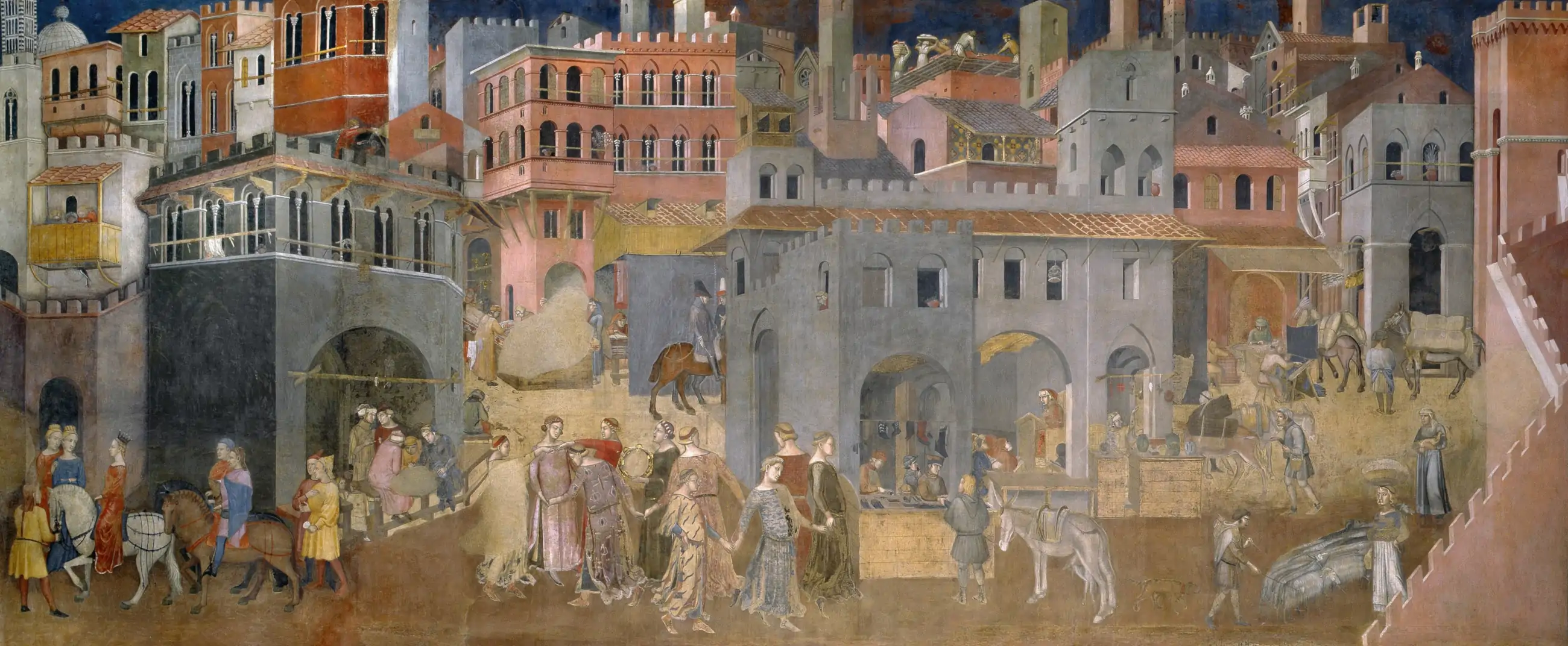
Political institutions should be judged by the life they enable, not by who leads them: Ambrogio Lorenzetti, Effects of Good Government in the City (1338–39). Wikimedia
Democracy has developed through many different institutional forms. Elections, political parties, representative assemblies, executive offices, courts, public administrations and direct-democratic mechanisms are combined differently across existing systems. Some arrangements have proved durable and valuable; others reveal structural weaknesses that become increasingly important as societies grow more complex and interconnected.
Democracy itself is also under strain. In many countries, formal democratic institutions coexist with weakened political competition, concentrated power, declining rights, manipulation of public institutions or other forms of democratic erosion. These developments matter, but the deeper issue addressed here is not primarily the performance of particular governments or countries. It is the architecture through which democratic authority is organised.
Modern democracy still relies heavily on periodic delegation, political intermediaries and institutions inherited from earlier political eras. Citizens are formally the source of democratic authority, yet much of its practical exercise is transferred to representatives, parties, governments and other institutions between elections. At the same time, citizens generally lack a comparable permanent infrastructure for continuous political participation, shared knowledge, deliberation and direct democratic decision-making.
A global democracy gives us an opportunity to examine this architecture from first principles: how can democratic authority remain with the citizenry while knowledge, political organisation, public institutions and officeholders perform the functions a complex society requires?
4.1 Democratic authority between elections
Elections are the moment when citizens most visibly exercise democratic authority. Yet most political decisions are made in the long intervals between them, by representatives, governments and institutions acting on a mandate given years earlier.
This section examines what happens to democratic authority in those intervals: what citizens actually transfer when they vote, what they retain, and whether the distance between the source of authority and its everyday exercise is a necessary feature of democracy or an inherited arrangement that can now be reconsidered.
A problem with representation
Representative democracy solved a fundamental problem of scale. Large populations could exercise political influence without every citizen having to gather in one place or participate personally in every decision. Citizens elect representatives, representatives exercise political judgement, governments act, and later elections allow the electorate to renew or replace those entrusted with political power.
This remains an important democratic achievement. Complex societies need institutions that can work continuously, develop legislation, administer public services, respond to events and coordinate decisions across many areas.
Representation also creates a distance between the democratic source of authority and its everyday exercise.
For most of the electoral period, substantive political decisions are made by elected representatives, governments and other institutions.
Citizens remain politically active through public debate, organisations, campaigns, petitions, demonstrations, media and many other forms of participation, but the formal authority to decide normally resides elsewhere until the next election.
Elections then carry several functions at once. Citizens choose officeholders, evaluate previous performance, select among competing political programmes and indicate a general political direction. A single electoral choice may therefore stand in for political judgement across hundreds of questions for several years.
Digital communication and the possibility of permanent public democratic infrastructure make it reasonable to ask whether this degree of periodic delegation should remain the defining structure of democracy.
What do citizens actually delegate?
Every political system needs people who perform institutional functions. Legislatures require members who organise law-making. Administrations require people who implement public decisions. Courts require judges. Institutions need coordination, professional judgement, continuity and clearly assigned responsibility.
Public office remains necessary. The deeper question is what political authority citizens must transfer to those who hold it.
Election to public office can provide a mandate to perform an institutional function without necessarily transferring the citizenry’s substantive political judgement for the entire electoral term. This distinction becomes increasingly important as continuous democratic participation becomes technically and institutionally possible.
It also changes the question of accountability.
Representative democracy connects authority and responsibility through delegation: representatives receive political power and can later be rewarded or removed. Where citizens retain more substantive political authority themselves, responsibility has to be distinguished more carefully. Citizens remain responsible for collective political choices; public institutions remain responsible for the integrity of democratic procedures and for lawful, competent implementation.
The central question is therefore whether democracy should continue to be organised primarily around the periodic transfer of political judgement, or whether citizens can remain active holders of political authority while elected officeholders perform clearly defined institutional roles.
The proposed distinction between substantive democratic decisions and institutional mandates is developed further in Voting, elections, and continuous democracy and The transformed role of the branches.
4.2 Parties, political packages, and coherence over time
Political parties are so closely associated with modern democracy that they are often taken to be part of its definition. Yet parties are not a democratic principle; they are an organisational form that developed to meet practical needs in representative systems.
This section looks at the functions parties combine, at the difference between the coherence of a party programme and the coherence of political development over time, and at whether organised political life requires parties to serve as the gateway between citizens and public authority.
What political parties bring together
Political parties perform several important functions within representative democracy. They organise political participation, develop political ideas, recruit candidates, aggregate interests and combine positions across many policy areas into recognisable programmes.
This aggregation makes complex political fields easier to navigate. A voter cannot study every question in complete depth, and a governing system cannot operate as thousands of unrelated decisions without coordination. Parties therefore create political packages that connect positions on taxation, welfare, education, environment, security, infrastructure and many other issues.
Over time, several different functions have become concentrated within the same organisations. A party can simultaneously be a community of political identity, a producer of ideas, an electoral organisation, a mechanism for candidate selection, a parliamentary grouping and a route to governing authority.
This combination is familiar, but familiarity does not make every part of it necessary.
Political thought can be organised without political organisations owning mandates. Candidates can be selected without belonging to permanent electoral organisations. Citizens can agree with an organisation in one policy area and disagree with it in another. Political advocacy, ideological traditions and organised movements can remain active parts of democratic life without necessarily serving as the constitutional gateway between citizens and public authority.
Political coherence over time
Political programmes seek coherence within themselves. The larger problem is that the coherence of one programme is not the same as the coherence of political development over time.
Individuals, communities, societies and natural systems experience the cumulative consequences of decisions made across many policy areas and many electoral periods. Governments change. Coalitions form and dissolve. Priorities shift. Earlier decisions interact with later ones. Compromises made in one policy area alter possibilities in another. Some effects become visible only decades after the original political choice.
The political coherence that matters must therefore extend beyond any single governing programme.
A democratic system must be able to understand relations between decisions across time as well as within a single electoral platform. Climate policy interacts with transport and energy policy. Housing interacts with land use, infrastructure and social policy. Technology affects employment, security, education, culture and rights. The cumulative condition experienced by people and ecosystems is produced by all of these interactions together.
Political organisations also have organisational needs of their own. They compete for support, maintain coalitions, recruit candidates, manage internal disagreement, preserve organisational continuity and distinguish themselves from competitors. These activities are normal features of party politics. They are nevertheless different considerations from the substantive anatomy of a particular political question: the relevant knowledge, uncertainty, consequences, relationships to other questions and competing values.
This raises a structural question beyond the quality of any particular party or programme:
Where should the long-term integration of political decisions take place?
If that integration depends mainly on alternating governing programmes, political coherence changes with electoral cycles. A more continuous democratic architecture can instead preserve knowledge, relationships between policy areas, previous reasoning and accumulated consequences across successive decisions.
Political organisation without political ownership
Political organisations can remain valuable without being the owners of democratic authority.
People will continue to organise around political philosophies, economic interests, cultural perspectives, environmental priorities, social causes and competing views of society. They will continue to publish programmes, recommend policies, criticise institutions and persuade other citizens.
What can change is the structural relationship between such organisations and governing authority.
A citizen may agree with one political movement on ecological policy, another on economic policy, neither on education, and develop a different position again as new knowledge becomes available. Political judgement can then remain with the individual rather than being converted into support for an entire package before it can have democratic effect.
Organised political disagreement will continue. The democratic question is whether political organisations must remain privileged intermediaries between individual political judgement and public authority.
The proposed relationship between individual judgement, political organisations and democratic authority is developed further in GeoWeMe: Earth, society, and the individual and Transparency, identity, and post-party politics.
4.3 Knowledge in a complex democracy
Democracy rests on the equal political standing of citizens, while the questions before them grow ever more complex. These two facts pull in different directions. Ignoring knowledge weakens the quality of decisions; allowing expertise to confer political authority undermines democratic equality.
This section explores how a democracy can make relevant knowledge count without creating a new political class, and why the quality of knowledge and the integrity of interests must be addressed as separate problems.
Equal political standing, different relevant knowledge
Modern political decisions increasingly require specialised knowledge across several fields at once.
Energy policy can involve climate science, engineering, economics, public health, land use and security. Artificial intelligence raises questions across technology, labour, education, information, rights, defence and culture. Ecosystem policy interacts with agriculture, infrastructure, water, settlement patterns and long-term economic development.
Democratic equality means that citizens possess equal political standing. It does not mean that every person possesses the same relevant knowledge about every political question.
A person may understand a watershed exceptionally well after decades of scientific or practical work. Another may possess deep competence in public health, law, engineering, cultural history or economics. The same individuals may know very little about fields outside their own experience.
This creates a genuine democratic tension.
Expertise cannot itself create legitimate political authority. Scientific knowledge can clarify mechanisms, evidence and likely consequences, but it cannot determine every value judgement involved in a political choice. Ethical analysis can illuminate responsibilities and conflicts without acquiring sovereignty over citizens. Cultural knowledge can deepen understanding without giving cultural institutions the right to decide political outcomes.
At the same time, a democracy concerned with the quality of its decisions has reason to make relevant knowledge matter.
The challenge is therefore to preserve equal civic standing while recognising that competence is real, distributed and issue-specific. A democratic system should be able to use knowledge without turning knowledgeable people into a permanent political class.
This problem is developed further in PAI: Policy Area Index, PAI×SEC, and Knowledge-weighted direct democracy.
Knowledge and interests are different problems
Knowledge improves the conditions for political judgement, but knowledge and interest are not the same thing.
Greater understanding can reduce factual error, misunderstanding and decisions based on incomplete information. It can help reveal consequences, dependencies and uncertainty that would otherwise remain hidden.
Knowledge does not automatically remove self-interest, strategic behaviour or organised influence. People with exceptional understanding of a policy area may also have professional, financial, institutional or ideological interests in its outcome.
Democratic design must therefore address two different questions.
One concerns epistemic quality: how citizens can gain access to relevant knowledge, understand uncertainty, identify relationships between political questions and improve the basis on which they make decisions.
The other concerns integrity: how relevant interests become visible, how procedures are protected from manipulation, how institutional power is constrained, and how evidence and decisions remain open to scrutiny and challenge.
The distinction matters because neither problem can substitute for the other. Better information cannot by itself prevent strategic influence, while transparency about interests cannot make poorly informed decisions sound.
Political complexity also requires continuity across time. Knowledge accumulated during one decision should remain available to later processes. The reasons behind earlier choices, their expected consequences, subsequent evidence and emerging side effects should not disappear when governments or electoral majorities change.
A democratic system therefore needs durable knowledge and institutional memory without allowing the institutions that maintain them to acquire political sovereignty over the citizens they serve.
4.4 Institutions, offices, and political authority
Every democratic system needs offices, and every office needs people entrusted with real responsibilities. What is less often examined is the relationship between holding an office and holding political authority.
This section separates the functions a political system must perform from the authority that legitimises them, and then turns to the most visible office of all: the single political “head”, whether monarch, president or prime minister. It asks whether such a figure is functionally necessary, or whether political leadership can be organised without one.
Functions before offices
Constitutional democracy already rests on the principle that different public functions should be distinguished and constrained.
The classical legislative, executive and judicial branches separate law-making, implementation and adjudication because concentrating these functions creates dangerous concentrations of power. Modern states have subsequently added many authorities, commissions, agencies and specialised institutions as societies and public responsibilities have become more complex.
These additions often respond to real needs. Institutional accumulation can nevertheless make a political system increasingly difficult to understand. Responsibility becomes harder to locate. Different forms of authority can overlap. Citizens may know that an institution exists without being able to see clearly what kind of mandate it holds or how it relates to the democratic source of authority.
A functional approach begins from the opposite direction.
What needs to be done? What kind of authority does that function require? What safeguards does it need? And where does the underlying political authority remain?
This approach distinguishes the office from the authority that gives the office legitimacy.
Public officeholders require real mandates. Legislative drafting requires judgement. Administration requires discretion. Judicial interpretation requires independence. Institutions require leadership, budgeting, coordination, oversight, appointments, continuity and crisis capacity.
These responsibilities are substantial, but they do not automatically require officeholders to possess the citizenry’s substantive political authority.
People can hold authority to perform constitutional functions without owning the political authority from which those functions derive.
This distinction becomes particularly important in a global democratic system. Institutions operating at planetary scale could accumulate extraordinary political, technical and administrative capacity. Their legitimacy therefore depends not only on who occupies them, but on clear constitutional boundaries between democratic authority, knowledge, administration, adjudication and execution.
The proposed functional separation is developed further in The three-layer constitutional architecture and The three branches.
Does democracy need a “head”?
Political systems need leadership, executive coordination, continuity, public representation, crisis capacity and clearly assigned responsibility. These functions are real. A separate question is whether they require the political community itself to have a political head.
For most of political history, authority was personified. Kings, emperors and other rulers stood at the top of the political order and often embodied the state itself. Modern democracy transformed the source of legitimate authority, but it frequently retained the basic form: one person still occupies a uniquely visible position at the top as president, prime minister, monarch, or some combination of head of state and head of government.
The democratic transformation may therefore be incomplete in one important respect. We moved from hereditary rulers toward elected rulers, but largely retained the assumption that political order itself requires a singular person at the top.
This matters because headship creates a natural focal point for the personalisation of political authority. The more symbolic, executive and political functions are concentrated in one office, the easier it becomes for public attention, political loyalty and institutional power to become concentrated around the person who occupies it.
Russia shows an extreme form of this pattern in a nation-state where democratic government was never consolidated. The brief democratic opening after the Soviet collapse did not develop into a stable system of democratic transfer between competing political forces. Freedom House notes that Russia has never experienced a democratic transfer of power between rival groups. Today it describes Russia as an authoritarian system in which power is concentrated in President Vladimir Putin, genuine opposition is suppressed and elections are manipulated. Democratic institutions remain, to a large extent, as a façade around highly personalised rule. Source: Freedom House
Established democracies present a different problem. Their institutions and democratic cultures are much stronger, but singular political heads can still become centres around which extraordinary power and political identification accumulate.
The United States is an especially clear case because the presidency combines head-of-state functions with leadership of the executive branch. The nation-state continues to hold competitive elections, but V-Dem describes 2025 as a period of rapid autocratization marked particularly by executive overreach and weakened legislative constraints, while its electoral indicators remained stable. The significance is precisely that serious democratic erosion can occur even while electoral competition continues. Source: V-DEM
India illustrates a different path. It remains a multiparty electoral democracy, and its president is largely symbolic, but political leadership has become strongly identified with Prime Minister Narendra Modi. Freedom House reports increasing use of state institutions against political opponents, weakening freedoms, discriminatory policies and increased persecution affecting Muslims under Modi and the Hindu-nationalist BJP. The concern here is not the same as in Russia or the United States: it is how a dominant political leader and majority identity can become mutually reinforcing within an electoral democracy. Source: Freedom House
These cases should not be treated as equivalent. Russia is an authoritarian system; the United States and India retain competitive electoral institutions. Their relevance here is structural. They show different political environments in which authority can become strongly personified around a dominant individual.
Democracy is better off without political “heads”
The contrast is important because singular headship is not functionally unavoidable.
Switzerland has no individual head of state. The seven-member Federal Council collectively performs that function, while the annually elected President of the Confederation is only primus inter pares — first among equals. Switzerland remains a representative, party-based democracy and is therefore not an example of the system proposed here, but it demonstrates that even a modern state does not require one person to occupy the constitutional position of head of state. Source: Swiss government
This allows the question to be taken one step further.
Institutions can have leaders without the polity having a singular leader. Executive responsibilities can be distributed among defined offices. Emergency authority can be established constitutionally before crises occur. Representation can be performed by different people for different purposes. Continuity can reside in institutions and law rather than in one person. None of these functions necessarily requires a president, prime minister or equivalent figure to personify political authority.
A democracy can therefore ask whether the historical movement from monarchy to popular sovereignty should be carried to its logical conclusion: political authority residing in the citizenry and its constitutional system, while individuals hold defined functional responsibilities without becoming the political head of the polity.
The question is not whether democracy needs leaders, but whether democracy needs a head at all.
The point of departure for this proposal is a clear no:
A functioning democracy requires neither a king nor a president, nor even a prime minister or equivalent political head. Leadership can be exercised by a group of appointed or elected people.
The proposed system therefore develops democracy without political heads: no king, no president, no prime minister or equivalent. The demos itself remains the bearer of political authority.
4.5 Democracy as self-government
The previous sections each examined one part of the democratic architecture: the mandate between elections, the role of parties, the place of knowledge and the nature of public office.
Taken together, they point in a single direction: from choosing who governs us toward governing ourselves, with institutions organised around that principle.
From choosing rulers to governing ourselves
Much of democratic history has centred on the question of who should govern. Political authority moved from hereditary rulers toward elected governments, constitutional constraints, universal suffrage and increasingly equal political standing.
That development can continue.
The next question is how far citizens themselves can remain the active holders of political authority while institutions perform the specialised functions that make collective government possible.
This development makes institutional design more important.
A democracy capable of continuous participation needs reliable procedures, accessible public knowledge, secure infrastructure, institutional memory, constitutional limits, competent administration and mechanisms for resolving conflict. Direct citizen authority without such structures could become chaotic or vulnerable to manipulation. Strong institutions without continuing citizen authority could reproduce the distance democracy is meant to overcome.
Institutions around citizen authority
The task is therefore to combine both.
Political organisations can contribute ideas without owning political authority. Knowledge institutions can improve the basis for judgement without governing. Elected officeholders can perform institutional functions without receiving unrestricted substantive political mandates. Executive institutions can act effectively without becoming the source of democratic legitimacy.
The underlying democratic principle remains simple:
legitimate political authority belongs to the citizenry.
The institutional challenge is to organise everything required around that principle.
A global democracy should therefore be built from democratic principles and contemporary functional needs rather than by automatically reproducing the institutional forms inherited from existing states.
The proposal (WHAT) develops one proposed architecture for doing this.
The next chapter turns to another requirement of any global democratic system: global governance must strengthen rather than erase the places where human life is actually lived.
That is the glocal connection.
5. The glocal connection
The glocal reality is already here: the global and the local are inseparable, and the quality and integrity of each depend on the other. The everyday conditions of our streets, workplaces, homes, and local cultures ultimately reflect systemic forces operating far beyond them.
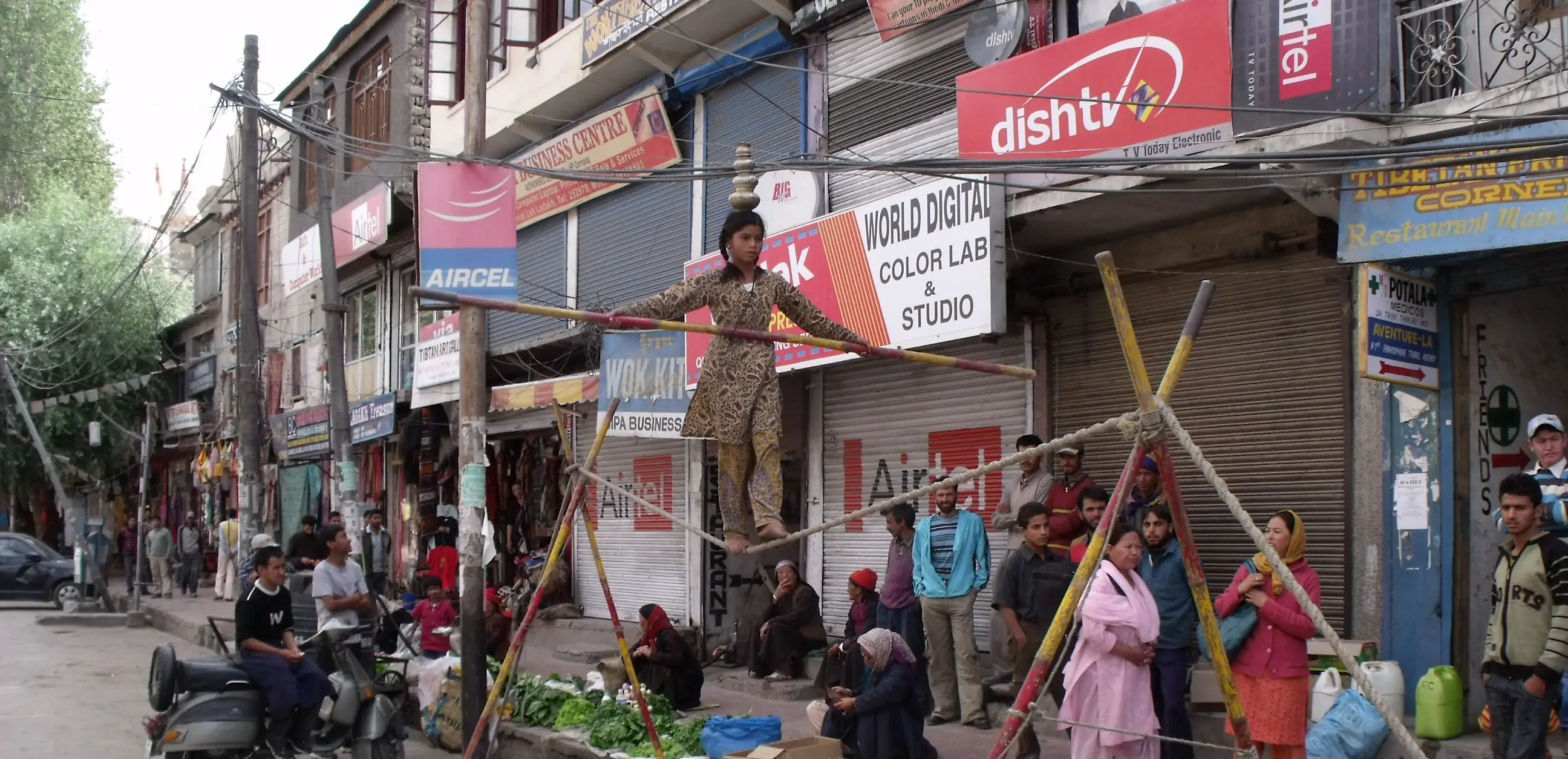
Local meets global: A tightrope performer balances above a street in Ladakh, western Himalayas, beneath advertising from the globalised communications economy. Image by PublicDomainPictures from Pixabay
5.1 Local is where life takes place
All human experience is local. We eat, sleep, work, raise families, and build culture in physical environments shared with neighbours, not inside abstract states, trading blocs, or geopolitical categories. Even the individuals who make monumental decisions in parliaments, ministries, corporate boardrooms, or international summits do so inside buildings embedded within local communities.
This groundedness makes the local level the true cradle of human meaning and belonging. It is where identity forms, where community is felt, and where the visceral consequences of political decisions are experienced.
Any higher level of governance must therefore be judged by a single, uncompromising question: Does it protect and sustain the specific places where people actually live their lives?
Higher levels of governance are instruments, not ends in themselves. Their ultimate purpose is to protect the conditions under which local life can remain viable, free, and diverse. Yet local communities no longer control all the forces that shape those conditions.
Local life is lived locally, but it is increasingly shaped globally.
5.2 Destructive, unchecked globalisation
Today’s dominant form of globalisation has evolved without democratic governance operating at the same global scale. Corporations, financial actors, digital platforms, supply chains, and powerful states move resources and exercise power across frontiers, while democratic authority remains largely confined within national borders. The severe externalised costs of their actions are routinely pushed downward onto local environments, workers, and vulnerable communities.
Jobs vanish, local economies are destabilised, public spaces and local cultures are hollowed out, and environmental degradation is left in the backyards of ordinary people. Decisions taken thousands of miles away become conditions that must be endured locally.
This systemic loss of control produces a powerful psychological backlash. Confronted by distant, unaccountable forces, many people retreat into defensive nationalism, aggressive protectionism, identity politics, and deep distrust of global institutions. This desire to defend one’s community and reclaim agency is entirely rational.
It is therefore completely understandable why global governance itself can appear to be part of the threat. Yet the destructive forces of globalisation do not arise from democratic authority at the global level. They can operate across and damage communities precisely because no such authority exists to govern them.
Nation-state governments can regulate within their own jurisdictions. Still, they cannot single-handedly govern transnational corporations, cross-border financial flows, global supply chains, borderless digital architectures, or a collapsing biosphere. Retreating behind national borders does not bring these forces back under nation-state control. The forces remain global; only democratic oversight retreats.
The absence of democratic global governance is not a shield against destructive globalisation. It is the very vacuum that allows it to remain unchecked.
5.3 Global democracy protecting the local
The antidote to destructive globalisation is not a political retreat into smaller, fragmented units, but democratic governance at the level where global power operates. When planetary coordination is democratic and accountable, it ceases to be a distant threat and becomes a protective framework for the places where life actually unfolds.
Global democracy must be structurally strong enough to govern global forces, yet constitutionally limited enough to leave local life locally governed. This vital balance is secured through the principle of subsidiarity: authority remains at the lowest level capable of handling a matter, moving upward only when the problem exceeds the capacity of the levels below.
Under this architecture, global institutions must regulate the systems and activities affecting the climate, govern the global commons and transnational economic and technological power, and maintain international peace and security. Simultaneously, local and regional communities must retain full authority within their constitutional areas of competence.
By setting enforceable boundaries for large-scale economic, technological, and political forces, global democracy restores rather than removes local agency. It creates the structural conditions for the macroeconomic and ecological stability required for cultural identities, neighbourhoods, workplaces, and ecosystems to thrive rather than be overwhelmed by unregulated global pressures.
The goal is to stabilise the planetary conditions that allow diverse local societies to remain free, secure, and viable.
As stated above, and it is worth repeating: it is understandable why many people see the very idea of global governance itself as a part of the threat. This scepticism is what fuels the withdrawal to nationalism and other identity-based protectionism that we see all over the world nowadays.
This is a huge mistake. It only makes all the real global problems worse. We challenge this trend with the following claim:
Global democracy is not the enemy of local freedom. It is the missing constitutional structure required to defend it!
6. Psychological impact and its answer
The fragmented geopolitical condition described above produces not only the risk of material catastrophe, but also profound psychological consequences. These responses are understandable reactions to real global threats and to humanity’s persistent inability to address them adequately. Some motivate sustained concern and action; others may protect people from overwhelming insecurity or apparent powerlessness. Their causes and consequences cannot be understood independently of the structural failure that makes an adequate collective response so difficult.
6.1 Alarm and psychological responses

Overwhelmed by global threats and individual helplessness
Here, our Earthwheel model serves as a metaphor for widespread political paralysis. Humanity appears as a passive grey mass, while the missing global core manifests as a black hole emitting continuous alarms. The red arrows represent relentless signals of existential danger that find no coordinated collective response.
CC BY-SA 4.0 United.Earth Initiative
Prolonged exposure to global threats does not produce one uniform psychological response. People may react in different ways, and the same person may move between them over time. Four responses are particularly important here: alarm, fear and moral outrage; numbness and withdrawal; retreat into the familiar; and denial.
These responses differ not only psychologically, but also politically. Alarm can motivate concern, resistance and sustained action.
The other responses can lead people to withdraw, seek protection in familiar political structures or reject the implications of the threats themselves.
Yet even sustained engagement can fail to produce adequate collective results when the necessary global governance structure is missing. From the perspective of political power, humanity may remain a largely unorganised grey mass despite the efforts of millions of committed individuals.
6.2 Alarm, fear and moral outrage
For many people, the first response to mounting global threats is neither numbness nor denial, but alarm. They recognise the dangers, take them seriously, and react with fear for the future, grief over what is being lost, anger at political inaction, and a powerful sense that something must change.
For children and young people, this realisation can be particularly unsettling. They are growing up in a world whose adults have known about major planetary threats for decades, yet have failed to bring them under effective collective control. They inherit the consequences without having had the power to make the decisions that created them. Their fear and anger can therefore express not only personal distress, but a legitimate demand for responsibility and political action.
Such reactions can also sustain lifelong commitments. Many people have spent decades studying, warning, organising, protesting, developing solutions and trying to change political priorities. Their persistence reflects an understanding that these dangers are real and that society has a responsibility to address them.
Alarm is not itself paralysis. Fear can sharpen attention, anger can express moral judgement, and concern for future generations can motivate extraordinary dedication. These responses can be rational, morally grounded and constructive. They become difficult to sustain when repeated efforts fail to produce results at the scale required.
Decades of scientific progress, political effort, international cooperation and individual commitment have produced important results. Yet taken together, these efforts remain far from sufficient to prevent global catastrophe. The persistence of the alarm reflects this discrepancy between what humanity knows must be done and what its existing political institutions have been able to achieve.
Without credible pathways to effective collective action, prolonged alarm may turn into exhaustion, helplessness and withdrawal. The challenge is therefore not to silence the alarm or persuade concerned people to care less. It is to overcome the structural conditions that prevent their concern and efforts from becoming sufficiently effective.
6.3 Numbness and withdrawal
Numbness describes a condition in which repeated distress signals no longer produce a meaningful response. A comparable paralysis now characterises much of our global political reality.
People are exposed daily to a compounding cascade of crises: climate inaction, ecological collapse, economic instability, territorial wars, and the erosion of international law. Yet many feel fundamentally unable to respond in ways that matter.
Some look away and focus on the parts of life they can still influence. Others concentrate on valuable local projects or throw themselves into global activism, only to burn out when their efforts fail to alter the larger structure. While each response is understandable, none can by itself compensate for the missing global architecture. The collective result remains atomised paralysis.
This pattern should not be mistaken simply for apathy, ignorance, or lack of concern. It can be a protective response to prolonged exposure to existential alarm without access to a credible and effective vehicle for collective action.
The structural truth remains simple: no single individual, community, NGO, or nation-state can resolve planetary challenges in isolation. Millions of well-intentioned individual actions cannot by themselves produce a global solution if the coordinating layer is missing.
When perception repeatedly fails to produce effective collective consequence, disengagement becomes understandable. Numbness protects the individual from the continuous alarm, while withdrawal reduces exposure to a problem that appears impossible to influence.
6.4 The false security of the familiar
A different response is not to withdraw from politics, but to seek protection in political structures that already feel familiar and secure.
Under conditions of growing uncertainty, the state, the nation, sovereignty, borders, and established identity-based political communities can become powerful sources of psychological security. The response is understandable because these structures are real. They provide law, institutions, social belonging, collective memory, physical security, and political continuity. For many people, they are also closely connected to cultural identity.
This creates a paradox. The more global the threat becomes, the stronger the impulse may be to retreat into structures whose authority stops below the global level. When the familiar structure is based on ID=GOV, the search for security can reinforce the very geopolitical fragmentation that prevents adequate collective action. The more strongly sovereignty is held as protection for identity, the harder it becomes to build governance above the level where that sovereignty is located.
The result can become self-reinforcing:
global threat → greater insecurity → retreat into familiar structures → stronger geopolitical fragmentation → weaker global capacity → greater global risk
It is a little like hiding in bed and pulling the blanket tighter while the house is on fire. The blanket may provide a sense of immediate security, but it cannot address the danger surrounding it.
The person who retreats has not become politically passive in the ordinary sense. They may become highly politically engaged. Yet if that engagement primarily strengthens the structures blocking collective action at the necessary scale, the systemic result can still resemble withdrawal: humanity fails to activate as a global political community.
The familiar structures thus become a mental obstacle to structural change: they appear safest precisely because they are familiar, and become hardest to question at the moment when their limitations matter most.
6.5 The denial loop
Another response occurs when accepting the implications of a threat would require questioning a political structure or worldview to which a person is strongly committed.
People generally seek coherence between their understanding of reality and their political commitments. When a global threat points toward forms of coordination that conflict with an established political model, preserving that model creates pressure to reject one or more of the premises connecting the threat to structural change.
The threat may be denied, minimised or redefined. The need for global coordination may be disputed. Evidence may be selectively dismissed, or the institutions and people carrying the warning may be discredited.
This does not require unusual psychology. It follows from an ordinary desire to preserve a coherent understanding of the world.
The mechanism can also become self-reinforcing. The more an inherited political structure obstructs an adequate response, the more serious and visible the consequences become.
But those consequences increase the pressure on the worldview that helped preserve the structure, which can produce still stronger denial of the threat, its causes, its political implications, or even its very existence. The apparent coherence of one’s convictions is preserved; the threat is not reduced.
inherited model → inadequate response → growing threat → pressure on worldview → stronger denial → inherited model preserved
Denial therefore protects coherence in much the same way that numbness protects against emotional overload and retreat into the familiar protects against insecurity.
These three defensive responses can produce the same systemic outcome.
People remain dispersed, defensive, disengaged, or politically mobilised inside structures that cannot create an adequate collective response. The alarms continue, but humanity does not yet become the organised political subject capable of answering them.
6.6 Reclaiming agency and hope
Political agency does not emerge simply because individuals work harder, shout louder, or feel more intense outrage. It emerges when a shared, legitimate structure exists that can coordinate human effort at the scale required by the problem.
Humanity does not lack concern, intelligence, knowledge, technological capability or moral commitment. Decades of effort have produced significant achievements in many fields. But these achievements remain collectively insufficient to prevent global catastrophe because the political capacity to coordinate and implement solutions at the necessary scale and speed is missing.
The underlying problem is therefore structural. In our present geopolitical anarchy, global problems are addressed through fragmented national authority, international negotiations, voluntary agreements and competing interests. These mechanisms can produce important progress, but they cannot reliably deliver and enforce the comprehensive collective action required to prevent planetary catastrophe.
Preventing catastrophe is the goal. Global democratic governance is the necessary means.
The answer to political powerlessness is therefore not moral reassurance, appeals for endless individual sacrifice or encouragement to remain optimistic despite the evidence. It is to change the political conditions that make adequate collective action impossible.
A legitimate global democratic system would give humanity the capacity to make and implement binding collective decisions where the scale of the problem requires them, while protecting democratic freedom, cultural diversity and local self-government.
Through such a system, our accumulated knowledge, concern, creativity and determination could become effective political power at the planetary level.
This is also the basis for reclaiming hope. Hope cannot rest merely on the fact that many people are doing valuable work, when the combined results remain insufficient to avert disaster. It becomes rational when humanity can identify and begin building a credible means of doing enough.
Crucially, this structure cannot remain a mere blueprint for the future. It must begin to exist now: built, tested, refined, and socially rooted before an acute planetary crisis turns the need for binding global authority into panic that favours authoritarian power.
Building it will require sustained contributions from individuals across cultures, professions, and borders, together with broad consent, shared learning, democratic deliberation, and participation in voting as the architecture matures. Democratic participation must now explicitly encompass the global scale.
The urgent question is therefore not simply how to sustain hope in the face of mounting global threats. It is how to establish the democratic global capacity needed to prevent those threats from becoming catastrophe — and how to build it in time.
Build the democratic global system before humanity is forced to choose one in panic. United Earth exists to begin building that structure now.
Let’s aim at the first goal: to create the Earth Parliament!