United Earth initiative
Earth democracy
Why it is needed, what it is, and how we build it
This document contains the theoretical foundation of the UE initiative.
We invite everyone to an open discussion on how governance structures can evolve to address global challenges while safeguarding cultural identities within a shared democratic framework.
Claim your Earth Citizenship (EC) and influence at agora.united.earth
PLEASE MAKE SURE YOU HAVE THE LATEST VERSION OF ANY DOWNLOADED DOCUMENTS!
After major upgrades, the web version is compiled into downloadable documents (DOCX/ODT/PDF/MD) available at united.earth/en/documents
This is done for transparency and to preserve a record of its development.
Preface
The first versions of this material were drafted by a small group of engaged individuals calling themselves Worried Earthlings (WE). They have chosen to remain anonymous, partly due to security concerns because of the controversial character of their ideas, but mostly to foster a culture focused on our shared planet and the global society, rather than on individuals.
The name Worried Earthlings — WE — reflects the perspective from which the initiative emerged. Its participants share a strongly developed global awareness and sense of identity as Earthlings. Earth and humanity became the primary political frame through which they approached the problems addressed here, without requiring the abandonment of other personal identities.
WE do not assume that others will share this global identity with the same intensity. Their proposal instead asks whether enough people can develop a global perspective strong enough to recognise humanity as a political community where genuinely global problems require shared democratic action.
WE are convinced that dominant individualism, together with obsolete forms of tribalism, obscures the fact that many of the forces shaping individual and local life now operate globally without democratic control.
Global democratic governance is necessary precisely to protect individual freedom, diverse identities and local societies against these forces.
A fundamental hypothesis coming out of their ideas is that the principle of the sovereign nation-state, or more precisely the connection between cultural identity and governance, is the major obstacle to solving global existential threats.
WE and the United Earth initiative understand how sensitive this issue is, and urge all fellow Earth citizens to join this critical and challenging discussion with mutual respect and solidarity.
The proposal is no threat to cultural identity, like ethnicity, nation, religion, and ideology. It is, though, a rejection of the idea of using identity to exclude others by dominating governance.
The inclusive nature of this project seeks only to promote cooperation and bold thinking in the face of shared global problems threatening us all.
A geopolitical visualisation tool
The earthwheel is both a symbol and an analytical tool. It is designed to make visible a structural feature of today’s geopolitical condition that is difficult to see in conventional hierarchical diagrams: that the hierarchy of governance is incomplete as a whole, and that this incompleteness appears most clearly as a missing global centre.
The combined illustration below brings together three views of the same problem: the populated earthwheel, the empty five-level schema, and the linearised hierarchy. Read together, they show both why the conventional linear form remains useful and why the earthwheel was needed as a complementary model.
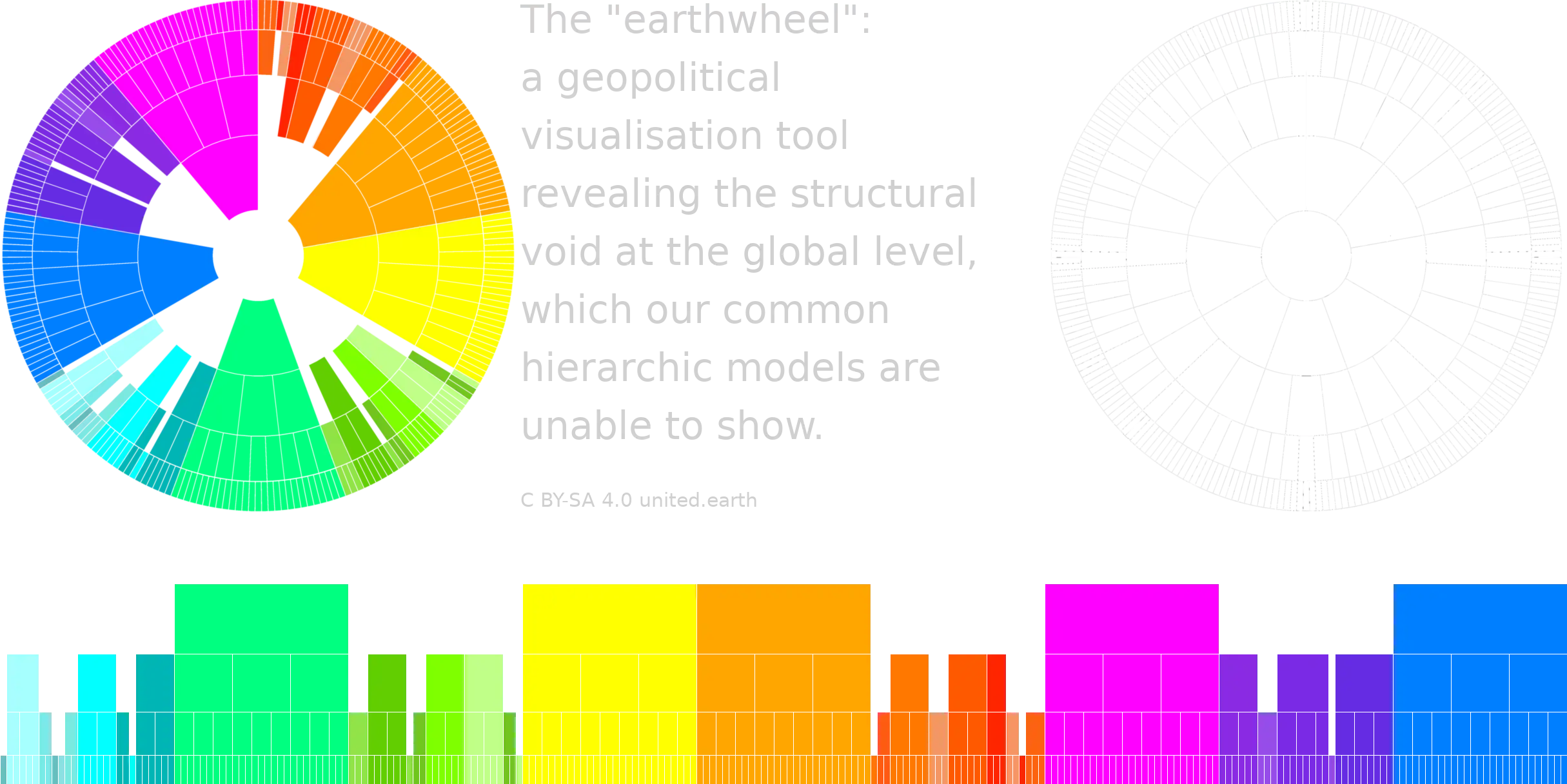
The linear hierarchy is the familiar way of representing nested political levels. It has real strengths. It is immediately legible, it can be extended horizontally with little loss of readability, and it can in principle scale toward a far more empirically complete representation of the world’s nearly 200 sovereign states. In that sense, it is well suited for enumeration and for showing large numbers of distinct units within a vertical hierarchy.
Its weakness is more structural. Once the same geopolitical condition is unfolded into a linear arrangement, what is missing no longer appears as a single absence. The gaps are dispersed between columns, and attention is drawn mainly toward the individual units and their separate heights. This makes the form analytically weaker at revealing a central fact of the present world order: that the global level is absent as such, and that the broader hierarchy therefore remains incomplete.
The empty five-level schema shows the same model in its most reduced form: global, bloc, sub-bloc, regional, and local. It presents the intended geometry of a complete hierarchy before empirical irregularities are introduced. Read alongside the populated earthwheel, it clarifies that the present geopolitical condition is defined not only by the entities that exist, but also by the levels that are absent, fragmented, or unevenly developed.
The earthwheel can be used to analyse geopolitical systems across several dimensions, including:
- Completeness – the degree of organisational development at each level, including whether hierarchical relations exist or are absent
- Balance – proportionality in geographic size, population, military power, economic strength, or other relevant variables
- Sovereignty vs. subsidiarity – how authority and responsibility are distributed between levels
- Identity and legitimacy – how cultural identity relates to political legitimacy, function and democratic authority within each governance entity
The model is deliberately highly abstract. To make the structural point visible, the number of units shown at each level is sharply reduced. The earthwheel is therefore not a literal cartographic rendering of the world’s sovereign states, but a conceptual compression. Its purpose is not to enumerate everything, but to show something that enumeration tends to obscure: where the hierarchy is complete, where it is incomplete, and how that incompleteness defines the geopolitical system as a whole.
10. The layers of governance
The governance levels define the vertical and territorial structure of governance. The layers define the recurring institutional and functional systems that operate within governance units and connect them across levels.
The proposed system consists of three governance layers: AGORA, the SEC Councils, and the three classical branches. Each performs a different constitutional function. PAI provides the shared classification of policy areas, while SEC provides the scientific, ethical and cultural knowledge and competence bases relevant to them.
The levels therefore answer where political authority and responsibility are located. The layers answer how democratic authority, informed judgement, and formal institutional power operate within those levels.
The following sections explain why modern governance requires more than a single institutional layer, then define the constitutional relationship between the three layers. The following chapters describe AGORA, the SEC Councils, and the branches in detail.
The units of governance bring the levels and layers together within the complete unit of governance.
10.1 Extending the three branches
This infographic contrasts two fundamentally different ways of responding to increasing political complexity, which we could call:
ad hoc and structured expansion of the constitutional architecture.
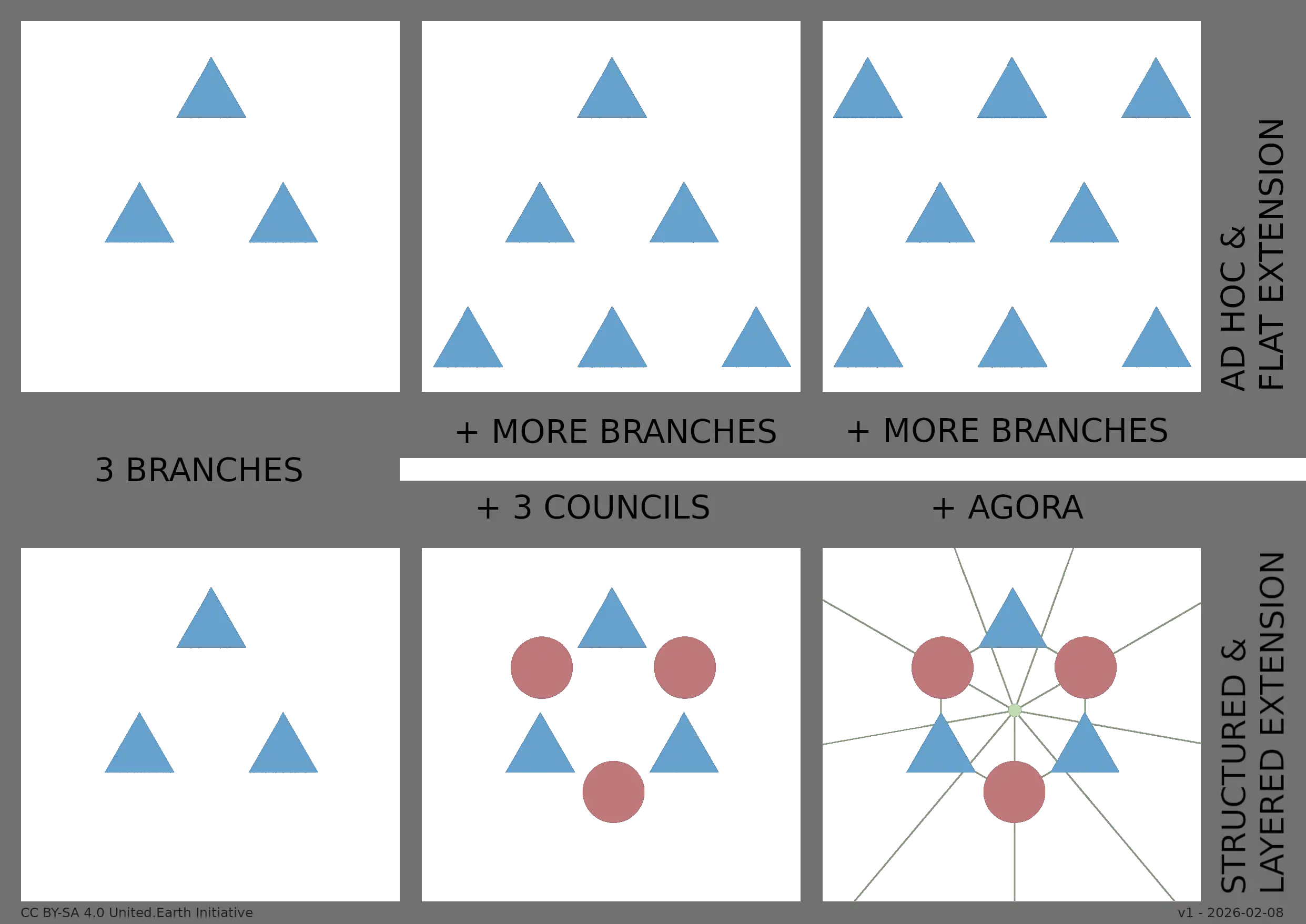
The upper row illustrates a familiar historical pattern: extending the three branches by adding more institutions of broadly similar constitutional character, resulting in ad hoc, flat expansion and growing systemic opacity and complexity.
The lower row shows an alternative response: preserving the essential functions of the three branches while organising additional constitutional functions through two distinct layers, the Councils and AGORA. Complexity is handled through structural differentiation rather than institutional accumulation.
The classical separation of powers into legislative, executive, and judicial branches has proven remarkably durable. It provides a clear and widely understood model for distributing and constraining institutional power. Modern societies, however, require permanent capacities that cannot be coherently contained within those three functions alone.
Historically, one response has been to add authorities, offices, commissions, agencies, and other institutions alongside the existing branches. These additions may address real needs, but continued horizontal expansion can increase institutional density while making responsibility and constitutional relationships harder to understand.
The problem is therefore not simply that modern governance needs more institutions. It needs different constitutional functions to be structurally distinguished.
The proposed system retains the legislative, executive, and judicial branches because their essential functions remain necessary. Their relationship to democratic authority is transformed, however. The branches no longer stand as the principal institutional holders of political judgement transferred from citizens between elections. They receive defined mandates to formalise, implement, protect, and maintain a democratic constitutional order in which Earth Citizens retain substantive political authority.
Two additional layers provide functions that should not be absorbed into the branches.
AGORA provides the constitutional public sphere through which Earth Citizens learn, deliberate, develop proposals, vote, elect institutional officeholders, scrutinise public authority, and exercise democratic political authority continuously.
The SEC Councils provide the permanent scientific, ethical, and cultural integrity layer. They safeguard knowledge, competence, methods, assessment, and the conditions for informed democratic judgement without acquiring political finality themselves.
The following section defines the resulting relationship between the three layers.
They examine AGORA, the three Councils, and the three branches, respectively.
10.2 The three-layer constitutional architecture
The proposed system separates three different constitutional functions that should not be concentrated within the same institutions:
- AGORA provides democratic authority.
- The Councils safeguard the basis for informed democratic decision-making.
- The branches provide formal institutional authority.
These layers are interdependent but constitutionally distinct. AGORA is where Earth Citizens exercise political authority. The Councils protect the integrity of the knowledge, competence, ethical reflection, and cultural understanding on which democratic decisions depend. The legislative, executive, and judicial branches turn valid democratic authority into law, implementation, and constitutional protection.
The purpose of the layered architecture is therefore the same as the classical separation of powers, applied more broadly: different forms of power and responsibility should be distinguished so that none can absorb the others.
The following chapters describe the three layers individually before The units of governance shows how they operate together.
11. AGORA (layer)
AGORA is the constitutional digital public sphere of the proposed system: the governance layer through which Earth Citizens form a democratic public and exercise political authority within and across every governance unit and level.
It brings learning, relevant competence and knowledge, deliberation, proposal development, political opinion profiles and public polling, voting, elections, and publicly owned AI capacity into one continuous democratic infrastructure.

WHEEL < 14/18 >
A networked global public square
The illustration shows AGORA as a distinct layer formed by interconnected nodes within every governance unit and at every level.
Unlike the branches and Councils, which operate as institutions within governance units, AGORA also connects the units. The network therefore represents both the public sphere within each jurisdiction and the shared infrastructure connecting the constitutional system as a whole into a new civilisation-scale federated architecture.
Go to the operational website of AGORA (proto version)
You are now in the theoretical basis of the United Earth project (WHY-WHAT-HOW). To participate in our early-phase proto version of AGORA, go to its operational website at >> agora.united.earth
11.1 What AGORA is
AGORA is designed as the constitutional public sphere through which Earth Citizens participate in governance. Its core functions can also operate before constitutional authority exists, providing useful public infrastructure for learning, deliberation, proposal development, political opinion formation and measurement, public polling, advisory voting, and coordination among citizens and institutions while the system is being built and tested.
Citizens use it to access public knowledge, learn, deliberate, maintain and revise political opinion profiles, participate in polls, develop and revise proposals, vote, elect parliamentarians (non-voting stewards), scrutinise institutions, and follow decisions through formalisation and implementation.
AGORA is not a social network or commercial platform. Its purpose is not to maximise attention, advertising, engagement, or the circulation of opinions. It is specialised political infrastructure designed to support informed democratic judgement and legitimate collective decisions.
Nor is AGORA a fourth branch of power. It does not administer public services, issue judicial rulings, or independently convert political preferences into law. It provides the structured public process through which citizens exercise democratic authority, while the Councils clarify the basis for judgement and the three branches make valid decisions legally and institutionally operative.
Democratic authority therefore originates continuously among Earth Citizens rather than primarily through parties and periodic elections. Citizens can engage directly with particular questions according to their interests, knowledge, responsibilities, and available time instead of choosing between complete political packages.
AGORA operates across the full governance hierarchy. The constitutional allocation of authority determines which governance unit can make a binding decision, while the Policy Area Index (PAI) identifies the policy domains involved.
AGORA is therefore not an interface added to representative democracy. It is the public democratic foundation through which citizens exercise political authority and institutions remain visible, contestable, and accountable.
11.2 PAI: Policy Area Index

PAI conceptually illustrated with 16 main categories and two subdivisions. The lines show relationships between policy domains.
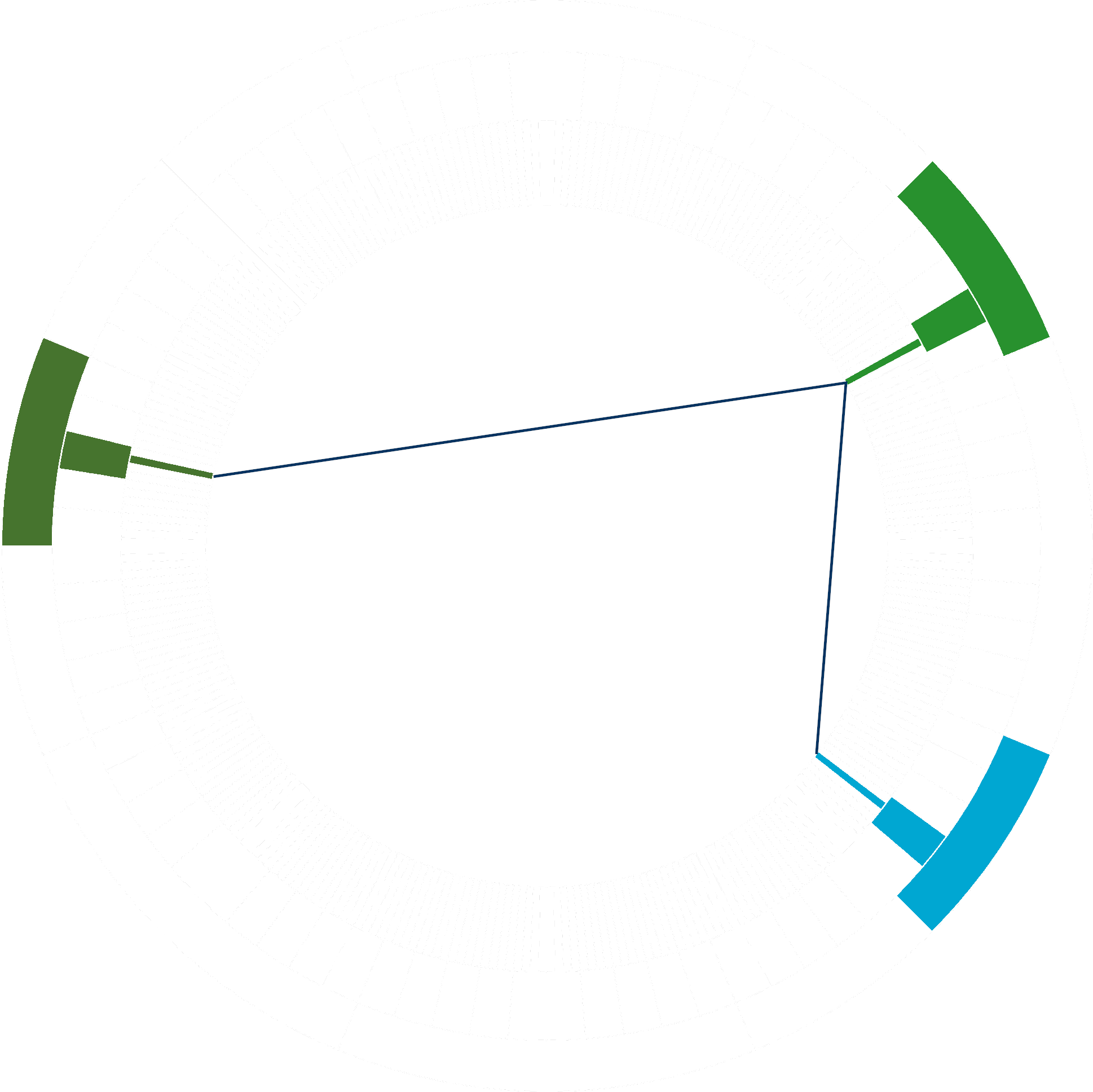
Conceptual illustration of one relational set involving three policy domains. A classic example is infrastructure, land use, and climate.
A shared global standard for categorising political domains
The illustrations show the Policy Area Index (PAI) as a shared, global index for political governance. The circular form is a conceptual visualisation. In practice, the Policy Area Index exists as structured data that can be queried and visualised in many ways.
The outer ring shows the full scope of governance-relevant policy domains, such as land use, infrastructure, education, and health.
The connecting lines in the centre show relationships between policy domains. Real political issues are often cross‑cutting and involve several domains at the same time. The illustrations therefore show both the structural division of policy domains and the relationships between them.
The PAI circle has no structural relationship to the Earthwheel models, which describe the geopolitical structure as a whole.
The Policy Area Index (PAI) defines what political governance is about in the proposed system. A global governance system cannot function without a shared and explicit classification of what governance is responsible for.
While governance levels define where authority is exercised, and governance layers define how power, knowledge and participation are organised, PAI defines the policy domains to which political questions relate and makes the relationships among those domains explicit. It provides a persistent, issue-based map of the political problem space that can remain stable across institutions, governments and electoral periods.
PAI is therefore not a programme, an agenda or a set of priorities. It is a structural classification system through which separate political questions can be located within a larger whole. This allows relationships, accumulated effects and dependencies across policy areas to remain visible over time, while democratic deliberation, knowledge production and institutional decision-making continue to refer to the same underlying structure.
From implicit politics to an explicit global structure
All modern governance systems already rely on ways of classifying political activity. These appear through ministries, parliamentary committees, budgets, regulatory mandates, statistical systems, and other institutional structures. Some are largely products of political and administrative history, while others have been developed as explicit standards.
Important foundations already exist at the global level. The United Nations system has developed a broad family of classifications, including the Classification of the Functions of Government (COFOG), and maintains institutional processes for improving harmonisation and convergence between international classifications. This work is not identical to PAI, but it provides standards, methods, categories, and accumulated expertise that should be examined and incorporated wherever relevant.
PAI should therefore be developed through systematic comparison, mapping, incorporation, and harmonisation of existing classifications rather than by recreating this work from scratch. Its aim is one coherent global standard for defining and relating policy areas and relevant combinations of policy areas, while maintaining explicit correspondences with specialised classifications where these remain useful.
PAI extends this harmonisation task into the political architecture as a whole. It must cover the full governance-relevant problem space, make relationships between policy areas explicit, and provide a common structure across democratic deliberation, knowledge and competence, institutional decision-making, and all governance levels.
Its domains are designed to be comprehensive, as clearly differentiated as possible, ideologically neutral, and sufficiently stable to provide a common reference over time. Their definitions and relationships remain open to transparent, democratically governed revision as knowledge, existing standards, and political reality develop.
Political disagreement does not disappear under this structure. It becomes situated: disagreement occurs within clearly defined policy domains, rather than through continual redefinition of the political terrain itself.
A common reference across all governance layers
PAI functions as a shared reference system across the entire governance architecture:
- The legislative branch uses PAI to structure the political agenda and decision procedure
- The executive branch uses it to organise implementation and coordination,
- The judicial branch uses it to contextualise interpretation and accountability,
- The Councils use it to anchor scientific, ethical, and cultural evaluation,
- AGORA uses it to structure learning, competence profiles, political opinion profiles and polling, deliberation, proposals, and voting.
A shared policy grammar allows the same political question and its relationships to be followed across deliberation, knowledge systems, institutional processing, implementation and later evaluation. It also allows the consequences of decisions to remain connected to related questions as circumstances and governments change.
PAI thus acts as the semantic backbone of the proposed system: a common, durable structure through which political complexity can be organised without requiring one political organisation or governing programme to supply the integration.
Stewardship and democratic legitimacy
Because the Policy Area Index defines the shared reference frame for political governance, its maintenance carries structural significance. Changes to the index can shape how political questions are framed, compared, and coordinated across the system.
For this reason, stewardship of the PAI must rest with a democratically legitimised and competence-based institution within the system as a whole. In the proposed system, this responsibility lies with the SEC Councils, which jointly maintain PAI while safeguarding its scientific, ethical and cultural integrity.
The process of maintaining and updating the PAI is conducted openly and transparently, with broad participation enabled through AGORA. Proposed revisions, evaluations, and justifications are made publicly accessible, allowing citizens and institutions at all levels to follow, scrutinise, and contribute to the evolution of the index.
11.3 SEC: Science, Ethics and Culture knowledge and competence
Political decisions involve three fundamental questions: What is real? What responsibilities follow from it? How will possible decisions affect and be understood by different people and societies?
AGORA therefore distinguishes between three named knowledge and competence bases: Science, Ethics and Culture. Together they are referred to as SEC. Each supports a corresponding dimension of competence, and their relative importance depends on the question being decided.
Scientific knowledge and competence
Scientific competence concerns the ability to understand and evaluate relevant reality: evidence, methods, causal relationships, uncertainty, competing explanations, risks, consequences, systemic effects, and practical feasibility.
Relevant knowledge may be research-based, technical, professional, practical, experiential, local, or traditional. The purpose is not to privilege academic institutions, but to recognise demonstrated understanding.
Ethical knowledge and competence
Ethical competence concerns the ability to identify and analyse responsibilities: rights and duties, power and vulnerability, necessity and proportionality, competing values, distribution of benefits and burdens, effects on future generations, and conflicts between legitimate ethical considerations.
It does not measure whether a person is morally good or whether they agree with one prescribed conclusion.
Cultural knowledge and competence
Cultural competence concerns understanding how political questions may be interpreted and experienced in different human contexts, including language, history, cultural meanings, worldviews, sources of trust and mistrust, and risks of exclusion, humiliation, domination, or conflict.
Personal experience and cultural belonging may contribute to such understanding, but belonging itself does not establish relevant competence.
Cultural identity does not confer political weight. Cultural understanding may.
Across all three dimensions, competence concerns understanding rather than political conformity.
Competence requires understanding, not agreement.
11.4 PAI×SEC
Knowledge-based democracy requires more than access to information. Citizens need a shared structure in which relevant knowledge and competence can be found, understood, compared, challenged, and revised.
The knowledge and competence structure
PAI defines the policy areas and relevant combinations of policy areas. Science, Ethics and Culture are three complementary knowledge and competence bases that organise access to relevant understanding drawn from a wider global knowledge ecosystem. PAI×SEC expresses the relationship between the policy structure and the knowledge and competence structure: PAI identifies the area, or combination of areas, relevant to a political question, while SEC provides the relevant scientific, ethical and cultural knowledge and competence.
Within this structure, concepts, evidence, research, data, methods, uncertainties, ethical considerations, cultural contexts, arguments, consequences, and relationships between policy areas can be connected to the political questions they inform. The purpose is not to reproduce all relevant knowledge inside one system, but to provide a shared interface through which existing sources, institutions, communities, and competing perspectives can be found, compared, and connected. A decision concerning transport, for example, may involve land use, energy, health, climate, economics, and local communities. Such connections must remain visible rather than being divided into institutional silos.
Knowledge without enforced consensus
The SEC bases do not provide one authorised political conclusion that citizens are expected to accept.
They must make clear what is established, uncertain, contested, unresolved, unknown, or speculative, according to the standards appropriate to Science, Ethics and Culture.
Sources, methods, assumptions, relevant interests, disagreements, minority assessments, and revision histories must remain visible. Credible competing interpretations cannot simply disappear because one position becomes dominant.
This principle is important for both knowledge and political integrity. Influence cannot be eliminated from society. The objective is to make the production, financing, contestation, and revision of politically relevant knowledge increasingly transparent and traceable.
Citizens, researchers, institutions, communities, and other contributors can therefore provide knowledge, criticism, alternative perspectives, and corrections through open procedures.
The SEC Councils safeguard the methods, structure, integrity, and accessibility of their respective bases and the standards connecting them to PAI. They do not determine the political conclusions citizens must reach.
Public knowledge independent of AI
The SEC bases must remain directly accessible independently of the AI systems used to navigate them.
Sources, classifications, uncertainty, disagreement, and revision histories constitute public infrastructure. They cannot be concealed inside proprietary models or automated outputs.
The relationship is therefore:
PAI structures the policy areas. SEC provides the relevant scientific, ethical and cultural knowledge and competence. PAI×SEC connects the two. Public AI helps people navigate and learn from them.
11.5 Learning and competence verification
Knowledge-based democracy can only be legitimate if every citizen has a genuine opportunity to develop and demonstrate relevant competence.
Learning through PAI×SEC
AGORA provides the common learning framework through PAI×SEC. PAI identifies the policy area, or combination of areas, relevant to a question, while Science, Ethics and Culture provide the corresponding knowledge and competence. Citizens can explore relevant evidence, concepts, uncertainty, ethical questions, cultural contexts, competing interpretations, and relationships between policy areas through accessible forms of learning.
Assessment must test understanding rather than simple memorisation. Depending on the field, this may include evaluating sources, interpreting uncertainty, analysing consequences, comparing perspectives, or explaining competing arguments.
A dynamic competence profile
Verified competence forms a profile structured through PAI and SEC. It records the areas in which understanding has been demonstrated, its scope, and whether it remains current.
Competence is not a permanent status. It can be developed, reassessed, expanded, challenged, updated, or expire as knowledge and circumstances change.
Knowledge acquired elsewhere
AGORA should not require citizens to prove again what has already been credibly demonstrated.
Formal education, professional practice, research, publications, practical experience, local and traditional expertise, and other verifiable knowledge can therefore contribute through transparent procedures.
The relevant question is what understanding has been demonstrated and how it relates to the competence required for a particular political question.
Verification methods and classifications must be transparent, reviewable, and open to correction and appeal.
11.6 Lifelong civic participation
Earth Citizenship provides the common civic standing through which people participate in AGORA.
Access and civic development
Access to public political knowledge and civic processes is a universal right. This requires practical access through appropriate technology, connectivity, language support, public facilities, and assistance where needed.
Participation can begin before voting age. Children and young people can learn, deliberate, develop proposals, take competence assessments, and participate in simulated votes and elections. Their results can be displayed without becoming binding political authority.
This creates gradual civic development rather than a sudden transition from political exclusion to full voting rights at adulthood.
Public AGORA facilities must provide accessible interfaces and appropriate assistance so that citizens with disabilities, limited digital skills or no personal technology can exercise their democratic rights, including civic identity verification and competence assessment. Such assistance must preserve the independence and secrecy of democratic participation.
Verified civic identity
Every Earth Citizen can hold only one verified civic account. Verification establishes that the participant is one unique and eligible human being without requiring their legal identity to become public.
Public participation may therefore be pseudonymous. The verified legal identity remains protected, while votes and elections remain secret.
This combines democratic integrity with protection against social, professional, economic, or political retaliation.
Democratic jurisdiction
Each citizen is connected to a primary locus through their home address. This establishes the territorial sequence of governance units in which they hold binding democratic rights. The sequence includes only the governance levels constitutionally applicable to that territory: local, regional, sub-blocal where applicable, blocal where applicable, and global.
The jurisdictional connection does not restrict access to information or public discussion.
AGORA remains a shared public sphere in which citizens can follow and contribute to processes elsewhere. Binding voting authority, however, belongs to the governance units of which the citizen is constitutionally part.
Earth Citizenship consequently combines universal civic standing with territorially situated democratic authority.
11.7 Knowledge-weighted direct democracy
Every adult Earth Citizen has the right to participate in binding political votes. No competence test is required, and every eligible citizen begins with a voting weight of 1.
Universal rights, differentiated knowledge
Verified competence relevant to a particular decision can increase voting weight within the proposed range from 1 to 100.
The principle is that greater demonstrated understanding of the matter being decided can provide greater influence within that matter.
Additional weight is always issue-specific. Expertise in one field creates no general political rank and provides no additional weight in unrelated questions.
Most political questions involve more than one area of knowledge. A proposal may therefore require a competence profile combining several PAI areas and SEC dimensions. Their relevance and weighting must be determined before the vote through transparent procedures and remain open to challenge and review.
Degrees, professions, institutional positions, wealth, fame, organisational power, and social status create no political weight in themselves.
Knowledge without expert rule
This is knowledge-based (epistemic) democracy, not epistocracy (see Wikipedia). Political authority remains distributed among all adult citizens. Relevant competence strengthens each citizen’s own participation rather than transferring authority to a permanent expert class.
The system favours knowledge, not a class of knowers.
Citizens do not have to delegate their vote to knowledgeable intermediaries as proposed in the concept of liquid democracy (see Wikipedia). They retain their own political authority and can develop competence in whichever policy areas they choose.
The model therefore combines universal democratic standing with a permanent incentive to learn.
11.8 Public AI as democratic infrastructure
Modern political knowledge is too extensive and complex for any citizen to navigate alone. AGORA therefore requires a permanent public AI infrastructure, publicly owned, constitutionally governed, and dedicated to AGORA’s democratic functions.
AI as a public service
AI can help citizens search and understand knowledge, translate languages, compare arguments, identify assumptions, explore uncertainty and consequences, follow relationships between policy areas, develop proposals, prepare for deliberation and democratic participation, and build personalised learning paths.
Its democratic purpose is accessibility. Political competence should not depend primarily on exceptional education, institutional access, free time, language skills, or the ability to navigate specialist literature unaided.
Public ownership, plurality, and transparency
The core AI capacity on which AGORA depends must remain publicly owned and capable of operating independently of private providers. It can include multiple models, specialised systems, and technical approaches, allowing comparison, challenge, independent auditing, and continuous improvement within the public infrastructure.
Relevant sources, assumptions, methods, limitations, and uncertainty must be inspectable. Citizens must retain direct access to the underlying public knowledge.
Personalisation may help people learn and navigate complexity, but it must not covertly manipulate political behaviour, selectively conceal relevant information, or construct individually engineered political realities.
No single model should become an unchallengeable interpreter of the SEC bases or of political questions. Different models and methods within the public infrastructure should remain available for comparison, auditing, challenge, and review.
Universities, public agencies, cooperatives, non-profit organisations, private developers, and external AI systems can contribute research, technology, models, and services or interact with AGORA through open interfaces. Such contributions do not transfer ownership or control of AGORA’s core AI infrastructure, citizen profiles, public knowledge bases, or democratic processes. Essential AI functions must remain operable without dependence on any single private provider.
Human political authority
AI may assist democratic processes, but it cannot possess civic standing or independent constitutional authority.
It cannot vote, stand for election, or hold public office. Where automated systems influence competence assessment, moderation, proposal processing, or other consequential functions, their role must be transparent, and decisions must remain contestable.
AI may extend human understanding and collective intelligence, but political authority remains human.
11.9 Deliberation, proposals, and the public agenda
AGORA connects public knowledge to structured democratic action.
Structured deliberation
A formal political process links the competent governance unit with the relevant PAI areas, available knowledge, competing arguments, uncertainty, ethical and cultural considerations, proposed alternatives, expected consequences, and a traceable history of revisions.
This does not replace ordinary political discussion, advocacy, disagreement, emotion, or mobilisation. It gives formal democratic processes a common structure through which citizens can understand what is proposed, why, how it has changed, and what consequences have been identified.
Within AGORA, arguments offered to justify common public decisions must be assessable without accepting any collective identity’s claimed truth, authority or universal validity. These are rules for political reasoning, not a requirement that citizens personally endorse every constitutional principle.
Citizens’ assemblies
For particularly important, complex, contested or long-term questions, citizens’ assemblies can be convened through AGORA at any governance level, under transparent and publicly accountable procedures. Participants are selected through transparent, inclusive procedures designed to bring together a broad cross-section of the affected population. They are given sufficient time, independent facilitation and access to relevant PAI×SEC knowledge, Council assessments, competing arguments, experts and affected groups.
Citizens’ assemblies examine questions in depth, explore alternatives and trade-offs, and publish reasoned findings and recommendations, including disagreements and minority perspectives. Their proceedings and conclusions become part of AGORA’s public deliberative record, enabling the wider citizenry to follow the reasoning, assess the evidence and develop informed judgements of their own. Assemblies may operate physically, digitally or in hybrid form.
Citizens’ assemblies strengthen direct democracy; they do not replace it. They exercise no delegated voting authority and cannot make binding political decisions on behalf of other citizens. Their role is to improve the quality of public deliberation and the knowledge available to every Earth Citizen, who retains the right to vote directly under AGORA’s knowledge-weighted democratic procedures.
Assembly recommendations are deliberative contributions, not representative measurements of public opinion, and participation in an assembly does not itself confer verified competence or additional voting weight.
An open political agenda
Earth Citizens can initiate political processes, develop proposals, support or oppose initiatives, propose alternatives, and submit amendments.
A proposal may begin as a problem, objective, principle, or practical suggestion. Through learning, deliberation, revision, and institutional input, it can mature into a form suitable for democratic decision.
Public institutions, research environments, civil-society organisations, companies, and other organised actors can contribute evidence, criticism, proposals, technical work, negotiations, and voluntary commitments through defined interfaces. Their participation can help coordinate action around a political process, but it gives them no collective democratic voting weight or ownership of the process.
Competing alternatives should remain visible, including the option of retaining current policy.
The political agenda therefore does not belong exclusively to parliaments, governments, parties, media, wealthy interests, or platform owners. Institutions retain the right to initiate processes within their responsibilities, while citizens receive a defined route to formal consideration once transparent requirements for support, competence, admissibility, and procedure are met.
These requirements are necessary to prevent incoherence, flooding, and manipulation, but they must not become concealed political vetoes.
The legislative branch then has a duty to process qualified initiatives according to established procedures.
11.10 Political opinion profiles and public polling
AGORA provides permanent infrastructure for recording and measuring expressed political opinion alongside formal democratic votes.
Political opinion profiles
Each Earth Citizen can maintain a political opinion profile structured through PAI, recording, revising, or withdrawing positions on policy areas, specific questions, proposals, priorities, and ongoing public processes.
Positions can be entered directly or updated through participation in polls and other AGORA processes. The citizen controls the individual profile, including which positions are publicly visible. Aggregated opinion can become part of the shared democratic information infrastructure under privacy rules that prevent protected individual positions from being exposed or reconstructed.
A recorded position is not a ballot. It expresses a standing political judgement but has no binding or advisory voting status unless the citizen participates in the separate formal process established for that vote.
Active public polling
AGORA can actively invite a defined constituency to consider a question and respond. An invitation can address everyone within a governance unit or another transparent and legitimate filter, or use a documented sample where representative estimation is the purpose.
Polls can connect directly to relevant PAI×SEC knowledge, deliberation, competing arguments, uncertainty, and learning resources. Citizens who develop and demonstrate relevant competence while preparing to respond can update their competence profiles through the same verification procedures used elsewhere. Merely answering a poll does not itself establish competence.
A continuously measurable democratic public
Aggregated results can show the distribution of expressed political opinion globally, within governance units, across other legitimate filters, and over time.
Each result must make its evidential basis clear. This includes the size of the relevant constituency, the number of citizens with a current registered position, the number invited where applicable, participation and non-response, and the age or freshness of recorded positions. Where representative sampling is used, statistical weighting, methods, and uncertainty must be transparent.
Political opinion measurement counts people, not competence-weighted votes. Relevant competence can be displayed as an analytical dimension where privacy permits, but it does not change how many citizens hold a position. The separate rules for knowledge-weighted democratic voting apply only when a formal vote is conducted.
At sufficient scale, AGORA can become the primary public infrastructure for political opinion measurement. Instead of relying mainly on external polling organisations to infer what populations think, citizens themselves can maintain a continuously updated political record whose aggregated patterns can be examined directly.
This also makes support for particular initiatives measurable, verifiable, and politically legible. AGORA can show both the size of the overall Earth Citizenship constituency and the verified constituency explicitly supporting a particular political process, without confusing such support with a constitutional vote.
11.11 Voting, elections, and continuous democracy
AGORA separates substantive political decisions from the election of people who maintain political institutions.
Democratic votes
Binding political votes determine substantive questions within the constitutional competence of the relevant governance unit. Before voting begins, the process identifies the question, alternatives, relevant PAI areas, applicable competence profile, and legal status of the result.
A constitutionally valid binding decision cannot be replaced by parliament simply because parliamentarians prefer another outcome.
Such decisions remain subject to judicial review concerning constitutional competence, protected rights, subsidiarity, procedural integrity, and the validity of the democratic process. Judicial review concerns legality and constitutional validity, not whether judges prefer another political result.
Citizens can later amend or replace a decision through another valid democratic process.
Constitutional votes concern the foundations of the political order and therefore require separate procedures and demanding thresholds defined by the Constitution.
Advisory votes can measure public judgement without producing a binding outcome. Simulated votes allow learning, testing, and participation without constitutional effect. Their status must always be clear in advance.
Elections and institutional mandates
Elections select the people responsible for parliamentary institutions and legislative stewardship.
Candidates stand as individuals rather than party delegates. Citizens can examine their competence, reasoning, interests, affiliations, public participation, proposals, and previous institutional performance through AGORA.
Knowledge-weighting does not give candidates or voters a permanent general political rank in elections. Relevant competence can instead contribute to eligibility requirements and to the information citizens use when evaluating candidates.
The essential distinction is between deciding policy and maintaining the institutions through which democratic decisions become workable.
The election gives parliamentarians an institutional mandate. It does not transfer the citizenry’s substantive political authority to them.
Parliamentarians organise and safeguard legislative process, develop workable agendas, integrate qualified initiatives, formalise democratic decisions, and maintain institutional continuity. Their fuller role is described in the chapter on the legislative branch.
Continuous democracy
Citizens therefore do not have to wait for elections to exercise political authority or participate in the continuous democratic process. Learning, political opinion formation and polling, deliberation, proposals, and substantive voting continue throughout the political cycle.
Elections remain necessary because institutions require identifiable people who organise formal processes, exercise defined responsibilities, and answer publicly for institutional performance.
The proposed structure uses a rolling sequence:
- Year 1: local elections
- Year 2: regional elections
- Year 3: sub-blocal elections
- Year 4: blocal elections
- Year 5: global elections
In a four-level structure without the sub-blocal level, this, of course, becomes a four-year sequence.
One level therefore receives primary electoral attention each year while democratic participation continues continuously across all levels.
11.12 Transparency, identity, and post-party politics
A democratic system needs transparency about interests that may materially affect political judgement. It does not require citizens to expose the personal identities through which they understand themselves or live their private lives.
Relevant interests and protected identity
Relevant financial, organisational, employment, ownership, funding, or public-office relationships may require disclosure when they affect the interpretation of a proposal, candidacy, assessment, or institutional decision.
Requirements become stronger with institutional responsibility and direct conflicts of interest, but they must remain proportionate.
This must not become general political surveillance. Ethnicity, nationality, religion, philosophy, political self-identification, sexuality, health, family relationships, and other protected personal characteristics are not disclosure requirements merely because someone participates politically.
Public pseudonymity therefore remains compatible with political transparency.
Organisations without political ownership
Cultural, religious, ideological, economic, and political organisations remain free to develop ideas, publish analyses, organise learning, advocate positions, mobilise support, and recommend candidates.
They do not acquire political authority as collective persons.
Political parties may therefore continue to exist. What disappears is their privileged constitutional role as gateways between citizens and political power.
They cannot own mandates, control electoral candidacy or candidate lists, receive reserved representation, exercise collective voting rights, or bind elected parliamentarians through party discipline.
Candidates stand as individuals. Voluntary political cooperation remains unrestricted, but organisations cannot acquire political authority independent of the individuals participating in them.
Post-party politics
Post-party politics preserves organised political thought and disagreement while changing where democratic integration takes place. Ideologies, movements, religions, political traditions and other organisations remain free to develop comprehensive positions, arguments and programmes.
Political organisations remain free to organise political thought. They no longer organise democratic authority.
Political integration instead takes place around the questions themselves. PAI locates each issue within the wider policy structure and keeps its relationships to other issues visible. PAI×SEC connects it to relevant scientific, ethical and cultural knowledge and competence. AGORA provides the common environment for learning, deliberation, proposals and direct democratic judgement.
Citizens can therefore form their own political synthesis from issue to issue. Different organisations may influence that judgement, and individuals may continue to identify strongly with particular political traditions, but democratic authority does not depend on accepting a complete organisational package.
The result is an issue-based democratic structure in which political continuity and integration are carried by shared public institutions and the accumulated democratic record, while substantive political judgement remains with the citizenry.
11.13 Federated architecture, integrity, and resilience
A democratic infrastructure serving humanity cannot depend on one platform, database, organisation, provider, technical centre, or communication route.
Federated constitutional infrastructure
AGORA must be publicly governed, federated, distributed, modular, redundant, interoperable, and constitutionally protected.
Its nodes operate under compatible constitutional and technical standards while retaining sufficient local capacity to maintain essential democratic functions. Connections and replication across the network provide alternative routes and allow the system to survive the failure or isolation of individual components.
No external provider can acquire proprietary or exclusive control over civic identity, citizen profiles, democratic access, competence systems, the SEC bases, proposal visibility, voting, elections, public records, or continued operation. Essential AGORA functions must remain operable within the public constitutional infrastructure.
The more detailed node structure is described in the chapter on governance units.
Separation of identity, activity, and voting
One verified civic account must coexist with strong separation between confidential identity verification, public civic profiles, political activity, competence information, and secret voting.
No institution should be able to combine these layers into a comprehensive system of political surveillance. Access must be limited by function, legally controlled, auditable, and technically separated wherever possible.
The same principle applies institutionally. No government, provider, organisation, or political majority should be able to gain unilateral control over the complete democratic infrastructure.
An Earth Citizen’s digital profile belongs to the citizen and remains under the citizen’s control. A social network, AI service, media platform, or other external service receives authorised access to specified data for defined purposes; it does not acquire the citizen’s profile as a proprietary asset.
AGORA should provide interoperable standards through which citizens can activate selected parts of their profiles in external services, limit or revoke access, and retrieve personal data and profile information generated through the relationship in a portable form. The profile follows the citizen rather than the platform.
When a citizen ends the relationship, the service must delete the citizen’s personal data and derived personal profile unless a specific valid legal obligation requires limited retention. Data retained for such a purpose cannot be repurposed into a continuing commercial or political profile.
Citizen-controlled data can remain distributed across functionally separated systems. Confidential identity verification, public civic profiles, political activity, competence information, other personal data, and secret voting remain separated, with access granted only to the information required for a defined purpose. The citizen’s ability to authorise, retrieve, move, and revoke access to data does not create institutional access across these boundaries.
Integrity and political capture
AGORA must protect against identity fraud, multiple accounts, account theft, coercion, vote buying, automated false participants, manipulation of competence and voting systems, concealed algorithmic control, unauthorised surveillance, sabotage, and alteration of democratic records.
The technologies used to achieve this will change. The constitutional requirements are more durable: verified human participation, secret voting, procedural transparency, distributed control, protected identity data, independent auditing, and the right to challenge consequential decisions.
Security systems must themselves remain accountable. Automated detection may identify possible manipulation, but it cannot silently remove civic rights, alter votes, invalidate competence, or classify lawful disagreement as a security threat.
No architecture can make political, economic, or epistemic influence disappear. Interests will continue to organise, campaign, educate, persuade, and attempt to influence public knowledge and political outcomes.
The objective is therefore not an impossible system without influence. It is a system in which influence, funding, interests, knowledge claims, disagreement, institutional changes, and attempts at capture become increasingly visible, distributed, traceable, and contestable.
Resilience and continuity
Formal proposals, revisions, assessments, aggregated results, valid decisions, institutional actions, and later corrections must form a durable democratic record.
AGORA must also continue functioning during cyberattack, political conflict, infrastructure failure, natural disaster, or institutional crisis. Parts of the system may enter degraded modes, but essential civic identity, constitutional procedures, valid decisions, democratic records, and the capacity for legitimate recovery must survive.
Technical resilience alone cannot secure democratic integrity. Permanent institutions are also needed to maintain knowledge standards, expose uncertainty and disagreement, evaluate methods, identify ethical and cultural consequences, and challenge failures without taking over democratic decision-making.
These functions belong to the three Councils.
12. The SEC Councils (layer)
The Science Council, Ethics Council and Culture Council, collectively the SEC Councils, form the permanent scientific, ethical, and cultural integrity layer of the proposed system. They safeguard the knowledge, competence, methods, and public assessments needed for informed democratic judgement.
They do not govern instead of citizens, parliaments, executives, or courts. Their task is to make reality, uncertainty, ethical conflict, cultural consequences, and long-term risks visible and contestable before, during, and after political decisions.
The system cannot guarantee good decisions. The Councils are designed to increase their probability. Science clarifies reality. Ethics clarifies responsibility. Culture clarifies human meaning.
Citizens decide.
WHEEL < 15/18 >
The democratic integrity layer
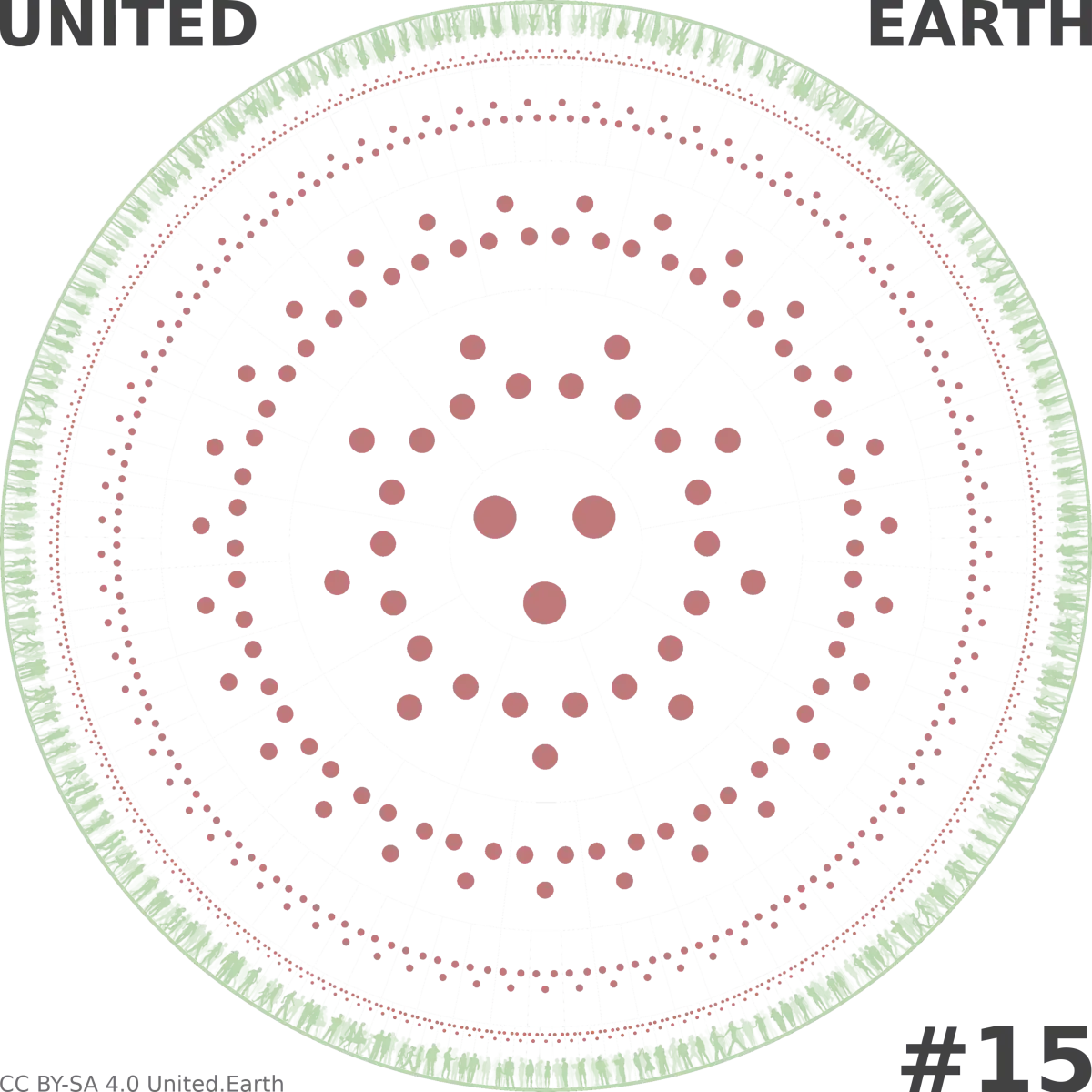
The illustration shows the Science Council, the Ethics Council, and the Culture Council as a distinct governance layer operating within every governance unit and across all levels.
They are permanent constitutional institutions, not temporary committees, extensions of the branches, or parallel political decision-makers. Their federated structure allows knowledge, assessments, warnings, methods, and institutional learning to circulate throughout the system while remaining connected to local and regional realities.
Go to the operational website of the Councils
You are now in the theoretical basis of the United Earth project (WHY-WHAT-HOW). To participate in our early-phase version of the COUNCILS, go to its operational website at >> councils.united.earth
12.1 What the Councils are
The Councils have substantive institutional authority within their defined responsibilities. They establish and maintain standards for knowledge, assessment, competence, verification, and public evaluation where the Constitution assigns these functions to them.
They do not possess sovereign political authority. They cannot enact laws, administer policy, issue judicial rulings, overturn a valid democratic decision because they disagree with it, or acquire a general veto over political processes.
The Council system is therefore neither a small expert committee above democracy nor a single central institution. It is a federated network distributed across governance units, levels, policy areas, and fields of competence. This allows practical, professional, local, scientific, cultural, and other relevant knowledge to enter the system from many directions.
Their authority concerns the integrity of the basis for judgement, not the political conclusion drawn from it.
Standing contact structures
The Councils cannot safeguard open and plural knowledge if they depend only on their own members or on established institutional networks. Each Council therefore maintains standing, open contact structures through which relevant communities, institutions, traditions, and knowledge holders can contribute to its work and to the corresponding SEC base.
These contact structures provide durable routes for knowledge, criticism, missing perspectives, corrections, competing interpretations, and emerging concerns to enter the Council system. They do not create Council membership, reserved seats, collective political mandates, veto rights, or privileged authority over democratic decisions.
The form of these structures differs according to the Council:
- Science maintains contact with research institutions, scientific and professional communities, technical and practical knowledge networks, independent researchers, local observers, and holders of relevant traditional knowledge.
- Ethics maintains contact with ethical and philosophical traditions, human-rights and legal communities, religious and non-religious life-view communities, civil-society organisations, and other sources of normative reasoning.
- Culture maintains contact with cultural identities and communities, including nations and stateless nations, Indigenous peoples, ethnic and linguistic communities, religions and life-view communities, ideological traditions, diasporas, and other forms of cultural organisation. Access to these channels does not depend on statehood, territorial sovereignty, demographic size, or prior official recognition.
Council membership remains competence-based. The Councils remain responsible for assessing contributions through transparent and contestable standards.
No Council may treat one organisation, institution, spokesperson, or tradition as the exclusive representative of an entire field, community, or identity. Internal diversity and competing voices must remain able to enter the system.
Such distribution cannot make institutional capture impossible. It can make capture harder to centralise, easier to expose, and more reversible through transparency, comparison, challenge, democratic renewal, and institutional pluralism.
12.2 Science Council
The Science Council safeguards the scientific and epistemic integrity of the governance system and maintains Science, the scientific knowledge and competence base.
Its central questions are:
- What is known?
- How is it known?
- How certain is it?
- What remains unknown or disputed?
- What consequences can reasonably be expected?
The Council maintains standards concerning evidence, data quality, verification, methods, causal reasoning, modelling, uncertainty, risk, systemic effects, and practical feasibility.
Its task is not to turn science into an institutional doctrine. Scientific understanding changes, methods can fail, and credible experts may disagree. The Council must therefore preserve distinctions between established knowledge, uncertainty, competing explanations, unresolved questions, and speculation, while making the evidence and reasoning behind these distinctions visible.
Scientific stewardship also includes relevant knowledge that does not originate in universities. Professional practice, technical experience, local observation, traditional knowledge, and other demonstrated forms of understanding may be essential to a political question.
The Council helps ensure that such knowledge can be incorporated into Science and democratic assessment according to transparent standards of relevance and reliability.
Science can clarify reality, probable consequences, and feasible alternatives. It cannot determine by itself what society ought to choose.
12.3 Ethics Council
The Ethics Council safeguards ethical reasoning, responsibility, rights, non-domination, and ethical consistency, and maintains Ethics, the ethical knowledge and competence base.
Its work is grounded in the intrinsic value of life and addresses questions including rights and duties, power and vulnerability, necessity and proportionality, non-domination, distribution of benefits and burdens, responsibility toward future generations, ecological responsibility, and conflicts between legitimate values.
Political decisions frequently involve ethical tensions rather than one obvious moral answer. Protecting one right may restrict another. A policy may benefit society overall while imposing disproportionate burdens on particular people, communities, future generations, or other life.
The Council’s task is to expose such conflicts and clarify the principles and consequences involved. It does not establish one complete ethical doctrine that citizens must accept.
It may identify conflicts between a proposal and constitutionally protected rights, the intrinsic value of life, non-domination, or other foundational principles. Binding interpretation of constitutional law remains with the judicial branch.
The Council also contributes to the continued development and public understanding of foundational documents such as the Declaration of the Rights of Life and the ethical principles of the Earth Constitution, without replacing the democratic procedures through which those documents are established or amended.
Ethical competence concerns the ability to recognise and reason through such conflicts. It does not require agreement with the Council or with one prescribed conclusion.
12.4 Culture Council
The Culture Council safeguards cultural understanding, dignity, plurality, and interpretive fairness, and maintains Culture, the cultural knowledge and competence base.
Political decisions do not enter culturally empty societies. Language, history, worldview, identity, collective memory, social context, and previous experiences with authority shape how policies are understood and experienced.
A measure that appears neutral in abstract legal or technical terms may therefore create trust in one context and fear, exclusion, humiliation, or conflict in another.
The Council makes these differences visible so that cultural consequences can enter democratic judgement before they become unintended political effects.
The Culture Council’s standing contact structures allow cultural identities and communities to speak into the system without turning them into constitutional constituencies within the Council.
A nation, religion, ethnicity, ideology, or other identity may contribute knowledge about itself, challenge misrepresentation, provide competing interpretations, and raise cultural consequences that might otherwise remain invisible.
This does not make these identities members of the Council or collective political persons within it. Contact carries no Council seat, vote, veto, or political authority, and no organisation gains a monopoly on interpreting an identity merely by claiming to represent it.
Nor may the Council decide which identities are authentic, who belongs to them, or which interpretation of a culture is correct. The contact structure must therefore remain open to internal diversity, disagreement, change, and criticism, including competing voices within the same identity.
Cultural knowledge without cultural ownership
Personal belonging can provide important situated knowledge, but belonging alone does not establish complete competence or political authority.
Relevant cultural knowledge may also come from practical experience, local communities, Indigenous and traditional knowledge systems, historical research, language expertise, or other demonstrated understanding.
The Council helps ensure that these forms of knowledge can enter public assessment without turning identity itself into a constitutional claim to authority.
The Council also contributes cultural knowledge and standards to the stewardship of living cultural heritage, including sacred buildings, landscapes, Indigenous heritage and other places whose continuing significance depends on cultural practice. It helps document affected traditions, competing claims, historical continuity and risks of cultural loss or conflict. It does not own, govern or allocate such sites; their legal status remains subject to the democratic, executive and judicial institutions of the constitutional order.
Cultural neutrality therefore does not mean removing culture from public life. It means that governance does not belong to any culture.
12.5 Shared responsibilities and stewardship
The SEC Councils contribute different forms of integrity stewardship across the same democratic system.
| Governance responsibility | Science Council | Ethics Council | Culture Council |
|---|---|---|---|
| Constitutional and normative foundations | Examines empirical premises, conceptual clarity, feasibility, and systemic consequences. | Clarifies rights, duties, non-domination, responsibility toward life, and ethical consistency. | Safeguards culturally neutral and inclusive interpretation across different human contexts. |
| Policy Area Index (PAI) | Safeguards empirical grounding, classification, and coherence between policy areas. | Safeguards ethical boundaries, responsibilities, and affected interests. | Safeguards culturally neutral framing, linguistic accessibility, and protection against identity bias. |
| Science, Ethics, and Culture (SEC) knowledge and competence bases | Maintains standards for evidence, methods, uncertainty, modelling, and scientific disagreement. | Makes ethical constraints, rights implications, burdens, and long-term responsibilities visible. | Makes cultural context, differing interpretations, and consequences across societies visible. |
| Learning and competence | Safeguards standards for relevant scientific, technical, practical, and methodological competence. | Safeguards standards for understanding ethical conflict, rights, responsibility, and consequences. | Safeguards standards for cultural, linguistic, contextual, and interpretive competence. |
| Political proposals | Assesses evidence, feasibility, risk, causal relationships, and expected effects. | Assesses rights, proportionality, distribution, ethical conflict, and intergenerational consequences. | Assesses meaning, dignity, coexistence, and risks of exclusion or cultural domination. |
| Long-term stewardship | Follows changing evidence, system dynamics, risks, and observed consequences. | Maintains attention to future generations, vulnerable life, and enduring responsibilities. | Maintains attention to cultural continuity, plurality, adaptation, and mutual understanding. |
| Public integrity | Issues assessments and warnings concerning failures in evidence, methods, and knowledge systems. | Issues assessments and warnings concerning ethical and constitutional responsibilities. | Issues assessments and warnings concerning cultural consequences, exclusion, and identity-based domination. |
Stewardship of the PAI
PAI classifications shape how political questions are understood, connected, and assigned competence requirements. Their stewardship cannot therefore belong to one discipline, political institution, technical provider, or temporary majority.
The Councils jointly maintain the definitions, scope, relationships, and coherence of PAI. Proposed changes must be public, reasoned, and contestable through AGORA.
PAI stewardship does not allow the Councils to determine which political questions should receive priority or which solutions citizens should choose.
Stewardship of Science, Ethics and Culture (SEC)
Each SEC Council stewards its corresponding knowledge and competence base by maintaining standards, connections, and public access across a wider ecosystem of relevant sources and contributors. The three Councils jointly safeguard the integrity of SEC as a whole, while AGORA remains the civic environment in which citizens use it.
The Councils do not need to produce or own all knowledge within their domains. Their role is to organise access, identify gaps, safeguard appropriate standards, make sources, uncertainty and disagreement visible, and preserve the possibility of challenge, correction, and revision.
The Councils cannot require ideological conformity as a condition for knowledge or competence. Their responsibility is to protect standards of understanding and transparency.
Competence profiles for political decisions
Before a knowledge-weighted vote, the relevant competence profile must identify the PAI domains and SEC dimensions involved, their relative significance, the required scope and currency of competence, and the method through which additional voting weight is calculated.
Complex questions may involve several areas simultaneously. An infrastructure proposal, for example, may require understanding of economics, ecology, technology, health, local conditions, and other relevant domains.
The competence profile must therefore be established before the result of the vote is known, publicly explained, and open to challenge and judicial review.
It cannot be adjusted to favour a proposal, group of citizens, expected majority, or political outcome. Where classification is genuinely disputed, the disagreement and alternative assessments must remain visible.
Standards for public AI
The Councils also maintain the scientific, ethical, and cultural standards governing public AI in AGORA.
They do not control one exclusive AI system. Their task is to ensure that competing systems can be evaluated against public standards concerning transparency, auditability, uncertainty, privacy, cultural and linguistic accessibility, absence of concealed persuasion, and access to the underlying public knowledge.
AI remains subordinate to human and constitutional authority.
12.6 Evaluation, warnings, and public knowledge
The Councils apply their combined competence to proposals, draft laws, existing policies, institutional practices, and emerging conditions.
Their purpose is not to produce one Council-approved political answer. It is to make the relevant basis for judgement visible before citizens and institutions act.
Public assessments
Council assessments should identify the evidence and methods used, relevant assumptions, what is known and uncertain, important disagreements, expected consequences, missing information, and relevant conflicts of interest.
Assessments are publicly connected through AGORA to the proposals, laws, policies, or conditions they concern.
Warnings must state their grounds, urgency, limitations, and the conditions under which they should be revised or withdrawn.
A strong warning may create a constitutional duty for the responsible institutions to respond publicly, provide further documentation, or complete additional review. It does not allow the Council to impose its preferred political solution.
Warnings
A Council may issue a public warning when it identifies serious danger, major uncertainty, neglected consequences, unreliable evidence or methodology, ethical or cultural risks, institutional capture, or substantial failures in knowledge, competence, or AI systems.
Warnings must state their grounds, urgency, limitations, and conditions for revision or withdrawal.
A sufficiently serious warning may create a constitutional duty for responsible institutions to respond publicly, provide further documentation, or undertake additional review.
It does not give the Council authority to impose its preferred political solution.
Evaluation after implementation
Council responsibility continues after a decision has been implemented.
Expected consequences can be compared with observed results, predicted risks with actual effects, and earlier scientific, ethical, and cultural assessments with what later experience reveals.
New evidence, mistakes, changing circumstances, and unintended consequences can then feed back into the relevant parts of Science, Ethics and Culture and into new democratic processes.
Assessments, disagreements, warnings, evidence, and revisions should remain connected over time so citizens can see not only what institutions currently conclude, but how understanding developed.
Council work must therefore remain public, reasoned, traceable, criticisable, and revisable.
The Councils can warn with the full weight of their constitutional responsibility. They cannot make their preferred political conclusion binding.
12.7 Composition, independence, and democratic legitimacy
The Councils cannot safeguard democratic integrity unless their own composition is competent, plural, independent, open to renewal, and democratically legitimate.
Competence and eligibility
Council membership requires documented competence relevant to the responsibility involved.
Competence may be demonstrated through research, education, professional practice, practical experience, publications, local or traditional knowledge, public reasoning, AGORA competence systems, or other relevant forms of verified understanding.
No single qualification, profession, institution, methodology, or academic tradition may control access.
The Councils have a continuing responsibility to identify gaps in their own competence and to recruit a large and diverse pool of qualified candidates for future membership.
Recruitment cannot be a closed process controlled by sitting members. Open applications, external nominations, active recruitment, and other transparent routes must allow qualified people from outside existing Council networks to enter the candidate pool.
Eligibility criteria and qualification procedures must be public, reviewable, and open to appeal. Sitting Council members cannot possess exclusive authority to determine who is qualified to replace or challenge them.
The candidate pool should be substantially larger than the number of available Council positions, so that the later democratic choice is real rather than a formal confirmation of candidates effectively selected in advance.
Democratic selection
Council members are elected from this qualified pool by the parliament of the relevant governance unit. This creates a deliberate division of responsibility:
Competence determines eligibility. Democracy determines who receives the mandate.
Candidates should have public AGORA profiles through which citizens and parliamentarians can examine their demonstrated competence, experience, reasoning, methodological positions, relevant affiliations and interests, and previous Council work where applicable.
Public discussion and scrutiny can therefore inform the selection before parliament makes its decision.
This gives parliament an important institutional stewardship role without transferring substantive political decision-making from Earth Citizens to parliamentarians.
Parliament chooses who will hold Council responsibility. It cannot dictate the scientific, ethical, or cultural conclusions those members must later reach.
The same principle prevents the Councils from becoming a self-perpetuating expert class and prevents democratic selection from becoming a general popularity contest without competence requirements.
Independence
Once elected, Council members exercise their institutional responsibilities independently.
Relevant relationships with governments, parliamentarians, political organisations, economic interests, funders, professional bodies, religious or ideological organisations, knowledge providers, and institutions under evaluation must therefore be transparent where they create potential conflicts.
Independence does not prohibit experience, membership, association, or political opinions. It prohibits outside actors from directing Council assessments or controlling institutional conclusions.
Rules concerning conflicts of interest, recusal, incompatible roles, funding, external assignments, gifts, and post-service relationships must be public and enforceable.
Renewal and accountability
Council mandates must be time-limited and renewed through staggered cycles so that continuity and accumulated competence coexist with regular democratic renewal.
Repeated service may be limited to prevent permanent institutional ownership.
Members must be removable through transparent procedures for serious misconduct, corruption, concealed conflicts of interest, abuse of authority, deliberate falsification or suppression of knowledge, or sustained inability to perform their function.
Removal cannot depend merely on political disagreement or an unpopular assessment.
The Councils must also remain internally plural. Differences in discipline, method, experience, geography, language, and cultural context should be represented where relevant without converting identities into collective political mandates.
The standing contact structures described above are separate from Council composition. Participation in them may contribute knowledge, identify missing competence, expose blind spots, and bring potential candidates to wider attention, but it creates no entitlement to Council membership or reserved representation.
Conversely, a Council member does not sit as a delegate of a profession, institution, community, tradition, or cultural identity. Once selected, members exercise an independent competence-based institutional mandate.
Their federated structure further reduces dependence on any one institutional centre. Capture may still occur in individual parts of the system, but comparison across jurisdictions and institutions, public reasoning, disclosed interests, open recruitment, parliamentary renewal, and independent challenge make complete capture harder to centralise and conceal.
The Councils are competence-based institutions in a democracy, not institutions through which competent people acquire sovereignty over it.
12.8 Relationship to AGORA and the branches
AGORA, the Councils, and the three branches perform different but interdependent constitutional functions.
Earth Citizens exercise democratic authority through AGORA.
The Councils safeguard the knowledge, methods, competence structures, and scientific, ethical, and cultural assessments on which informed judgement depends.
The branches make valid democratic authority legally and institutionally operative.
Before, during, and after decisions
Before a decision, the Councils help structure knowledge, competence requirements, uncertainty, ethical responsibilities, and cultural consequences.
During deliberation, they provide assessments, respond to new information, expose disagreement, and issue warnings where necessary.
After implementation, they compare expectations with consequences and return what has been learned to the relevant parts of Science, Ethics and Culture and to future democratic processes.
Mutual limits
The branches cannot require a Council to alter an assessment for political convenience.
The Councils cannot block a constitutionally valid democratic decision merely because they disagree with it.
Disputes concerning constitutional authority, legal procedure, protected rights, or the lawful exercise of Council powers remain subject to judicial review.
The result is a system in which no one layer is expected to perform the functions of all the others:
AGORA prevents political authority from being enclosed within institutions and organisations.
The Councils prevent democratic judgement from becoming detached from knowledge, responsibility, and human context.
The branches prevent democratic decisions from remaining informal, unenforceable, or legally unprotected.
The Councils therefore strengthen democracy without replacing it.
13. The three branches (layer)
The proposed system retains the classical separation of powers into legislative, executive, and judicial branches. Their essential functions remain necessary: democratic decisions must become law, law must be implemented through capable institutions, and the constitutional order must be interpreted and protected by independent courts.
What changes is the source and flow of political authority. Earth Citizens exercise substantive democratic authority through AGORA. The Councils safeguard the knowledge, competence, and scientific, ethical, and cultural basis for judgement. The three branches make valid democratic authority legally and institutionally operative.
The branches therefore remain powerful constitutional institutions, but they are not alternative sources of sovereignty.
Citizens decide. The legislative branch formalises. The executive branch implements. The judicial branch adjudicates.

WHEEL < 16/18 >
Completion of the branches layer
The illustration shows the legislative, executive, and judicial branches as a distinct governance layer operating within every governance unit and across all levels.
Together, they provide the formal institutions through which democratic authority becomes legally binding, operationally effective, and constitutionally controlled. The branches remain separate from one another and from AGORA and the Councils. None may absorb the functions or authority of the others.
Go to UE transitional parties
You are now in the theoretical basis of the United Earth project (WHY-WHAT-HOW). To participate in building the strategic transitional PARTIES to promote the UE vision in every current sovereign state, and implement it directly from within, go to its operational workspace at >> parties.united.earth
13.1 The transformed role of the branches
The three branches retain the classical functions of legislation, execution, and adjudication. What changes is their place within the democratic system.
In conventional representative systems, citizens commonly transfer much of their effective political authority to elected representatives for the period between elections. In the proposed system, Earth Citizens retain substantive political authority continuously through AGORA.
Officeholders instead receive institutional mandates to perform defined constitutional functions.
This does not reduce the branches to passive machinery. Legislative drafting requires judgement. Administration requires professional discretion. Judicial interpretation requires independent legal reasoning. Institutional continuity, oversight, appointments, budgeting, coordination, and crisis management all require competent people exercising responsibility.
The distinction lies in political finality. Branch officeholders may exercise judgement within their constitutional functions, but they cannot treat that institutional authority as ownership of the political authority from which it derives.
Officeholders receive mandates to perform constitutional functions. They do not receive ownership of the political authority from which those mandates arise.
Recruitment also changes, according to the description of the voting process in AGORA. Candidates can be evaluated through AGORA according to competence, public reasoning, interests, experience, participation, and institutional performance rather than through privileged party structures or closed political organisations.
Once constituted, the branches remain institutionally distinct. Earth Citizens exercise democratic authority, the Councils safeguard the basis for informed judgement, and the branches perform the formal functions required to turn valid decisions into a functioning constitutional order.
13.2 The legislative branch
The legislative branch organises the formal law-making process and ensures that valid democratic decisions become coherent, applicable, and publicly accessible law.
Its central institution is the parliament within each governance unit. Parliamentarians are elected as individuals and receive an institutional mandate from the Earth Citizens of that unit. Their mandates do not belong to political parties, electoral organisations, or other collective intermediaries.
Legislative stewardship
Parliamentarians are not simply technicians who wait for completed public votes. They remain active participants in political and institutional development.
They may identify problems, initiate proposals, develop alternatives, organise legislative agendas, commission assessments, examine Council warnings, participate publicly in AGORA, integrate qualified citizen initiatives, and help proposals mature into forms suitable for democratic decision and legislation.
Qualified citizen initiatives must have a predictable route into formal legislative treatment. Parliament may establish transparent requirements concerning support, constitutional competence, procedural completeness, and timing, but it cannot suppress an initiative merely because parliamentarians oppose its purpose or expect an unfavourable result.
Committees may investigate proposals, gather information, clarify alternatives, and improve legislative quality. Their procedural authority cannot become a concealed veto.
Parliament also performs important constitutional stewardship beyond individual policy decisions.
One such responsibility is the democratic constitution of the Councils. As described in the Council architecture, each Council develops and qualifies a broad candidate pool through open and reviewable procedures. Parliament then elects Council members from among those qualified candidates.
This creates a deliberate division of responsibility:
Competence determines eligibility. Democracy determines who receives the mandate.
Parliament gives Council members their public institutional mandate, but cannot direct the scientific, ethical, or cultural conclusions they subsequently reach.
This illustrates the transformed parliamentary role. Parliamentarians exercise meaningful judgement in maintaining democratic institutions without taking over the substantive political authority of Earth Citizens.
From political decision to law
A democratic decision may establish an objective, principle, prohibition, priority, or policy direction without already providing complete legislative language.
Parliament must translate its valid substance into coherent law.
This can require definitions, institutional responsibilities, implementation schedules, enforcement provisions, transitional rules, budgetary frameworks, and coordination with existing legislation.
Legal clarification must not become political substitution.
Where several legal formulations can faithfully implement the same decision, parliament may use legislative judgement. It cannot reverse the result, remove its essential effect, change its objective, or introduce provisions incompatible with what citizens decided.
A material political change must return to the appropriate democratic process.
Once a decision has been constitutionally and procedurally validated, parliament has a duty to formalise it within established procedures and reasonable time limits.
Budgets and oversight
Parliament establishes budgets and general legal frameworks for public administration.
Budgetary authority cannot be used to nullify a valid democratic decision indirectly. Where implementation requires resources, parliament must provide a lawful framework for them, identify a genuine constitutional or material obstacle, or initiate a transparent process for reconsideration.
The legislative branch also oversees the executive.
It may require reports, investigate administrative conduct, review expenditure, examine implementation, demand explanations, and use constitutionally defined accountability procedures.
Oversight must protect lawful implementation without turning parliament into the executive authority it supervises.
13.3 The executive branch
The executive branch turns law and valid democratic decisions into organised public action.
It administers public institutions, manages resources, provides services, implements legislation, coordinates operational activity, and responds to changing conditions within the authority assigned to its governance unit.
Execution necessarily involves professional judgement. Law cannot specify every practical decision in advance.
Executive discretion must therefore operate within constitutional competence, law, authorised budgets, delegated authority, publicly defined objectives, institutional oversight, and judicial review.
The executive may choose lawful and effective means of implementation. It cannot use administrative discretion to replace the objective established through democratic and legislative processes.
Administration structured by PAI
PAI provides a common functional structure for public administration across governance units and levels.
Administrative institutions do not need to be identical everywhere, but compatible policy classification allows legislation, implementation, knowledge, budgets, Council assessments, and democratic processes to refer to the same policy domains.
This creates continuity while allowing institutional form to adapt to scale and circumstance.
Administrative structures should therefore follow durable governance functions rather than being repeatedly reorganised around temporary political branding, executive preference, or short-term institutional fashion.
Coordination across the system
Many public functions cross organisational and territorial boundaries.
Executive institutions may therefore coordinate horizontally with other units at the same level and vertically with units above and below them.
Such coordination does not itself transfer constitutional competence.
A higher level cannot take over a lower-level responsibility merely because central administration appears more convenient. Nor can a lower level prevent legitimate higher-level coordination where the problem cannot be solved adequately below.
The constitutional principles of subsidiarity, necessity, proportionality, and defined competence remain controlling.
PAI provides a shared language through which these relationships can be organised without requiring identical administrative structures.
Civil crisis response
The executive branch requires capacity to respond rapidly to emergencies such as natural disasters, infrastructure failures, epidemics, severe ecological events, or other acute threats.
Emergency authority must be constitutionally defined before a crisis occurs.
Exceptional powers must have a clear legal basis, limited scope, defined duration, continuing documentation, independent oversight, and procedures for review and termination.
Emergency necessity cannot become a general route around democratic authority or constitutional rights.
The purpose of crisis authority is to preserve the functioning constitutional order during exceptional conditions, not to replace it.
Military capacity
Military executive authority exists only at the blocal and global levels and follows a special constitutional distribution designed to prevent the concentration of coercive power.
Within the blocal zone, blocs retain territorial military authority within their respective territories. Within the global zone, the corresponding territorial military authority belongs to the global level, which also holds the military and security responsibilities assigned to non-territorial global domains.
Ordinary global executive authority therefore does not imply a unified global military command over bloc territory.
More detailed descriptions of the allocation of military authority, peacekeeping responsibilities, and procedures for armed intervention are provided in the chapter The bloc-based peacekeeping system.
The executive is accountable not only for whether it acted, but for how faithfully, effectively, and lawfully it transformed democratic authority into practical results.
13.4 The judicial branch
The judicial branch protects the constitutional and legal integrity of the governance system.
Independent courts interpret and apply the Earth Constitution and valid law, resolve disputes, protect rights, review procedures, and determine whether institutions and governance units have remained within their lawful authority.
Their responsibilities include constitutional interpretation, rights protection, review of governance competence, subsidiarity, necessity and proportionality, legality of public action, disputes between governance units, validity of democratic procedures, and remedies for unlawful institutional conduct.
Constitutional competence
The judicial branch determines whether a political question has been decided by the governance unit constitutionally authorised to decide it.
A democratic majority cannot create competence that the relevant governance unit does not possess.
A local majority cannot lawfully decide a matter constitutionally assigned to a higher level. Equally, a higher-level institution cannot absorb a responsibility constitutionally protected at a lower level.
Courts must therefore review not only whether an institution acted lawfully, but whether it had authority to act at all.
Where authority moves upward, courts can also review whether the requirements of subsidiarity, necessity, and proportionality have been satisfied. Administrative convenience or political preference alone is not sufficient justification for centralisation.
Review of democratic decisions
A court may invalidate a democratic decision when its constitutional conditions are not satisfied, including where it violates protected rights, exceeds the competence of the governance unit, breaches applicable subsidiarity or proportionality requirements, or results from material corruption, coercion, manipulation, or procedural failure.
Judicial review protects the conditions under which democratic authority is valid. It does not give judges a superior political vote.
Courts cannot invalidate a constitutionally valid decision because they consider it unwise, scientifically mistaken, ethically objectionable, culturally harmful, economically inefficient, or politically undesirable.
Council assessments may inform judicial understanding where evidence, ethical foundations, cultural context, or institutional methods are legally relevant. They do not dictate the judgement.
Courts may similarly review whether AGORA, PAI, the SEC bases, competence profiles, public AI, and related procedures have been applied lawfully. They do not assume the scientific, ethical, cultural, or methodological stewardship assigned to the SEC Councils.
Institutional protection
The judicial branch protects institutional boundaries across the constitutional system.
It may intervene where one branch attempts to absorb another, an executive obstructs judicial independence, parliament refuses a legally mandatory democratic process, a Council exceeds its constitutional function, AGORA is unlawfully manipulated, protected rights are violated through civic or competence systems, or a governance unit acts outside the shared constitutional order.
Judicial independence is therefore indispensable.
Courts must be protected from government direction, parliamentary retaliation, political organisations, private interests, public intimidation, and capture by the institutions they review.
Judicial power must itself remain transparent, reasoned, appealable, and constitutionally limited.
The courts protect the validity of democratic authority. They do not become its source.
13.5 Democratic finality and constitutional revision
Finality without permanence
A constitutionally valid democratic decision is binding on the legislative and executive branches.
Parliament must formalise it faithfully, and the executive must implement it within valid law and its constitutional authority. Neither branch may reopen the substantive political result merely because its officeholders disagree with it.
Finality does not place a democratic decision above the Constitution.
Every exercise of democratic authority remains constrained by protected rights, constitutional competence, subsidiarity, necessity and proportionality where applicable, procedural integrity, and judicial review.
A court may invalidate a decision when these constitutional conditions have not been met. It cannot invalidate a lawful decision because it prefers another political outcome.
Finality also does not mean permanence.
Knowledge develops, circumstances change, consequences become visible, and citizens may reconsider earlier decisions.
A valid decision can therefore be amended or replaced through another valid democratic process.
Democratic authority must be capable both of deciding and of learning.
Constitutional revision
Changes to the Earth Constitution require procedures distinct from ordinary political decisions.
Constitutional revision may alter rights, allocation of authority, governance levels and units, the functions of AGORA, the Councils and the branches, democratic procedures, or safeguards controlling institutional power.
Because such changes redefine the rules within which ordinary democracy operates, they require extended public deliberation, constitutional review, and demanding participation and approval thresholds defined by the Constitution itself.
Institutions cannot remove constitutional limits simply by exercising the powers those limits regulate.
The constitutional order must therefore be stable enough to protect rights, institutional boundaries, and democratic continuity, while remaining amendable through a legitimate constituent process.
A valid democratic decision must have consequences. A democratic system must also retain the capacity to recognise error and change direction.
13.6 Transparency, accountability, and institutional memory
Public authority must remain visible to the people from whom it originates.
Public transparency
Citizens must be able to follow the institutional path from democratic decision to legislation, implementation, adjudication, evaluation, and later revision.
The branches must therefore maintain public procedures, accessible laws and decisions, transparent delegations of authority, relevant interest disclosures, financial and administrative auditing, complaint and appeal mechanisms, and traceable institutional records.
Transparency has legitimate limits.
Information may require protection where disclosure would violate privacy, compromise legitimate security, expose confidential civic identity, or undermine a fair judicial process.
Such restrictions require a legal basis, must be proportionate, and must remain subject to independent review.
Secrecy cannot be used merely to protect institutions from criticism, embarrassment, or responsibility.
Reasoned authority
Consequential institutional actions must be accompanied by reasons.
The responsible institution should make visible the legal authority under which it acted, the democratic decision or delegated mandate involved, relevant evidence and assumptions, the responsible actors, and available procedures for challenge or appeal.
Publishing only the final action is not sufficient. The authority and reasoning behind it must also be traceable.
AGORA provides the civic interface through which citizens can inspect this record, scrutinise institutional conduct, identify responsibility, challenge decisions, and initiate democratic reconsideration.
Council assessments may supplement this accountability by evaluating evidence, methods, responsibilities, cultural consequences, risks, and observed outcomes. They do not replace the legal responsibility of the branches.
Delegation and responsibility
Authority may be delegated within and between public institutions where constitutionally permitted.
Every significant delegation must identify its source, recipient, scope, legal basis, duration, reporting requirements, and conditions for review, withdrawal, or renewal.
Delegation transfers authority to perform a defined function. It does not erase responsibility for how that authority was granted or exercised.
Officeholders and institutions must be accountable for unlawful action, failure to perform mandatory duties, misuse of public resources, concealed conflicts of interest, and abuse of delegated authority.
Accountability must distinguish between political disagreement, reasonable error, negligence, misconduct, and deliberate abuse.
Institutions cannot function if every unsuccessful decision is treated as wrongdoing. They cannot remain legitimate if serious abuse has no consequence.
Institutional memory
The governance system must preserve a durable record connecting democratic decisions, legislative development, Council assessments, executive implementation, judicial interpretation, delegated authority, observed consequences, audits, challenges, and later revisions.
Institutional memory allows citizens and officeholders to understand not only what was decided, but why it was decided, how it was implemented, what followed, and what the system learned.
Records must remain connected across AGORA, PAI, SEC, the SEC Councils, and the branches even when terminology, institutions, or technology change.
This continuity protects the system against repeated error, institutional amnesia, manipulation of political history, and the disappearance of responsibility between successive officeholders.
13.7 Separation and mutual constraint
Separation of powers and layers
The separation of powers remains a foundational constitutional safeguard.
Legislative, executive, and judicial functions must remain distinct because their concentration would allow public authority to become self-authorising, self-executing, and self-judging.
Parliament cannot control judicial outcomes or remove judicial independence because it dislikes a legal interpretation.
The executive cannot suspend law, control courts, obstruct legitimate oversight, or convert temporary administrative necessity into permanent political authority.
The judicial branch cannot take over the political agenda, administer public policy, or replace constitutionally valid political decisions with judicial preferences.
The branches must also remain distinct from the other governance layers.
The Councils cannot enact law, administer policy, issue judicial rulings, or make their scientific, ethical, or cultural conclusions politically binding.
AGORA cannot become a public administration, executive command structure, or court. It remains the constitutional public sphere through which Earth Citizens exercise democratic authority.
Conversely, the branches cannot take control of AGORA, PAI, SEC, competence verification, or Council assessments in order to shape democratic participation or public knowledge around institutional interests.
Mutual constraint
Separation does not mean isolation.
The institutions operate within one constitutional order and constrain one another through defined competence, transparency, legislative oversight, independent Council assessment, judicial review, and democratic accountability.
Parliament oversees the executive without administering it. Courts review institutions without governing in their place. The executive implements law without becoming an independent source of political authority. The Councils evaluate knowledge and consequences without deciding political outcomes.
Earth Citizens retain political authority without personally administering every institution or adjudicating every legal dispute.
Each component therefore possesses enough authority to perform its function, but not enough to absorb the functions of the whole.
The purpose of separation is not permanent institutional conflict. It is to prevent any temporary majority, officeholder, profession, organisation, governance level, or technical system from converting a limited mandate into uncontrolled power.
No branch owns the authority it exercises. No Council owns the knowledge it safeguards. No platform owns the democratic public sphere.
All derive their legitimacy and limits from the shared constitutional order.
The following section brings AGORA, the Councils, and the three branches together within the complete architecture of a governance unit.
14. The units of governance
The preceding sections described the three governance layers separately. A governance unit is where these layers meet within one constitutionally defined territorial unit.
Every local community (locus), region, sub-bloc, bloc, and the global level follows the same basic architecture. Earth Citizens exercise democratic authority through AGORA. The SEC Councils safeguard the basis for informed judgement. The branches provide legislative, executive, and judicial capacity. PAI identifies the relevant policy areas, while SEC provides the corresponding scientific, ethical and cultural knowledge and competence. Together, PAI×SEC connects political questions to the relevant basis for judgement.
The architecture is self-similar, not identical. Its constitutional relationships remain consistent while institutional size, administrative capacity, executive authority, and practical form vary according to level and function.
One constitutional architecture operates across all levels, differentiated by competence and scale.
14.1 One governance unit
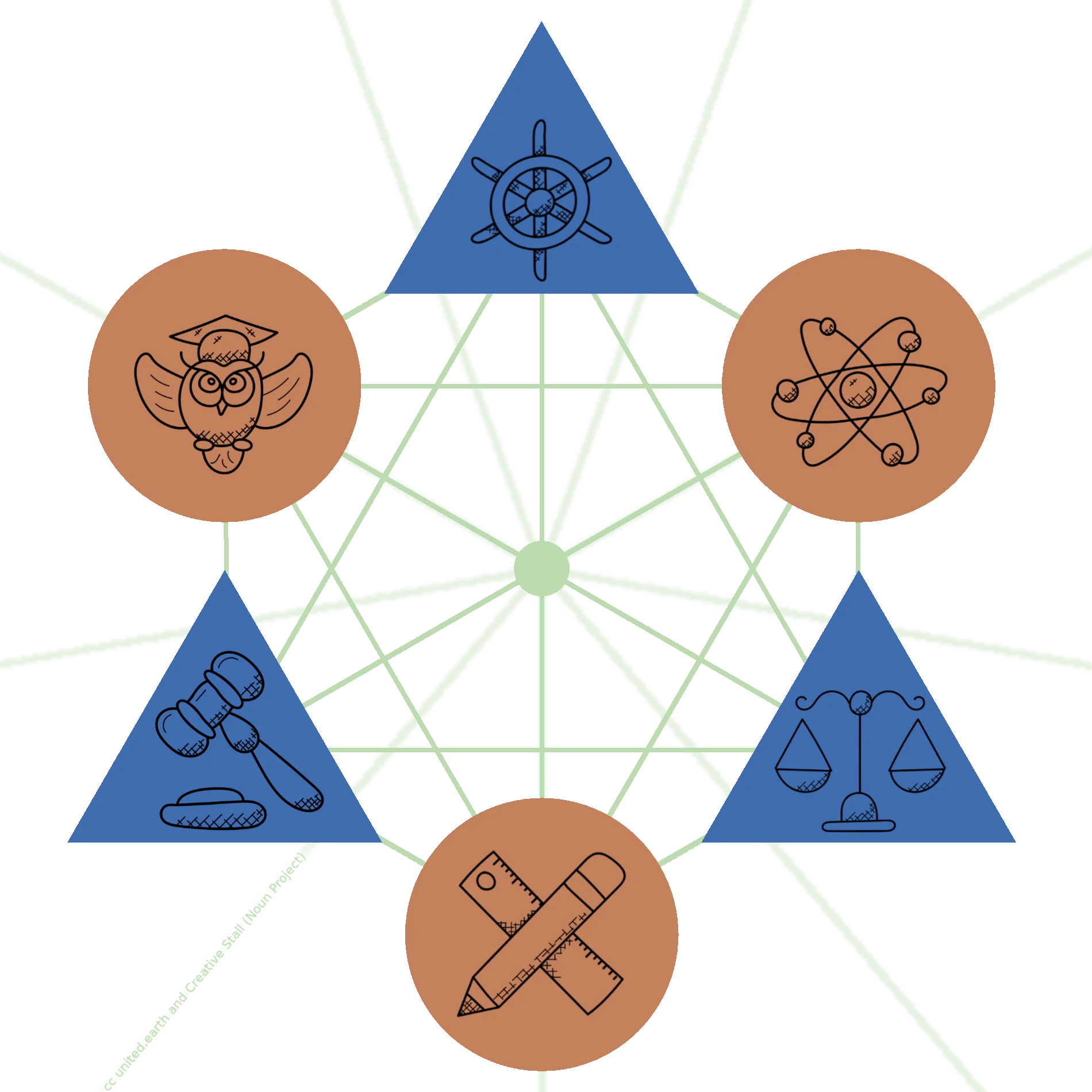
Three layers in every unit
The illustration shows the three governance layers operating together within one governance unit:
I: The three branches of power (blue triangles)
- The legislative (gavel)
- The executive (ship’s helm)
- The judiciary (scales)
II: The three SEC Councils (orange spheres)
- Science Council (atom)
- Ethics Council (wise owl)
- Culture Council (pencil and ruler)
III: The AGORA node and connections (green web)
A governance unit is a territorially defined political unit situated at a particular governance level and assigned constitutionally defined responsibilities.
A locus, region, sub-bloc, bloc, and the globe are therefore different kinds of governance units. Each has a defined field of constitutional competence and the institutions required to exercise it.
For most populated governance units, the three layers follow the ordinary architecture described here. Nature regions remain governance units at the regional level, but use a reduced, specialised version of that architecture. Their core is a dedicated stewardship authority bound to ecological integrity under ecosystem sovereignty. It operates under constitutional oversight by the bloc, or the global level within the global zone, independent review and judicial control; the SEC Councils provide knowledge and assessments rather than political command.
Permanently inhabited nature regions contain loci for their resident communities and a compact regional democratic body for matters within the residents’ legitimate competence and their participation in stewardship. AGORA, Council, and judicial functions can be supplied through shared federated networks.
Neither the regional body nor its resident loci can convert the territory to ordinary settlement, production, or extraction. A sanctuary may support a locus but does not itself constitute public government, and an Indigenous community’s democratic rights do not depend on adopting sanctuary status.
Further constitutional development may consider whether some nature regions can be governed adequately without a separate regional democratic level, provided their ecological stewardship, oversight, and every resident’s complete democratic jurisdictional chain remain protected.
Earth Citizens belong through their primary locus to the sequence of governance units constitutionally applicable to that territory: local, regional, sub-blocal where applicable, blocal where applicable, and global.
Their binding democratic authority applies within those units according to constitutional competence. A question that can be handled adequately within a locus belongs there. A question that requires binding planetary coordination belongs at the global level.
A governance unit is therefore where territory, democratic participation, constitutional competence, knowledge, and institutional capacity become operational together.
14.2 The common internal architecture
The same three-layer logic recurs across populated governance units, although its institutional form changes with scale.
This does not mean that every unit has identical institutions, staffing, administrative capacity, or technical organisation. It means that the fundamental democratic and constitutional relationships remain recognisable throughout the system.
AGORA within the unit
AGORA provides the constitutional public sphere connecting Earth Citizens to democratic processes within their governance unit and to the wider federated system.
Each populated governance unit below the global level has a physical public AGORA node connected to its institutional centre. Where one place serves several governance levels, their node functions can be co-located and integrated. At the global level, physical presence is distributed through two complementary networks: global constitutional precincts beside the principal institutional centres of the blocs, and global-zone hubs within the directly governed global territorial sphere. Both can carry global top-level AGORA functions according to their institutional role.
Citizens should always be able to see which governance unit owns a process, which constitutional competence applies, and how that process relates to other levels.
AGORA is one connected democratic environment rather than a collection of isolated local, regional, blocal, and global platforms.
The Councils within the unit
Each populated governance unit contains the three Council functions of Science, Ethics, and Culture at a scale appropriate to its responsibilities.
A large bloc may require extensive specialised Council institutions. A locus may operate with much smaller bodies while relying on federated access to specialised knowledge and competence elsewhere in the Council network.
The Councils remain connected vertically and horizontally so that knowledge and assessments can move through the system without requiring every governance unit to reproduce the same institutional capacity.
The branches within the unit
Legislative, executive, and judicial functions are likewise present within ordinary populated governance units.
Their organisational form may vary greatly. Small units can use compact institutions or share specialised services where constitutionally appropriate, while larger units require extensive legislative, administrative, and judicial capacity.
The functions themselves remain distinct even where their practical organisation differs.
AGORA supplies democratic authority, the Councils protect the basis for judgement, and the branches provide legal and operational capacity.
A complete governance unit requires all three while preventing any one layer from absorbing the functions of the others.
14.3 The democratic decision cycle
A governance unit is not only a collection of institutions. It is an operating democratic process through which society can recognise conditions, build knowledge, decide, act, observe consequences, and learn.
Political questions can enter this process through citizens, Councils, branches, public institutions, changing conditions, observed consequences, or developments elsewhere in the governance system.
From issue to implementation
A typical process may proceed as follows:
| Step | What | How |
|---|---|---|
| 1 | A condition, need, risk, or opportunity is identified. | It enters AGORA with its source, available documentation, and known institutional context. |
| 2 | The relevant domains and governance competence are established. | PAI identifies the policy areas involved, while the Earth Constitution determines which governance unit has authority under subsidiarity and the constitutional allocation of competence. |
| 3 | The knowledge foundation is developed. | PAI × SEC and the Councils make relevant evidence, uncertainty, disagreement, ethical responsibilities, cultural contexts, existing experience, and expected consequences visible. |
| 4 | Citizens learn, deliberate, and develop alternatives. | Through AGORA they can challenge assumptions, compare proposals, identify consequences, and improve possible solutions. |
| 5 | Proposals pass transparent procedural requirements. | Constitutional admissibility, governance competence, clarity, documentation, relevant interests, and applicable thresholds are verified before a formal decision. |
| 6 | Earth Citizens make the substantive democratic decision. | Voting takes place within the competent governance unit according to the applicable democratic and competence rules. |
| 7 | Parliament develops and formalises the valid result. | It translates the decision into coherent law, budgets, mandates, and institutional arrangements, using legislative judgement without replacing the political substance decided by citizens. |
| 8 | The executive implements the decision. | Public institutions translate law and democratic objectives into practical action within their delegated authority. Courts review legality and constitutional validity where required. |
| 9 | Consequences are observed and evaluated. | Results, new evidence, unintended effects, Council assessments, administrative experience, and judicial findings return to AGORA and the relevant parts of Science, Ethics and Culture. |
| 10 | The decision can be corrected or replaced. | Citizens and institutions can initiate a new process when knowledge, circumstances, consequences, or political judgement change. |
Learning and correction
The cycle is not always linear.
New evidence may send a proposal back to deliberation. A Council warning may require further investigation. Executive analysis may expose practical problems. Judicial review may identify a constitutional defect.
These movements should be visible rather than resolved through concealed institutional negotiation.
Democracy therefore does not end with a vote. It includes the capacity to perceive, learn, deliberate, decide, implement, observe consequences, preserve what has been learned, and correct error.
This is where collective intelligence becomes institutionally concrete.
14.4 Relations between units and levels
No governance unit functions in isolation. Each belongs to the shared constitutional order and relates both vertically to units above and below it and horizontally to other units at the same level.
AGORA and its federated nodes support these relationships, while constitutional competence determines where political authority lies.
Vertical relationships
Vertical relationships follow subsidiarity.
Authority remains at the lowest governance level capable of handling a responsibility adequately. It moves upward only where the scale, external effects, required coordination, or constitutional nature of the problem makes lower-level authority insufficient.
Where higher-level authority is valid, its law prevails within that competence. Lower governance units retain their own constitutional authority outside it.
They also retain the right to challenge whether a higher-level institution has exceeded its competence or violated subsidiarity, necessity, proportionality, protected rights, or other constitutional limits.
Higher-level legislation does not require higher-level administration of every task. Global or blocal law may be implemented through regional and local institutions where this is appropriate.
The source of legal authority and the place of implementation are therefore distinct.
This allows common rules where necessary while preserving distributed executive capacity.
Horizontal relationships
Governance units at the same level should cooperate directly where voluntary coordination is sufficient.
Such cooperation may concern shared infrastructure, ecosystems, transport, health services, emergency preparedness, knowledge, economic activity, or other cross-border matters.
Horizontal cooperation does not create a new governance level merely because several units work together.
Where voluntary cooperation repeatedly proves insufficient for a problem requiring binding coordination, responsibility may need to move to the appropriate higher level according to the Constitution.
Subsidiarity therefore operates in both directions: it protects lower-level autonomy against unnecessary centralisation while preventing lower-level fragmentation from blocking solutions to problems they cannot solve independently.
The purpose is neither centralisation nor fragmentation. It is to place each responsibility where it can be exercised effectively, democratically, and accountably.
14.5 The governance-unit headquarters and AGORA node
Every governance unit below the global level has a principal institutional centre connecting its democratic, Council, legislative, executive, judicial, and administrative functions.
The institutional centre
The governance-unit headquarters does not have to be one building or enclosed complex.
It may consist of several connected institutions, facilities, public spaces, and technical installations. What defines it is its role as the principal physical and institutional centre of the governance unit.
Its architecture should reflect the same constitutional principle as the political system itself: public institutions should be accessible, connected, transparent, and capable of continuing their essential functions during disruption.
The constitutional AGORA node
Each headquarters contains or is directly integrated with the unit’s constitutional AGORA node.
An AGORA node is the physical, digital, and constitutional interface through which a governance unit connects its citizens, institutions, knowledge infrastructure, democratic processes, and public records to the wider AGORA network.
A node is therefore more than a data centre.
It may combine secure civic identity and voting infrastructure, knowledge and public AI systems, institutional records and communications, public participation facilities, and redundant systems for continuity and recovery.
The form and capacity vary with scale. A locus may need modest technical and public facilities. Regional, sub-blocal, and blocal nodes require progressively greater institutional, communication, and continuity capacity.
The constitutional relationship remains the same.
Access, federation, and continuity
Earth Citizens can connect through personal devices or public access points associated with their governance-unit infrastructure.
Political participation cannot depend on owning suitable private technology, subscribing to a commercial platform, or having reliable personal connectivity. Governance units must provide practical means through which citizens can exercise their democratic rights.
Nodes connect horizontally and vertically through the federated AGORA network. No unit should depend on one superior node or one exclusive communication route to remain part of the constitutional system.
Each node must retain enough local capacity to preserve essential civic identity, democratic procedures, institutional records, and continuity if parts of the wider network become unavailable.
As a general rule, higher governance levels connect through the network rather than being physically embedded inside every lower-level headquarters.
The global-blocal relationship is the major exception.
14.6 The global-blocal node interface
The relationship between the global and blocal levels is structurally different from the relationships below them.
A distributed global presence
The global governance unit and the blocs form the two higher territorial components of the operational federation.
The global level provides the shared constitutional and legal order, Earth Parliament, the global judiciary, and direct executive authority within constitutionally defined global domains. Within the global zone, it also holds the higher territorial executive, security, and enforcement responsibilities that blocs perform within the blocal zone.
The blocs retain constitutionally protected territorial executive sovereignty and capacity within the blocal zone. They also provide the principal distributed land-based military capacity of the federation.
This division between direct global territorial authority and semi-sovereign blocal authority is a permanent anti-tyranny structure, not an incomplete stage awaiting later global centralisation.
The global level also develops a distributed physical presence within its own territorial sphere through global-zone hubs. The present section focuses on the complementary interface required where global and blocal authority meet.
Because global law and institutions must operate continuously in relation to semi-sovereign territorial blocs, the interface between these two levels requires a closer physical and institutional connection than exists between lower levels.
Global constitutional precincts
Each bloc headquarters is therefore paired with a second, constitutionally separate structure: a global constitutional precinct containing one of AGORA’s global top-level nodes.
The precinct is located directly beside and functionally connected with the bloc’s principal institutional centre.
The global and blocal nodes remain constitutionally distinct. Their proximity allows continuous cooperation between global institutions and the institutions responsible for territorial execution within the bloc.
The precinct is not simply a facility supplied or leased by the surrounding bloc. It is a clearly delimited area held under the limited sovereignty and jurisdiction of the global governance unit through the Earth Constitution.
That global jurisdiction applies only to the precinct and its defined institutional functions.
It does not give Earth Government general territorial authority over the surrounding bloc or over its land territory.
Each precinct contains a global top-level AGORA node and can provide facilities for Earth Parliament and its committees, global Council and judicial functions, Earth Government, peacekeeping coordination, public participation, archives, secure communication, and constitutional continuity.
The global and blocal nodes form a closely connected pair.
The blocal node serves the bloc’s own citizens, institutions, democratic processes, knowledge systems, and territorial responsibilities.
The global node connects the bloc directly to Earth Parliament, the global Councils, the global judiciary, Earth Government, and the corresponding global nodes in every other bloc.
Neither node is technically subordinate to the other. Their constitutional functions differ, and both must remain capable of independent operation where necessary.
Their connection represents interdependence without institutional merger.
One federation without one capital
The network of global constitutional precincts forms one part of a wider distributed global capital geography.
A second network of global-zone hubs provides institutional and operational locations within the directly global territorial sphere. Together, the two networks allow the global governance unit to exist as a physically distributed constitutional system rather than being concentrated in one capital.
Earth Parliament, the global Councils, the global judiciary, Earth Government, AGORA, scientific institutions, archives, communications, stewardship, emergency systems, security functions, and other specialised global institutions can distribute their physical activities between these locations according to function.
Earth Parliament can hold plenary sessions in different precincts or other suitable global institutional locations. Committees, Council bodies, judicial proceedings, executive meetings, public hearings, research, monitoring, and operational functions can likewise be distributed.
This prevents one city, territory, bloc, island, or region from becoming the permanent geographical owner of global political life.
No bloc gains privileged access to global institutions merely because some of those institutions operate within or beside its territory.
The global level is physically present within every bloc, while remaining territorially dominant in none of them.
Within the global zone, by contrast, the global level also possesses its own distributed territorial and operational geography.
Protection and constitutional neutrality
Global precincts require constitutional protection against unilateral control by the surrounding bloc.
Their institutional access, communications, records, systems, and constitutional status cannot be lawfully seized, closed, obstructed, or altered by blocal authorities.
A serious attempt to take control of a precinct would constitute a breach of the shared constitutional order.
All blocs must contain constitutionally equivalent precincts. Physical scale and design may vary according to local conditions, but their legal status, institutional role, protection, and network access must remain equal.
No individual precinct becomes the global capital or headquarters.
This symmetry creates global neutrality through equivalent presence within every bloc rather than by concentrating the system in one supposedly neutral governing city.
The precinct architecture therefore connects global constitutional unity with permanent territorial distribution of executive power.
It creates global presence without global territorial absorption.
The global and blocal nodes form the constitutional and operational interface through which the two higher territorial structures of one federation remain continuously connected.
14.7 The civilisational scale
The preceding sections have described the architecture of individual governance units and the relationships between them. Seen as a whole, the same constitutional structure extends across the inhabited world, from local communities to the global level.
This makes scale an intrinsic part of the proposal. A system designed for one governance unit has very different implications when its basic architecture recurs across millions of units and connects billions of people.
The figures below are therefore intended as order-of-magnitude estimates. They are not predictions, fixed requirements, or a proposed final territorial map.
Their purpose is to make the structural scale of the system visible and to test whether the approximate numbers developed under The levels of governance produce a plausible civilisational architecture when combined.
For this overview, the mature four-level structure — global, blocal, regional, and local — provides the clearest basis. The transitional sub-blocal level is omitted from the totals. As its functions are redistributed under subsidiarity, primarily downward to regions and partly upward to blocs, its relatively small number of units does not materially affect the overall order of magnitude.
This proposal is not merely civilisational in scale. It concerns the democratic governance structure of global civilisation itself.
Approximate territorial scale
The resulting structure is overwhelmingly local.
With approximately two million loci and a reference population of eight billion, the mathematical average becomes approximately 4,000 people per locus. This is not a target population for local communities. Actual loci could range from urban districts within large cities to towns, villages, rural communities, island communities and sparsely populated territories, and their populations and territorial extent could differ greatly.
The average is nevertheless a useful scale check. It suggests that the estimate of roughly two million local governance units produces a recognisable local scale rather than an obviously implausible abstraction.
The higher levels then organise progressively larger shared systems above this local foundation: tens of thousands of regions, a few dozen blocs, and one global governance unit.
| Level | Approximate number of governance units | Approximate relationship | Indicative human scale |
|---|---|---|---|
| Global | 1 | One global constitutional jurisdiction | Humanity as a whole |
| Blocal | ~20–40 blocs | A few dozen major territorial units | Hundreds of millions, with wide variation |
| Regional | up to ~40,000 regions | Roughly 1,000–2,000 per bloc at this overall scale | Highly variable |
| Local | up to ~2,000,000 loci | Roughly 50 per region | ~4,000 people on mathematical average |
| Total | ~2.04 million governance units | Overwhelmingly local | ~8 billion people in the present reference calculation |
The constitutional architecture at scale
The territorial numbers show only one dimension of the system. Each ordinary populated governance unit also contains the recurring constitutional architecture described in this chapter: democratic participation through AGORA, the three SEC Council functions, and legislative, executive, and judicial capacity.
Applying that architecture across the territorial structure reveals a second kind of scale.
| Recurring constitutional capacity | Basic relationship within a populated governance unit | Approximate civilisational scale |
|---|---|---|
| Governance units | One territorial democratic unit | ~2.04 million |
| Science Councils | One Council function per unit | ~2 million |
| Ethics Councils | One Council function per unit | ~2 million |
| Culture Councils | One Council function per unit | ~2 million |
| SEC Councils combined | Three Council functions per unit | ~6 million |
| Legislative function | Present within each ordinary populated unit | ~2 million unit-level functions |
| Executive function | Present within each ordinary populated unit | ~2 million unit-level functions |
| Judicial function | Present within each ordinary populated unit | ~2 million unit-level functions |
| Constitutional AGORA infrastructure | A node relationship connects each unit to the federated system | ~2 million local nodes, plus higher-level node functions |
These figures describe constitutional functions at scale, not a count of separate buildings, organisations, full-time jobs, or bureaucracies.
Institutional form varies greatly between levels. Small governance units can use compact institutions and share specialised services. Council bodies can draw on knowledge and competence elsewhere in their federated networks rather than reproducing every specialism locally. Higher-level AGORA functions can be co-located with lower-level infrastructure where appropriate. Nature regions also have a specialised institutional architecture rather than the ordinary resident-based form.
The numbers therefore indicate the footprint of the constitutional structure rather than prescribing how every function must be physically or administratively organised.
They nevertheless reveal an important property of the proposal. Planetary governance does not primarily mean constructing one enormous global bureaucracy. Most governance units, institutions, nodes and democratic relationships remain distributed close to where people live.
The human scale of the Council layer
The Council layer provides a particularly useful illustration because it represents a constitutional capacity that does not presently exist in this distributed and systematic form.
The proposal does not specify a fixed number of Council members at each level.
Local Councils in particular could remain small while drawing on the much larger federated Science, Ethics and Culture networks.
Even very small local bodies, however, become substantial when repeated across approximately two million loci.
| Illustrative members per local Council | Council mandates per locus | Across ~2 million loci | Approximate share of 8 billion people |
|---|---|---|---|
| 3 | 9 | ~18 million mandates | ~0.23% |
| 5 | 15 | ~30 million mandates | ~0.38% |
| 7 | 21 | ~42 million mandates | ~0.53% |
These examples are illustrations, not proposed Council sizes. Mandates are also not equivalent to unique people, full-time positions, or permanent jobs. Terms of office, part-time participation, staffing, candidate pools, shared administrative support and institutional organisation would all affect the number of people involved.
The calculation nevertheless shows the scale of direct institutional participation implied by the architecture. Even a very small Council structure at the local level alone could create tens of millions of Council mandates across the world.
The higher-level Councils would add comparatively little to that numerical total. Their significance would instead lie in their larger areas of responsibility, greater specialisation, and role within the federated Council network.
The same distinction applies more broadly. A civilisational system can be institutionally enormous without being institutionally centralised.
Completing and reorganising existing public structure
These numbers should not be read as the amount of governance infrastructure that would have to be created from nothing.
Much of the legislative, executive, judicial, administrative and physical capacity required by the proposed system already exists in some form. Municipalities, cities, regional authorities, states, courts, parliaments, public administrations, civic buildings, communications infrastructure, registries and many other existing institutions can provide foundations for the future structure.
The transition would therefore involve a combination of continuity, reorganisation, integration, adaptation and new construction.
Some governance units could develop directly from existing institutions. Others would require changed boundaries, combinations, subdivisions or new constitutional relationships. Existing public infrastructure could often be reused while its functions and connections change.
Other capacities are much less developed or structurally absent. A democratic global constitutional level must be established. AGORA requires a common federated democratic infrastructure connecting governance units and citizens across the entire system. The SEC Councils require a new constitutional layer, even though much of the scientific, ethical and cultural knowledge and institutional capacity they would connect already exists throughout society.
The total institutional footprint of the mature system is therefore not the same as the additional cost of building it. Determining transition costs would require distinguishing what already exists, what can be reused, what must be integrated or transformed, and what must be built as genuinely new capacity.
What the present estimates establish is the scale of the structure itself.
The proposal operates at civilisational scale in a precise sense: it concerns the shared democratic governance infrastructure within global civilisation, extending from the communities where people live to humanity as a whole. Its task is not to create civilisation, but to complete, connect and reorganise the public structure through which a global civilisation can govern itself.
This integrated description of governance units and their civilisational scale provides the institutional foundation for the functional governance geography developed in the next chapter.