United Earth initiative
Earth democracy
Why it is needed, what it is, and how we build it
This document contains the theoretical foundation of the UE initiative.
We invite everyone to an open discussion on how governance structures can evolve to address global challenges while safeguarding cultural identities within a shared democratic framework.
Claim your Earth Citizenship (EC) and influence at agora.united.earth
PLEASE MAKE SURE YOU HAVE THE LATEST VERSION OF ANY DOWNLOADED DOCUMENTS!
After major upgrades, the web version is compiled into downloadable documents (DOCX/ODT/PDF/MD) available at united.earth/en/documents
This is done for transparency and to preserve a record of its development.
Preface
The first versions of this material were drafted by a small group of engaged individuals calling themselves Worried Earthlings (WE). They have chosen to remain anonymous, partly due to security concerns because of the controversial character of their ideas, but mostly to foster a culture focused on our shared planet and the global society, rather than on individuals.
The name Worried Earthlings — WE — reflects the perspective from which the initiative emerged. Its participants share a strongly developed global awareness and sense of identity as Earthlings. Earth and humanity became the primary political frame through which they approached the problems addressed here, without requiring the abandonment of other personal identities.
WE do not assume that others will share this global identity with the same intensity. Their proposal instead asks whether enough people can develop a global perspective strong enough to recognise humanity as a political community where genuinely global problems require shared democratic action.
WE are convinced that dominant individualism, together with obsolete forms of tribalism, obscures the fact that many of the forces shaping individual and local life now operate globally without democratic control.
Global democratic governance is necessary precisely to protect individual freedom, diverse identities and local societies against these forces.
A fundamental hypothesis coming out of their ideas is that the principle of the sovereign nation-state, or more precisely the connection between cultural identity and governance, is the major obstacle to solving global existential threats.
WE and the United Earth initiative understand how sensitive this issue is, and urge all fellow Earth citizens to join this critical and challenging discussion with mutual respect and solidarity.
The proposal is no threat to cultural identity, like ethnicity, nation, religion, and ideology. It is, though, a rejection of the idea of using identity to exclude others by dominating governance.
The inclusive nature of this project seeks only to promote cooperation and bold thinking in the face of shared global problems threatening us all.
A geopolitical visualisation tool
The earthwheel is both a symbol and an analytical tool. It is designed to make visible a structural feature of today’s geopolitical condition that is difficult to see in conventional hierarchical diagrams: that the hierarchy of governance is incomplete as a whole, and that this incompleteness appears most clearly as a missing global centre.
The combined illustration below brings together three views of the same problem: the populated earthwheel, the empty five-level schema, and the linearised hierarchy. Read together, they show both why the conventional linear form remains useful and why the earthwheel was needed as a complementary model.
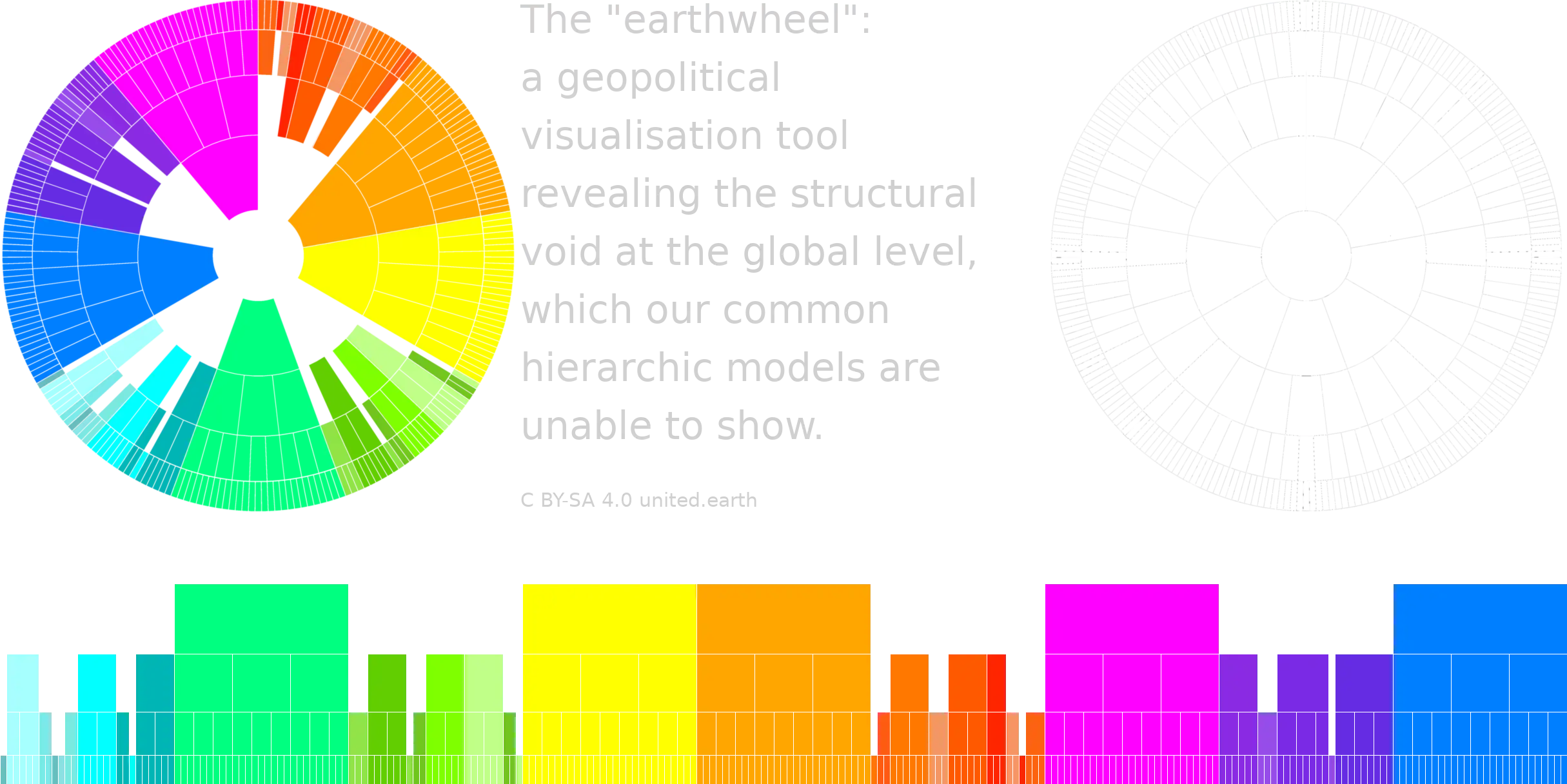
The linear hierarchy is the familiar way of representing nested political levels. It has real strengths. It is immediately legible, it can be extended horizontally with little loss of readability, and it can in principle scale toward a far more empirically complete representation of the world’s nearly 200 sovereign states. In that sense, it is well suited for enumeration and for showing large numbers of distinct units within a vertical hierarchy.
Its weakness is more structural. Once the same geopolitical condition is unfolded into a linear arrangement, what is missing no longer appears as a single absence. The gaps are dispersed between columns, and attention is drawn mainly toward the individual units and their separate heights. This makes the form analytically weaker at revealing a central fact of the present world order: that the global level is absent as such, and that the broader hierarchy therefore remains incomplete.
The empty five-level schema shows the same model in its most reduced form: global, bloc, sub-bloc, regional, and local. It presents the intended geometry of a complete hierarchy before empirical irregularities are introduced. Read alongside the populated earthwheel, it clarifies that the present geopolitical condition is defined not only by the entities that exist, but also by the levels that are absent, fragmented, or unevenly developed.
The earthwheel can be used to analyse geopolitical systems across several dimensions, including:
- Completeness – the degree of organisational development at each level, including whether hierarchical relations exist or are absent
- Balance – proportionality in geographic size, population, military power, economic strength, or other relevant variables
- Sovereignty vs. subsidiarity – how authority and responsibility are distributed between levels
- Identity and legitimacy – how cultural identity relates to political legitimacy, function and democratic authority within each governance entity
The model is deliberately highly abstract. To make the structural point visible, the number of units shown at each level is sharply reduced. The earthwheel is therefore not a literal cartographic rendering of the world’s sovereign states, but a conceptual compression. Its purpose is not to enumerate everything, but to show something that enumeration tends to obscure: where the hierarchy is complete, where it is incomplete, and how that incompleteness defines the geopolitical system as a whole.
15. A functional governance geography
A global democratic constitutional order requires a territorial geography matched to the scale and function of governance.
The proposal therefore organises Earth’s surface through two connected territorial zones. The global zone is under direct global jurisdiction. The blocal zone is organised through semi-sovereign blocs within the same constitutional order. Regional and local self-government operates throughout both zones according to the principle of subsidiarity.
The present political map is the accumulated result of history. Borders and political units reflect wars, empires, colonisation, dynastic arrangements, secession, political compromise, geography, and countless other processes. A functional global system creates the possibility of asking a different question: how should territorial governance be organised when the whole planet belongs to one constitutional order?
Towards a new geopolitical map
The map on this globe illustrates an early concept for a geopolitical structure of more equally sized blocs: a precondition for a peaceful, sustainable, and economically just Earth civilisation. THE BORDERS ARE ONLY MEANT TO ILLUSTRATE THE PRINCIPLE AND MUST NOT BE SEEN AS ACTUAL PROPOSALS. A territorial order like this can arise only through voluntary democratic and constitutional accession. See A federation that grows over time and Establishing Earth Parliament by 2035.
Blocal zone: Macro-territorial governance through 20–40 federated semi-sovereign blocs within the same global constitutional order. The white dashed lines mark functional boundaries between the blocs in accordance with the GOV//ID principle and the bloc-based peacekeeping structure; they are not sovereign borders between separate states.
Global zone: Direct global jurisdiction over the oceans and, by default, islands and archipelagos, as well as polar areas, maritime routes and chokepoints, and tropical rainforest territories of planetary significance.
Both zones: Regional and local self-government within populated societal regions is secured by the subsidiarity principle.
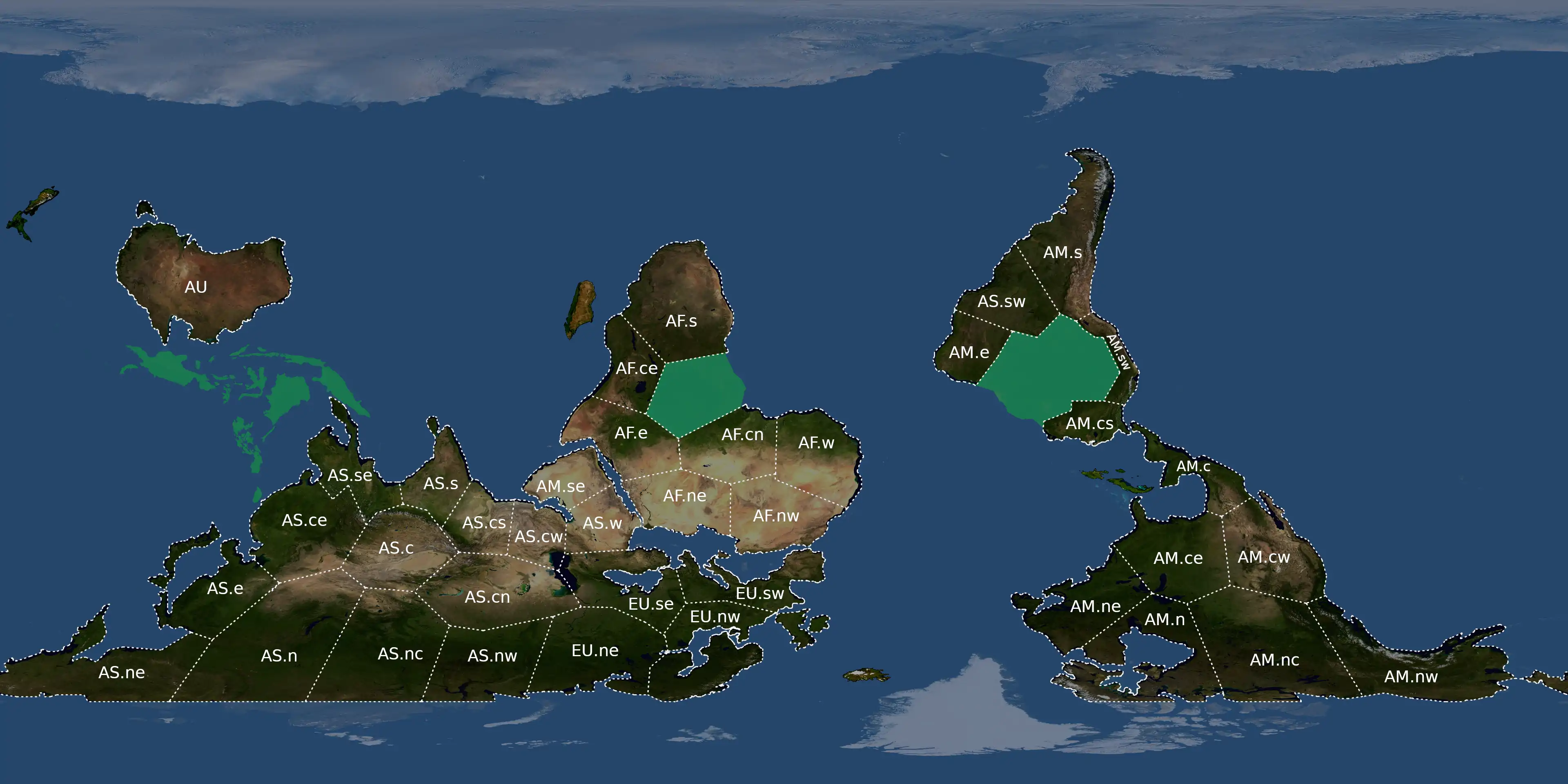
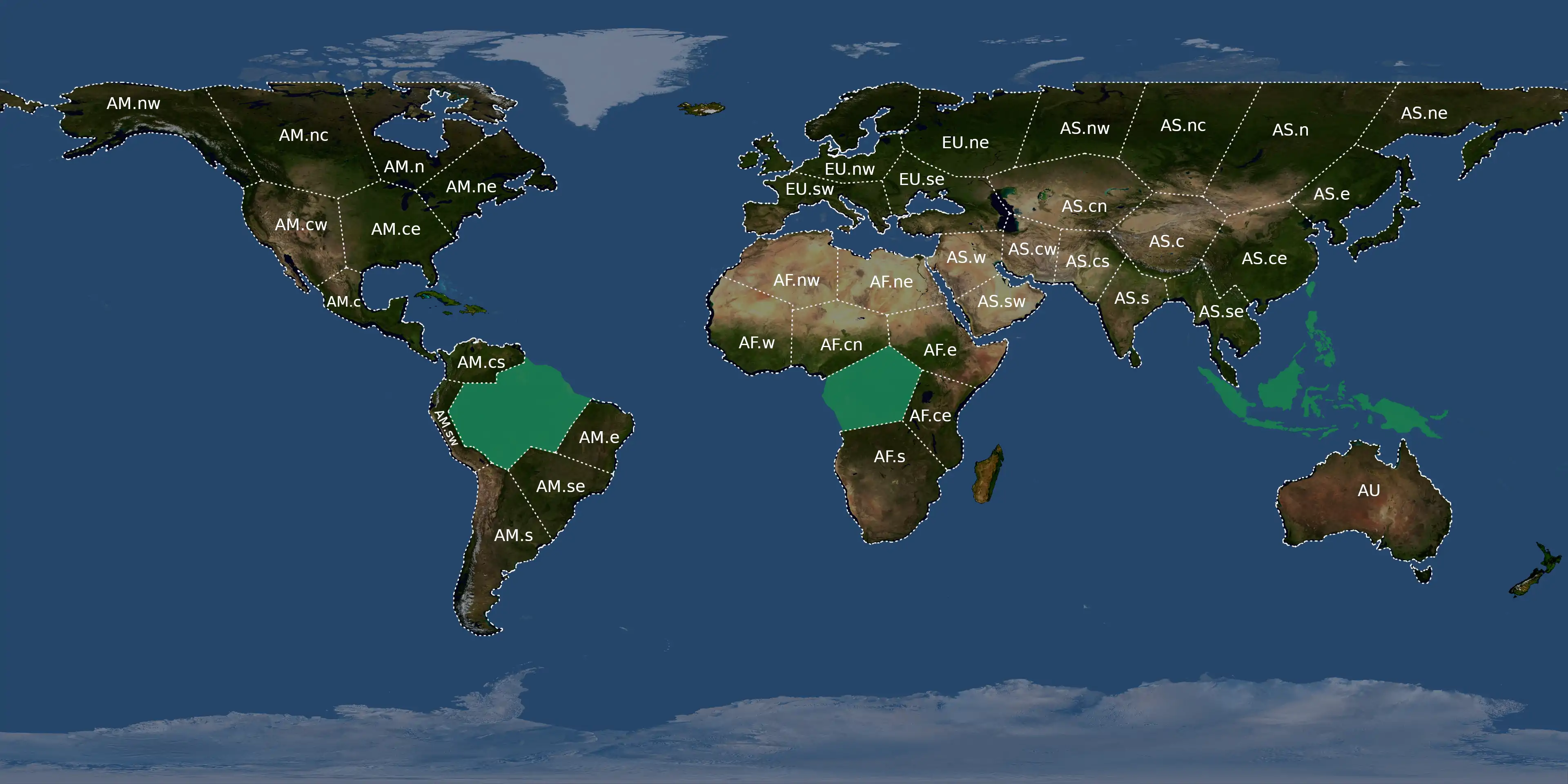
Illustration: The blocal zone with 38 blocs. The global zone includes the rainforests, the oceans, the polar areas including Greenland, all other islands and archipelagos, except a few large ones, which are included within nearby blocs under the island exception described below. Plate Carrée (equirectangular) projection. [Wikipedia]
| AS.s | ASIA.south |
| AS.se | ASIA.south-east |
| AS.sw | ASIA.south-west |
| AS.cs | ASIA.central-south |
| AS.c | ASIA.central |
| AS.ce | ASIA.central-east |
| AS.cw | ASIA.central-west |
| AS.cn | ASIA.central-north |
| AS.e | ASIA.east |
| AS.w | ASIA.west |
| AS.ne | ASIA.north-east |
| AS.n | ASIA.north |
| AS.nc | ASIA.north-central |
| AS.nw | ASIA.north-west |
| AU | AUSTRALIA |
| AF.s | AFRICA.south |
| AF.ce | AFRICA.central-east |
| AF.cn | AFRICA.central-north |
| AF.e | AFRICA.east |
| AF.w | AFRICA.west |
| AF.ne | AFRICA.north-east |
| AF.nw | AFRICA.north-west |
| EU.se | EUROPE.south-east |
| EU.sw | EUROPE.south-west |
| EU.ne | EUROPE.north-east |
| EU.nw | EUROPE.north-west |
| AM.s | AMERICA.south |
| AM.se | AMERICA.south-east |
| AM.e | AMERICA.east |
| AM.sw | AMERICA.south-west |
| AM.cs | AMERICA.central-south |
| AM.c | AMERICA.central |
| AM.ce | AMERICA.central-east |
| AM.cw | AMERICA.central-west |
| AM.ne | AMERICA.north-east |
| AM.nc | AMERICA.north-central |
| AM.nw | AMERICA.north-west |
| AM.n | AMERICA.north |
| AM.n | AMERICA.north |
| AM.nw | AMERICA.north-west |
| AM.nc | AMERICA.north-central |
| AM.ne | AMERICA.north-east |
| AM.cw | AMERICA.central-west |
| AM.ce | AMERICA.central-east |
| AM.c | AMERICA.central |
| AM.cs | AMERICA.central-south |
| AM.sw | AMERICA.south-west |
| AM.e | AMERICA.east |
| AM.se | AMERICA.south-east |
| AM.s | AMERICA.south |
| EU.nw | EUROPE.north-west |
| EU.ne | EUROPE.north-east |
| EU.sw | EUROPE.south-west |
| EU.se | EUROPE.south-east |
| AF.nw | AFRICA.north-west |
| AF.ne | AFRICA.north-east |
| AF.w | AFRICA.west |
| AF.e | AFRICA.east |
| AF.cn | AFRICA.central-north |
| AF.ce | AFRICA.central-east |
| AF.s | AFRICA.south |
| AU | AUSTRALIA |
| AS.nw | ASIA.north-west |
| AS.nc | ASIA.north-central |
| AS.n | ASIA.north |
| AS.ne | ASIA.north-east |
| AS.w | ASIA.west |
| AS.e | ASIA.east |
| AS.cn | ASIA.central-north |
| AS.cw | ASIA.central-west |
| AS.ce | ASIA.central-east |
| AS.c | ASIA.central |
| AS.cs | ASIA.central-south |
| AS.sw | ASIA.south-west |
| AS.se | ASIA.south-east |
| AS.s | ASIA.south |
Go to the operational website of AGORA (proto version)
You are now in the theoretical basis of the United Earth project (Why – What – How). To participate in our early-phase proto version of AGORA, claim your Earth Citizenship (EC) and go to its operational website, where we discuss and develop all aspects of the United Earth proposal.
15.1 One global and blocal territorial system
The two zones form alternative territorial structures within the same global constitutional order. The difference is whether regional and local governance connects upward through a semi-sovereign bloc or directly to the global level.
In the global zone, the mature territorial chain is:
locus → region → global
In the blocal zone, it is:
locus → region → bloc → global
A transitional sub-blocal level can remain between regions and blocs where institutional continuity requires it.
The distinction concerns the allocation of territorial executive authority, not citizenship or democratic status. Earth Citizenship, constitutional rights, participation through AGORA, and global democratic representation are the same throughout the system.
People living in the global zone participate at the global, regional, and local levels; they simply have no blocal parliament or government above them because no bloc exists there.
In the blocal zone, blocs exercise constitutionally protected territorial executive authority. In the global zone, the corresponding higher territorial executive, security, and enforcement functions belong directly to the global level. Regional and local governance retains its own subsidiary responsibilities in both zones.
The term global zone refers specifically to this directly governed territorial geography on and around Earth’s surface. It does not replace the broader concept of the global commons, which also includes planetary systems and domains such as the atmosphere and near-Earth space that cannot be represented simply as surface territory.
From territorial ownership to functional jurisdiction
The present political map carries far more than administrative meaning. Its divisions are tied to sovereignty, historical claims, national and cultural identities, and ideas of territorial ownership. Moving a line can therefore immediately become a question of who gains, who loses, and which collective is understood to own the territory.
The GOV//ID principle changes the constitutional meaning of these boundaries. Cultural identities remain free to continue, overlap, organise, and cross governance boundaries, while territorial governance is organised according to democratic and functional requirements.
A functional global order can therefore treat territorial organisation as a question of governance rather than collective dispossession. Cultural continuity, history, belonging, and equal civic protection remain secure even where political responsibilities or boundaries change.
Boundaries can then be discussed openly, adjusted through democratic procedure, and evaluated by whether they produce workable governance, without anyone being asked to surrender a homeland, a history, or a cultural identity.
The question can therefore be reformulated:
Which governance structure within one global federal democratic state is most appropriate for this territory and the functions that must be performed there?
The answer can be a region connected directly to the global level, a region within a semi-sovereign bloc, or a territorially defined commons whose planetary function requires direct global jurisdiction.
The map itself assigns no present state or territory to Earth Federation. Territorial reorganisation becomes public authority only through democratic and constitutional accession and implementation.
Two forms of higher territorial executive authority
Blocs are semi-sovereign constituent units of the global state. Their territorial executive authority is constitutionally protected rather than merely delegated by Earth Government.
They are not separate sovereign states, alliances, or successors to present empires. Their semi-sovereignty is limited by membership in the global constitutional order. They have no independent external sovereignty, cannot unilaterally nullify valid global law, and cannot place themselves outside the constitutional and collective security system.
Bloc semi-sovereignty is a permanent constitutional safeguard against global tyranny.
The global zone creates the complementary territorial arrangement. Where no bloc exists, Earth Government exercises the higher territorial executive and security functions that a bloc would otherwise perform, within constitutionally defined global competence and under the same constraints of subsidiarity, necessity, proportionality, democratic control, and judicial review.
This creates one state with two territorial paths to the global level rather than two kinds of political membership.
15.2 The global zone
The constitutional basis for the global commons is developed under The commons principle, Governing the planetary commons, and in HOW under Direct and distributed global stewardship.
This chapter focuses on their territorial geography.
The global zone connects the oceans, islands and archipelagos that remain directly global, polar domains, critical maritime routes and passages, and selected land ecosystems whose planetary significance warrants coherent direct global jurisdiction.
Islands within the global maritime system
The oceans form the largest continuous part of the global zone. Islands and archipelagos belong to this directly global maritime geography by default rather than inheriting higher territorial affiliation from present states, former colonial powers, strategic possession, or historical metropolitan relationships.
This default is particularly important for islands and island groups that are geographically distant from continental landmasses. Islands have repeatedly functioned as strategic possessions, military footholds, colonial remnants, and pieces in wider geopolitical competition. The proposed system removes that inherited logic: historical sovereignty or possession creates no presumption that an island geographically distant from continental land should follow a present metropolitan territory into a future bloc.
Large inhabited islands or island groups can nevertheless form part of a nearby continental bloc where close geographic proximity, functional integration, and governance scale make the bloc level clearly appropriate. A narrow maritime separation need not create a different higher territorial structure merely because water lies between the island and the continental part of the bloc.
The current map therefore treats Britain and Ireland as part of a nearby European bloc and Japan as part of a nearby East Asian bloc. Comparable cases should be assessed individually. Large islands and island groups that are geographically distant from the nearest continental landmass, including cases such as New Zealand and Madagascar, require specific evaluation rather than an automatic rule.
The intervening sea remains within the global zone. A bloc can therefore include island territory without acquiring higher territorial jurisdiction over the maritime space between that island and the bloc’s continental territory.
This exception does not create a general category of island mini-blocs. A bloc must still meet the scale, capacity, and balance requirements of the blocal system. Where an island society does not form part of an appropriate nearby bloc, its regions and loci connect directly to the global level.
Where islands remain within the global zone, their populations do not sit outside the federal structure because they lack a bloc. They connect directly to the global level itself.
They retain the same Earth Citizenship, constitutional rights, democratic participation, cultural self-determination, and regional and local self-government as populations in the blocal zone. What differs is the higher territorial authority above them.
Their security and the territorial executive and coercive functions that would otherwise belong to a bloc are correspondingly exercised through the global constitutional system.
Polar domains
Antarctica belongs directly to the global zone.
The Arctic is treated as a connected circumpolar commons rather than as the northern extension of several separate higher territorial systems. Its final boundaries should follow the ecological, climatic, geographic, scientific, navigational, and security functions that require coherent global stewardship.
The resulting Arctic Commons can include Greenland, Svalbard, Novaya Zemlya, the Arctic Ocean and sea ice, and appropriate northern coastal belts in North America and Eurasia.
Regional and local self-government continues wherever people live. Global jurisdiction concerns the higher territorial functions that make the Arctic one connected planetary system.
Maritime routes and chokepoints
A global maritime system also requires critical routes and passages to remain continuously available under common rules.
Where an interoceanic or inter-bloc chokepoint would otherwise make a genuinely global function dependent on the exclusive territorial authority of one bloc, the passage and the land area required for its neutral, safe, and effective operation can form part of the global zone.
The precise territorial footprint must remain limited by function and necessity. The purpose is to secure globally indispensable movement and infrastructure, not to create a general route for Earth Government to extend direct jurisdiction into bloc territory.
Regional and local self-government continues wherever populated societal regions fall within such areas.
A global tropical rainforest belt
The great tropical rainforest systems perform ecological, climatic, hydrological, and biodiversity functions whose consequences extend far beyond the territories in which they are located.
The proposal therefore places tropical rainforest territories of planetary significance directly within the global zone. The initial geography includes the great rainforest systems of the Amazon basin, the Congo basin, and tropical South and Southeast Asia, while exact boundaries require scientific mapping, democratic deliberation, and constitutional determination.
These territories receive two independent forms of constitutional protection.
First, under Nature/humanity: 50/50, rainforest nature regions operate under ecosystem sovereignty. Their primary purpose is the continuity, restoration, and protection of ecological systems.
Second, their position within the global zone removes their higher territorial jurisdiction from individual blocs. The planetary rainforest system is therefore not fragmented into separate bloc-controlled ecological assets whose protection can be subordinated to competing territorial interests.
On islands that remain within the global zone, societal regions and nature regions remain distinct at the regional level while sharing the same direct relationship to the global level.
Where a large island or archipelago forms part of a bloc, tropical rainforest territories of planetary significance can still lie directly within the global zone inside that otherwise blocal geography, just as they can on continents. Their boundaries should follow ecological function rather than inherited political borders.
Together, these two protections create a globally governed tropical ecological belt while preserving regional and local democratic life in inhabited areas.
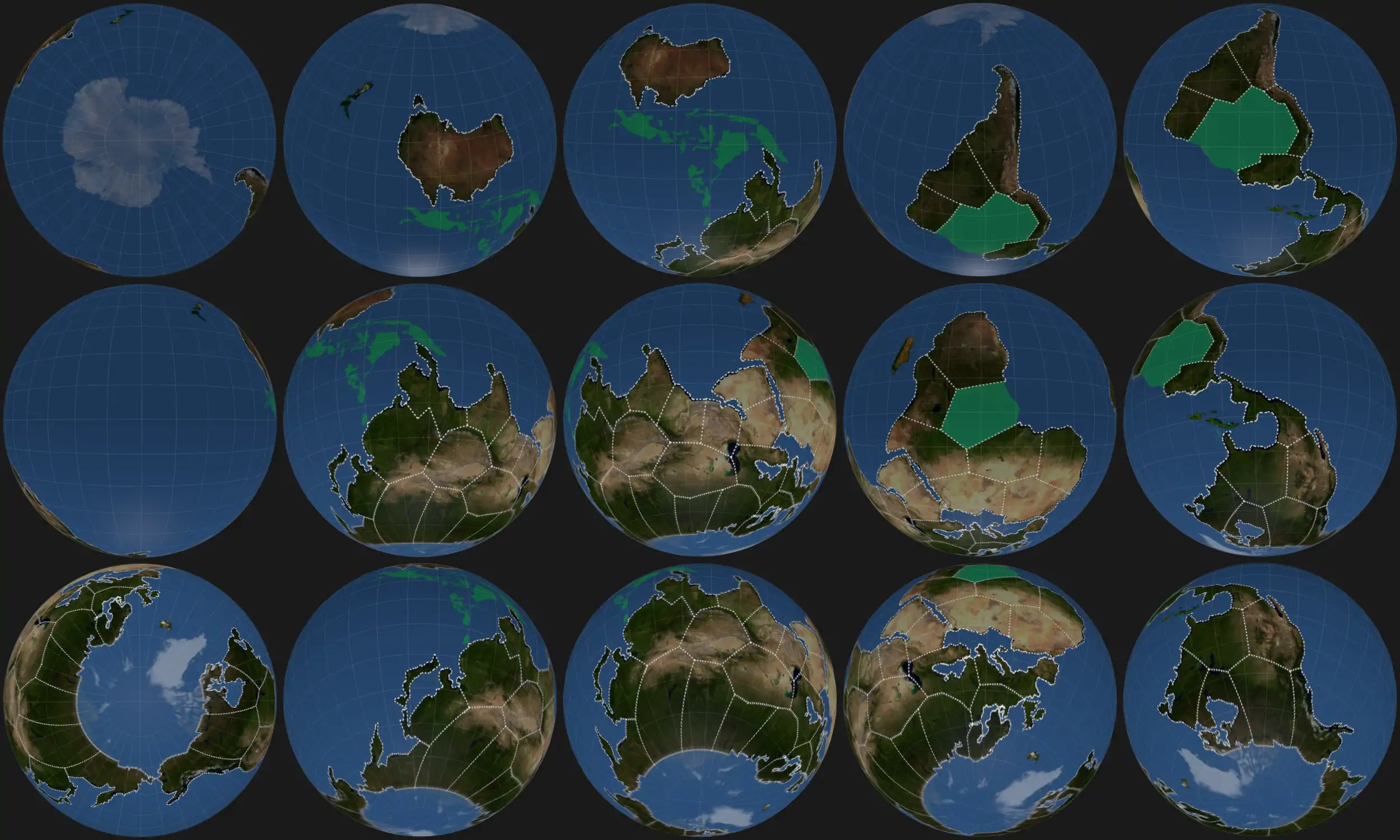
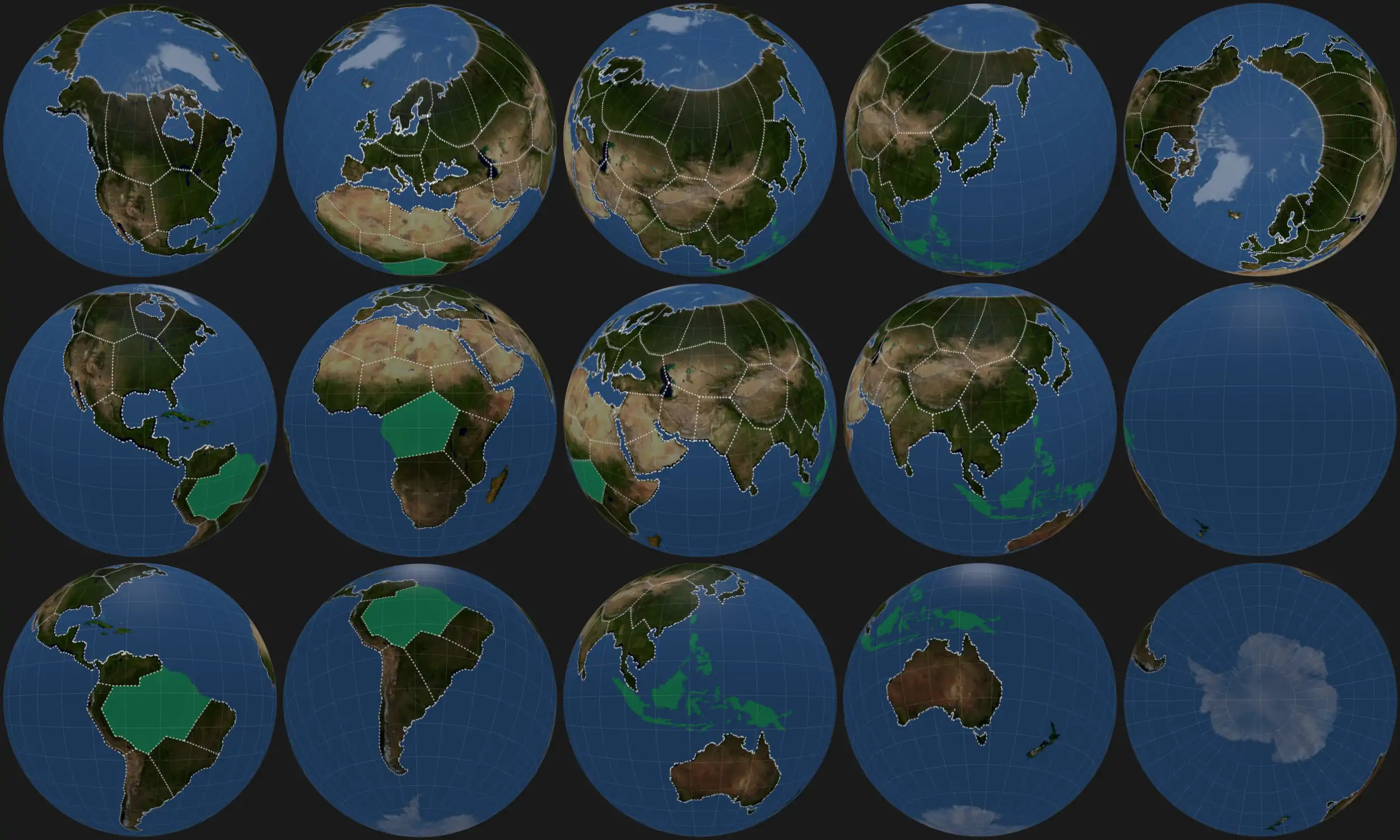
Illustration: The blocal zone with 38 blocs. The global zone includes the rainforests, the oceans, the polar areas including Greenland, all other islands and archipelagos, except a few large ones, which are included within nearby blocs under the island exception described below. Screenshots of global projection for near-correct bloc size comparison. >>> See the globe
15.3 Designing the blocal zone for balance
The blocal zone provides the principal macro-territorial structure for continental land and for large nearby islands or archipelagos where a bloc relationship is functionally appropriate.
Blocs are normally the highest territorial governance units for significantly populated continental land and can also include large island territories where close geographic proximity, functional integration, and governance scale make the bloc level appropriate. They are semi-sovereign constituent units with constitutionally protected territorial executive authority under the Earth Constitution and valid global law.
Their role is both practical and constitutional. They organise continental territory at a scale capable of carrying major executive, infrastructural, economic, and security responsibilities, while preventing those capacities from becoming concentrated in one global territorial government.
Size, population, and functional balance
The proposed structure uses approximately 20–40 blocs.
The objective is not equal territorial size. Equal area would produce radically unequal governance units because population, economic activity, resources, infrastructure, strategic position, climate, water, productive land, accessibility, and technological capacity are distributed unevenly.
Population and territorial area are important variables, but neither should be applied mechanically.
Densely populated continental areas will generally require smaller blocs than sparsely populated areas. Blocs must nevertheless remain large enough to function as robust macro-units with the administrative, economic, infrastructural, and security capacity required at this level.
Area is not valuable merely because it is large. Climate, water, resources, ecosystems, infrastructure, accessibility, productive land, transport networks, economic capacity, and other conditions determine what a territory can support.
Bloc design should prevent any one unit from combining such a concentration of population, territory, economic capacity, resources, or strategic power that it can structurally dominate the federation.
The assessment must therefore consider variables together rather than treating any single criterion as decisive.
More numerous and more balanced blocs
The general direction is towards more numerous, more balanced, and on average smaller blocs than the largest political units of the present situation.
The largest existing concentrations of territory, population, economic capacity, and power may therefore require more extensive reorganisation than smaller structures. The same principles apply everywhere. Existing political size provides neither a presumption for preservation nor a reason for division in itself.
The purpose is to prevent extreme concentrations of territorial power from being reproduced inside the federation.
Too few blocs would concentrate power excessively. Too many could fragment coordination and weaken the distributed collective-security structure. Bloc formation must therefore balance the capacity of each unit with the requirements of the system as a whole.
The resulting blocs will never be equal. Geography makes that impossible.
The objective is to make the differences manageable.
Proposed configurations should be examined openly through AGORA, with criteria, assumptions, trade-offs, and alternative structures available for public comparison.
15.4 Neutral geographic names and functional boundaries
A functional territorial structure also needs names and boundaries that describe governance without assigning territory to cultural or political owners.
Continent first, direction second
The proposed bloc naming system therefore uses geography itself.
Each bloc receives a continental root and, where more than one bloc occupies that continental structure, a directional specification.
Examples include:
- AFRICA.north
- AMERICA.central-south
- ASIA.west
- EUROPE.east
- AUSTRALIA
The abbreviated form follows the same grammar:
- AF.n
- AM.cs
- AS.w
- EU.e
- AU
The first part identifies the broad continental geography. The second identifies the bloc’s position within it.
The names describe where the blocs are, not who owns them.
This is especially useful where inherited geopolitical terminology carries assumptions about identity, historical ownership, or external perspective. A name such as ASIA.west describes location rather than reproducing a civilisational or geopolitical claim.
Continental roots remain working geographic categories rather than immutable scientific boundaries. Bloc design follows governance function first; the naming system follows the geography that results.
The names serve the geography, not the other way around.
Boundaries as governance tools
The defining difference between this map and a traditional map of sovereign states is what the lines mean.
Within one global democratic state, Earth Citizenship, constitutional rights, global law within legitimate global competence, and participation through AGORA continue across every bloc boundary.
A bloc boundary determines which semi-sovereign territorial unit carries particular responsibilities. It does not mark entry into a different sovereign state or a territory constitutionally owned by another nation, ethnicity, religion, ideology, or other cultural identity.
This is the territorial application of GOV//ID.
It changes the significance of where a boundary is drawn.
A valley, city, coastal area, watershed, infrastructure corridor, or region near a proposed bloc boundary can be evaluated according to governance effectiveness, accessibility, ecological systems, economic relationships, security, and subsidiarity rather than through a contest over sovereign national ownership.
Territory is three-dimensional
Territorial jurisdiction includes the physical volume required for governance.
Within the blocal zone, bloc authority extends downward into the subsurface and upward into lower airspace as far as necessary to perform legitimate territorial functions. The exact vertical limits require technical and constitutional development.
The atmosphere as a planetary system remains a global commons regardless of the territorial jurisdiction below it.
The ocean itself belongs to the global zone. Coastal blocs, regions, and loci can nevertheless retain the functions required for ports, shore infrastructure, coastal settlement, and other responsibilities allocated to them under subsidiarity, while higher maritime jurisdiction, security, and common infrastructure remain global.
Subsurface authority should likewise follow functional need rather than an arbitrary geometric depth. Infrastructure, groundwater, minerals, geothermal systems, storage, and deeper planetary systems can require different allocations of responsibility.
The military consequences of these territorial distinctions are developed under the bloc-based peacekeeping system.
Political geography can evolve
Once territory is part of one constitutional order, changing an internal governance boundary is no longer equivalent to transferring sovereign ownership between independent states.
A region can move from one bloc to another. Two units can be combined. One can be divided. Transitional sub-blocs can disappear. Present international boundaries can become regional or local administrative boundaries, while others can lose practical relevance.
Any such change must include formal democratic participation by the populations directly affected together with decision-making at the governance levels responsible for wider consequences.
Changes should be assessed through subsidiarity, governance capacity, geographic coherence, economic and ecological function, infrastructure, security, accessibility, and systemic balance.
The system neither preserves nor removes inherited borders merely because they exist.
It organises territory according to the functions governance must perform.
15.5 A map for better questions
Maps influence political thought because they define the units through which problems are seen.
The present world map directs attention towards sovereign states, national interests, territorial ownership, alliances, historical claims, access to strategic territory, and the defence or alteration of inherited borders.
A different map creates different questions.
From ownership to governance
The proposed geography does not by itself settle conflicts, determine final boundaries, or provide a completed territorial design.
It creates a different frame in which those questions can be examined.
Instead of beginning with the assumption that every existing sovereign unit must remain intact, or that territory must constitutionally belong to a national or cultural identity, the system can ask:
- Which functions genuinely require direct global jurisdiction?
- Which continental territories should form coherent blocs?
- What scale gives each bloc sufficient capacity without creating structural dominance?
- Which responsibilities should remain regional or local?
- Which ecological systems need continuous governance across inherited borders?
- Which routes and infrastructures must remain globally accessible?
- Which existing boundaries remain useful, and at what governance level?
- How can populations with different cultural identities share governance without any identity owning it?
The same method applies throughout the global and blocal zones.
A bloc such as ASIA.west does not itself resolve the conflicts located within that geography. It changes the constitutional frame in which they can be addressed: populations currently separated by competing sovereignties can belong to one shared global order while retaining regional, local, civic, and cultural autonomy.
Likewise, placing an island in the global zone, or integrating a large island with a nearby bloc, does not determine the details of its regional institutions. It determines which higher territorial relationship applies above them: directly global or blocal.
Placing a rainforest territory in the global zone does not determine every rule governing human activity there. It establishes the higher jurisdiction within which ecosystem sovereignty, regional stewardship, and the Rights of Life can operate.
The map is a tool for making better questions possible, not a claim to provide all the answers.
Developing the map through AGORA
The geography should therefore be developed through proto-AGORA rather than treated as a finished territorial plan.
Stable geographic discussion spaces can provide a framework in which Earth Citizens examine the global-zone boundaries, proposed bloc structures, rainforest systems, Arctic geography, maritime routes and chokepoints, and alternative territorial configurations.
The present map is a hypothesis to be examined, criticised, compared, and revised.
Knowledge about geography, demographics, ecology, economics, infrastructure, culture, security, resources, transport, climate, settlement patterns, and other relevant conditions can progressively improve the design.
Alternative maps can be developed. Proposed boundaries can be challenged. Different numbers and configurations of blocs can be modelled. Scientific definitions of directly global ecological territories can be refined.
Proto-AGORA can therefore become not only a forum for discussing the proposed system, but an early democratic environment in which its territorial geography is developed.
15.6 Geography, peace, and shared global capacity
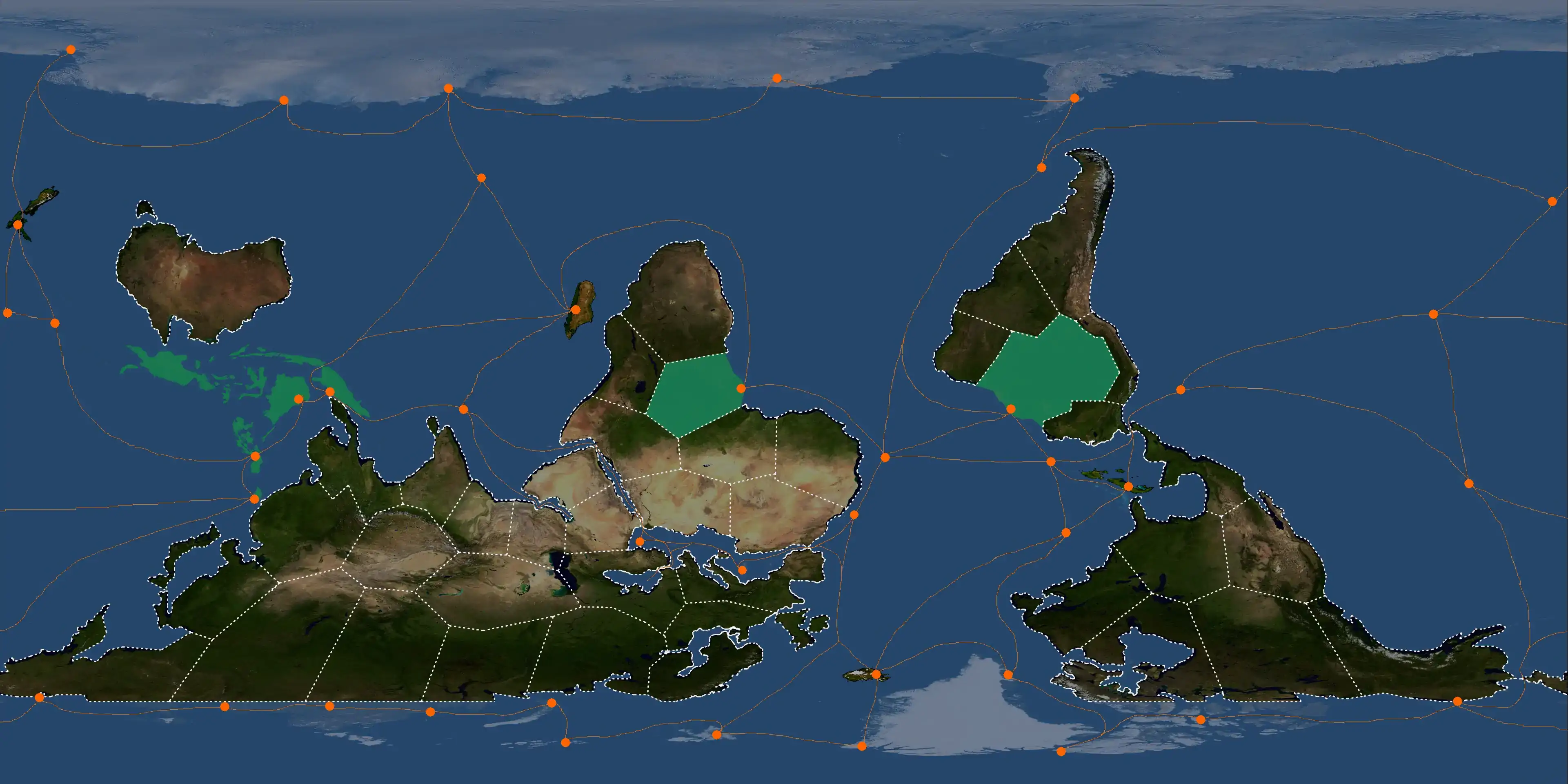
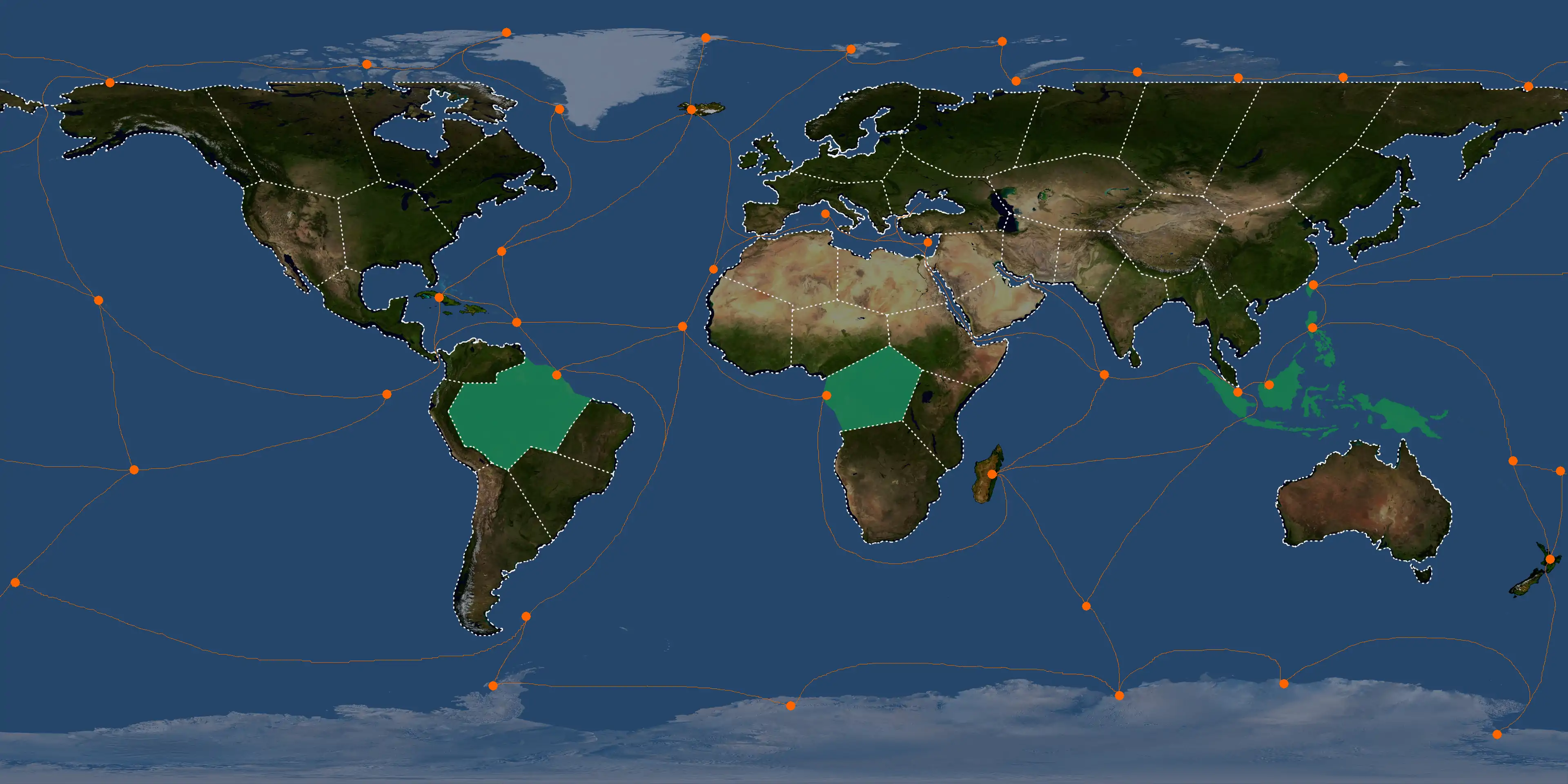
In this version of the map, the orange layer illustrates one possible distributed global institutional and operational network within the global zone.
The nodes can host different global functions — including democratic institutions, AGORA infrastructure, research, monitoring, archives, communications, stewardship, emergency response, logistics, and security capacity — while the lines illustrate their connection as a planetary network.
Locations and connections are illustrative rather than proposed final sites or routes. Hubs can be located in inhabited island societies, on strategically placed smaller islands, in polar areas, and at carefully bounded sites within globally protected rainforest territories.
A functional governance geography establishes the spatial structure through which security, global institutions, ecological stewardship, infrastructure, and economic coordination can operate without concentrating the whole system in one territorial centre.
It does more than allocate territory.
Distributed coercive power
The blocal zone distributes the principal continental territorial military capacity across semi-sovereign blocs.
Their number, distribution, scale, and relative strength therefore affect whether organised force can remain sufficiently distributed to prevent both geopolitical anarchy and global domination.
The global zone creates the corresponding territorial domain for global executive and security capacity. Earth Government must possess sufficient lawful capacity to govern and protect the oceans, global-zone islands and archipelagos, polar domains, rainforest territories, maritime routes and chokepoints, and other directly global areas for which it is constitutionally responsible.
This requires a substantial distributed global capacity for enforcing valid global law, protecting common infrastructure, maintaining maritime security, search and rescue, suppressing piracy and other organised predation, responding to emergencies, preventing unlawful dumping and pollution, and protecting globally governed ecosystems.
Direct global capacity must nevertheless remain constitutionally balanced against the protected territorial capacity of the blocs.
The bloc-based peacekeeping system develops this distribution of coercive authority in detail.
The ocean as a physical anchor of global governance
The map treats the ocean not as the space left between land jurisdictions, but as the largest continuous territorial part of the global zone.
This changes its political role.
Many of the problems associated with shared maritime space arise precisely because no single democratic territorial authority is responsible for the whole. The proposed system instead makes stewardship, security, infrastructure, access, environmental protection, and lawful use ordinary public responsibilities within one global constitutional framework.
The ocean thereby becomes more than a commons to be protected. It becomes the principal continuous physical space connecting the directly global territories and institutions of the planetary governance level.
The islands and archipelagos that remain directly global, the polar domains at the ocean’s northern and southern limits, the maritime passages that connect its basins, and the global ecological territories linked to planetary stewardship together create a physical geography for the global level itself.
A distributed global capital geography
The global governance level requires physical places from which its common functions can operate.
Earth Parliament, the global judiciary, Earth Government, the Councils, AGORA, scientific institutions, archives, emergency systems, global public infrastructure, stewardship institutions, and security functions do not need to be concentrated in one capital. They can be distributed across multiple locations and institutional environments.
This creates a distributed global capital geography rather than a single global capital.
Different functions can be located where their institutional and operational requirements are best served. Parliamentary, judicial, administrative, scientific, infrastructural, stewardship, emergency, and security capacities need not share one metropolitan centre or even one type of physical environment.
Global-zone hubs provide one part of this geography. A hub within a nature region remains subordinate to ecosystem sovereignty: its presence does not convert the surrounding territory into an ordinary development zone, and its footprint and activities must remain limited to the functions justified there.
This network complements rather than replaces the global constitutional precincts located beside the institutional centres of the blocs. Those precincts maintain the continuous global–blocal interface, while global-zone hubs give the global level a distributed territorial base within its own zone.
Together, the two systems allow global institutions to remain physically present both within the directly global sphere and at the interface with every bloc.
No single city, island, bloc, or region thereby becomes the geographical owner of global political life.
The arrangement also makes it possible for global institutions to operate across radically different planetary environments rather than allowing one metropolitan setting to define the physical experience of global governance.
Economic and infrastructural coherence
Territorial geography also affects economic and strategic power.
One global maritime zone allows shipping routes, chokepoints, communication systems, shared infrastructure, and maritime access to operate within a common legal framework rather than through competing higher territorial jurisdictions.
The global zone can support shared physical infrastructure and global public systems whose operation should not depend on the territorial control of one bloc.
It can also provide locations in which new global systems are developed and tested before wider deployment. The exact functions may include democratic, scientific, digital, financial, logistical, ecological, or other common infrastructures and should remain open to later design.
At the same time, the blocal geography must prevent extreme differences between blocs from becoming durable structures of strategic dominance.
Political and military balance cannot be sustained indefinitely where differences in wealth, technology, infrastructure, resources, resilience, or productive capacity become overwhelming.
The sustainable and just economic system therefore forms the material counterpart to the territorial and security architecture. It allows economic diversity while preventing extreme dependence and concentration from undermining the constitutional balance.
The resulting sequence is interconnected:
functional geography → distributed security → shared global capacity → economic coherence
None can be designed independently of the others.
Together they provide the territorial, institutional, security, and material foundations for a global federation in which planetary coordination is strong enough to govern shared systems while political and coercive capacity remain sufficiently distributed to constrain domination.
16. The bloc-based peacekeeping system
The functional governance geography provides the territorial structure for one global federal state. The bloc-based peacekeeping system provides its security structure.
The system has two equally fundamental purposes: to prevent organised conflict through credible deterrence, and to (re-)establish permanent peace where conflict is already structurally embedded.
The first purpose is preventive. Military authority, escalation pathways, intervention thresholds and democratic responsibilities are defined in advance so aggression cannot be tested against uncertainty, vetoes, hesitation or improvised coalitions. Predictability makes escalation less attractive before violence begins.
The second purpose is constructive. Humanity does not enter the proposed transition from a condition of peace. Many societies inherit armed conflict, territorial disputes, collective trauma, hostile identity narratives and expectations of renewed violence. The system must therefore be capable not only of stopping violence, but of establishing the durable institutional peace within which shared society and social reconciliation can develop over years or generations.
Many of the world’s most entrenched conflicts cannot be permanently resolved one by one while the geopolitical system that sustains their security dilemmas remains unchanged. Their histories and immediate causes differ, but conflicts in Sudan, Israel/Palestine, in Ukraine/Russia, Kashmir, across the Taiwan Strait, and elsewhere are embedded in wider structures of sovereign military power. Permanent peace in such conflict regions requires permanent peace in the geopolitical system as a whole.
The architecture therefore depends on the blocs being designed with broadly comparable overall starting conditions. They need not be equal, but extreme concentrations of population, territory, economic strength or strategic capacity in any single bloc would weaken the distributed balance on which the system relies. The geography proposed above is part of the security architecture, not merely an administrative map.
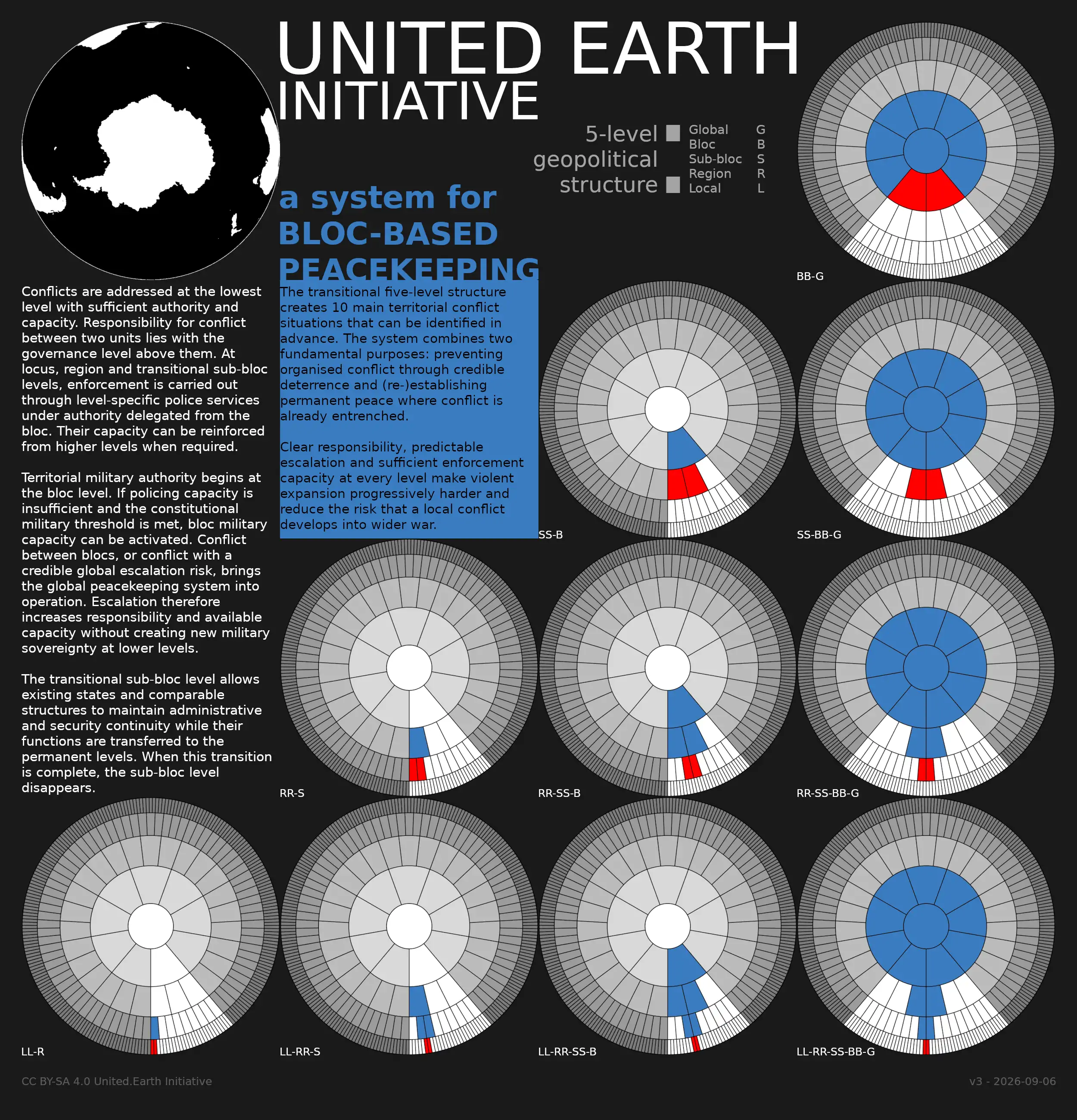
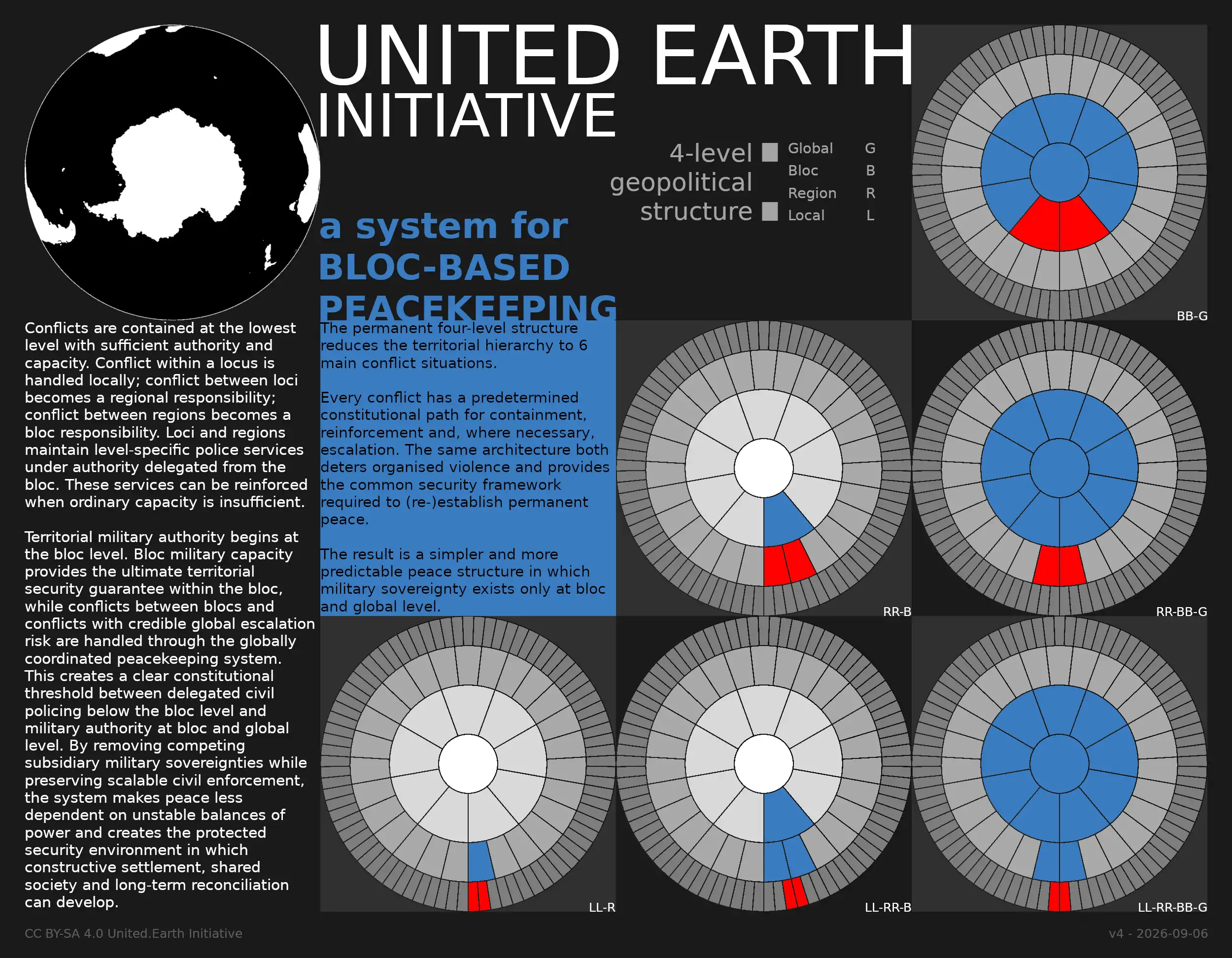
The posters above and below apply the same peacekeeping principles to two possible configurations of the geopolitical structure. The sections below explain the system in detail.
The first poster shows a five-level structure, including a sub-blocal policing tier; the second uses the four levels without it.
If the sub-blocal level becomes redundant, the number of structurally distinct territorial conflict situations falls from ten to six. The underlying principles of responsibility, reinforcement, escalation and distributed coercive authority remain the same.
16.1 One global state, distributed military authority
The proposed system constitutes a single global democratic state. The constitutional monopoly on legitimate organised military force therefore belongs to one state system, but military authority within that system is deliberately distributed rather than concentrated in one hierarchical global command.
Within the blocal zone, territorial military authority is constitutionally vested in the blocs. Each bloc holds protected territorial command over military force within its own territory, subject to the Earth Constitution and valid global law.
Within the global zone, the corresponding territorial military authority belongs to the global level. This includes the oceans, directly global islands and archipelagos, polar domains, tropical rainforest territories under direct global jurisdiction, maritime routes and chokepoints, and other territories constitutionally assigned to the global zone.
The global level also holds the military and security authority assigned to non-territorial global domains such as near-Earth space.
The ocean does not become bloc military territory merely because it lies beside bloc land. Coastal blocs and their subsidiary regions and loci retain the territorial responsibilities required for ports, shore infrastructure, coastal communities, and other constitutionally allocated functions, while higher maritime territorial security remains global.
Military executive authority exists only at the blocal and global levels. Loci and regions, and transitional sub-blocs while they exist, maintain level-specific police services under authority allocated through the constitutional hierarchy applicable to their territory.
Within the blocal zone, that hierarchy leads upward to the bloc. Within the global zone, regional and local policing connects upward directly to the global level.
These services exercise the civil coercive authority required at their governance level and can be reinforced from above when their ordinary capacity is insufficient. They do not possess independent military authority or territorial military sovereignty.
This creates a clear threshold in the coercive architecture: below the higher territorial military level, public force is exercised as policing rather than as independent military sovereignty.
Within the blocal zone, loci, regions, and transitional sub-blocs form civil policing tiers beneath bloc military authority. Within the global zone, loci and regions form the corresponding civil policing structure beneath global territorial military authority.
This division separates two questions that are combined in the present state system: whether humanity forms one constitutional security order, and whether one central authority commands all military force. United Earth answers yes to the first and no to the second.
One global state does not require one global military command.
The result is one constitutional monopoly on legitimate coercive force: civil enforcement is delegated downward through level-specific police services, while territorial military authority is distributed between blocal and global commands. This arrangement is a permanent safeguard against both geopolitical anarchy and global tyranny.
16.2 Collective security without global domination
The bloc structure described under Designing for balance makes collective security possible without creating one territorially dominant global military power.
The global level must nevertheless possess substantial and geographically distributed security capacity of its own. The global zone is a real territorial jurisdiction rather than a residual space between blocs, and its oceans, islands, polar domains, ecological territories, strategic passages, infrastructure, and communities must be governable and protectable in practice.
This capacity can include maritime and territorial surveillance, law enforcement support, search and rescue, emergency response, infrastructure protection, suppression of piracy and other organised predation, ecological enforcement, and the military capacity required when threats exceed ordinary civil enforcement.
The global level possesses independent military initiative and enforcement capacity within constitutionally defined global domains, including the full global zone. Within the blocal zone, however, its military authority is constrained in three decisive ways:
- It has no general right to project force into bloc territory.
- It may intervene within the blocal zone only under formally defined peacekeeping conditions requiring coordinated bloc participation.
- Its own standing military capacity may never exceed 50% of the combined military capacity of all blocs.
The 50% ceiling is an additional quantitative safeguard within a broader anti-tyranny architecture. The more fundamental protection is structural: Earth Government does not command a unified land military, while bloc forces remain under their own constitutionally protected territorial commands.
At the same time, bloc semi-sovereignty does not recreate sovereign military anarchy at a higher level. Blocs are constituent units of the global state, not independent geopolitical powers. No bloc can place itself outside the collective security order, veto a lawfully authorised peacekeeping process, or unilaterally redefine the conditions under which common security obligations apply.
Global military authority can coordinate and participate in constitutionally authorised operations, while bloc forces provide the distributed territorial capacity through which collective action becomes possible. Standing coordination and multiblocal participation prevent the common system from depending on improvised alliances after a crisis has already begun.
The same distinction applies in the opposite direction. Bloc forces can operate beyond their own territorial commands when constitutionally authorised, including within the global zone as part of common operations, but this does not give any bloc territorial military jurisdiction over the ocean or other global-zone territory.
The federation therefore combines capacities that the present condition generally separates: global legal authority strong enough to enforce collective peace, and distributed coercive power strong enough to prevent global domination.
16.3 Deterrence through predictability
The first fundamental task of the peacekeeping system is to prevent organised conflict from beginning.
Because the territorial hierarchy is formally defined, the pathways through which conflicts can escalate are finite and known in advance. Within a five-level structure, conflicts between units at the same level produce ten structurally distinct territorial escalation paths. In a four-level structure without the sub-bloc tier, the number falls to six.
The two peacekeeping matrices presented at the beginning of this chapter illustrate a general principle rather than a prediction of particular wars. For each territorial relationship, the system can define in advance which level carries responsibility, what evidence thresholds apply, how operational responsibility and reinforcement move upward when necessary, and which enforcement capacities can be activated.
Together, the matrices describe more than a chain of political responsibility. Every level assigned responsibility for containing conflict between subsidiary units must have sufficient lawful enforcement capacity to perform that task. Below the bloc level, this capacity is provided through level-specific police services rather than military sovereignty.
Where ordinary police capacity is insufficient, higher levels can provide reinforcement. If a conflict crosses the threshold requiring military force, the military authority of the competent higher territorial level becomes available: the bloc within the blocal zone and the global level within the global zone.
Authority to contain conflict must be matched by sufficient enforcement capacity.
Predictability is itself deterrence.
A political or military leadership considering aggression should not be able to gamble on whether a powerful ally will block action, whether outside states will agree to intervene, whether an improvised coalition can be assembled in time, or whether limited violence can be used to create irreversible facts before the wider system responds.
The peacekeeping architecture instead aims to make the institutional consequences of escalation foreseeable. Aggression is confronted by a constitutional system whose obligations already exist before the crisis.
This differs from deterrence based mainly on competing sovereign threats. The objective is not to preserve peace by ensuring that potential enemies can inflict unacceptable destruction on one another. It is to make organised aggression predictably unsuccessful because no territorial actor can convert military initiative into a durable political gain outside the common constitutional order.
16.4 Procedural intervention and escalation
Deterrence cannot completely eliminate conflict. When it fails, enforcement must remain fast enough to prevent escalation while being tightly bound to democratic and constitutional authority.
A general subsidiarity rule governs the escalation chain: conflict is contained at the lowest competent level with sufficient lawful authority and capacity. When that capacity is insufficient, operational responsibility and reinforcement move upward through the governance hierarchy. Escalation increases available capacity and can transfer operational responsibility; it does not create new military sovereignty at lower levels.
All use of military force is governed by explicit constitutional procedures established democratically in advance.
Within the blocal zone, bloc military action within its own territory is activated only when the competent policing structure lacks sufficient capacity and the defined military threshold has been met.
Within the global zone, the global level performs the corresponding territorial security function. Global military capacity can therefore be activated there under constitutionally defined thresholds without being treated as an intervention into another territorial authority.
The projection of bloc military force beyond its own territorial command, and any projection of global military force into bloc territory, are subject to the additional collective peacekeeping procedures defined for those cases. These procedures establish the conditions for immediate defensive or peacekeeping action, the authority delegated to relevant executives, and the thresholds at which additional democratic authorisation is required.
Within an existing mandate, Earth Government and the relevant blocal executives must have sufficient operational discretion to act rapidly. Where escalation exceeds previously authorised powers, the substantive political decision returns to the competent democratic process through AGORA, with the relevant parliament formalising the decision and the executive carrying it out.
Operational coordination between global and blocal institutions takes place through the global-blocal node interfaces, while the distributed global-zone hub network provides additional operational capacity within directly global territory.
Military operations inevitably require human judgement under conditions that cannot be fully anticipated. The system does not attempt to eliminate discretion, but to define its mandate, limits, responsibilities and accountability before it is exercised. Operational judgement must remain bounded by constitutional purpose rather than becoming an independent source of political authority.
Exceptional interventions are:
- purpose-limited,
- scope-limited,
- subject to continuing constitutional and institutional oversight,
- and subject to subsequent democratic accountability and judicial review.
They are also time-limited as exceptional interventions. This does not prevent a continuing peacekeeping presence from being constitutionally authorised where durable security requires it. Such a presence must instead be subject to regular democratic renewal, proportionality, review and termination procedures.
Conflict classification must consider two different dimensions: territorial location and escalation scope.
A conflict can be geographically contained within one locus, region or bloc while credibly mobilising actors across several blocs through religious, ethnic, ideological, strategic or other transnational networks. In such cases, the territorial conflict can become a threat to peace at a higher level than its physical location alone would suggest.
The peacekeeping level is therefore determined not only by where a conflict occurs, but also by the highest level at which it creates a credible threat to peace. Wider symbolic importance alone is insufficient. Escalation risk must be operationally credible, and any upward movement of authority must remain necessary and proportionate.
The global peacekeeping system thereby functions as an escalation firewall: strong enough to act across levels when required, but prevented from treating every conflict as a justification for unrestricted global military authority.
16.5 The security guarantee must encompass the conflict
Deterrence and intervention explain how the constitutional order protects peace once it exists. Entrenched conflict areas raise a harder question: what security structure must exist before existing subsidiary military sovereignties can safely be dissolved?
The answer depends on the full scale of the conflict system, not only on the territory where violence is concentrated.
A geographically local conflict can remain embedded in neighbouring sovereign militaries, military alliances, external patronage, refugee and diaspora politics, transnational identity mobilisation, strategic competition and expectations of future intervention by outside powers. If those structures remain intact, changing the constitutional arrangement inside the immediate conflict territory does not remove the wider security dilemma.
The security architecture must encompass the full scale of the conflict it is intended to resolve.
This produces a strict sequence of constitutional requirements. A population that depends on sovereign military capacity for existential security cannot reasonably be expected to surrender that protection before a stronger common security guarantee is actually capable of replacing it. Otherwise, integration can create a security vacuum and intensify the conflict it is intended to resolve.
A higher-order common security guarantee must therefore be operational before, or at the same time as, the subsidiary military sovereignties it replaces are dismantled.
This is why a local one-state solution can be structurally impossible inside a wider anarchic conflict system. Combining hostile populations within one local polity does not create peace if their security remains tied to competing armed powers outside that polity.
A local one-state solution in a deeply entrenched conflict area will in practice require a higher-order common state whose security architecture encompasses the conflict system itself. Where the conflict system is embedded in global geopolitical anarchy, that means the global federal state.
Western Asia illustrates the principle particularly clearly. A future bloc such as ASIA.west can provide the territorial structure within which populations now separated by sovereign state systems can live under common law and equal citizenship. But ASIA.west cannot safely be created as an isolated regional security order under present geopolitical conditions.
For Israel in particular, transferring territorial military sovereignty into a wider regional structure before a credible higher-order common guarantee exists would remove the sovereign security capacity on which the state currently depends while leaving the wider regional and global conflict system intact. In that setting, without a higher-order common security system, a local one-state solution effectively asks Israel to risk its own dissolution in pursuit of peace.
The same structural problem appears in different forms elsewhere. Kashmir cannot be separated from the wider India–Pakistan–China security system. The Taiwan Strait cannot be separated from the wider China–United States and Pacific security structure. The Korean peninsula cannot be separated from the surrounding nuclear and great-power order. The Ukraine–Russia conflict cannot be separated from the wider European and transatlantic security system.
The political histories and settlements required in these conflicts are not identical. The common point is that permanent peace cannot be established below the level at which the decisive security dilemma remains active.
Once the global federal peace system exists, this logic changes. ASIA.west is then not merely a better frame for discussing Western Asian conflicts. It becomes part of the answer because it is a semi-sovereign constituent bloc operating under common constitutional law and protected by a common security system that neither local party nor surrounding identity group controls.
How humanity can build that higher-order peacekeeping structure without first creating the security vacuums it is meant to eliminate is a transition problem for HOW. The structural requirement in WHAT is simpler:
Replacement security must exist before the security it replaces is removed.
16.6 (Re-)establishing permanent peace
The second fundamental task of the peacekeeping system is to establish a durable condition of peace where organised conflict is already embedded.
This is more than stopping active violence. Existing conflict systems can reproduce themselves through fear, collective trauma, inherited grievance, hostile historical narratives, segregation, material inequality, contested institutions and the expectation that armed struggle will eventually return.
A permanent peace strategy must therefore combine security with active social and institutional construction.
Peace before reconciliation
Deep conflict creates a security problem that cannot be solved by first requiring the populations involved to trust, forgive or identify with one another.
As long as renewed organised violence remains credible, fear is rationally reinforced. Each side has reason to remain mobilised, political actors can gain from sustaining threat perceptions, and every new episode of violence confirms the belief that independent power against the other side remains necessary.
Social reconciliation cannot therefore be a precondition for institutional peace.
Institutional peace is not sufficient for social reconciliation, but it is the indispensable precondition that makes sustained reconciliation possible.
The peacekeeping system does not wait for reconciliation in order to establish peace. It establishes and protects peace so that reconciliation can become possible.
This does not require people to abandon grief, historical memory, religious conviction, national belonging or incompatible interpretations of the past. It requires them to live under a constitutional reality in which these differences can no longer be converted into territorial military domination.
Building shared society under protected peace
Peace before reconciliation does not mean imposing military quiet while society waits passively for attitudes to change.
Once organised violence has been made structurally unavailable, peace must be used to build the practical conditions of shared life.
Do not wait for shared identity. Build shared society under the protection of a strong, globally coordinated peacekeeping system.
The objective is not a new compulsory cultural identity. Nations, religions, ethnicities, languages, worldviews and other cultural identities can continue within a shared civic and constitutional order.
What must grow instead is a shared civic reality: reliable common rights, institutions, services, infrastructure, economic relationships and everyday meeting points that belong to the society as a whole.
Schools, healthcare, social security, housing, workplaces, public services, transport, local institutions, civil society, sport, cultural life and common infrastructure all help create repeated experience of functioning together. Economic and social policy can reduce material conditions that otherwise allow identity conflict to reproduce itself.
The development of welfare states offers a useful general lesson. Social cohesion did not always precede common institutions. Common institutions themselves helped populations with deep class, regional, religious and political divisions develop greater practical interdependence and shared security.
The same principle applies more broadly in societies emerging from entrenched identity conflict. People do not first need to agree about who they are. They need a common society that works while they continue to disagree.
Security across generations
Institutional security can be established more quickly than collective trauma can disappear.
People who directly experienced war, terrorism, displacement, persecution or recurring insecurity may carry those experiences throughout their lives. Their children can inherit memories, fears and narratives formed by events they did not themselves experience.
Deeply entrenched conflicts may therefore require a visible and credible peacekeeping guarantee for decades or generations.
Such a presence is not the same as an exceptional military occupation. Where constitutionally required, it is part of the common security order and must protect all populations under the same law. Its mandate, composition, scale and duration remain subject to democratic control, proportionality, independent review and judicial accountability.
Its basic promise is simple: no former adversary, identity movement or subsidiary governance unit will again be permitted to rebuild an independent territorial military capacity and return to organised violence.
Over time, new generations can then grow up without war repeatedly confirming inherited enemy narratives as present political reality. Reconciliation remains neither automatic nor compulsory, but the structural conditions that continually destroy it are removed.
The peacekeeping system protects the time that social reconciliation requires.
16.7 Constructive settlements, not frozen conflicts
Permanent peace cannot be built simply by stopping violence and freezing every existing territorial, institutional or cultural arrangement in place.
A status quo can itself contain unresolved injustice, exclusion, displacement, unequal access, identity domination or arrangements created by earlier force. Peacekeeping must prevent unilateral change through violence, but it cannot make existing control the automatic constitutional answer.
Protected peace instead creates the conditions under which difficult substantive conflicts can be moved from military competition into a common democratic, legal and knowledge-based process.
The costs imposed by preserving an existing arrangement must be considered alongside the costs created by changing it.
Identity-related conflicts under protected peace
Protected peace creates a constitutional space in which nations, religions, ethnicities, ideologies and other identities can remain strong, organised and politically active while sharing territorial governance as equal citizens.
Maintaining this relationship requires continuous constitutional stewardship. Cultural continuity, historical grievance, language, sacred and living heritage, access, recognition and other legitimate identity-related concerns must have effective democratic and legal channels through which they can be expressed, examined and addressed.
AGORA, the SEC system, the branches and the courts provide these channels within the common constitutional order. They allow identity-related conflicts to become matters of knowledge, deliberation, rights, law and democratic settlement rather than territorial competition between sovereign groups.
The purpose is to protect both identity freedom and the equal civic character of public authority.
The issue becomes a security matter when an organisation attempts to convert identity-based mobilisation into independent territorial coercive power. Civil policing provides the ordinary means of enforcing the common legal order, with responsibility and capacity escalating through the governance hierarchy where necessary.
Where such an attempt develops into organised armed force or sustained violent control of territory, the bloc-based peacekeeping system provides the ultimate constitutional backstop.
Peacekeeping ensures that no identity movement can establish or restore independent territorial power through force.
No historical zero point
Territorial identity conflicts often appeal to history to establish who ultimately owns a place.
But historical ownership produces an indefinite regress. Should public sovereignty be reconstructed from the borders before the latest war, before colonial rule, before an earlier conquest, before a migration, or from an ancient polity? Every chosen starting point privileges one historical population, state, conquest or movement over others.
There is no generally defensible historical zero point from which inherited identity ownership of territorial public governance can be reconstructed.
Most people alive today were born into demographic and political realities created long before them. They cannot reasonably bear personal responsibility for every conquest, displacement, migration, boundary or injustice that produced the society in which they live.
The proposed system therefore starts from present populations as equal citizens under the common constitutional order, not from an attempt to identify the historically rightful cultural owner of a territory.
History remains highly relevant. It matters to memory, trauma, restitution, cultural continuity, historical responsibility and the stewardship and use of cultural and sacred heritage. What it does not create is inherited territorial public sovereignty.
Historical grievance and identity claims can be expressed, organised and argued politically, but they do not create a right to territorial military power or domination over others.
Living and sacred heritage
Some of the most difficult inherited conflicts concern places where history is not merely remembered but actively lived.
Sacred buildings, burial grounds, pilgrimage sites, Indigenous landscapes, mountains, forests, religious complexes and other culturally significant places can remain integral to living identities across centuries. Their significance can involve physical presence, ritual practice, custodianship, access, continuity and the continued ability to use the place in ways central to the tradition concerned.
The Culture Council, together with the wider SEC system, can provide the cultural, historical, ethical and empirical knowledge needed to understand such claims without turning the Council itself into a sovereign authority over the site.
Where several identities hold substantial historical and continuing connections to the same heritage domain, the same constitutional principles must apply to all of them.
Present control does not by itself establish superior constitutional standing. Historical priority does not by itself establish sovereignty. At the same time, meaningful recognition of a living heritage claim should, where practically possible, be reflected in actual continuing use rather than reduced to symbolic acknowledgement.
This requires case-specific democratic and legal judgement. Relevant knowledge can be developed through the SEC system, competing arrangements deliberated through AGORA, constitutional rights and law applied by the competent institutions, and an agreed settlement implemented by the executive under a security guarantee strong enough to prevent any party from imposing a different outcome through force.
Some sacred places also have an escalation scope far beyond their physical location. A dispute over a small site can mobilise political and religious communities across several blocs and become a threat to global peace. In such cases, the site may require globally guaranteed protection even though ordinary territorial governance remains blocal or regional.
16.8 No guarantees, but greatly reduced risk
The peacekeeping system offers no guarantee against catastrophe, tyranny, renewed aggression, failed settlements or ultimate institutional breakdown. Human error, political failure, technical malfunction and deliberate abuse remain possible.
Nor can constitutional peace guarantee social reconciliation. Populations can remain divided, historical grievances can persist, and political conflict will continue.
What the system provides is a structural reduction of risk on both sides of the peace problem: fewer incentives and pathways for organised aggression, and a far stronger institutional basis for establishing durable peace where violence and identity conflict are already embedded.
It replaces unstable balances of sovereign military power with a common constitutional security order, while distributing military capacity so that the peace system itself does not become an easy instrument of global domination.
It also creates the protected time and civic space within which constructive settlements, shared institutions and social reconciliation can develop without recurring organised violence repeatedly destroying them.
The aim is to make war progressively less available as a way of conducting it, not to abolish conflict altogether, because that is impossible.
Peacekeeping prevents conflict from destroying shared society. Permanent peace is built by enabling shared society to outgrow conflict.
This is the security foundation for Permanent peace as a structural condition in Earth civilisation.
17. A sustainable and just economic system
The proposed system establishes an economic architecture designed to support life, maintain social stability, and prevent systemic coercion across all levels of governance. As with peacekeeping, we know that no economic system can eliminate risk or conflict, but it should prevent economic power from being used to destabilise societies, dominate territories, or undermine democratic self-government.
Economic order is treated as a core component of global stability. The functional governance geography gives the blocs broadly comparable starting conditions, while the peacekeeping system distributes territorial security power among them. The economic system must help sustain that balance over time, while remaining grounded in ecological limits and glocal subsidiarity. Local resilience is a primary design constraint, and higher-level optimisation must not undermine it.
Economic stability is also part of the constructive side of permanent peace. Security can prevent armed actors from imposing political outcomes, but protected peace must then be filled with functioning shared society. Reliable access to work, housing, food, care, public services, infrastructure and economic participation gives people practical stakes in common institutions and reduces material conditions through which entrenched conflict can reproduce itself.
The economic architecture therefore supports peace in two directions: it prevents economic differences between blocs from becoming strategic domination, and it helps create the shared material conditions within which populations emerging from conflict can build a common civic society without requiring a common cultural identity.
This chapter drafts the constitutional principles and distribution of authority within the economic system, not a complete economic model. Within the constitutional principles already established — including the Rights of Life, the commons principle and its stewardship requirements — the specific design of monetary systems, taxation, forms of ownership and use, trade, labour, welfare, resource accounting, and other economic arrangements must be developed and continuously revised through AGORA and the democratic institutions of the relevant governance levels.
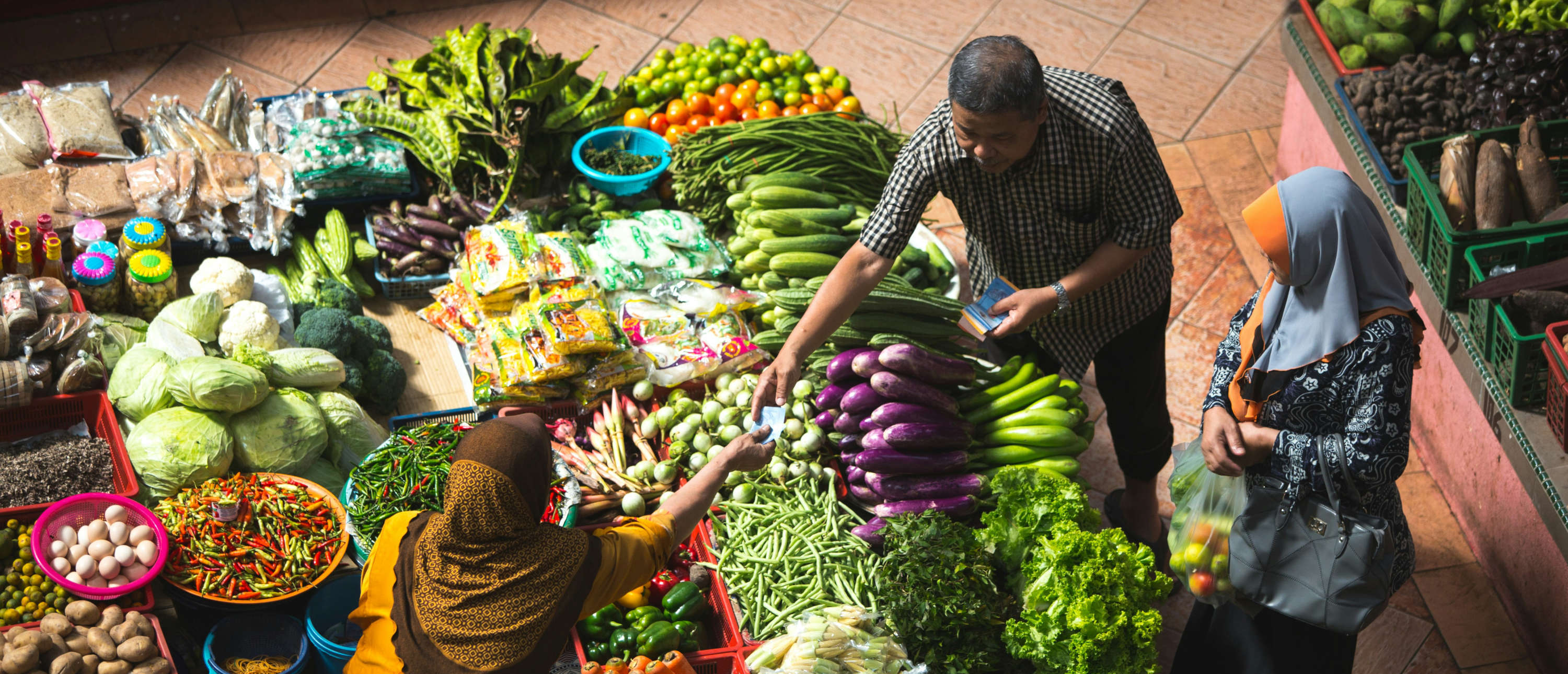
Local economy: Citizens selling and buying food at the Siti Khatijah Market, Kelantan, Malaysia. Photo by Alex Hudson on Unsplash
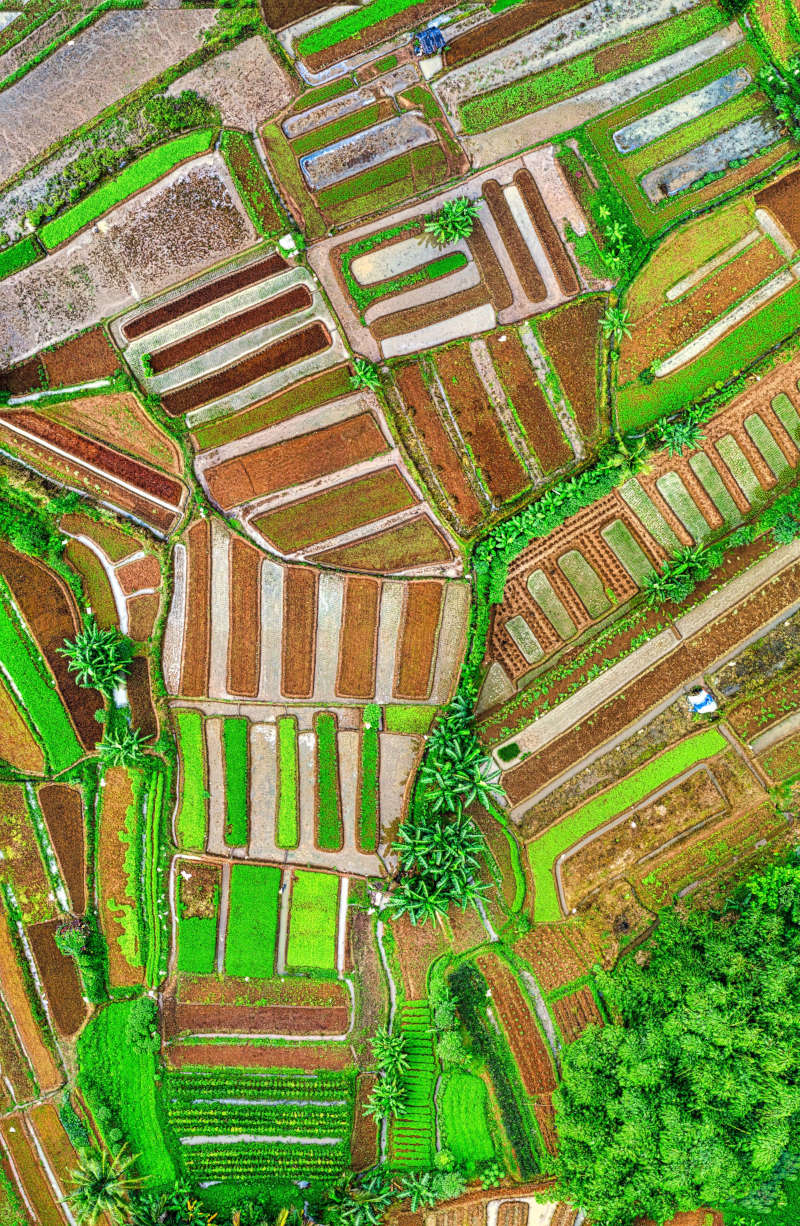
Local food production: Aerial snapshot showcasing the lush, patchwork farmland of Banten, Indonesia. Image by Tom Fisk from Pexels
The real economy is local
All human life is lived locally. Food is grown, work is done, care is given, and communities endure in physical places, shaped by climate, land, and social relations.
Any global economic system that does not protect the capacity of local economic life to continue during severe disruption at higher levels is structurally unsound, regardless of how sophisticated it appears at those levels.
Local resilience does not mean isolation or that everything must be produced locally. It means that essential economic life must remain functional, and that exchange with higher levels strengthens rather than replaces local productive capacity and local exchange.
17.1 The economy as a tool of society
Human society exists as part of the biosphere. Economic systems are created within society to organise production, exchange, distribution, investment, provisioning, and other aspects of material life.
The economy is therefore neither an autonomous force nor an end in itself. It is a practical tool through which society pursues democratically defined political, ethical, social, and ecological goals within the Rights of Life and the biophysical boundaries of the living planet.
This reverses the relationship established under capitalism, where societies and ecosystems are repeatedly required to adapt to the demands of capital accumulation, profitability, and economic growth.
In the proposed order, democratic politics defines the goals and boundaries of economic activity. Economic institutions and mechanisms are selected according to how well they serve people, society, and the living planet.
Economic success is therefore measured through human well-being, social justice, ecological regeneration, and systemic resilience rather than through unlimited material growth or capital accumulation.
17.2 A post-ideological economic order
Capitalism, socialism, communism, and other comprehensive economic ideologies do not serve as constitutional templates for society. They remain protected as bodies of thought, political identities, and sources of analysis, but none possesses governing status or permanent authority over the organisation of the economy.
Post-ideological does not mean the absence of political disagreement, economic alternatives, or competing values. It means that economic mechanisms are evaluated pragmatically according to knowledge, context, governance level, and democratically defined purpose rather than derived from a predetermined doctrine.
Capitalism
Capitalism is treated as a completed historical paradigm rather than the default condition of economic life.
Its defining principles, including the primacy of capital accumulation, the systemic pursuit of private profit, and the conversion of economic ownership into political and social power, cannot remain the organising principles of society.
This does not mean the rejection of markets, investment, enterprise, innovation, or personal ownership. Market economy and capitalism are not synonymous.
Markets are mechanisms of communication, exchange, and coordination that existed before capitalism and can continue within a post-capitalist order.
Private ownership remains a protected economic institution, but it does not create an unrestricted right to accumulate control over resources, housing, infrastructure or other assets on which the rights and material security of others depend.
Food-producing land and housing make this distinction especially clear. Both are foundations of material security before they are objects of exchange or investment. Their systems of ownership, use, finance and exchange must therefore be organised first around their social and ecological functions: food security, secure housing, ecological stewardship and resilient communities. Market exchange and personal ownership can operate within those purposes, but capital accumulation and concentrations of economic control cannot be allowed to determine them.
Housing is part of society’s material infrastructure. The housing stock as a whole forms part of the urban commons: its primary function is to provide secure homes within viable settlements. Individual dwellings may remain subject to different forms of personal, cooperative, communal or public ownership and use, but the wider system must prevent speculative accumulation from overriding access to housing, social stability and local resilience.
Socialism and communism
Socialism and communism are treated as related but distinct historical paradigms, not as replacement constitutional ideologies.
Public ownership, redistribution, universal social provision, democratic control of essential infrastructure, economic planning, commons, cooperatives, shared stewardship, economic equality, and collective responsibility may all serve legitimate purposes within the proposed order.
The system does not presume, however, that the state should own or centrally direct all productive activity, or that markets, personal ownership, plural forms of enterprise, and political diversity should be abolished.
Public, cooperative, communal, and other collective forms of organisation are evaluated by the same standard as private forms: whether they serve the Rights of Life, democratic goals, ecological integrity, social justice, and the practical needs of the communities involved.
Markets and democratic planning
Markets and planning are complementary instruments rather than opposing ideological systems.
Markets organise much decentralised production, exchange, innovation, and distribution. Democratic planning coordinates the material systems that cannot be governed coherently through fragmented market decisions alone, including land use, settlement patterns, infrastructure, transport, energy, food systems, resource flows, and ecosystem restoration.
Neither markets nor planning possess autonomous authority. Their roles are determined democratically according to the scale, purpose, and consequences of the activity involved.
17.3 One economic order, distributed authority
The global civilisation operates within one economic order governed by a shared constitutional and legal framework. This provides common rights, responsibilities, ecological boundaries, standards, and procedures for economic activity across all governance levels.
One economic order does not mean one currency, one ownership model, or one centrally administered economy. Economic authority is distributed according to subsidiarity, with different levels responsible for the functions that correspond to their scale, capacity, and consequences.
The shared framework provides interoperability between economic systems, including common principles for accounting, payments, clearing, cross-bloc exchange, public economic data, and the resolution of disputes. Governance units may develop different institutions and mechanisms within this framework, provided that they respect constitutional rights, the commons, and the legitimate authority of other levels.
The global level can establish binding rules for activities that cross blocs, affect the planetary commons, or threaten the stability of the system as a whole. This authority must not become unrestricted economic dominance or allow shared financial infrastructure to be used for arbitrary political coercion.
No global institution may:
- suspend essential economic activity within a bloc or territory outside constitutionally defined legal procedures
- use payment systems, transaction costs, or access barriers as instruments of political coercion
- monopolise payment, settlement, credit, or other essential financial infrastructure
- override the authority of lower governance levels outside constitutionally allocated global competence
Essential economic systems must therefore remain distributed, interoperable, and sufficiently redundant. No currency, financial centre, payment network, institution, bloc, or governance level can become an unavoidable point of control over the economic life of the whole.
Economic unity is created through constitutional coherence, not central command.
17.4 Glocal subsidiarity and local resilience
Local communities form the smallest economic cells of the global system. They should retain the greatest possible capacity to organise and sustain their own economic life, including food, shelter, energy, care, basic services, local production, and exchange.
Economic authority remains at the lowest governance level capable of exercising it effectively. Local communities determine their own priorities and economic arrangements within constitutional rights, ecological boundaries, and the responsibilities assigned to their governance level.
Regional, blocal, and global institutions support local economies where wider coordination, infrastructure, redistribution, or protection is required. Their role is to strengthen local agency, protect communities against external extraction and concentrated economic power, and address conditions that cannot be handled locally.
Trade and wider economic integration expand access to knowledge, resources, goods, and services. They must operate in ways that preserve local productive capacity rather than hollow it out or make essential economic life dependent on distant corporations, financial institutions, or fragile supply chains.
Local currencies, mutual credit systems, cooperatives, public services, private enterprise, community provisioning, and other locally appropriate mechanisms can operate within the shared economic order.
This structure allows communities to remain open and connected while retaining the capacity to act, adapt, and provide for essential needs through their own institutions and resources.
Higher governance levels exist to protect and enable local economic agency, and thus increase the resilience of the system as a whole.
17.5 The regional level as the primary physical‑ecological coordination layer
The regional level connects local economic life with the wider physical and ecological systems on which communities depend. It provides the principal scale for coordinating land use, settlement patterns, food systems, water, energy, transport, infrastructure, material flows, waste systems, and ecosystem restoration.
These systems form connected landscapes and networks that extend beyond individual properties and local boundaries. Their cumulative development therefore requires coherent democratic planning based on ecological knowledge, social needs, and long-term regional capacity.
Regional planning establishes the shared spatial and infrastructural framework within which local communities, public institutions, cooperatives, enterprises, and markets operate. It protects productive land and ecosystems, coordinates essential networks, and ensures that separate economic decisions contribute to a viable regional whole.
Food systems show how this structure works in practice. Regional coordination can protect productive land, soil and water, crop and seed diversity, open and reproducible seed systems, processing and distribution capacity, while loci, producers and communities retain room for different forms of agriculture, enterprise and exchange.
The objective is a distributed and resilient food system in which local and regional productive capacity is strengthened rather than displaced by concentrated ownership, proprietary dependence or distant supply chains.
This does not imply a return to pre-industrial production. Scientific knowledge, automation, data, modern machinery and other technologies can be used where they improve ecological, social and productive outcomes. The governing question is what combination of methods best serves long-term food security, ecological integrity and resilient communities.
This planning does not direct every activity or exchange. It defines the physical, ecological, and social conditions within which decentralised initiative can flourish without allowing fragmented property interests or short-term market incentives to determine the future of the region.
The regional level should strengthen the distinct character, productive capacity, and resilience of its local communities while coordinating the systems they cannot manage separately.
The region provides the coherent physical and ecological framework within which local economic agency can thrive.
17.6 Blocal and global economic coordination
Macro-cells of economic stability
Blocs provide the principal scale for monetary coordination, fiscal capacity, redistribution, strategic investment, major infrastructure, and economic stabilisation across large territories.
The functional governance geography described earlier aims to give these blocs broadly comparable overall starting conditions. Geography can never make them equal, and economic development will continually change their relative strength. The wider economic architecture must therefore also prevent large differences from hardening into structural dependence or domination.
Each bloc should develop and maintain sufficient diversity and productive capacity to preserve essential economic functions during severe disruption of cross-bloc trade or global financial systems. This includes the capacity to support its regions and local communities without making them permanently dependent on one external currency, financial centre, production system, or supply network.
Blocal economic authority also protects regions and communities against transnational monopolies, speculative disruption, resource extraction, and other concentrations of economic power that exceed the capacity of lower governance levels.
This protection becomes especially important when essential systems are exposed to economic actors and ownership structures operating across jurisdictions. Land, housing, food-producing capacity and other foundations of material life can be accumulated, financed or treated primarily as financial assets through decisions made far from the communities affected. Blocal and global rules must therefore prevent concentrated economic power, cross-border ownership and financing structures, or relocation of production from defeating democratically established regional and local protections.
The blocs remain economically interconnected. Shared standards and predictable rules support trade, knowledge exchange, specialisation, and cooperation while reducing the ability of any bloc to use economic dependence as a weapon against another.
Global coordination as stabilisation
The global level coordinates economic conditions and actors whose effects extend across blocs or affect humanity and the planetary commons as a whole.
Its responsibilities include global financial interoperability, transnational economic power, systemic crises, cross-bloc shocks, global resource constraints, cross-bloc redistribution and common investment where required to prevent structural dependence or destabilising divergence, and collective objectives that cannot be achieved through separate bloc action.
The purpose is not to equalise blocs or eliminate legitimate economic differences between them. It is to prevent extreme disparities from becoming durable structures of dependency, coercion or strategic domination.
The same balancing principle applies recursively throughout the economic hierarchy and ultimately to households and individuals. Global institutions can address destabilising disparities between blocs; blocs perform corresponding functions between regions; regions support loci whose own capacities are insufficient; and the combined social, fiscal and economic framework addresses material insecurity and excessive concentrations of economic power among households and individuals. The purpose at every scale is not uniformity, but to secure the material conditions for a good life and prevent economic differences from hardening into structures of dependency, exclusion or domination. Because disparities continually re-emerge, this balancing is a permanent function of the economic order, not only a transitional programme.
Global economic authority may establish binding rights, obligations, ecological limits, and common standards within these areas. Its interventions must be democratically authorised, procedurally defined, transparent, subject to review, and implemented through blocal and lower governance levels wherever possible.
The global level does not direct ordinary production, exchange, enterprise, or local economic life. It protects the constitutional framework within which diverse economies operate and coordinates collective action when fragmentation would threaten the wider system.
The purpose of global economic coordination is to preserve coherence, prevent domination, and maintain the conditions under which blocs, regions, and local communities can govern their own economic lives.
Higher-level coordination protects the whole so that economic agency can remain distributed throughout it.
18. Earth civilisation
Earth civilisation refers to the systemic condition that becomes possible when governance, economy, security, and ecology are designed to function together at planetary scale. It is not defined by ideology, culture, or technological ambition, but by the capacity of human societies to organise themselves within the limits of the biosphere while sustaining democratic agency at all levels.
The preceding chapters of this WHAT page have described the structural components of such a system: a multi-level democratic architecture, a functional governance geography, a bloc-based peacekeeping system, and a federated economic order grounded in glocal subsidiarity. This chapter describes the civilisational coherence that emerges when these structures operate as an integrated whole, and shows how this coherence can support enduring forms of local life and stewardship.
A place to put down roots. An illustration of a 1000-Year Earth Sanctuary, where homes, community life and productive landscapes are integrated with ecological stewardship. Such places are envisaged as part of Earth civilisation’s globally distributed network for preserving and developing living agrobiodiversity across generations.
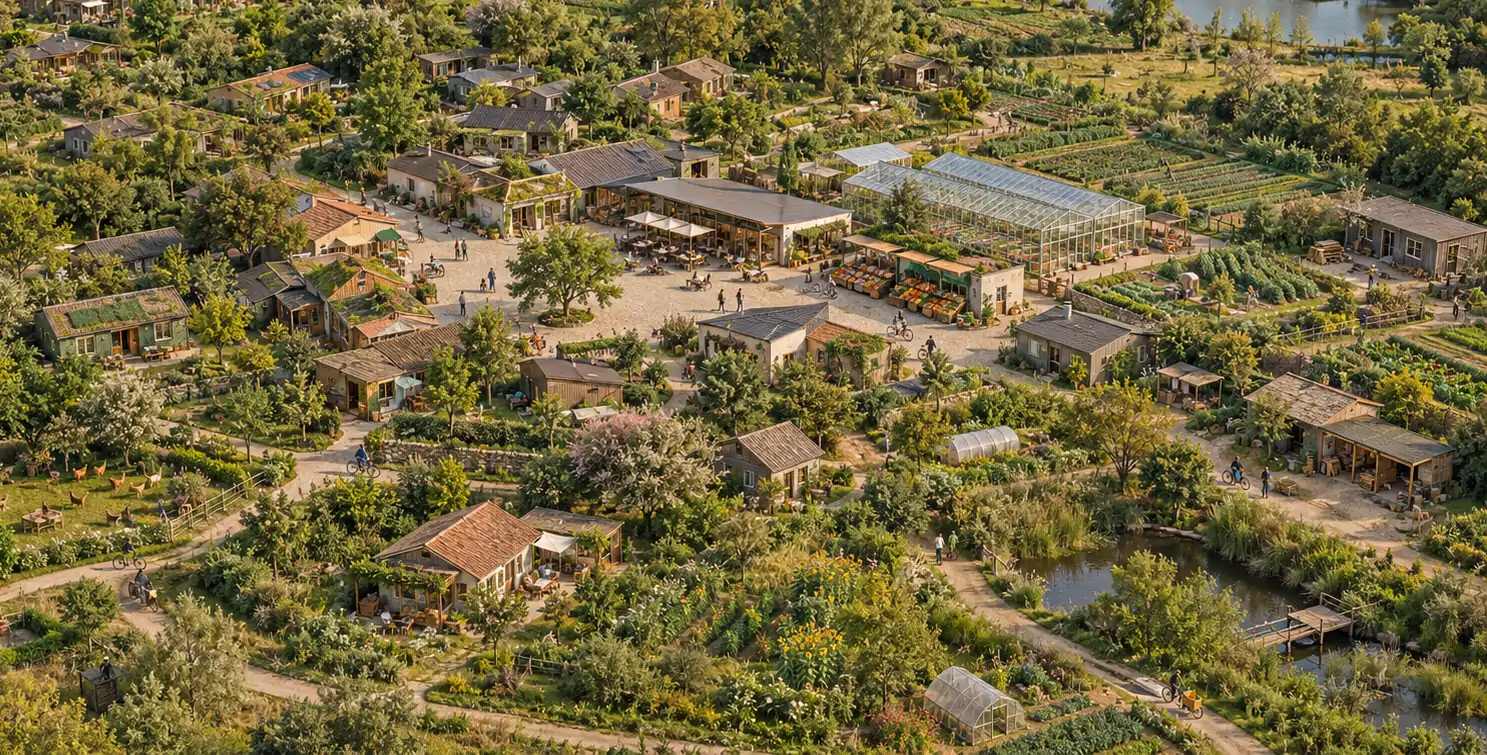
18.1 A global democratic civilisation
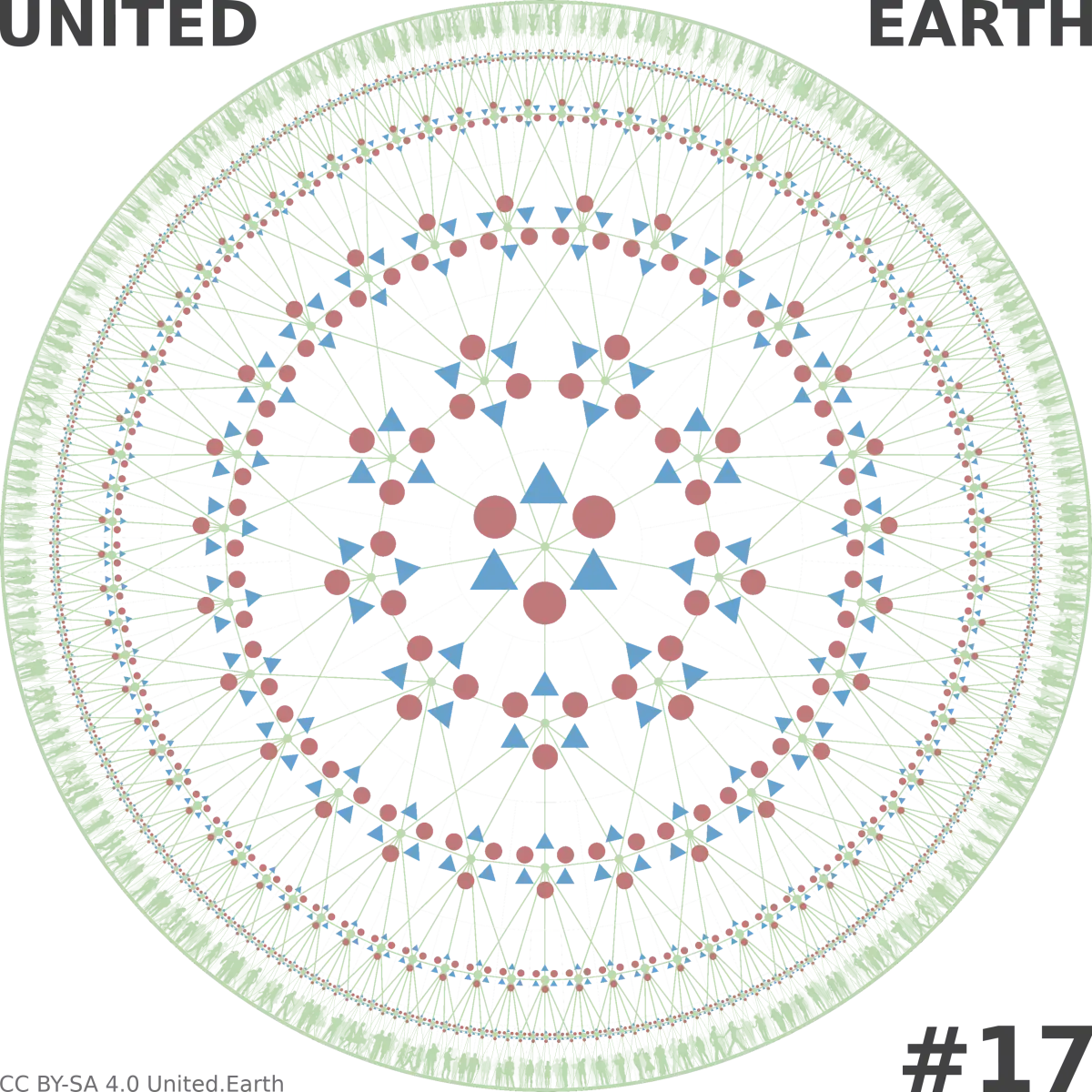
Earth civilisation is democratic by necessity rather than by doctrine. Decisions with planetary consequences require institutions capable of operating at planetary scale, while remaining anchored in local and regional self-government.
The proposed system is a single global democratic state composed of multiple levels of governance, functional units, and institutional layers. Power is distributed rather than concentrated, ensuring that no level can dominate the whole, while all levels remain structurally connected.
Democracy in this context is not limited to representation at the top, but embedded throughout the system: from local communities to regional coordination, bloc-level governance, and global institutions. Democratic legitimacy is generated at every level through the participation of Earth Citizens within the common constitutional order, enabling collective action without erasing local autonomy.
18.2 Governing the planetary commons
Earth civilisation requires explicit governance of shared planetary systems, commons, and territories whose integrity, function, or consequences are genuinely global.
The commons principle defines the broader category. It includes planetary systems such as the atmosphere as well as natural, digital, and other commons whose governance can cross several territorial levels.
The global zone is more specific. It is the territorial geography on and around Earth’s surface in which the global level itself holds the higher territorial executive authority. It includes the oceans, directly global islands and archipelagos, polar domains, maritime routes and chokepoints where direct global jurisdiction is required, and tropical rainforest territories of planetary significance.
Global commons and global zone therefore overlap, but they are not interchangeable. A commons can extend across the blocal zone without becoming direct global territory, while territory within the global zone is governed directly at the higher territorial level by the global constitutional system.
At the global level, the planetary commons receive explicit constitutional status, clearly allocated responsibilities, and enforceable democratic governance. Their global status is a constitutional allocation of jurisdiction and stewardship. Humanity holds them in trust through the global democratic system.
Research, access, resource use, infrastructure, and economic activity can take place within global commons under common rules that protect their integrity, peaceful use, fair access, and long-term continuity. Particularly vulnerable commons may instead be governed primarily for preservation and restoration, with major exploitation requiring exceptional democratic and scientific justification.
Within the global zone, people retain the same constitutional rights, Earth Citizenship, cultural self-determination, and democratic standing as elsewhere. Regional and local self-government continues under subsidiarity.
The global level performs the higher territorial executive, security, and enforcement functions that blocs perform within the blocal zone. Loci and societal regions retain ordinary public administration, public services, policing, and other responsibilities appropriate to their level.
The mature territorial chain is therefore:
locus → region → global
rather than:
locus → region → bloc → global
Across the blocal zone, planetary commons and global responsibilities are instead implemented through binding global frameworks together with blocs, regions, and loci wherever subsidiarity permits.
Global security capacity consequently includes the military, executive, maritime, emergency, and enforcement capacity required to govern and protect the global zone in practice, while bloc-based territorial security remains the corresponding higher structure within the blocal zone.
Their governance must connect climate stability, biodiversity, ecological restoration, security, scientific knowledge, and economic coordination rather than treating them as separate policy fields. Through continuous democratic stewardship, the global system replaces fragmented agreements and geopolitical competition with one coherent constitutional responsibility.
The wider Solar Commons extends the same principle beyond the immediate planetary domain, as described under The commons principle.
18.3 Nature/humanity: 50/50
Regional level
This image presents the 50/50 principle as a regional pattern. The dark field represents continuous nature regions where ecosystem sovereignty takes priority and human intervention is limited, regulated, and constitutionally constrained. The light field represents societal regions organised for settlement, food production, forestry, infrastructure, mobility, culture, and economic life.
Both are regions in their own right at the same governance level. Within the blocal zone, they form the regional structure through which humanity’s civic footprint is connected with a continuous natural commons. The same regional distinction applies within the global zone wherever inhabited societal regions and nature regions are required.
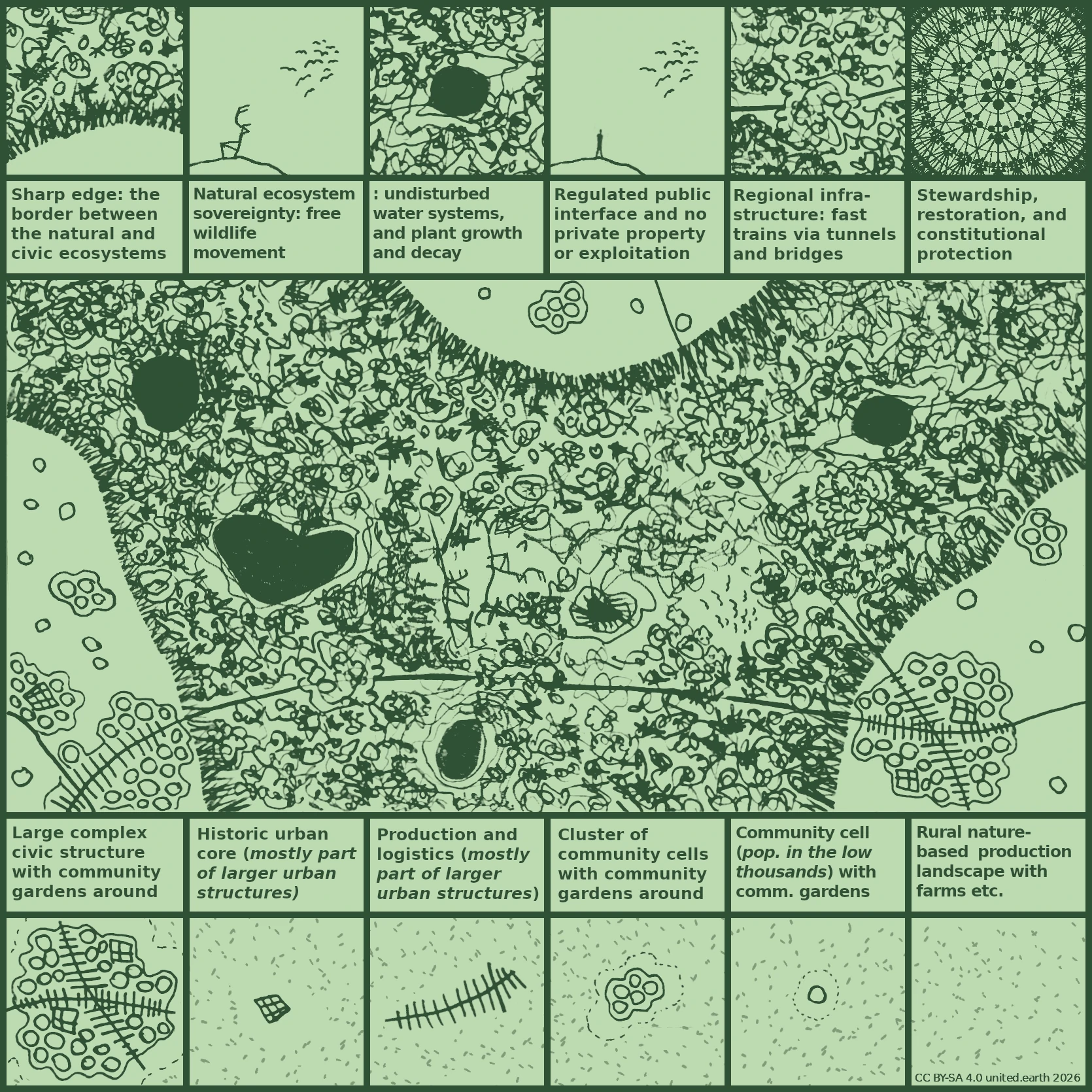
Local level
This image shows how the two regional regimes meet at the local scale. The upper legend defines the internal logic of nature regions: sharp edges, ecosystem sovereignty, free wildlife movement, undisturbed water systems, natural plant growth and decay, regulated access, light-touch crossings, and constitutional stewardship.
The lower legend defines the societal region as a managed ecosystem for human life: community cells, clusters, historic urban cores, production and logistics structures, larger civic formations, and rural landscapes for food and forestry.
The central field shows how these two regimes meet through a legible territorial structure linking commons protection, land use, infrastructure, and everyday habitation.
Half of the land and half of the oceans
The 50/50 principle proposes that roughly half of Earth’s land area and half of its ocean area should be secured under ecosystem sovereignty. The two categories are assessed separately, so extensive protection of the oceans cannot compensate for continued fragmentation of the land, or the other way around.
Land within the global zone is included in the terrestrial 50/50 balance on the same ecological basis as land within the blocal zone.
50/50 is a global result target rather than an identical territorial quota for every bloc or region. Its actual geography must be developed through a global ecological and land-use plan that considers population density, urbanisation, the land and marine areas required for food, forestry and other necessary nature-based production, the location of intact ecosystems, restoration potential, and the need to create large connected ecological systems.
The resulting balance can therefore differ between blocs and regions. Some may contain more than half nature regions, others less, while the global terrestrial and marine targets are achieved as coherent ecological systems rather than as mechanically repeated percentages.
This raises the planning requirements at the global, blocal and especially regional levels. The two regional forms — nature regions and societal regions — provide the principal territorial mechanism through which the global 50/50 pattern is developed and maintained.
The principle is inspired by E. O. Wilson’s Half-Earth proposal, but develops it into a territorial and constitutional model for Earth civilisation. It seeks to provide the large, connected spaces required for biodiversity, ecological adaptation, migration, reproduction, and the free continuity of life processes.
The remaining half constitutes humanity’s civic footprint. It includes the territories and marine areas primarily organised for settlement, food production, forestry, transport, energy, economic activity, culture, and other human purposes.
Both halves remain parts of the same living Earth system. The distinction concerns what they are primarily organised to serve. Ecosystem sovereignty has priority within one half, while the other is organised to support human civilisation within the Rights of Life, the commons principle, and ecological limits.
Two parallel types of regions
On land, the 50/50 principle becomes part of the regional structure itself. Across both territorial zones, land can be organised through two parallel types of regions: societal regions and nature regions. Their higher territorial relationship differs — through a bloc in the blocal zone and directly to the global level in the global zone — but their regional constitutional status remains the same.
Societal regions organise human settlement, civic life, infrastructure, agriculture, agroforestry, industry, energy, transport, and economic activity. They follow the ordinary democratic architecture of populated governance units.
Nature regions organise the protection and restoration of continuous ecosystems under ecosystem sovereignty. They have dedicated regional stewardship authorities, constitutionally accountable for ecological integrity, access, restoration, monitoring, and the regulation of permitted human activity. Their institutional structure is reduced and specialised. Permanently resident communities participate through loci and a compact regional democratic body, without acquiring authority to redirect the ecological purpose of the territory.
Both are constitutionally recognised regional units at the same governance level. Nature regions are therefore not reserves contained within societal regions, residual spaces between them, or territories administered for their benefit. They are regions in their own right with a fundamentally different purpose and institutional form.
Within the blocal zone, the two region types together realise the 50/50 principle. Their boundaries are established and revised by the bloc in consultation with the affected regions and loci. Within directly global land territories, the same responsibility belongs to the global level in consultation with the affected lower-level governance units. In both cases, ecological knowledge, democratic deliberation, and the need to create coherent natural systems across governance boundaries guide the process.
Planetary rainforest systems
The great tropical rainforest territories of planetary significance receive an additional layer of protection.
They are organised regionally as nature regions under ecosystem sovereignty, while their higher territorial jurisdiction belongs directly to the global zone.
These are two distinct constitutional protections. Ecosystem sovereignty determines the primary purpose and internal governance of the nature regions. Global-zone status prevents the same planetary ecological system from being divided at the higher territorial level among competing blocs.
The principle applies to the major tropical rainforest systems of the Amazon basin, the Congo basin, and tropical South and Southeast Asia, with exact boundaries determined through ecological mapping, democratic deliberation, and constitutional development.
Where such rainforest territories occur on an otherwise blocal continent or island, their direct global status does not require the surrounding territory to share that status.
Ecosystem sovereignty
Ecosystem sovereignty means that the continuity and integrity of ecological processes possess constitutional priority within nature regions.
Wildlife must be able to move freely. Water systems must flow with minimal interruption. Plant life must be able to grow, reproduce, die, decay, and regenerate according to its own dynamics. Ecosystems must retain the space and connectivity required to adapt over time.
Human institutions remain responsible for protecting, restoring, monitoring, and administering nature regions. Their governing authority is limited, however, by the ecological purpose of the territory. Nature regions cannot be reorganised as ordinary areas for settlement, private property, production, or resource extraction.
Existing resident communities retain their constitutional rights and compatible forms of life and stewardship. New, purpose-bound 1000-Year Earth Sanctuaries may also be approved where they strengthen ecological stewardship and living biodiversity without compromising ecosystem sovereignty.
Human institutions govern the protection of nature regions, but they do not govern their ecosystems for human purposes.
Nature regions contain no permanent private property. Existing private titles are gradually transitioned into collective stewardship through the processes described under The Commons Principle.
Land, buildings, facilities, and rights of use within these regions are held collectively and remain conditional upon their compatibility with ecosystem sovereignty.
Humanity’s civic footprint
Humanity’s civic footprint comprises the societal regions and other areas primarily organised for human life and activity. It is not a zone of uncontrolled development, but a carefully designed and managed ecosystem for settlement, food production, forestry, mobility, culture, and economic life.
Societal regions gradually form more coherent systems of settlements, infrastructure, production landscapes, and civic environments. Agriculture, forestry, transport, energy, logistics, and urban development are coordinated regionally so that human activity occupies a clear and disciplined territorial structure.
This reverses the dominant contemporary pattern. Nature currently survives largely as fragmented islands within an almost continuous human landscape. In the proposed pattern, nature regions form the continuous system, while societal regions become clearly bounded islands, peninsulas, corridors, and defined extensions within it.
Humanity remains part of nature within the civic footprint. Settlements, farms, forests, gardens, parks, waterways, and infrastructure all form living ecological environments. The difference is that these landscapes are organised primarily to support human society, while remaining subject to ecological limits and the Rights of Life.
The civic footprint must therefore become more spatially disciplined, productive, resilient, and beautiful. Its purpose is to provide good conditions for human life without continuously expanding into the territories required for the free continuity of other life.
Sharp edges and light-touch crossings
A sharp edge is a concrete legal, administrative, and spatial boundary between a societal region and a nature region.
The boundary identifies where ordinary rights of settlement, construction, ownership, agriculture, forestry, production, and infrastructure development end. It prevents gradual encroachment, speculative expansion, endless sprawl, and the continued fragmentation of natural habitats.
The edge is sharp as a matter of governance and land-use authority. Ecological transition zones, floodplains, shorelines, buffer habitats, and other natural gradients can extend across it where required by the ecosystem.
The competent higher territorial authority determines the overall boundaries in consultation with the regions because the pattern must remain coherent across large territories.
This will normally be the bloc within the blocal zone and the global level within the global zone. Global coordination ensures continuity where ecosystems, watersheds, migratory routes, and nature regions cross bloc borders.
Infrastructure connecting societal regions can pass through nature regions where necessary. These connections must be designed as light-touch crossings, primarily through tunnels, bridges, and other solutions that preserve wildlife movement, water systems, vegetation, and ecological continuity.
Ordinary development cannot follow these crossings into the surrounding nature region. A transport connection remains a limited passage through the natural commons rather than a corridor for settlement and commercial expansion.
The marine pattern
The same 50/50 principle applies separately to the oceans. Roughly half of the ocean area forms a continuous marine natural commons under ecosystem sovereignty, while the remaining half accommodates regulated human activity such as shipping, fishing, energy production, cables, research, aquaculture, and other maritime uses.
Marine nature areas must protect migration routes, breeding grounds, food webs, seafloor ecosystems, coastal connections, and the movement of species across climatic zones. Their boundaries and internal connections must be based on ecological systems rather than existing territorial claims or the immediate economic interests of individual actors.
Necessary transport, research, monitoring, and infrastructure can pass through or operate within marine nature areas under clearly defined conditions. The integrity and continuity of the ecosystem remain the governing purpose.
The oceans lie within the global zone, so the global level holds the higher territorial responsibility for the marine pattern as a whole. Blocs, coastal regions, and local communities retain subsidiary responsibilities where marine systems connect with ports, shore infrastructure, coastlines, fisheries, local livelihoods, and other functions appropriately governed closer to the communities concerned.
The 50/50 distinction therefore operates within one global maritime jurisdiction: roughly half of the ocean is organised primarily under ecosystem sovereignty, while the remaining marine space accommodates regulated human use under the same global constitutional order.
The 50/50 principle adapts the foundational concept proposed by biologist E. O. Wilson in his ‘Half-Earth’ thesis into a binding territorial and constitutional model for Earth civilization. See E. O. Wilson’s “Half-Earth” concept on its website, and Wikipedia
18.4 Permanent peace as a structural condition
Peace in Earth civilisation is an actively maintained structural condition. Conflict remains an inherent feature of complex societies, but institutions are designed to identify, mediate, contain, and resolve it before it develops into uncontrolled escalation. War is treated as a systemic failure.
The global and blocal peacekeeping system makes peace substantially more robust by constraining the pathways through which conflict can intensify. Distributed military authority, shared situational awareness, transparent procedures, early intervention, and coordinated escalation control reduce both the probability of large-scale violence and the probability that limited violence develops into wider war.
Permanent peace also depends on preventing identity conflicts from becoming renewed struggles for independent territorial coercive power. Cultural identities can remain strong, organised, and politically active, while democratic, judicial, cultural, and security institutions provide peaceful channels for recognition, disagreement, and conflict resolution. Where organised actors attempt to turn identity mobilisation into territorial power through coercion, the peacekeeping system provides the ultimate common security guarantee.
Where conflict is already entrenched, the same system does more than deter renewed war. It establishes protected institutional peace, supports constructive settlement, and protects the time and civic space required for shared society and social reconciliation to develop.
Peace therefore becomes a substantially more durable outcome of institutional design: protected both against renewed organised violence and against the structural conditions that allow entrenched conflict to reproduce itself. It remains vulnerable to human error and institutional failure, but is far more likely to endure than under a system dependent on unstable balances of sovereign power, deterrence, and improvised crisis diplomacy.
18.5 Prosperity and justice within ecological limits
Economic life begins in local communities, where people provide for their needs, care for one another, work, produce, exchange, and build shared life. Economic policy aims to strengthen their capacity to sustain themselves, shape their own development, and create the conditions for good, free, meaningful, and materially secure lives.
Regional planning coordinates the physical and ecological systems on which local economic life depends, including land, food, water, energy, infrastructure, transport, production, and ecosystem restoration. Blocal and global institutions provide redistribution, stabilisation, interoperability, and protection against concentrated economic power where the required action exceeds the capacity of lower levels. Across blocs, common investment and redistribution can also prevent extreme disparities from becoming durable structures of dependency, coercion or strategic domination.
Economic and social institutions also support the constructive side of permanent peace. Where organised violence has been contained, reliable access to work, housing, food, care, public services, infrastructure and economic participation helps turn protected institutional peace into a functioning shared society. Security protects the civic space in which this can develop; economic and social life gives people practical stakes in the common institutions they share without requiring a common cultural identity.
Reliable life-supporting systems form the material foundation of prosperity, but prosperity extends beyond survival and stability. It includes health, freedom, meaningful activity, social participation, cultural life, security, and real opportunities to flourish. Economic institutions remain practical tools for achieving these conditions, not ends in themselves.
Housing illustrates this ordering of priorities directly. The economic system should secure every person’s access to a stable home compatible with a good standard of living before scarce land, materials, energy and building capacity are extensively allocated to additional private dwellings for people whose basic housing needs are already met. Once this foundation is secured, remaining capacity can be used for additional housing and accommodation beyond primary need. The precise balance between ownership, rental, shared use, temporary accommodation and additional private housing remains a matter for democratic policy within available resources and ecological limits.
Justice requires the fair distribution of risks, benefits, opportunities, and obligations. The economic system must not depend upon structural exploitation, and present prosperity must not destroy the capacity of future generations to live well within planetary boundaries.
18.6 Millions of 1000-Year Earth Sanctuaries
A living network across Earth. The dots illustrate how 1000-Year Earth Sanctuaries could be distributed throughout societal and nature regions, forming a global backbone for living agrobiodiversity and long-term food security. In nature regions, sanctuary functions must remain compatible with ecosystem sovereignty.

Photo: rawpixel.com / Magnific — Designed by Magnific.
A global sanctuary network for agrobiodiversity and food security
Living diversity: seeds are grown, selected, improved and shared, carrying biological potential and practical knowledge into the next generation.
1000-Year Earth Sanctuaries would be purpose-bound places for long-term ecological stewardship in which living agrobiodiversity, ecological restoration and, where appropriate, human habitation are developed together. They would preserve, cultivate, develop and share locally adapted seeds, crops and other biological resources. Sustained by people who make ecological stewardship part of their lives, this living work complements seed vaults and research collections and strengthens the foundations of long-term food security.
Millions of sites are possible. An illustrative average of 50 sanctuaries across 40,000 regions would mean two million places worldwide. The network could begin with far fewer, recognise existing initiatives and grow as new places are established. These figures illustrate potential reach, not quotas or prescribed targets.
The 1000-Year Earth Sanctuaries programme sets out how this work can begin now.
Earth civilisation needs a geographically distributed foundation for the genetic diversity on which local, ecological production of food and other nature-based products depends.
Seed vaults and scientific collections are essential, but cannot replace continued cultivation, breeding, adaptation and the practical knowledge developed in living places. Sustaining this agrobiodiversity is a permanent public responsibility.
A living network within the 50/50 structure
The network belongs within Nature/humanity: 50/50. In societal regions, sanctuaries may integrate homes, cultivation, research, and ecological restoration. In nature regions, they may include existing Indigenous and other resident communities whose stewardship protects ecosystems, wild genetic diversity, and compatible traditional uses. Their participation is voluntary, and recognition must respect their rights, institutions, and knowledge.
New 1000-Year Earth Sanctuaries may also be established within nature regions where a documented ecological and stewardship need justifies a limited permanent human presence. Proposed by independent, purpose-bound stewards or other qualified initiatives, they require approval by the region’s dedicated stewardship authority, with affected Indigenous peoples and other rights-holders appropriately involved. Such places can serve as local bases for ecological monitoring, restoration, living genetic diversity, and stewardship of the wider nature region. Their physical footprint and permitted activities must remain compatible with ecosystem sovereignty. Access must use existing or ecologically light-touch connections, without opening ordinary roads, settlement corridors, or resource-extraction routes. Their land counts within the nature half of 50/50 only for as long as its actual use meets the applicable ecological criteria.
The possible scale is considerable, even if individual places remain small. At an illustrative 10 hectares per sanctuary, two million sites would together occupy 200,000 km², about twice Iceland’s area and equivalent in area to approximately 1.3% of global cropland (FAO, 2023). This is a comparison of total area, not a proposal to convert existing cropland or to require ten hectares at every site. Site sizes, purposes and numbers of residents would vary, particularly between the two regional forms.
Existing Indigenous communities, seed-saving networks, regenerative farms, research initiatives and intentional communities may join voluntarily, with their rights, knowledge and institutions respected. New places may also be established. No single identity, belief, technology or form of community defines a sanctuary.
Strong rights to reproduce, breed, improve, exchange and freely distribute stewarded biological material must coexist with biosafety, ecological safeguards and the rights of traditional-knowledge holders. Networked sites share genetic resources, skills and research with wider agriculture and society.
Sanctuaries as integrated living systems
Sanctuaries maintain locally adapted seeds, crops, livestock, wild relatives, habitats and ecological relationships. This diversity cannot be sustained as isolated biological material: it depends on living cultivation systems, functioning habitats, soils, water cycles and the practical knowledge that connects them. Where people live and work within a sanctuary, these ecological systems also interact with buildings, energy, sanitation and other infrastructure. The sanctuary as a whole should therefore be planned and developed as an integrated living system rather than as a collection of separate land uses, buildings and infrastructure projects.
In nature regions, any inhabited sanctuary must integrate all applicable aspects of land use, cultivation, water, nutrient cycles, soils, habitat, energy, buildings and other infrastructure within the local ecosystem.
In societal regions, sanctuaries should aim to make settlement itself part of long-term ecological restoration and local resilience, and to become as locally self-supporting as practicable while remaining integrated with the surrounding societal fabric where shared systems provide the more appropriate solution.
People who choose to carry the work forward
A sanctuary can be an attractive place to build a home and a life among gardens, orchards, productive landscapes and shared work, without prescribing how its residents should live or engage with the wider world. Some sites may embrace advanced science and global exchange, others simpler methods.
The stewardship work calls for dedication beyond ordinary investment and project horizons. Intentional communities may be particularly well suited because stewardship can be a shared, freely chosen way of life. Indigenous communities, farming families, researchers and others bring their own forms of continuity. Sanctuary residents retain the same choices about technology, global engagement and democratic participation as all Earth Citizens.
Residents need secure, long-term rights to their homes and livelihoods, a voice in community life and protection against arbitrary eviction. Descendants should have priority to continue living and participating there if they freely accept the lawful sanctuary purpose. This supports intergenerational knowledge without creating inheritable land ownership, hereditary public authority or compulsory membership.
Where a sanctuary organisation exercises substantial practical authority over housing, work, care or participation, safeguards must include an independent route for reporting, review or escalation outside the authority implicated in a serious complaint. Sanctuary arrangements remain subject to ordinary constitutional rights, public law and access to the courts.
Where demand exceeds capacity in societal regions, local and regional governance units should enable expansion or new sanctuaries on suitable land within the 50/50 framework. Within nature regions, any additional sites or enlargement must instead be justified by ecological stewardship needs and compatible with ecosystem sovereignty, not by residential demand alone. The network should be able to grow in number and area where its protected purpose can be sustained.
A thousand-year commitment
Sanctuary land remains part of the commons. Its distinguishing feature is constitutionally protected stewardship for at least 1,000 years, under independent, transparent arrangements subject to oversight and judicial review. Institutional forms remain open to democratic development. Neither residents nor operators can privatise the land or essential protected assets. Identity-based communities may organise their voluntary internal affairs, but sanctuary status creates no territorial sovereignty or identity-based public governance.
A viable sanctuary cannot be reclaimed or converted for ordinary political, fiscal or commercial reasons; altering the constitutional guarantee requires constitutional revision. Rights and ecological and social standards remain enforceable. Serious stewardship failure calls for independently reviewed transfer to a qualified successor bound by the same purpose. If irreversible environmental change makes a site unsuitable, equivalent protection must follow suitable replacement land, never serving as a pretext to release a viable site for development.
Sanctuaries may offer emergency refuge when capacity and safeguards exist. Assistance must not require religious, political or organisational conformity, and temporary refuge does not automatically grant permanent residence or membership.
By recognising and supporting those already doing this work, while making room for many more, Earth civilisation can grow a living backbone of agrobiodiversity and resilience — rooted locally, connected globally and protected across generations.
18.7 A civilisation designed for uncertainty
Earth civilisation is designed for a dangerous and uncertain world. Human error, conflict, natural hazards, technological failure, and unforeseen events remain unavoidable parts of existence.
The task of governance is to prevent humanity from amplifying these risks into avoidable civilisational catastrophe. Institutions are designed to detect danger early, absorb shocks, correct mistakes, and contain escalation before nuclear war, ecological breakdown, uncontrolled technological races, or other systemic failures place life on Earth at unnecessary risk.
Resilience is built through distribution as well as coordination. Authority, critical capacities, knowledge and infrastructure should not depend on a single institution, network, bloc or governance level whose failure or capture could bring down the whole system.
The same institutions should increase humanity’s collective capacity to reduce suffering, protect the conditions for life, and expand the possibilities for health, freedom, meaning, security, and well-being.
The proposed system offers no guarantee of survival or success. Its more modest and fundamental purpose is to make humanity less likely to destroy what sustains us, and more capable of improving life together.
19. Earth Citizenship
Earth Citizenship describes how the structures outlined in this proposal (WHAT) are lived and experienced by individual people. It is the common legal and constitutional status through which every person belongs to the shared political order, is protected by it, and can participate in it. Its practical meaning therefore extends far beyond formal membership alone.
Where Earth civilisation describes the coherence of the system as a whole, Earth Citizenship describes the position of the individual within it: the rights, responsibilities, protections, and opportunities that arise when governance, economy, security, and ecological responsibility are organised across all levels while remaining anchored in local society.
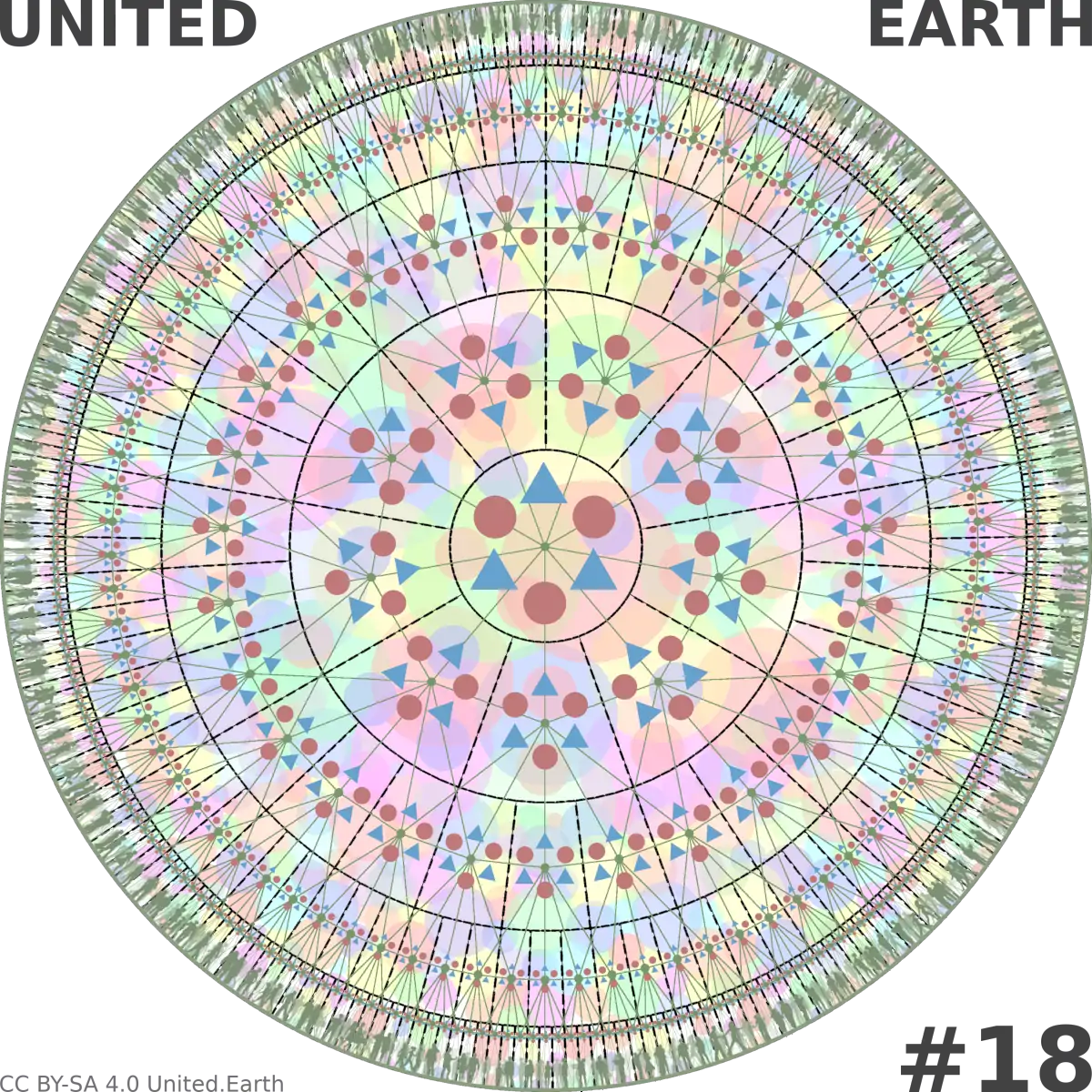
WHEEL < 18/18 >
We, our identities, and the structure
This Earthwheel shows the complete institutional structure described across this proposal, together with the overlapping cultural patterns of human life: languages, traditions, beliefs, communities, and ways of belonging.
These identities cross territorial boundaries and coexist within the same constitutional framework. Earth Citizenship provides the shared political status through which individuals belong to and participate in this structure while remaining free to belong to diverse cultural identities.
Claim your Earth Citizenship (EC) and influence United Earth
You are now in the theoretical basis of the United Earth project (WHY-WHAT-HOW). If you like this initiative, the best way to support it is to sign up for our symbolic Earth Citizenship (>>>) and, by that, contribute directly to growing the movement that makes it go from symbolic to real. Then, find our other spheres of participation:
19.1 Citizenship beyond identity
Earth Citizenship(EC) does not replace cultural, linguistic, national, religious, ideological, or local identities. It provides a shared political status and constitutional framework within which people belonging to different identities participate on equal civic terms.
A person may belong strongly to a nation, religion, ethnicity, ideology, language community, locality, profession, movement, or many other identities. Earth Citizenship establishes equal political standing without requiring cultural sameness.
Earth Citizenship is a constitutional status, not an identity requirement. A person may identify strongly as an Earthling, weakly, or not at all. The constitutional order requires equal civic membership, not emotional, cultural or ideological identification with humanity as a single people.
Citizens remain free to form, express, develop, organise, and participate in diverse identities and communities. These identities can contribute knowledge, values, interests, arguments, traditions, and political ideas to public life. Civic rights, political standing, and democratic participation belong equally to citizens regardless of identity.
Where a present-day state democratically enters the constitutional order, the resulting civic status also applies to those who opposed accession. The democratic decision binds legal membership; it does not define anyone’s personal identity or reduce their right to maintain, organise and express it.
Earth Citizenship is therefore a political status shared across differences, not another cultural identity intended to replace them.
19.2 Participation on all levels
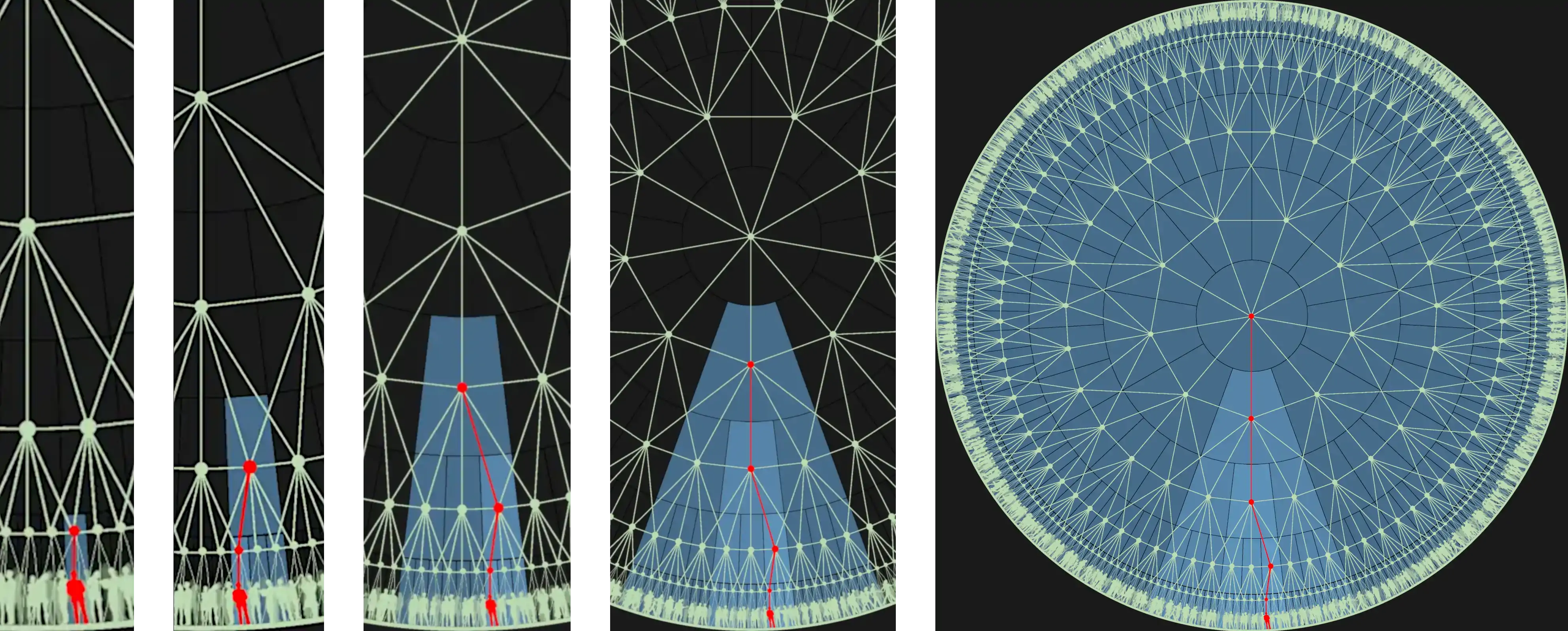
In the proposed system, Earth Citizens will be able to vote via AGORA at all levels of global democracy. We will deliberate and vote on all types of issues that interest us continuously throughout the year. This is a real direct democracy. Annually, there are elections for members of parliament (local to global in a five-year cycle). MPs are now stewards of the democratic process, but they no longer vote on our behalf.
NB! The image is based on the five-level version of the system, which includes the sub-bloc level in the middle.
For each Earth Citizen, the applicable territorial jurisdictions are determined by the citizen’s registered primary locus. A person’s verified home address normally establishes this primary locus. Within the blocal zone, the mature chain is locus, region, bloc and global, with a transitional sub-bloc where that level still applies. Within the global zone, the chain is locus, region and global.
These are not separate citizenships, but the territorial jurisdictions within which the rights, duties and democratic participation of one common Earth Citizenship are exercised.
One citizen within the node network
The illustration shows the governance system from the perspective of one Earth Citizen.
The complete network on the right represents the federated AGORA structure. The red person at the outer edge is one citizen. The red route follows that citizen through the governance units and AGORA nodes connected to their primary locus, from the local level through the intermediate levels to the global node.
The enlarged views on the left progressively move closer to this individual relationship. What appears as an enormous network when seen as a whole becomes a relatively simple constitutional path when seen by one citizen.
The citizen does not need to relate democratically to every governance unit on Earth. Their binding political participation follows the specific chain of units to which they belong.
A local question is decided within the relevant locus. A regional question is decided by the Earth Citizens belonging to that region. Where sub-blocal or blocal levels apply, the same principle applies there. Only at the global level do all Earth Citizens belong to the same democratic jurisdiction.
The constitutional allocation of competence determines which level may make the decision. Earth Citizenship and the primary locus determine which citizens belong to the electorate for that decision.
Information and voting through AGORA
The same node relationship allows AGORA to connect each citizen to the democratic processes relevant to them.
Proposals, elections, voting information, Council assessments, material from Science, Ethics and Culture, public deliberation, and institutional records can be associated with the governance unit responsible for the process and made available to the citizens who belong to it.
When a citizen participates, AGORA can therefore establish both the relevant political process and the citizen’s constitutional relationship to it.
This does not mean that votes travel upward through the hierarchy or are progressively aggregated from locus to region, bloc, and globe.
Each election or substantive vote belongs directly to its competent governance unit. A vote in the locus remains a local vote. A regional vote is cast directly within the regional democratic process. A global vote is cast directly within the global process.
The node network connects these democratic jurisdictions. It does not turn them into stages in one ascending voting chain.
Civic identity and voting eligibility must also remain technically separated from the secrecy of the ballot. The system needs to verify that a person is entitled to vote in a particular governance unit without making their secret vote part of their public civic identity.
From the citizen’s perspective, the result is one coherent democratic environment connecting several scales of political life.
One Earth Citizen, one civic relationship to AGORA, several democratic jurisdictions.
19.3 Rights as conditions for participation
Earth Citizenship carries a common constitutional foundation of rights across the whole global state. These include equal standing before the law, freedom of expression and association, access to public information and democratic processes, and the freedom to move, reside, and work throughout the system, subject only to constitutionally justified limitations.
These rights are fundamental in their own right. They are also practical conditions for meaningful democratic participation, personal agency, and the ability to build a life within the shared political order.
Political rights cannot be exercised fairly where people lack access to knowledge, communication, education, physical security, stable housing, or other basic material conditions required for independent participation.
This includes practical access to AGORA. Democratic rights cannot depend on private ownership of suitable technology, commercial digital services, advanced digital skills, or the ability to communicate in a dominant language. Public access points, accessibility support, connectivity, language services, and other necessary forms of assistance are therefore part of the democratic infrastructure.
Rights are protected both as expressions of human dignity and as structural prerequisites for democracy itself.
19.4 Responsibilities and fair obligations
Earth Citizenship also entails reciprocal responsibilities. Life within a shared political, economic, and ecological order entails fair contributions to the institutions and commons that make shared freedom possible.
These obligations may include taxation and other clearly defined civic duties. They must be established democratically, allocated through the appropriate governance level, and distributed according to capacity and context.
Every obligation must be proportionate, transparent, legally defined, and open to democratic scrutiny and judicial review. This prevents both coercive uniformity and unchecked free-riding while recognising that people live under different material and personal conditions.
These principles also protect subsistence-based and partly non-monetised ways of life. People and communities that meet much of their own needs through local production and exchange must be able to fulfil their public obligations without being forced into unnecessary monetary dependence. Their contributions must reflect actual capacity, their actual use of and burden on shared systems, and the contribution their way of life itself makes to ecological stewardship and resilience.
Where appropriate, obligations may be fulfilled in kind or through public work rather than only in money. Low monetary income resulting from genuine self-provisioning must not in itself make such ways of life economically unviable.
Democratic participation remains voluntary. Taking part in public life is a civic opportunity and responsibility, but citizens cannot be compelled to maintain a particular level of political activity, knowledge, or engagement.
Nor does Earth Citizenship require citizens to develop expertise across every field of politics. People may concentrate their attention where they have knowledge, interest, responsibility, available time, or a direct reason to participate.
Responsibility is therefore understood as reciprocal contribution rather than moral conformity. Citizens support the shared conditions that protect their own freedom and the equal freedom of others.
19.5 Democratic participation on fair premises
Democratic participation in Earth civilisation is continuously available rather than confined to periodic elections.
Through AGORA, citizens can learn, deliberate, develop proposals, participate in elections and substantive votes, scrutinise institutions, and follow how democratic decisions are formalised and implemented.
Participation is voluntary. People can engage at the governance levels and within the policy areas that correspond to their interests, knowledge, responsibilities, available time, and the consequences that affect them.
The conditions for participation are actively maintained as public goods. These include access to reliable knowledge, accessible technology and public interfaces, language support, transparent procedures, opportunities for civic learning, and effective protection against exclusion or retaliation.
Every adult Earth Citizen begins with the same basic political status and the same right to participate.
In substantive political decisions, influence may vary according to relevant verified competence as described in the AGORA architecture. The applicable criteria must be public, attainable, issue-specific, established before the vote, and open to review.
Wealth, popularity, social status, cultural identity, organisational affiliation, and political influence provide no automatic democratic weight.
The purpose is not to create a governing class of experts. Every citizen retains political standing, while relevant demonstrated understanding can carry greater weight within the specific questions to which it applies.
Elections to institutional offices follow a different principle. Candidates compete as individuals for institutional mandates rather than receiving additional electoral weight from their competence ratings.
Political participation remains voluntary, including the choice not to use AGORA or engage in political life at all. Citizens who make this choice retain their full constitutional standing, rights and access to public services. AGORA remains the common infrastructure for formal democratic participation, and choosing not to participate in its processes means foregoing the political influence they provide. Public access facilities, accessible interfaces and appropriate assistance must nevertheless ensure that citizens who wish to participate are not excluded because of disability, limited digital skills or lack of personal technology.
This structure supports broad and informed participation without expecting uniform political interest, expertise, or continuous engagement from every citizen.
19.6 Living locally in a global civilisation
Earth Citizenship is lived locally.
People work, care, create, exchange, participate, and belong within physical places and social relationships. A global constitutional status does not move everyday life away from these communities.
A person’s primary locus connects this everyday life to the wider constitutional structure. It is both the place where much of daily political life occurs and the territorial starting point for the layered democratic relationship illustrated above.
Local communities retain authority over the matters they are capable of governing themselves. Regional, blocal, and global institutions support and protect this agency by coordinating the systems that exceed local capacity and by limiting external political, economic, technological, ecological, and security pressures that communities cannot control alone.
The global political framework does not seek to standardise local life. Different communities can develop different institutions, practices, cultures, economic arrangements, public spaces, and ways of living within the shared constitutional limits protecting equal rights and the wider commons.
This freedom includes the choice to live a largely local and self-provisioning life: growing food, meeting essential needs through local production, participating in voluntary communities, and organising exchange through cooperatives, mutual credit, local currencies and other lawful arrangements.
Citizens must be able to sustain such ways of life without compulsory dependence on blocal or global currencies, digital payment systems or continuous online connectivity. Fair public obligations remain applicable, with provision for non-monetary contributions where appropriate, as described under Responsibilities and fair obligations.
Freedom of movement throughout the system also means that political belonging need not become territorial confinement. People may move, settle, and build new lives elsewhere, with their primary locus and corresponding democratic jurisdictions changing accordingly.
The shared global framework protects cultural and local diversity rather than replacing it. Its purpose is to establish the peaceful, stable, just, and ecologically viable conditions within which different communities can shape their own development.
Earth Citizenship therefore connects three scales of belonging that need not conflict:
the freedom of the individual, participation in the communities where life actually takes place, and equal membership in the political community of Earth.
Earth Citizenship connects universal political equality with concrete local belonging. It enables humanity to act together at planetary scale while protecting the freedom of individuals and communities to shape their own lives locally.