United Earth initiative
Earth democracy
Why it is needed, what it is, and how we build it
This document contains the theoretical foundation of the UE initiative.
We invite everyone to an open discussion on how governance structures can evolve to address global challenges while safeguarding cultural identities within a shared democratic framework.
Claim your Earth Citizenship (EC) and influence at agora.united.earth
PLEASE MAKE SURE YOU HAVE THE LATEST VERSION OF ANY DOWNLOADED DOCUMENTS!
After major upgrades, the web version is compiled into downloadable documents (DOCX/ODT/PDF/MD) available at united.earth/en/documents
This is done for transparency and to preserve a record of its development.
Preface
The first versions of this material were drafted by a small group of engaged individuals calling themselves Worried Earthlings (WE). They have chosen to remain anonymous, partly due to security concerns because of the controversial character of their ideas, but mostly to foster a culture focused on our shared planet and the global society, rather than on individuals.
The name Worried Earthlings — WE — reflects the perspective from which the initiative emerged. Its participants share a strongly developed global awareness and sense of identity as Earthlings. Earth and humanity became the primary political frame through which they approached the problems addressed here, without requiring the abandonment of other personal identities.
WE do not assume that others will share this global identity with the same intensity. Their proposal instead asks whether enough people can develop a global perspective strong enough to recognise humanity as a political community where genuinely global problems require shared democratic action.
WE are convinced that dominant individualism, together with obsolete forms of tribalism, obscures the fact that many of the forces shaping individual and local life now operate globally without democratic control.
Global democratic governance is necessary precisely to protect individual freedom, diverse identities and local societies against these forces.
A fundamental hypothesis coming out of their ideas is that the principle of the sovereign nation-state, or more precisely the connection between cultural identity and governance, is the major obstacle to solving global existential threats.
WE and the United Earth initiative understand how sensitive this issue is, and urge all fellow Earth citizens to join this critical and challenging discussion with mutual respect and solidarity.
The proposal is no threat to cultural identity, like ethnicity, nation, religion, and ideology. It is, though, a rejection of the idea of using identity to exclude others by dominating governance.
The inclusive nature of this project seeks only to promote cooperation and bold thinking in the face of shared global problems threatening us all.
A geopolitical visualisation tool
The earthwheel is both a symbol and an analytical tool. It is designed to make visible a structural feature of today’s geopolitical condition that is difficult to see in conventional hierarchical diagrams: that the hierarchy of governance is incomplete as a whole, and that this incompleteness appears most clearly as a missing global centre.
The combined illustration below brings together three views of the same problem: the populated earthwheel, the empty five-level schema, and the linearised hierarchy. Read together, they show both why the conventional linear form remains useful and why the earthwheel was needed as a complementary model.
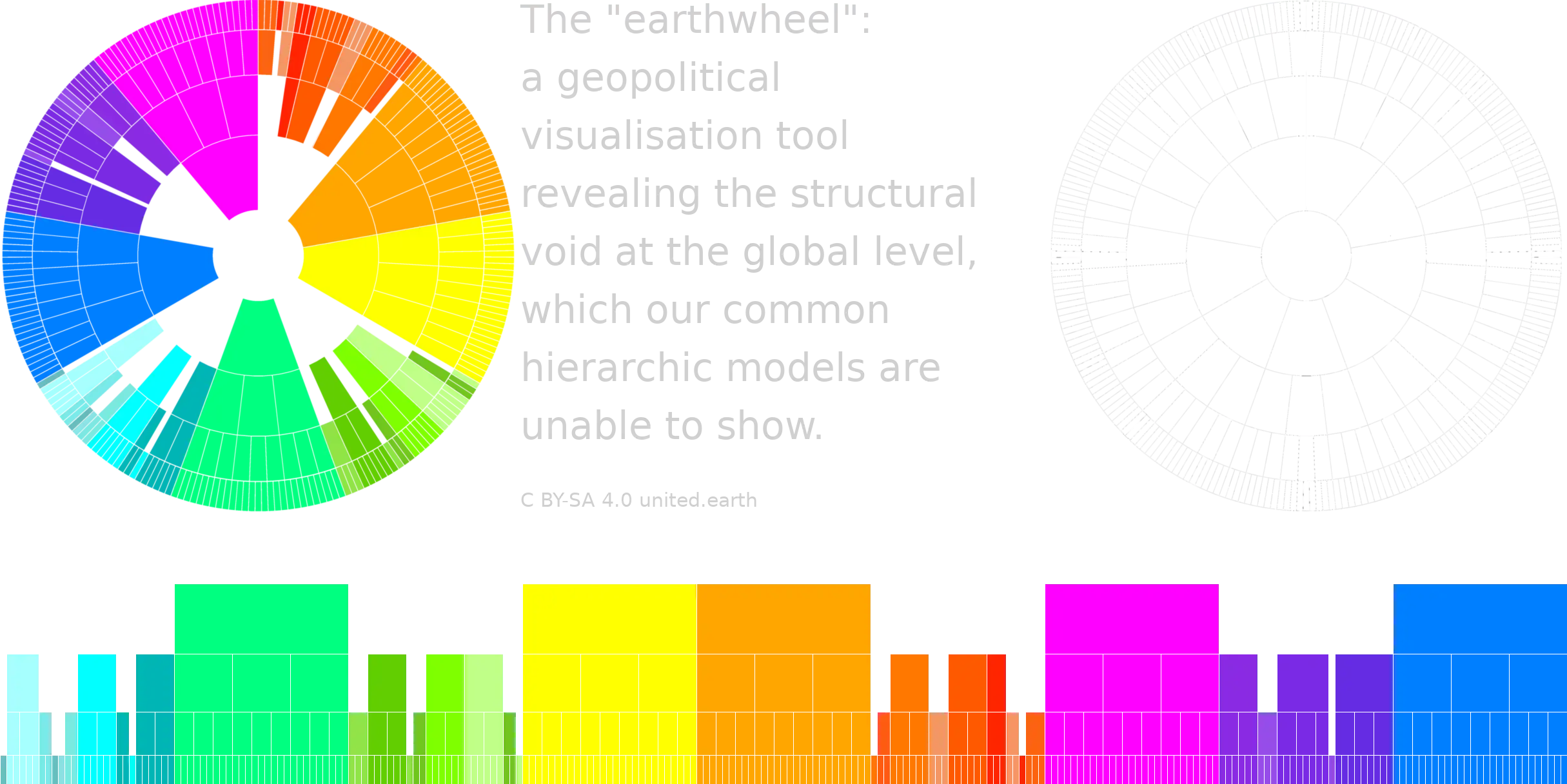
The linear hierarchy is the familiar way of representing nested political levels. It has real strengths. It is immediately legible, it can be extended horizontally with little loss of readability, and it can in principle scale toward a far more empirically complete representation of the world’s nearly 200 sovereign states. In that sense, it is well suited for enumeration and for showing large numbers of distinct units within a vertical hierarchy.
Its weakness is more structural. Once the same geopolitical condition is unfolded into a linear arrangement, what is missing no longer appears as a single absence. The gaps are dispersed between columns, and attention is drawn mainly toward the individual units and their separate heights. This makes the form analytically weaker at revealing a central fact of the present world order: that the global level is absent as such, and that the broader hierarchy therefore remains incomplete.
The empty five-level schema shows the same model in its most reduced form: global, bloc, sub-bloc, regional, and local. It presents the intended geometry of a complete hierarchy before empirical irregularities are introduced. Read alongside the populated earthwheel, it clarifies that the present geopolitical condition is defined not only by the entities that exist, but also by the levels that are absent, fragmented, or unevenly developed.
The earthwheel can be used to analyse geopolitical systems across several dimensions, including:
- Completeness – the degree of organisational development at each level, including whether hierarchical relations exist or are absent
- Balance – proportionality in geographic size, population, military power, economic strength, or other relevant variables
- Sovereignty vs. subsidiarity – how authority and responsibility are distributed between levels
- Identity and legitimacy – how cultural identity relates to political legitimacy, function and democratic authority within each governance entity
The model is deliberately highly abstract. To make the structural point visible, the number of units shown at each level is sharply reduced. The earthwheel is therefore not a literal cartographic rendering of the world’s sovereign states, but a conceptual compression. Its purpose is not to enumerate everything, but to show something that enumeration tends to obscure: where the hierarchy is complete, where it is incomplete, and how that incompleteness defines the geopolitical system as a whole.
How can we build it in time?
Who can found a global democracy when no existing authority can create it?
How can it be built and tested from below before it holds constitutional authority?
How can today’s states and institutions join it and contribute to it?
What can each of us do to help build it?
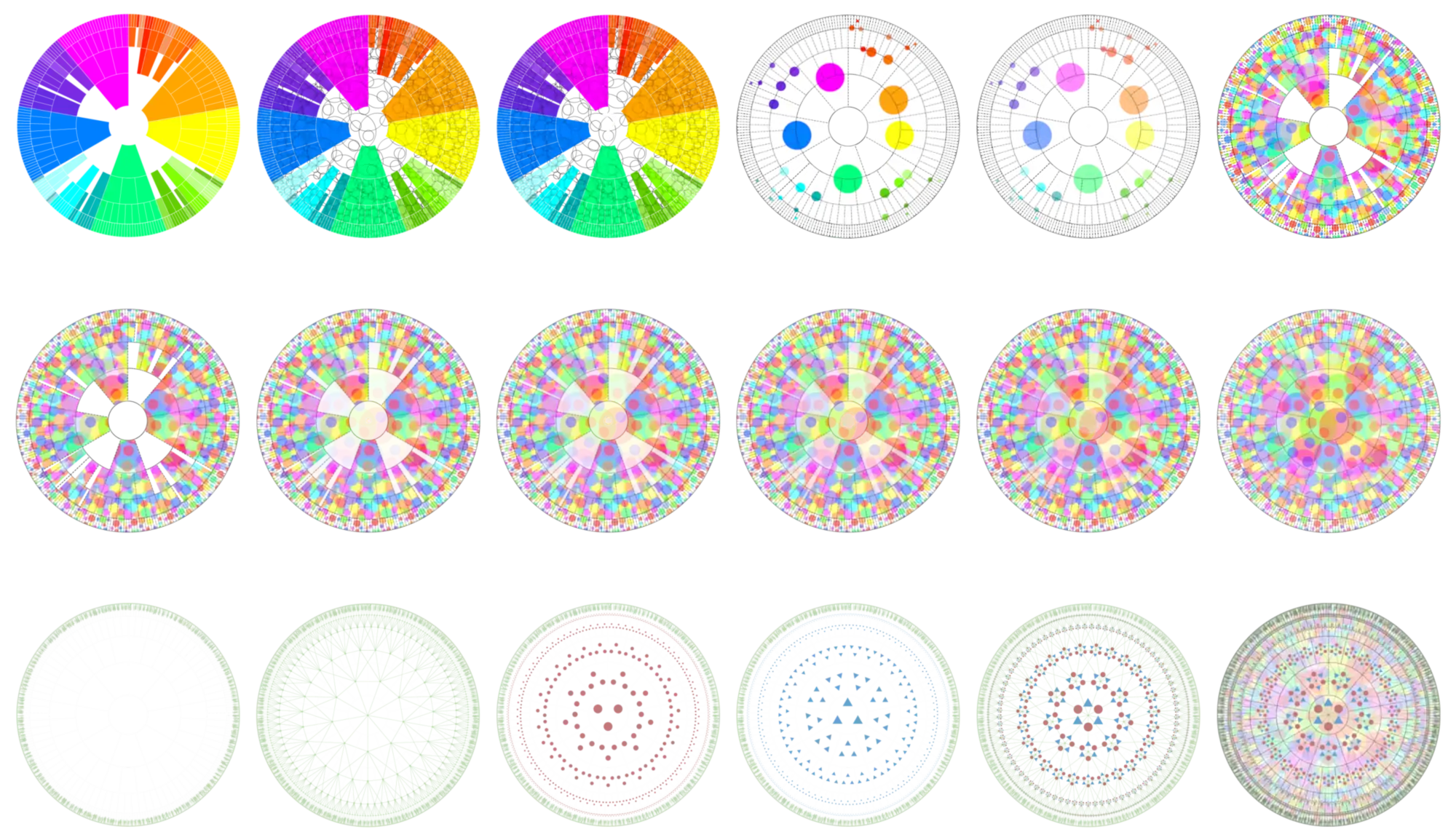
Overview (Earthwheels):
V2026-09-07
Summary
This page sets out a method for building democratic global governance in time: a constituent path through which humanity can create its own global democratic authority without waiting for the present interstate order to overcome its structural limits. Its most urgent purposes lie on radically different timescales: as soon as possible, and ideally by 2027, to stop the race toward superintelligence before it crosses an irreversible threshold; by 2075, to restore the climate. Alongside them, it must mitigate other human-made and natural threats to the biosphere, including threats to our own species.
The United Nations and sovereign states remain openly challenged to establish such authority (“global plan A”), but the method does not depend on it. “Global plan B” builds a new constituent force from below, outside the intergovernmental chain of authority, while carrying forward and repurposing the existing institutions, knowledge and capacities that can serve the new system.
The transition begins with a proto-system that mirrors the system it initiates. Proto-Earth Citizenship (ECp) forms the global political community, AGORA provides its democratic infrastructure, nodes organise it locally, the SEC Council network builds its knowledge and competence base, and proto-parliaments develop institutional practice. The method can be summarised as build → use → connect → constitute: functions are built in proto-form, used on real problems from the start, connected to existing public authority, and constituted as legitimate authority only through valid democratic and constitutional decisions.
The constituent process begins with one founding question: Should Earth Parliament be established? Support for it is not assent to the proposed system or to any later constitutional choice.
Predetermined and independently verifiable rules transfer control as the community grows. At 1 billion verified adult ECp holders, Earth Citizens elect a Proto-Earth Parliament. Its candidates are qualified through the SEC Council network, a temporary safeguard that ends at 2 billion, when ordinary eligibility requirements apply. At 4 billion, the parliament acquires constitutional status as Earth Parliament. Three conditions must then be met: readiness conditions are satisfied, the minimum constitutional operating terms have been established through a vote open to all eligible Earth Citizens, and the parliament itself has been elected by the same electorate.
The UE Pact binds every participating unit of the founding organisation, including the UE Foundation, to this programmed succession, which none may suspend, weaken or reverse. The preferred target is 23 April 2031, the latest 23 April 2035, followed by an operational Earth Federation by 2050.
Until new constitutional authority exists, binding public effect passes through existing institutions. Programmes in seven Global Task Areas give the emerging system real work while it is being built, and temporary UE Parties carry AGORA mandates into existing parliaments.
Territorial authority develops separately from the founding of Earth Parliament. Polities join Earth Federation through gradual and voluntary constitutional entry, the global commons pass domain by domain into global stewardship, replacement security is built before existing protection is removed, and the shifts from ID=GOV to GOV//ID and from five governance levels to four proceed at different speeds in different places.
The following chapters describe this transition, a scenario for 2026–2050, Earth Parliament Day as its annual global pulse, and the deliberately small first step open to each of us: declaring support for establishing Earth Parliament.
United Earth builds the structure. Humanity decides what to make of it.
20. Renewal from outside the UN
Humanity already possesses global institutions, but no democratic global polity. The obvious route would be for the United Nations and sovereign states to use their public authority, resources and worldwide reach to establish one. The analysis (WHY) has shown why the present geopolitical order gives us little reason to expect that transformation from within.
The method (HOW) therefore begins from a fresh starting point: challenge the existing order to build the democratic global authority humanity needs, while simultaneously building an independent path that can grow into that authority from below. What works in the existing system should be carried forward and repurposed. Progress toward global democracy cannot depend on the present order overcoming its own structural limits first.
20.1 From alarm to alertness

A beacon of hope
Here, the same Earthwheel model that showed collective paralysis in the analysis (WHY) shows its opposite. Humanity is no longer a passive grey mass; it appears as a connected, alert citizenry.
At the empty centre, previously shown as a “black hole”, a single point of light now marks a declared beacon of hope: the annual countdown to Earth Parliament Day 23 April, with 23 April 2031 as the preferred target and 23 April 2035 as the latest target date for establishing Earth Parliament. These targets drive urgency, but cannot override the constituent threshold or the readiness requirements described below.
Hey, we are 8 billion! Come on, we can do this!
CC BY-SA 4.0 United.Earth Initiative
The analysis (WHY) ended with the psychological consequences of a world that can recognise global danger without possessing institutions capable of acting on it together. Repeated alarm without an adequate collective response can produce numbness, withdrawal and retreat into political structures that cannot solve the underlying problems.
The answer is collective political agency.
That does not require billions of people to agree in advance on every feature of a future global system. It requires enough people to recognise a common political task and begin building the capacity to work on it together.
That is why the first components are useful before the final constitutional outcome exists. Proto-Earth Citizenship (ECp) begins to form a global political community. AGORA creates a public sphere. Nodes create local organisation. Global task programmes give people substantive work on real problems and bring concrete proposals into the emerging process. SEC Councils organise knowledge and competence. Proto-parliaments create democratic and institutional practice. Earth Parliament provides a common constitutional objective.
Each step makes the next less abstract.
The appropriate response to a proposal of this scale is therefore active testing. Institutions can be built, used, criticised and improved while their political community grows.
Here hope stops being reassurance and becomes a task. The movement is from alarm without adequate instruments to alertness with something concrete to build.
This matters especially for children and young people, who are growing up inside global crises whose consequences will extend far into their lives. A credible political path can give them something more substantial than reassurance: evidence that the problems are being faced, that political structures can be changed, and that they can grow into a global political community capable of acting on the future they will inherit.
For younger generations, participation can begin as learning and democratic practice before it becomes formal political authority. They can grow up understanding the problems, challenging proposed solutions and practising the forms of collective action required to change them.
20.2 The unlikelihood of a UN path toward global democracy
The most obvious response to the need for global democratic authority is that the United Nations and the sovereign states should create it.
They already possess much of what such a transformation would require: public authority, governments and parliaments, electoral institutions, diplomatic networks, administrative systems, financial resources, technical expertise and worldwide institutional reach. The United Nations itself contains an extraordinary accumulation of knowledge, programmes and practical capacity.
Existing political authorities also carry responsibility for responding to the global problems described in the analysis. If the governments of the world can establish a democratic global authority capable of delivering peace, sustainability, social justice and effective action on planetary threats, they should do so.
United Earth therefore keeps this possibility openly on the table as “global plan A”.
The difficulty is structural:
The United Nations derives its authority from sovereign member states. Those states are themselves the holders of the sovereignty that a genuine global constitutional order would have to limit, redistribute and partly supersede. The missing global authority cannot be produced merely by extending the same intergovernmental structure that leaves the global level without independent democratic authority.
Those who believe sovereign states can break through this structural limitation are challenged to demonstrate it. They would have to establish a constituent process whose democratic authority no longer derives from the continuing supremacy of the states themselves.
That is the standing challenge of “global plan A”.
United Earth’s strategy is not based on the expectation that this will occur. The structural analysis points in the opposite direction. Humanity cannot make the creation of global democracy dependent on the institutions of the present interstate condition first overcoming the principle on which that condition is built.
20.3 Building global democracy from below
A new constituent force must therefore be built outside the existing intergovernmental chain of authority.
This is “global plan B”, and it is the path United Earth begins immediately.
The aim is to build the democratic structure through which humanity can constitute its own global political system: first in proto-form before it possesses constitutional authority, then under progressively transferred control of the emerging global demos.
ECp forms the civic basis of that process. AGORA provides its common democratic infrastructure. SEC Councils develop its knowledge and competence base. Proto-Earth Parliament introduces parliamentary governance as the political community reaches sufficient scale. Predetermined transition rules define how control passes from the founding phase to increasingly democratic governance and ultimately to Earth Parliament.
The proto-system is therefore more than a demonstration of what a future system could look like. It is the constituent process through which that system can become real.
United Earth can develop, test and advocate institutional and policy proposals through this structure, both within AGORA and toward existing institutions. Until democratically or lawfully adopted by an authority entitled to decide, they remain proposals.
The founding choice is explicit: support for establishing Earth Parliament. It can be declared before ECp is granted. This is a constituent choice to create the democratic arena itself, not advance agreement with the constitutional or political decisions later made within that arena.
As the number of verified adult ECp holders grows, governance of the proto-system changes with it. At the first population threshold, eligible ECp holders elect a Proto-Earth Parliament through AGORA from a large candidate pool qualified through the SEC Council network, and that parliament assumes democratic stewardship of the central proto-system.
At the next threshold, the special SEC-network route ends and Proto-Earth Parliament is elected through AGORA from candidates meeting the ordinary parliamentary eligibility requirements. At the founding threshold, once the required readiness conditions are also satisfied and the minimum constitutional operating terms required for Earth Parliament itself have been democratically established through a vote open to all eligible participants, including those who have not accepted the proto-system’s Participation Principles, the already functioning Proto-Earth Parliament acquires constitutional status as Earth Parliament.
The transition is therefore based on progressive democratic succession rather than a later handover to an unknown external authority.
Population alone is not enough. Each transition must also allow sufficient time for institutions to mature and must satisfy predetermined requirements for technical readiness, security, resilience, verification and operational capacity. These requirements must themselves be transparent and independently reviewable so that readiness cannot become a discretionary veto over democratic succession.
This path is ambitious because the infrastructure must ultimately operate at civilisational scale. AGORA alone must develop from an early prototype into critical democratic infrastructure capable of serving billions of people securely. The wider system will require technological, legal, scientific, organisational, financial and human resources on a scale appropriate to a planetary public system.
United Earth therefore begins small, but it does not conceive the task as small.
The strategy is simple in principle: build the democratic global system before humanity is forced to choose one in panic.
20.4 The rules of the constituent path
Transition rules determine how the emerging global political community can build Earth Parliament, how control of the proto-system passes to that community, and what must be verified before the parliament can be established.
Building a global democratic institution from below requires such rules to be clear before the decisive thresholds are reached.
These transition rules govern how the structure is built, verified and transferred into democratic control. They do not predetermine the eventual constitutional powers or wider design of Earth Parliament.
Once published, the transition rules cannot be changed in ways that weaken or reverse the programmed transfer of democratic control, create new discretionary vetoes, or allow the incumbent authority to retain control beyond the conditions already established. No change can apply to a threshold already under verification.
Together, these rules define the constituent path: the predetermined route through democratic succession, thresholds, readiness and activation. The constituent process is broader: the growing political process around that path, including Earth Citizenship, AGORA, Proto-Earth Parliament, constitutional deliberation, mobilisation and practical political work.
The UE Pact and the UE Foundation
United Earth begins as a founding proto-organisation that builds and tests functions the future democratic system will need. Its participating units — the UE Foundation, the independent SEC Council network, temporary UE Parties and other units that accede to the UE Pact — carry distinct responsibilities. The political community of Earth Citizens is wider than this organisation: support for establishing Earth Parliament and participation in AGORA do not imply membership in, or endorsement of, United Earth.
The published transition rules of the constituent path bind both the founding organisation and the transitional institutions established under them, including Proto-Earth Parliament. The UE Pact is the founding organisation’s binding proto-constitutional agreement. It binds every participating unit, including the UE Foundation itself, to respect and implement the transition rules. No participating unit thereby acquires authority over democratically elected transitional institutions, whose mandates derive from Earth Citizens under those rules.
The transition rules must provide for independent review of compliance by both the founding organisation and the transitional institutions. That review must cover the rules governing elections, mandates, threshold verification, readiness, democratic succession and amendments to the transition rules themselves, and it must be operational before the first threshold is verified.
It must remain separate from the organisational review exercised under the UE Pact. It protects the validity of the constituent process, but it cannot amend the rules, cannot substitute its judgement for the political decisions of elected institutions and issues no binding public judgments beyond that process.
The UE Foundation is being established as an independent foundation to own, safeguard and develop the shared name, intellectual property, AGORA infrastructure and other critical assets. It does not govern the SEC Councils, and its custodial powers are exercised under the Pact and subject to independent review. Legal ownership of infrastructure or assets does not create political ownership of the emerging democratic system and cannot be used to block the programmed transfer of democratic control.
One founding question
The constituent process begins with one clear political choice:
Should Earth Parliament be established?
Individuals can express their support for this objective before receiving ECp. The constituent thresholds, however, are based on verified adult ECp holders whose support remains valid.
It is a constituent metachoice: a decision to create the global democratic arena in which constitutional and political choices can subsequently be made.
It is not assent to the United Earth proposal as a whole, to the constitutional architecture developed in the proposal (WHAT), to a future Earth Constitution, or to any particular policy, programme or political decision.
Earth Citizens remain free to argue for, against and change every substantive proposal placed before the emerging democracy.
People below voting age can become Earth Citizens. Age-appropriate learning, discussion and democratic practice will be introduced when the necessary guidance and safeguarding are in place. Only unique and verified Earth Citizens aged 18 or older count toward the constituent thresholds.
Before Earth Parliament is established, an Earth Citizen can withdraw this constituent support. Only unique and verified adult Earth Citizens who remain registered and have not withdrawn count when a threshold is verified. Continued political activity in AGORA or other United Earth activities is not required, but the registry must include a secure and privacy-preserving way to confirm that counted citizens remain eligible to be counted.
Three thresholds of democratic succession
The proto-system is designed so that its governance changes as the global political community grows.
The thresholds are not three separate constituent votes. They are predetermined stages in the transfer of democratic control.
At 1 billion verified adult ECp holders, eligible AGORA participants elect a Proto-Earth Parliament through AGORA from a large candidate pool qualified through the SEC Council network. This is a deliberate and temporary safeguard while the emerging global demos remain unevenly developed and therefore especially vulnerable to coordinated capture. Qualification must follow open, public and reviewable procedures, and sitting Council members cannot hold exclusive control over who enters the candidate pool. The special SEC-network route ends automatically at the next threshold.
At 2 billion verified adult ECp holders, Proto-Earth Parliament is elected by Earth Citizens through AGORA from candidates meeting the ordinary parliamentary eligibility requirements. The special SEC-network route has ended, and the political community that has formed through Earth Citizenship now governs the proto-system directly through its own parliamentary institution. The exact electoral design can be developed as the democratic system matures.
At 4 billion verified adult ECp holders, once the required readiness conditions are also satisfied and the minimum constitutional operating terms required for Earth Parliament itself have been democratically established through a vote open to all eligible Earth Citizens, including those who have not accepted the participation conditions of proto-AGORA, Proto-Earth Parliament becomes Earth Parliament.
Those operating terms are deliberately narrow. They must be sufficient for Earth Parliament itself to function democratically and to define its lawful relationship to territories and people outside its public jurisdiction. They do not settle the wider distribution of public authority, the territorial system, GOV//ID or the other substantive proposals in the proposal (WHAT). Clarifying these minimum terms is one of the central democratic tasks the growing political community must undertake before activation.
The parliament does not need to be invented again at that point. The institution has already been built, tested, democratically governed, and repeatedly elected in proto-form. The threshold changes its status.
Because Proto-Earth Parliament is elected under proto-phase participation conditions, the parliament that becomes Earth Parliament must be elected by all eligible Earth Citizens. If the Proto-Earth Parliament in office was elected under those conditions, an election open to all eligible Earth Citizens is a condition of activation. Activation does not extend the mandate of the parliament then in office. Elections then continue according to the democratic rules in force at that stage.
There is therefore no second worldwide founding referendum after 4 billion Earth Citizens have already explicitly supported the establishment of Earth Parliament. The 4 billion figure is a founding threshold. Once Earth Parliament has been validly established, its continued existence does not depend on the Earth Citizen count remaining above that number.
Readiness and independently verifiable thresholds
Population thresholds alone are not sufficient.
The transition also depends on the maturity and security of the institutions that must carry the next stage. Technical infrastructure, identity verification, democratic procedures, organisational capacity, resilience, sufficient global geographic breadth and other critical functions must be ready to perform the role the transition assigns to them. Geographic breadth must be assessed through predetermined criteria designed to demonstrate genuinely global participation without giving any state, bloc or other territorial unit a veto by obstructing participation.
The transition therefore advances at the pace of the slowest critical requirement.
Those requirements must be defined in advance, made public and designed so that no incumbent authority can use an undefined claim of insufficient readiness to block democratic succession.
The Earth Citizen count must likewise be verifiable independently of the organisation that built the system.
No external institution decides whether humanity is permitted to establish Earth Parliament. At the same time, no constituent threshold can be declared reached without publicly auditable and independently reviewed verification.
Independent verification establishes whether the predetermined facts are true. It does not confer the democratic mandate and cannot become an external approval veto.
Democratic control without control of the democratic infrastructure
The transfer of political governance to Proto-Earth Parliament must not allow parliament to control the infrastructure through which its own mandate is created.
AGORA therefore remains institutionally protected as the democratic public sphere.
Parliament can exercise the political and institutional responsibilities assigned to it, including institutional rule-making, budgeting and democratic stewardship of the proto-system. It cannot manipulate voter verification, elections, participation records, threshold counting or the operation of the democratic infrastructure in its own interest.
The same principle applies to the founding organisation.
Its participating units, including the Foundation, may build, finance and protect the early system, but their control is temporary. The rules governing succession must be established before the relevant thresholds are reached, and legal ownership of infrastructure or assets cannot provide a veto over the predetermined transfer of democratic control.
The transition is therefore designed around continuity of infrastructure and programmed succession of authority.
Establishing Earth Parliament, not deciding everything
The 4 billion threshold answers the founding question. It establishes Earth Parliament as the global democratic institution that Earth Citizens have explicitly asked to create.
It does not settle the many constitutional questions that follow.
The powers and limits of the global institutions, the wider constitutional architecture, the future territorial system, the relationship among governance levels, and the substantive proposals developed in the proposal (WHAT) remain matters for democratic constitutional development.
Nor does the establishment of Earth Parliament automatically create territorial jurisdiction over states or territories that have not entered the emerging constitutional order.
Nor does Earth Parliament thereby acquire public legal authority over Earth Citizens living in territories that have not entered the emerging constitutional order, beyond the internal rules governing their voluntary participation in its democratic institutions.
The wider transformation proposed is transparent but unbundled from the founding assent. Establishing Earth Parliament does not constitute prior approval of GOV//ID, the bloc structure, the proposed phase-out of sovereign nation-states as sovereign constitutional units, or any other substantive proposal (WHAT).
Global constituent legitimacy and territorial jurisdiction are different transitions.
Earth Parliament provides humanity with the democratic institution through which the first can be exercised. Territorial authority develops separately through lawful accession, competence transfer and the wider constitutional transition described later in the method (HOW).
The central rule is therefore simple:
Earth Citizenship establishes the mandate to create Earth Parliament. Earth Parliament gives the global demos the institution through which the constitutional future can then be decided.
United Earth builds the structure. Humanity decides what to make of it.
20.5 A fresh constitutional start, carrying forward what works
Building a new source of democratic authority does not mean discarding the institutions, knowledge and capacities humanity has already developed.
The United Nations and the wider international system contain agencies, programmes, standards, scientific networks, humanitarian capacities, legal experience, administrative systems and specialised institutions that can contribute enormously to the emerging democratic order.
United Earth should seek cooperation with these institutions from the beginning wherever it strengthens the work being built.
As the new constitutional system develops, existing institutions and functions can be retained, transformed, integrated, repurposed or replaced according to their usefulness and constitutional fit. The same principle applies to public institutions below the global level. The transition carries forward functioning capacity while changing the constitutional structure within which that capacity operates.
A fresh start is therefore fresh at the level where the present system is structurally incomplete: the source of global political authority.
The objective is to establish that authority directly through a global democratic polity while preserving and developing everything from the existing international system that can serve it.
This also keeps “global plan A” permanently open as a challenge. If the United Nations and sovereign states initiate a credible process capable of establishing the required independent democratic global authority, the capacities developed through United Earth can contribute to it.
United Earth does not wait for that possibility.
“Global plan B” is already the work.
21. Preparations
Preparation begins with orientation. The proposal (WHAT) provides the system we are working toward. The method (HOW) part follows its main components through time: how they can begin in proto-form, develop through use and interaction with existing institutions, and, where democratically authorised, become parts of a system with real political capacity. Before following those paths in detail, we need a clear view of the route: the long-term targets, the broad patterns within the transition, the method that connects emerging political capacity to public authority, and the immediate task of using that capacity on urgent global problems while the system is still being built. The roadmap below brings these elements into one frame and serves as a basecamp — a point to return to for renewed orientation as the transition unfolds.
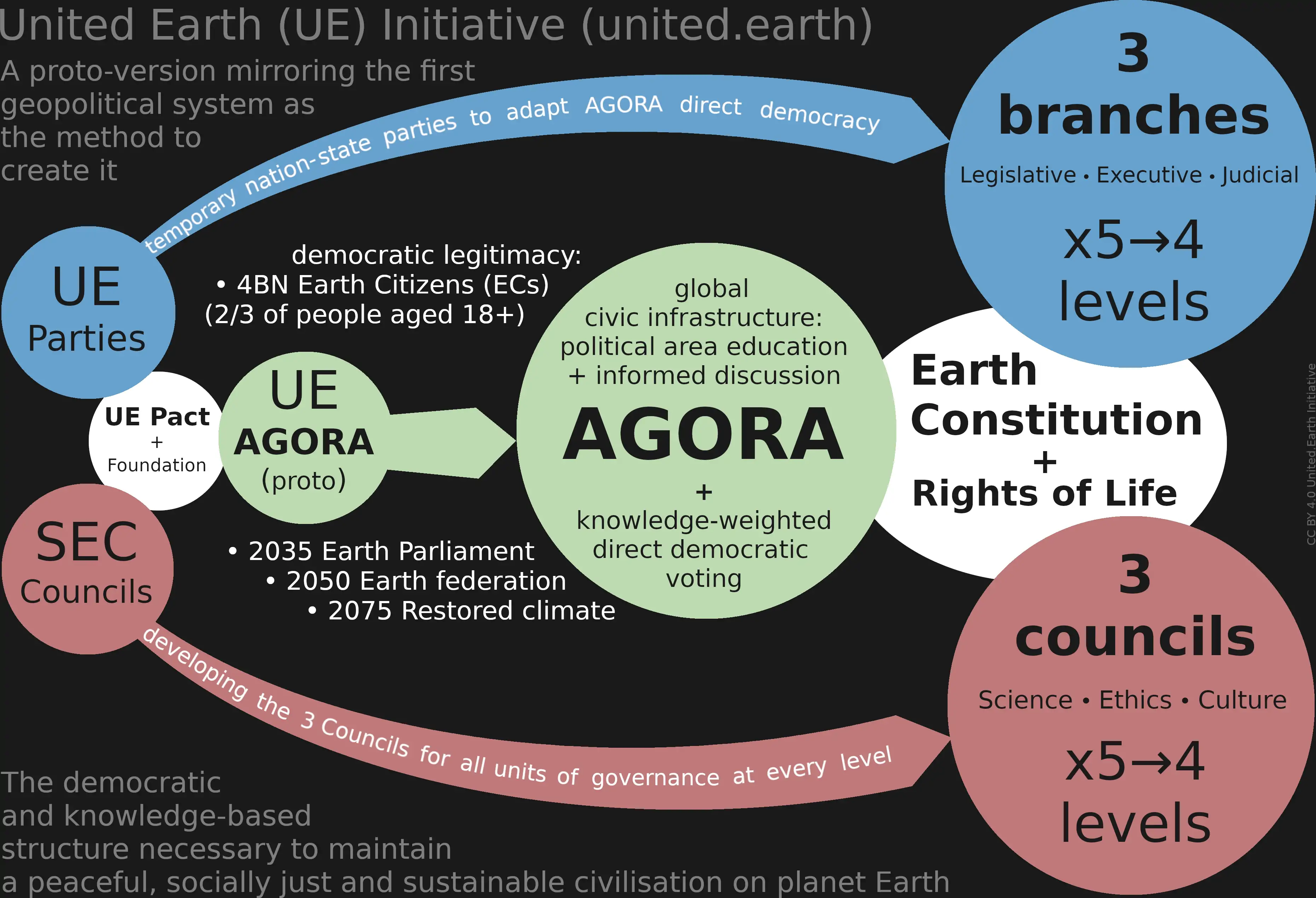
Content guide based on the roadmap
The links below follow the main transition paths shown in the roadmap. Each leads to the part of the method (HOW) where that element’s development through time is described.
21.1 A proto-system mirroring the system it initiates
The roadmap condenses the transition into one view. The destination is the geopolitical system developed in the proposal (WHAT); the roadmap follows selected elements of that system through time — from forms that can be built and tested before they hold constitutional authority, through the transition mechanisms that develop them, to the point at which their intended functions can operate within a legitimate constitutional order.
Several institutional paths develop together. Earth Citizenship and AGORA build the global political community and democratic infrastructure. The developing SEC Council network builds knowledge and competence capacity. Proto-parliaments develop democratic institutional practice, while temporary UE Parties provide a route through existing elections and parliaments toward changes that require present public authority. The UE Pact binds the participating units of the founding organisation to common safeguards and to the transition rules of programmed democratic succession, while the UE Foundation, now being established, is to hold critical assets and continuity responsibilities under the Pact.
This mirroring is deliberate. The transition begins by building and using functions that the future system itself will need. Experience gained through participation, deliberation, institutional practice and real political work can therefore improve the working model while simultaneously building the capacity required to realise it.
The intention is to develop the United Earth proposal into political reality, while allowing experience and legitimate democratic decisions to shape the form in which its components are ultimately established.
The arrows show development paths rather than automatic succession or a synchronised sequence of stages. Several processes must advance in parallel, different institutions and territories can move at different speeds, and constitutional and territorial changes will not occur everywhere in the same order. The order of the method (HOW) is therefore explanatory rather than strictly chronological.
One symbol in the roadmap requires particular care. ×5 → 4 shows the intended movement from five governance levels during the transition to four in the mature system. The targets, deadlines and transitional geography are developed below.
21.2 Long-term targets and deadlines
The destination is not a date. The aim is to develop a real geopolitical system capable of performing the democratic, constitutional and planetary functions described in the proposal (WHAT).
The three public deadlines provide long-term points of orientation along that transition:
democratic institution → constitutional system → planetary result
They are latest targets, not predictions. Earlier achievement is preferable wherever the necessary democratic legitimacy and institutional readiness exist.
Earth Parliament: preferred target 2031, latest target 2035
23 April 2031 is the preferred target for establishing Earth Parliament. 23 April 2035 is the latest target date. Neither date can substitute for the constituent threshold or the readiness requirements.
The first major scaling milestone is 1 billion verified adult ECp holders, when eligible AGORA participants elect Proto-Earth Parliament and democratic stewardship of the central proto-system begins. Reaching that milestone quickly matters in its own right: a functioning global democratic parliament can begin substantial political work before full constitutional activation.
The founding assent is expressed through an explicit declaration of support for establishing Earth Parliament. The full succession rules, including the later thresholds, readiness requirements and activation conditions, are defined in The rules of the constituent path
Establishing Earth Parliament is separate from completing Earth Federation. Territorial accession, transfers of public authority, bloc development, GOV//ID and the wider transformation proposed in WHAT can begin earlier, overlap with the founding process, or continue for many years afterwards.
2050 — Global democratic federation
2050 is the latest target for Earth Federation to become operational as one global federal state.
This does not require every territory on Earth to have acceded, every bloc to have reached its final form, or every transitional governance structure to have disappeared. It means that the global constitutional institutions and a sufficient territorial structure function together as a viable geopolitical system.
Earth Parliament, acceding blocs, the other constitutional branches, the Councils and the distributed security architecture must by then be capable of operating as one constitutional order. Accession and territorial development can continue afterwards.
2075 — Restored climate
2075 is the latest target for restoring the climate toward safe atmospheric conditions.
Restored climate is a visible test of whether humanity has acquired enough common political capacity to reverse a planetary problem that the present geopolitical system has proved unable to solve adequately. It is not the only or final purpose of Earth Federation, but a cause so vastly important that it may serve as a symbol of the kind of global tasks the system is created to solve.
Permanent peace, protection and restoration of the biosphere, safe governance of artificial intelligence, pandemic preparedness and the stewardship of planetary commons belong to the same larger purpose.
The sequence therefore matters. Democratic capacity must become constitutional political capacity early enough for that capacity to change real planetary outcomes.
21.3 Broad patterns within the transition
The transition develops through parallel and interdependent processes. Institutions, political communities and territorial structures can develop at different speeds, and several processes can reinforce one another over many years.
Two broad transformations are especially important. The global core develops through Earth Citizenship, AGORA, the Councils, parliamentary practice, constitutional work and the institutions required for legitimate global democratic authority. In parallel, the territorial system develops through existing public institutions, bloc formation, constitutional reform, common infrastructure, replacement security and the gradual transfer or reorganisation of authority.
These two transformations are functionally complementary. The global core must provide the shared constitutional order, democratic lawmaking, judiciary and coordination of planetary functions.
Across the blocal zone, the bloc level must develop the higher territorial executive and peacekeeping capacity through which much of that order can be implemented. Both take years to build, and neither can sensibly wait for the other to be completed first.
They therefore develop toward a common constitutional threshold around the establishment of Earth Parliament. Much can be prepared before that threshold, while constitutional authority and territorial jurisdiction arise only through the legitimate decisions required for them. Some territorial changes can begin earlier; others can continue long afterwards. The order of the method (HOW) is therefore explanatory rather than strictly chronological, and different places can follow different sequences while moving toward the same constitutional structure.
Across both transformations runs a material transition. Land, housing, food systems, infrastructure, finance and other foundations of material life are progressively reorganised so that their social and ecological functions take priority over capital accumulation. Much of this work can begin through existing local, regional and state authority before the new constitutional order exists. As blocal and global capacity develops, wider rules and cooperation can increasingly prevent concentrated economic power or the movement of ownership, finance and production across jurisdictions from undermining those changes.
Five levels during the transition, four in the mature system
The transition temporarily accommodates much of today’s nation-state structure as a sub-bloc level within the developing blocal zone:
locus → region → sub-bloc → bloc → global
As functions, authority, and administration are reorganised, the mature blocal chain becomes:
locus → region → bloc → global
Within the global zone, no bloc or sub-bloc intervenes:
locus → region → global
The movement from five levels to the mature structures follows functional development and subsidiarity rather than a synchronised timetable.
21.4 The method
The transition method can be summarised as:
build → use → connect → constitute
These are not four separate phases. They are functions that increasingly overlap as the transition develops.
Building before public authority
Much of the future system can begin in voluntary proto-form before it possesses public authority.
Earth Citizenship can build a global political community. AGORA can provide democratic participation and deliberation. The Councils can develop knowledge structures and institutional competence. Proto-parliamentary practice, verification systems and other functions can be built, tested and improved before they become parts of a constitutional system.
Building in proto-form therefore creates political and institutional capacity without claiming jurisdiction that does not yet exist.
Use what is being built
The emerging system does not have to remain in reserve while waiting for constitutional completion. Its developing capacities can be used on real political questions and global tasks from the beginning.
Practical use tests assumptions, exposes weaknesses, reveals missing capacities and gives participation value in the present rather than only as preparation for a future system. Use is therefore part of building.
Connect political capacity to public authority
Before new constitutional authority exists, binding public effect must pass through institutions that already possess lawful authority.
Proto-democratic outcomes can influence elections, parliaments, governments, referenda, courts, treaties and other existing political and constitutional processes. Political capacity can therefore produce real effects before the proto-system itself possesses public jurisdiction.
The distinction remains fundamental: political effect can precede public authority, but it does not become public authority merely by growing stronger.
Constitute legitimate public authority
The constituent path allows Earth Parliament to be established without requiring the wider territorial transformation to be completed first. Its succession and activation rules are defined in The rules of the constituent path
Earth Parliament can exercise public authority within its own constitutional institutions and within competences that have been lawfully constituted or transferred to the emerging order. Existing states retain the public authority they have not transferred, and territorial jurisdiction expands only through valid constitutional entry.
This separability is crucial. The democratic arena can be established first while the global demos, together with the populations and polities that choose to join, determine how far and how fast the wider constitutional transformation should proceed.
The four functions therefore reinforce one another rather than form a rigid sequence. Building enables use. Use strengthens what is being built. Connection creates political effects before constitutional completion. Constitutional authority can then expand as the democratic and territorial transitions develop.
21.5 Acting while we build
Building the proto-system and beginning to address the global tasks cannot be separate phases, since many of those tasks are too urgent to wait for the geopolitical system to be complete.
Addressing them through the emerging system also has a powerful additional effect: it can accelerate the development of the system itself.
Global tasks as drivers of the transition
Humanity already faces global tasks that exceed the political capacity available to address them. This is part of the reason the system is needed, but it can also provide momentum for building it.
A real global problem gives people a reason to participate. Participation creates a constituency. A constituency creates demand for knowledge, deliberation and political procedures. Those procedures can produce democratic judgments. Where those judgments are credible and connected to institutions capable of acting on them, they can have political effect. Visible effect can in turn strengthen credibility, participation and institutional capacity.
This creates a reinforcing loop:
urgent global problem → global democratic process → political effect → stronger constituency and institutions → greater problem-solving capacity → credibility → more participation → stronger system
The system is therefore not first built and then used. It develops by beginning to do the work it is ultimately meant to make possible.
Where existing public authorities adopt programme measures, this work can also begin changing material conditions before constitutional completion. Housing, food-system, land, infrastructure and local-resilience reforms can create practical value through authority that already exists. They can also reveal where local or regional action is being limited by cross-border economic structures or problems that require wider coordination. Practical use therefore develops both the emerging institutions and the material transition they are intended to make possible.
United Earth helps start this work by publishing provisional programme proposals and inviting citizens, Councils, affected communities and existing institutions to examine and revise them. It can advocate the proposals it judges promising while making their provisional status clear. AGORA opens them to competing alternatives and democratic judgement; institutions with the relevant lawful authority decide which measures to adopt. Practical initiative therefore helps build political capacity without conferring public authority on the organisation that took the initiative.
From participation to capacity
Political capacity grows through repeated use.
People may enter the system because a particular problem matters to them. Working on that problem then creates demand for knowledge, deliberation, proposals, democratic judgement, organisation and institutional follow-through. Repeated use develops skills, procedures, networks, institutional memory and credibility that remain available for the next task.
When participation produces value, even modest value, the system becomes easier to justify to the next participant or institution.
Participation creates capacity; capacity makes the next use more credible; successful use can produce more participation.
This is why each major pre-constitutional step should be useful on its own terms. A system that can justify participation only by promising an eventual global federation asks people to invest in an outcome they cannot know will arrive. A system that already helps people understand, organise and act on problems they care about can continue developing even while the constitutional outcome remains uncertain.
The transition therefore aims to create as much useful political capacity as possible before constitutional completion, while keeping the distinction between proto-democratic influence and legitimate public authority clear throughout.
22. Building the proto-system
The first large part of the transition can begin without waiting for states to transfer sovereignty. Its task is to build the political community, civic infrastructure, knowledge system and legislative practice that a global democracy would need in any case.
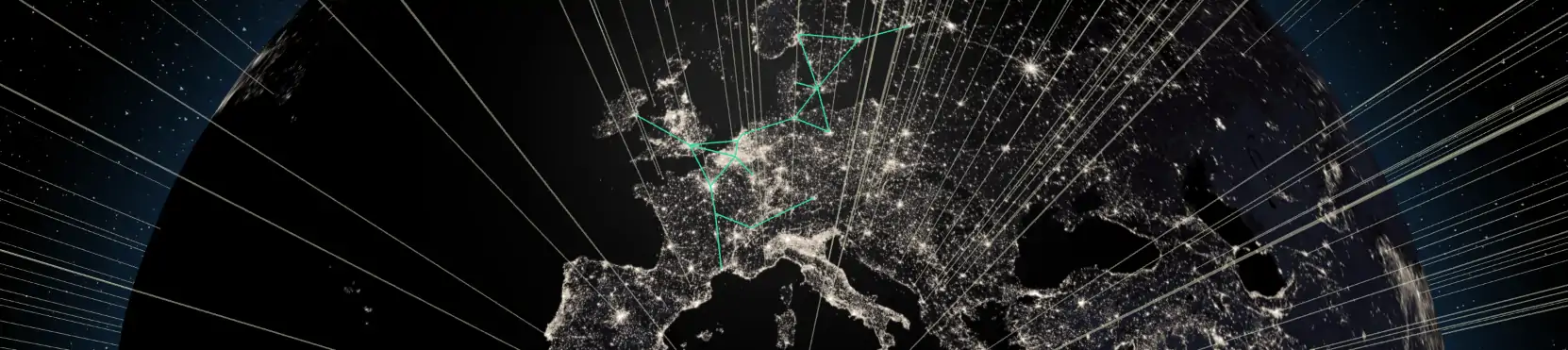
A global AGORA emerging as a network of local nodes
This globe visualises the growth of the AGORA network as Earth Citizens create nodes and connections across the planet. It shows the proto-system taking material form through local initiative, shared infrastructure and expanding participation.
This will be a continuous part of our developing media presence and the visual architecture framing important events, like the annual Earth Parliament Day.
22.1 Proto-Earth Citizenship and the global political community
Proto-Earth Citizenship (ECp) is the voluntary organisational civic status through which individuals join the emerging global political community. It exists alongside their existing state citizenships and does not constitute membership in any of the participating units of the United Earth initiative.
The constituent process begins with one explicit declaration:
I support establishing Earth Parliament.
This is a choice to create a global democratic institution, not advance agreement with the proposal (WHAT), a future Earth Constitution or any particular constitutional arrangement or policy. Support can be declared before ECp is granted, but only verified, eligible adult ECp holders with continuing support count toward the constituent thresholds.
As the political community grows, ECp connects its participants with AGORA, the node network, democratic practice and the institutions being developed around them. Verification, privacy, inclusive access and protection against manipulation are essential to the credibility of this process as it expands toward billions of participants.
Under the mature constitutional order, Earth Citizenship (EC) becomes the common constitutional status. The transition from ECp to EC thus forms part of the broader process through which the emerging global political community progressively establishes its own democratic institutions and constitutional authority.
22.2 Nodes and local organisation
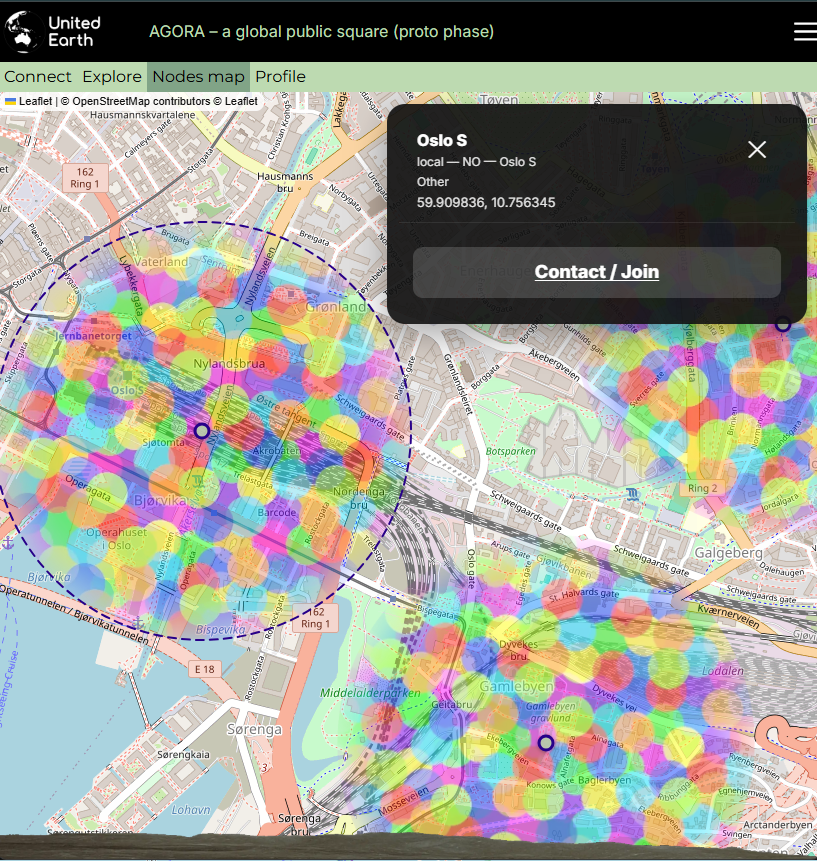
The interactive node map
Nodes are created by proto- Earth Citizens (ECp holders) with a registered profile in AGORA and are instantly visible on the interactive node map, along with the creation of a unique space in the agora.united.earth forum. From there, other participants can contact the node space and join the discussions.
Until the first Earth Parliament Day on 23 April 2027, the immediate priority is to encourage as many as possible to join AGORA and create nodes in cities, towns and villages all over the planet, making both the growth of the ECp community and support for establishing Earth Parliament visible.
CC BY-SA 4.0 United.Earth Initiative
Go to the operational website of AGORA (proto version)
You are now in the theoretical basis of the United Earth project (WHY-WHAT-HOW). To participate in our early-phase proto version of AGORA, go to its operational website at >> agora.united.earth
Nodes are open points of organisation within the wider AGORA network. They can represent places, themes, projects or other shared contexts, and ECp holders can join any node regardless of where they live. Some people may participate in many nodes, others in only one or two; some may create several nodes, while others simply join existing ones. All of these patterns are valid ways for the network to grow.
This openness allows nodes to support both local organisation and translocal network-building. A node can become a meeting point for people who live nearby, while at the same time connecting participants from across the world who share an interest, concern or project. Membership therefore does not identify a person as belonging to the locality represented by a node. Together with pseudonymous participation, this also reduces the extent to which the network can be used to map political participants within a particular community.
Nodes can host meetings, discussions, learning, projects, election activity, public events and outreach, while connecting local concerns upward into AGORA and bringing global processes back into places where people act. Their internal dynamics will develop through use. Some may become highly active organising centres, some may remain small or quiet, and others may evolve in ways that cannot be predicted in advance.
The common system provides the shared infrastructure, democratic procedures and connections within which many different forms of organisation can develop as parts of one global network. Each node can therefore find its own role and internal dynamics through use.
These transition nodes are distinct from the permanent AGORA contact infrastructure described in the proposal (WHAT). In the mature system, every governance unit is intended to have a robust digital point of contact with AGORA as part of the official interface between citizens and public institutions. The transition nodes described here can help initiate that development by creating local activity, building user communities, developing practical experience and, where possible, helping to finance the infrastructure required. As the constitutional system is established, the permanent public contact points can then take over that institutional role, while the earlier transition nodes may continue, change function or simply fade away.
AGORA is more than an online forum or social network. It is intended as the common civic environment in which the emerging political community can organise, deliberate, develop knowledge and proposals, and gradually connect its activity to institutions with public authority.
United Earth can use existing social media to distribute updates and invite people into this environment, but the political conversation itself is intended to take place in AGORA. This keeps discussion, organisation and democratic processes within one shared infrastructure rather than dispersing them across commercial platforms and separate online communities.
22.3 AGORA and democratic participation
AGORA is the political arena of the proto-system. Its purpose is to turn a worldwide population from an audience into participants.
During the proto-phase, active participation in AGORA by ECp holders is governed by the AGORA Participation Principles, including GOV//ID as a binding rule of the proto-system. The scope of participation expands as verification, safeguarding and democratic procedures mature.
If AGORA becomes an official democratic institution under a future constitutional system, access to its civic and democratic functions must follow citizens’ rights under that system, including for those who personally disagree with GOV//ID. All participants remain bound by applicable law and common procedures, but personal endorsement of a constitutional principle cannot be made a condition of the civic right to participate.
Within the proto-system, ECp holders can learn, develop a competence profile, express political views, start polls, raise questions, develop proposals, propose alternatives, submit amendments, build support, deliberate and vote. These are not all the same kind of act. A low-threshold poll should be easy to start. A proposal entering a formal parliamentary or constitutional process may require support, competence checks, admissibility rules and procedural thresholds.
The distinction matters because an open system must allow initiative without letting every expression become a formal agenda item. AGORA therefore needs both broad civic freedom and disciplined political procedure.
It also needs structural separability from United Earth. ECp holders must be able to originate questions that United Earth did not originate, develop proposals United Earth did not formulate, organise competing alternatives, and reach outcomes that United Earth has neither the role nor the power to alter, suppress or present as its own.
United Earth will necessarily initiate some of the earliest processes because nothing else exists yet. That bootstrap role should shrink as the political community becomes capable of setting its own agenda. Initiative then moves in two directions at once: participants continue to raise questions directly, while elected proto-parliamentarians acquire responsibility for prioritising, framing and carrying a parliamentary agenda.
PAI×SEC in deliberation and decision-making
As AGORA begins processing real questions, each proposal needs a way to find the relevant knowledge without waiting for a completed global knowledge system. An early programme on settlement and food, for example, crosses land use, transport, health, production, biodiversity and public finance. The first task is to identify these connections and the people affected by them, then make the evidence, uncertainty and competing values available for public examination.
PAI×SEC can begin as a working procedure. A question is located in the Policy Area Index, connected to the relevant Science, Ethics and Culture knowledge bases, and opened to challenge by qualified contributors and affected people. Citizens can then compare proposals, deliberate and reach advisory judgements in AGORA. The procedure can be tested on a limited set of actual questions, corrected when it misclassifies an issue or omits relevant knowledge, and extended as the Councils and their wider networks grow.
The working chain is:
Issue → PAI → SEC → deliberation → advisory voting → proposal
An advisory result may lead to another round of revision, a pilot with willing partners, or a proposal to a public institution that can act lawfully. The path taken and the reasons for accepting or rejecting the result should be visible to participants. The same record can show whether evidence was contested, whose interests were affected and what changed between the original proposal and the version taken forward.
The index itself must also develop through use. Existing policy classifications, including relevant work developed within the United Nations system, can be mapped against the questions entering AGORA, harmonised where possible and revised where practical cases reveal gaps. In this way, the shared structure grows from the work it is meant to support. Citizens and representatives retain political judgement throughout; the knowledge system makes the choices and their consequences more open to examination.
22.4 Councils and qualified knowledge
The Science Council, Ethics Council and Culture Council can begin in proto-form as networks assembled around work that is already needed. A first set of questions gives the networks a practical task: find qualified contributors, organise accessible assessments, state what remains uncertain or contested, and explain how new evidence or objections can change their conclusions.
The early Councils need transparent qualification and conflict-of-interest procedures. Their contributors must be able to disagree in public, and assessments should distinguish established knowledge from ethical judgement, cultural interpretation and unresolved political choices. Published work can then be tested by citizens in AGORA and by outside specialists and institutions. Credibility grows when criticism leads to correction, rather than from a claim of authority attached to the Council name.
Affected communities and knowledge-bearing organisations need usable channels to submit evidence, contest assumptions and participate in the work. These channels can be developed with cultural communities, scientific bodies, ethical traditions, professional organisations and other relevant contributors. Council members qualify through the applicable competence procedures; the channels for participation and challenge do not turn the Councils into assemblies of fixed group delegates.
Growing the Council network across units and levels
The network can grow from specific questions and places. Nodes may identify local expertise and invite contributors into shared work; regional and blocal processes may expose questions that require knowledge from several places at once. A societal-region programme linking housing, food, transport and services, for example, can use Council assessments from several policy areas while nature-region contributors assess ecological effects that cross the proposed administrative boundaries.
As cases accumulate, qualified contributors can develop common methods, education and review procedures across governance levels. Assessments produced for one process should remain available for scrutiny and reuse elsewhere, with their limits and local conditions attached. Public institutions can cooperate with proto-Councils before the Councils have a constitutional role; later institutional standing requires the appropriate lawful decisions.
Constitutional and legal drafting
The Council network is responsible for organising the preparation of proposals for the Earth Constitution, bringing together knowledge, drafting competence, public contributions and competing constitutional ideas without acquiring political authority over the outcome.
Multidisciplinary commissions can develop constitutional drafts, alternative clauses, competence rules, rights frameworks, accession criteria and institutional standards. United Earth’s proposal (WHAT) is one comprehensive contribution to this work, not a constitution that becomes binding because United Earth developed it.
AGORA exposes drafts and alternatives to public knowledge, criticism and amendment. Proto-Earth Parliament can structure and process constitutional alternatives politically, but cannot by itself exclude alternatives from the constituent vote. Constitutional alternatives, including proposals that reject GOV//ID’s unamendable status, must be able to reach the vote through open, published and reviewable procedures that do not depend on accepting proto-AGORA’s participation conditions. The final democratic authority over constitutional proposals rests with eligible Earth Citizens.
When the constituency reaches four billion or more adult Earth Citizens, proposals for the Earth Constitution are to be put to a global constituent vote under publicly established procedures. This vote concerns constitutional content; it is distinct from the founding assent already expressed through Earth Citizenship registration.
The relationship between this broader constitutional vote, the minimum terms required for Earth Parliament’s activation and subsequent constitutional development is to be worked out through the constituent process rather than fixed by United Earth at launch.
The Council network must also prepare proposals for the global vote’s rules and organisation, including voter eligibility, verification, accessibility, voting integrity and independent oversight. Cooperation with the United Nations should be sought where possible. Voting access must be available to all eligible Earth Citizens under the constituent procedures, regardless of whether they support United Earth’s constitutional proposals. The practical voting arrangements are to be developed through the constituent process.
Before Earth Parliament is established, this process must at least produce the minimum constitutional operating terms required for the parliament itself. Wider constitutional development can continue afterwards.
Councils organise knowledge and constitutional drafting → AGORA enables public scrutiny → Proto-Earth Parliament structures alternatives → Earth Citizens decide through an inclusive constituent vote
22.5 Practising issue-based democracy
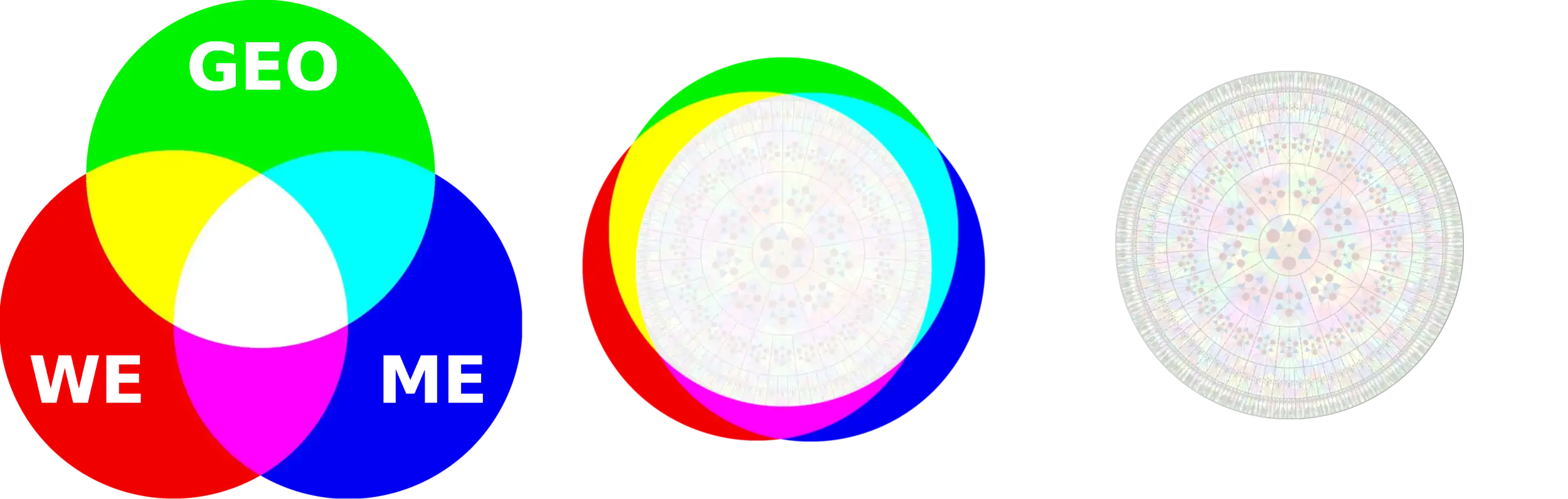
GeoWeMe: a permanent integration of concerns
GeoWeMe represents the permanent coexistence of ecological, societal and personal perspectives. Its purpose is to keep these dimensions visible together as political questions are examined. Read more about GeoWeMe
The illustration shows a transition from politics organised primarily through fixed ideological and party packages toward political judgement organised around issues themselves. GeoWeMe helps explain that transition, but it is not one of the mechanisms that carries it out.
In the proto-system, these concerns can enter political processes without first being assembled into one permanent ideological package. A question is located through PAI, connected to relevant knowledge and competence through SEC, deliberated through AGORA and judged by the participating citizens. Political organisations can contribute arguments, programmes and recommendations through defined interfaces, while democratic deliberation and voting remain functions of individual Earth Citizens.
This is also how the proto-system begins testing post-party political practice before the constitutional transition is complete. Citizens gain experience in approaching questions directly, comparing alternatives and revising their judgement issue by issue.
As this issue-based democratic practice begins to operate, it can already produce effects beyond the proto-system itself: through practical work on urgent global tasks, and through mechanisms such as UE Parties that transmit AGORA outcomes into institutions already exercising public authority. The next two chapters examine these two pathways.
GeoWeMe therefore remains explanatory throughout the transition. It helps with seeing the range of concerns that may be present in a question; the operational work is carried by PAI×SEC, AGORA, democratic procedures and the institutions being developed around them.
22.6 Proto-parliaments for existing and proposed units
Proto-parliaments are elected democratic assemblies for existing or proposed governance units, created to practise, test and demonstrate representative political capacity before those units hold constitutional public authority within Earth Federation.
They can be created where participation can take place lawfully and with acceptable risk. An existing democratic polity can operate a proto-parliament alongside its constitutional institutions. Proposed regions, sub-blocs and blocs can elect assemblies before the relevant governance unit formally exists. At the global level, Proto-Earth Parliament develops under the constituent path described earlier and is the institution that becomes Earth Parliament when the founding conditions are met. It is not a demonstration assembly that is later replaced by a separate “real” parliament.
These bodies can set agendas, form committees, debate, develop proposals and vote. Their decisions are politically real for participants and useful as public signals. They are also testbeds: procedures can be observed, corrected and improved before constitutional authority makes mistakes more costly.
The limit is equally important. A proto-parliament does not enact public law merely because it has been democratically elected. There is no corresponding proto-government commanding public administration and no proto-judiciary issuing binding public judgments. The proto-system builds legislative democratic capacity without constructing a rival sovereign state before constitutional legitimacy exists.
In jurisdictions where participation itself is dangerous, the public launch model should not prescribe territorial proto-parliaments as a standard answer. Democratic continuity, diaspora participation and other representative mechanisms may later become useful, but the political and personal-security consequences have to be assessed by the people concerned and by a movement large enough to protect them better than an early project can.
22.7 Political initiative, representation and responsibility
A democratic system also needs pathways through which citizens can become people who take sustained political responsibility.
The path can begin with very little commitment and deepen over time:
ECp → participation → competence and public profile → political initiative → elected or qualified institutional roles.
Some ECp holders will organise nodes. Some will become recognised for work on particular policy areas. Some will develop proposals, build support and stand for proto-parliament. Some will qualify for Council work. Most will do none of these things, and the system does not require any particular person to do so.
It does require enough people to do them. One purpose of AGORA is therefore to make political development possible without requiring conventional parties to serve as the permanent gatekeepers of political careers. Parties can continue as voluntary organisations and interest formations, but the political community itself must be able to discover, test and elect its representatives.
23. Global threats are global tasks
Building the proto-system and beginning to address the global tasks cannot be separate phases, since many of those tasks are too urgent to wait for the geopolitical system to be complete. Addressing them through the emerging system also has a powerful additional effect: it can accelerate the development of the system itself.
The proto-system can therefore begin working on the problems it is ultimately meant to help solve from the moment it starts to take shape. It can work alongside existing institutions, organisations and initiatives, connect their efforts where useful, and provide a shared democratic and knowledge-based framework for cooperation across them. Each practical use can test the emerging institutions, expose missing capacity, attract participation and produce political effects that help the system develop further.
A global ambition on display

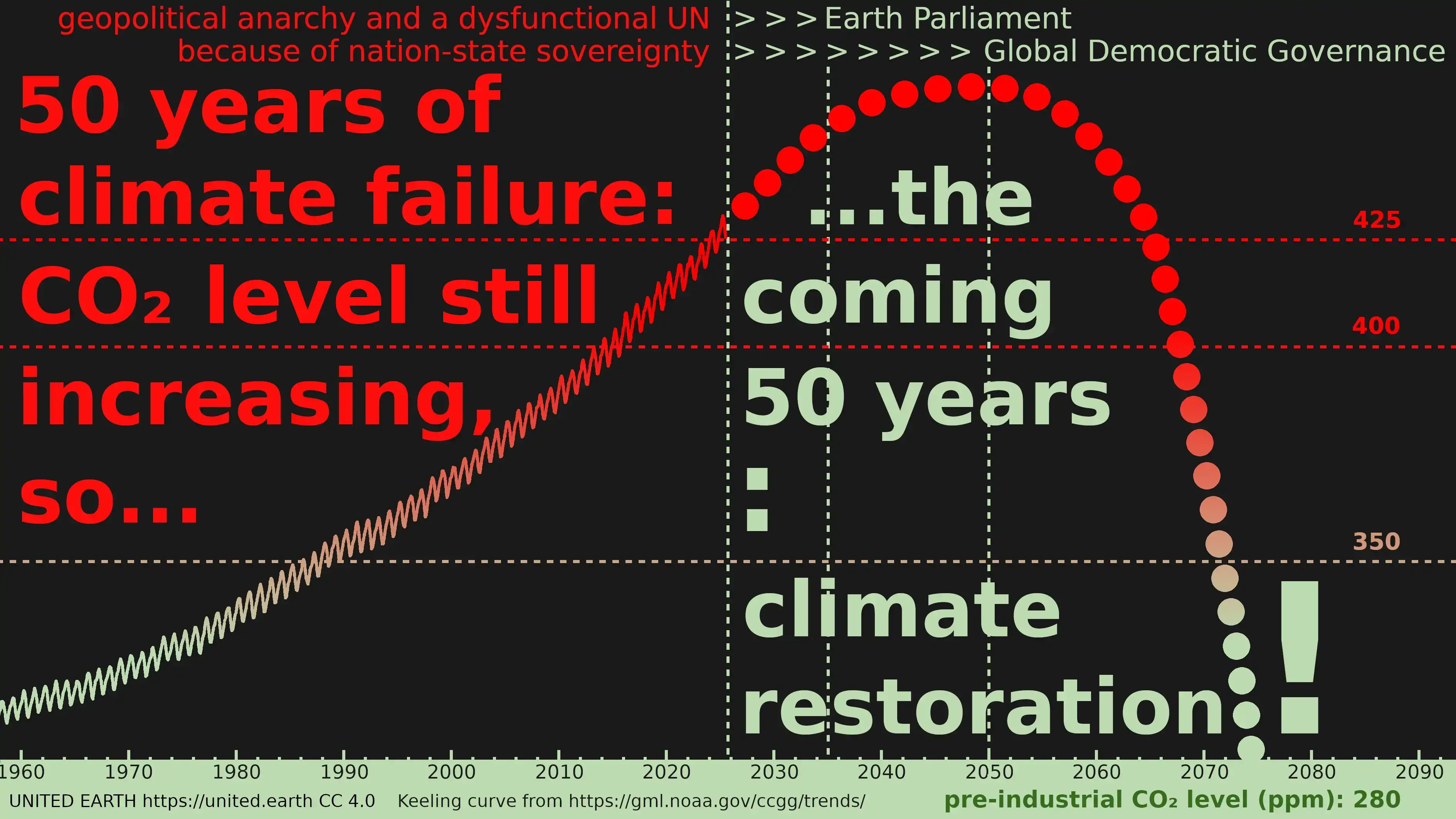
The projected curve illustrates the scale of ambition that becomes possible if humanity builds legitimate global democratic capacity. Even with decisive action, atmospheric CO₂ concentrations cannot be expected to turn downward immediately. We must expect further increase while energy systems, infrastructure and production are transformed. The curve would first have to flatten and peak before sustained emission reductions, carbon removal and ecological restoration could begin bringing concentrations back down, perhaps from about 2050.
Restoring atmospheric CO₂ to the pre-industrial level by 2075 would be extraordinarily ambitious. But that is precisely the point. If humanity succeeds in building a global system capable of coordinating knowledge, resources, policy and execution at planetary scale, why should we decide in advance to aim lower? United Earth exists precisely to help build the institutions, hope and collective will required to attempt what the global threats we face actually demand.
The future curve is not a given. Our task is to build the capacity to bend it.
ClimateRestoration2075 illustrates the relationship between the transition and its purpose: building global democratic capacity while beginning to use the capacity already available to address global tasks. It also raises a question that applies to every such task: how high should humanity set its ambition?
23.1 The real ambition global tasks require
Global tasks should not be judged only by whether the world is making progress. We also have to ask whether the level of ambition itself is proportionate to the task.
For problems involving planetary systems, systemic risk or potentially irreversible consequences, a target that is sufficient only if knowledge is complete, implementation proceeds on schedule and every major measure performs as intended leaves too little margin for error.
United Earth therefore distinguishes between two levels of ambition.
Current ambition
Current ambition is the strongest broadly established international target, commitment or level of ambition currently guiding collective action on a global task.
It represents what the international community has already succeeded in establishing as a common direction. It should therefore be treated as an important starting point and a shared basis for comparison.
Current ambition is not the same as the current trajectory. Governments and institutions may already be falling behind targets they have formally adopted. Nor should an internationally established target automatically be treated as the level ultimately required by the task itself.
Current ambition therefore tells us what humanity has already agreed to aim for. It does not by itself answer whether that ambition provides enough margin for the risks involved.
Such targets can reflect scientific knowledge and institutional experience while also incorporating political feasibility, negotiated compromise and uncertainty about what governments are prepared or able to implement.
Precautionary ambition
Precautionary ambition starts from the task itself.
The first question is what outcome would actually be needed to solve the problem, bring the risk under control or restore the relevant system to a sufficiently safe condition. The target is then set with additional margin for uncertainty, delay, implementation failure, unexpected feedbacks and other developments that can make the real-world transition harder than the original analysis assumed.
This assessment must include measures that present political and economic power keeps outside ordinary negotiations. A task may require changing profitable production systems, setting binding limits on powerful actors or sharing transition costs across territories. Such possibilities must be examined against scientific evidence, material feasibility, rights and their wider consequences. If they are excluded in advance because they are difficult to negotiate under the present order, current political feasibility has been mistaken for the ambition the task requires. Precautionary ambition identifies the outcome first; the transition must then build the democratic authority, cooperation and material support needed to pursue it.
The purpose is not to maximise ambition for its own sake. It is to avoid designing a global response around the theoretical minimum that would succeed only if everything works as expected.
The working method is therefore:
find out what is needed → add a precautionary margin → set the target → work backwards into the changes and capacity required
ClimateRestoration2075 illustrates this logic. The ambition is deliberately demanding because the physical system responds slowly, implementation will encounter obstacles and the consequences of falling short can be much greater than the consequences of reaching a safer condition earlier than necessary.
Comparing the two levels
The two levels should be shown together.
Current ambition provides the common international point of departure.
Precautionary ambition shows the higher level that should be examined when the severity of the task, uncertainty and the need for implementation margin are taken seriously.
The comparison is not intended to dismiss existing international agreements. It makes visible a different question: whether the ambition already established is itself sufficient for the problem humanity is trying to solve.
The distance between the two levels will differ from task to task. In some areas, established international ambition may already approach a precautionary level. In others, the gap may be substantial.
United Earth analyses can therefore show both levels rather than presenting one target as though no alternative level of ambition existed.
From ambition to action
Once an ambition level has been defined, the work can move backwards from the desired outcome.
A target can be translated into milestones, required capabilities, institutional development, investment, monitoring and other forms of implementation. Where the task develops over time in a way that can meaningfully be modelled, these steps can also form a pathway toward the target.
The substantive choices within that pathway remain political questions. Science, Ethics and Culture can clarify what is known, what is uncertain, what consequences follow from different choices and what values are in tension. AGORA and the democratic institutions determine which measures are actually pursued.
The purpose of the ambition framework is therefore not to predetermine policy. It is to prevent political deliberation from beginning with an ambition ceiling that may already be too low.
23.2 Seven global task areas
The transition needs a way to organise sustained work on problems that reach across territories, policy fields and generations. United Earth begins with seven Global Task Areas (GTA). Each identifies an enduring responsibility and provides a focus for public mobilisation, programme development and cooperation across governance levels.
The areas overlap. A programme for land use may advance ecology and climate goals while changing food production and livelihoods. AI can be a risk in its own right and a tool used in other areas. The seven areas keep the largest shared tasks in view; they do not assign every proposal to a single category.
PAI provides the more detailed structure for identifying the policy areas involved in a particular issue. Through PAI×SEC, proposals can be examined across the relevant scientific, ethical and cultural dimensions. The Global Task Areas serve a different purpose: they make humanity’s enduring shared responsibilities visible and help connect work across many policy areas.
The Global Task Areas provide one way to read the transition: they show the enduring problems the emerging system must be able to address. The transition programmes in the next section begin from a wider question—what must be built and changed to bring the system proposed in the proposal (WHAT) into being?
| Global Task Area | Core task |
|---|---|
| Space | Govern human activity beyond Earth as a peaceful commons, beginning with near-Earth space and the Earth–Moon domain, while protecting Earth and space infrastructure from orbital and other space-related hazards. |
| Climate | Reduce and remove greenhouse gases, stabilise the climate system and restore safer atmospheric conditions. |
| Ecology | Protect and restore biodiversity, ecosystems and ecological continuity on land and at sea. |
| One Health | One Health connects human, animal and ecosystem health. Within this task area, that integrated approach is combined with responsibility for physical and mental health and equitable access to health care and essential medicines. |
| Economy | Meet material needs and sustain economic stability while bringing production, investment and resource use within ecological limits. |
| AI | Keep advanced AI accountable to the public and bring risks that cross borders, developers and infrastructures under effective control. |
| Peace | Prevent war and replace military rivalry with reliable, constitutionally governed common protection. |
23.3 Turning the proposal into transition programmes
The programmes below are a first mapping of what must be built, reorganised and put into practice to roll out the system described in the proposal (WHAT). They are not a separate agenda added to that system. Most follow from its institutions, territorial structure, economic order, planetary commons, rights and peace order. Others develop capacities needed to address global risks that the system must be able to govern.
The names and boundaries are provisional. Each row identifies a connected field of transition work, not an approved programme with a fixed institution, budget or set of measures. The Global Task Areas provide a second reading of the portfolio: Direct identifies work aimed at part of a task itself; Supports identifies capacity that helps through other programmes or functions. Neither label claims that an effect has already been achieved.
The portfolio shows why building the system and addressing global threats develop together. Democratic and constitutional capacities make collective action more accountable. Work on land, settlement, food, services and infrastructure gives the proposed order practical meaning in regions and loci. Commons, risk and security programmes address responsibilities that exceed any one territory. These strands depend on one another, although they can begin at different times and under different lawful authorities.
The regional programmes are especially important to the material transition: societal regions connect the systems people live within, while nature regions protect ecological continuity under their own mandate. The Global Task Area links make those local and regional changes visible as part of larger planetary responsibilities.
23.4 Programmes to begin now
The list of transition programmes can be introduced gradually through a selection of clearly defined public proposals. United Earth puts forward at least one initial programme for each Global Task Area, directed at a central cause or an ambition that the present geopolitical order struggles to pursue. Each proposal should state the larger outcome plainly while identifying work that governments, institutions, researchers, communities and other actors can begin together now.
Current ambition identifies the strongest broadly established international starting points relevant to each proposal. They take different forms—treaty obligations, agreed targets and cooperative frameworks—and are therefore not always directly comparable with the programme’s proposed outcome. The programmes are open to challenge and revision. They do not have to cover everything within their task area, and their effects will often depend on other parts of the transition portfolio.
| Name and global task area | Current ambition | Proposed ambition |
|---|---|---|
| SolarCommons · Space — The solar system as a commons | The Outer Space Treaty prohibits national appropriation and makes states responsible for their space activities. UN sustainability guidelines rely on voluntary implementation. No common public body governs essential Earth–Moon infrastructure. | Bring essential Earth–Moon infrastructure under common democratic stewardship and binding shared duties, preventing exclusive national or corporate control of critical functions. Establish fair allocation of orbital and spectrum resources within shared safety and sustainability limits, alongside coordination of communications, observation, orbital traffic, debris removal and peaceful security. |
| ClimateRestoration2075 · Climate — Atmosphere as planetary commons | The Paris Agreement aims to hold warming well below 2°C, pursue 1.5°C and reach a balance between greenhouse-gas emissions and removals in the second half of this century. It sets no target for returning atmospheric CO₂ to its pre-industrial concentration. | Return atmospheric CO₂ toward its pre-industrial level of about 280 ppm by 2075. Pursue a coordinated fossil-fuel phase-out, emissions reduction, verified removal and ecological restoration, with shared support for the affected workers, communities and economies. |
| Earth50/50 · Ecology — Ecosystem sovereignty, nature regions and ocean commons | Target 3 of the Kunming–Montreal Global Biodiversity Framework calls for effective conservation and management of at least 30% of terrestrial and inland-water areas and 30% of coastal and marine areas by 2030. | Secure approximately half of Earth’s land and half of its ocean, measured separately, primarily for ecological continuity. Reorganise land and marine use, align resource-use rights with ecological responsibilities, and support affected communities and livelihoods through the transition. |
| 1000-Year Earth Sanctuaries · Ecology — A living network for agrobiodiversity and food security | The International Treaty on Plant Genetic Resources for Food and Agriculture recognises Farmers’ Rights but leaves their implementation largely to national law. The UN Declaration on the Rights of Peasants recognises the right to seeds, while Target 4 of the Kunming–Montreal Global Biodiversity Framework calls for maintaining and restoring genetic diversity in wild and domesticated species. Seed-marketing and plant-variety legislation can still restrict the circulation of biological material, and no equivalent global legal framework guarantees living stewardship sites protection across a thousand years. | Establish 1000-Year Earth Sanctuaries as a legally protected category in as many jurisdictions as possible, and ultimately in global law once Earth Parliament exercises constitutional legislative authority. Review laws governing seeds, genetic resources, land use and stewardship to secure long-term protection and the freedom to preserve, develop and share living agrobiodiversity, while safeguarding biosafety, Indigenous and community rights and equitable benefit-sharing. Enable existing independent initiatives to seek recognition voluntarily, support the establishment of new sites in societal and nature regions, and protect their stewardship purpose for at least 1,000 years without transferring ownership or organisational control to United Earth. |
| BioSafely · One Health — Regional food systems and global risk prevention | The amended International Health Regulations and the adopted WHO Pandemic Agreement set out prevention, preparedness, surveillance and equitable response. The 2024 UN Political Declaration on antimicrobial resistance sets a target of reducing deaths associated with bacterial AMR by 10% by 2030 and calls for a meaningful reduction of antimicrobial use in agrifood systems, but sets no quantified target for that reduction. Independent review of high-risk laboratory work is not generally required, and the Biological Weapons Convention has no verification mechanism. | Prevent biological health risks at their sources by transforming food-production systems that create high biological risk, including high-risk livestock production and other hazardous human–animal interfaces. Strengthen responsible antimicrobial use and infection prevention, independently review laboratory biosafety, and combine food-system transition with control of antimicrobial pollution, integrated surveillance, rapid outbreak response and fair access to effective tests, treatments and vaccines. |
| EcoBalance · Economy — Economic order within ecological limits | The 2030 Agenda seeks sustainable production and consumption. The Paris Agreement and biodiversity framework call for financial flows to align with their respective goals. No common global framework yet gives economic decisions democratically established ecological limits and a secure material floor. | Bind major budgets, investments and resource flows to democratically established ecological limits and social floors that secure the material conditions for a good life. Reorganise essential systems such as housing, land and food production around their social and ecological purposes rather than capital accumulation, and prevent concentrated economic power from overriding those purposes through ownership, finance or relocation across jurisdictions. Make economic effects publicly accountable and share transition costs fairly. |
| SECureAI · AI — Democratic authority over cross-border technological risks | The UN has established an Independent International Scientific Panel on AI and a Global Dialogue on AI Governance. The Council of Europe has opened a binding framework convention on AI and human rights. These frameworks do not establish a global pause on high-risk work toward superintelligence. | Ensure that high-risk work toward superintelligence proceeds only when safety can be demonstrated and legitimate public control is secured. Build a verifiable global pause agreement with common requirements for high-risk development, while advancing bounded AI and safety research. |
| EarthPeacePact · Peace — The bloc-based peacekeeping system | The UN Charter prohibits the threat or use of force in international relations, subject to the Charter’s exceptions. States retain their armed forces, and permanent Security Council members can block substantive decisions. The Non-Proliferation Treaty commits parties to nuclear-disarmament negotiations without a completion date. | Replace military rivalry with constitutionally governed common protection, with replacement security in place before existing protection is withdrawn. Begin with verified nuclear-risk reduction, negotiate the phased transfer of sovereign military authority into bloc and global capacities, and bring arms production and transfers under common requirements, with shared support for affected workers and regions. |
| GOV//ID(y’all) · Peace — Ending identity-based political domination | The Universal Declaration of Human Rights and the International Covenant on Civil and Political Rights establish international standards for equal rights, freedom of religion or belief, expression, association and political participation, and protection against discrimination. They do not require a universal constitutional separation between collective cultural identity and territorial public governance, or a general prohibition on non-violent political campaigns seeking identity-based rule. | Build a global democratic counter-movement against political fundamentalism and identity-based claims to rule. Establish GOV//ID—public governance constitutionally independent of every religious, national, ethnic or ideological identity—as an unamendable principle in polities voluntarily joining Earth Federation. Require public political proposals to be defended on identity-independent, publicly assessable grounds. Prohibit by law active political work to establish or restore ID=GOV, including non-violent campaigns, with defined offences, enforceable sanctions and independent judicial safeguards. Protect the resulting constitutional order through common law and the bloc-based peacekeeping system. |
These programmes are concrete proposals showing the level of ambition the global tasks may require. Their names are working names. If the proposals gain support following United Earth’s launch, their names will need thorough review for legal availability, suitability and possible confusion with existing initiatives, in dialogue with relevant actors.
The working name SECureAI deliberately capitalises SEC for Science, Ethics and Culture. It expresses a broader purpose than risk reduction alone: consequential AI development should be grounded in scientific knowledge, ethical judgement and cultural understanding, and remain directed by human purposes through legitimate democratic control.
The programmes deliberately overlap because the systems they address overlap. Food-system transformation connects BioSafely with Earth50/50, 1000-Year Earth Sanctuaries, EcoBalance and the regional transition programmes. Housing connects EcoBalance with settlement, land use, local livelihoods and regional planning. Land, water, finance, health, ecology, livelihoods and peace cannot be reorganised independently of one another. The programme structure divides the work into manageable fields; PAI×SEC, subsidiarity and democratic planning reconnect those fields where decisions and consequences intersect.
The programmes both put the proposal into practice and test its completeness. Work on the global tasks can reveal capacities that need further development, including pandemic prevention and advanced AI risk governance. The transition therefore develops the proposed system through practical work on the responsibilities it must fulfil. Where existing institutions lack the authority, coverage or capacity required, building that capacity becomes part of the task itself. The difficulty of doing so is not in itself a reason to reduce ambition to what present institutions can deliver.
The pathways described in Working through existing public authority, Bringing the commons into common governance and Completion of the bloc level explain how the necessary authority and capacity can be developed through lawful democratic and constitutional processes.
Each programme is both a challenge and an invitation. It asks existing powers to account for the distance between their present commitments and what the task may require, while offering them and others a concrete way to help close that distance. It also gives people who care about a particular global task a concrete entry point into the emerging democratic system. Through Earth Citizenship, PAI×SEC and AGORA, work on the task can help develop the political capacity needed to govern it at the appropriate scale.
Early agreements, shared standards, research, regional projects and lawful public decisions can produce results before Earth Federation exists. They can also reveal which problems cannot be resolved durably without legitimate democratic authority at the appropriate level.
United Earth can argue for these proposals and help bring participants together. PAI×SEC and AGORA provide ways to examine their assumptions, consequences and alternatives, and to test public support. A programme may be revised, replaced or rejected through that work. Support for one programme is valuable on its own terms; it is not automatically support for United Earth or for the constitutional transition.
24. Working through existing public authority
The proto-system can develop political capacity while existing governments, parliaments, courts and public administrations continue to exercise public authority. The transition must therefore work through the institutions that already exist until new constitutional authority has been legitimately created.
UE Parties to fill seats in parliaments at bloc level and below: The EU Parliamentary hemicycle in Espace Léopold in Brussels. Image by Marius Oprea from Unsplash
Existing institutions as channels of change
Existing parliaments, governments, courts and public administrations already possess the legal authority through which laws, constitutions, treaties and public institutions can be changed. The transition can therefore begin affecting real public authority before any new constitutional order exists.
The task is to connect the political capacity developing in the proto-system to these institutions through lawful democratic channels.
Different jurisdictions provide different routes, but the principle remains the same: emerging democratic capacity creates proposals, constituencies and pressure; existing institutions perform the legally binding acts until new constitutional authority has been legitimately created.
24.1 United Earth’s role in the transition
United Earth initiates the proposed transition and carries the initial responsibility for driving it forward. It cannot assume that another institution will take over a pathway that does not yet exist. It therefore develops system architecture and early infrastructure, builds AGORA and the proto-system, convenes participants, drives mobilisation and constitutional preparation, launches global-task processes and programmes, and works to connect the emerging system to institutions capable of exercising lawful public authority.
United Earth can also advocate particular programme proposals. Its proposals should make their assumptions, uncertainties, costs, affected interests and possible alternatives visible. A programme developed by the organisation enters AGORA as a contestable contribution: citizens and other actors can change it, organise competing proposals, support or reject it, and reach advisory judgements the organisation cannot rewrite.
United Earth can explain why it still supports a proposal, while remaining answerable for how it uses its own resources and name.
This combines an active initiating role with institutional independence. United Earth does not acquire a privileged vote or final say in AGORA because it convened a process or proposed its first draft. A programme can gain voluntary partners and produce lawful results before a new constitutional order exists. Legislation, public budgets, regulatory powers and territorial changes remain with the institutions that possess the relevant authority; a later constitutional polity can adopt, alter or end any programme through its own procedures.
Initiation without self-authorisation
United Earth can exercise substantial agenda-setting, organisational and infrastructural power during the founding phase. It cannot convert that power into public constitutional authority.
Its own control is bound by the UE Pact and the transition rules defined in The rules of the constituent path
. As the global political community grows, democratic stewardship passes progressively to the institutions elected by Earth Citizens.
Existing institutions can contribute access, expertise, administration, auditing and independent verification. The United Nations, states, electoral authorities, regional organisations and civil society can therefore strengthen the constituent process without becoming the source of its democratic mandate or acquiring an approval veto over it.
Permanent constitutional offices are filled under the procedures of the ratified system. Experience in a proto-institution may make a person a strong candidate, but it creates no right of succession to constitutional office.
Protection against capture and founder control
The same principle applies internally.
Infrastructure, funding, intellectual property, registration systems and technical competence all create forms of practical power. They must not become routes through which founders, major donors, corporations, states, parties or identity-based organisations acquire control over the emerging political community.
Critical democratic assets should therefore be governed under transparent, portable and capture-resistant arrangements from the beginning.
The citizen register, deliberative record, vote records, constitutional work, standards and other critical democratic assets must be transferable or reconstitutable under the programmed democratic succession, without the incumbent organisation being able to use ownership as a veto.
The UE Pact gives these safeguards organisational force. The Foundation can act against documented material breaches by participating units, but its own decisions and conduct are subject to independent review under the Pact, including through a Pact Tribunal once established.
The independent SEC Council network provides the recruitment base for both the Foundation’s board and the Tribunal. The Pact must therefore secure their mutual independence through rules on incompatible offices, conflicts of interest, appointment procedures and review. Pact review concerns organisational decisions and affiliations. It confers no authority over Earth Citizens or over democratically elected transitional institutions, whose compliance with the transition rules is subject to the separate review those rules must provide.
Experience in a proto-institution may make a person a strong candidate for later office, but it creates no personal right of succession. Constitutional offices and mandates are filled under the democratic and constitutional procedures established for the emerging public system.
24.2 Why existing institutions may accept change
The transition asks existing holders of power to participate in a process that can ultimately reduce or transform their present sovereignty. That requires a serious account of self-interest.
The starting point is shared exposure. Powerful states can shift costs, buy protection and delay consequences more effectively than weak states, but they cannot obtain a separate climate, nuclear environment, pandemic domain, biosphere, world economy or technological future. Many global risks remain risks to the powerful as well.
The cheapest response will often be coordination among the strongest rather than democracy. That is a real competitor to this project. A concert of major powers can coordinate while a particular distribution of power lasts and while the participants can agree. A constitutional order offers something different: rules that can survive changes in who is powerful.
This creates a form of long-term insurance. No state or governing elite knows its relative position several decades ahead. Rules accepted while influence is high can protect actors later when influence has declined. Larger common markets, reduced strategic competition, shared infrastructure, crisis capacity and more predictable law can also create immediate benefits during the transition.
These incentives do not make sovereignty transfer easy. The costs of giving up authority are immediate and visible, while many gains are shared and long-term. The argument is not that incumbents will naturally welcome the transition. It is that participation does not require altruism to be rational.
Economic interests throughout society
The material transition changes economic interests distributed far beyond governments and the most concentrated holders of economic power. Housing prices and rents, land values, business models, investment returns, pension systems, public revenues, household wealth and employment can all become tied to existing patterns of ownership and accumulation.
Reforms that reorganise housing, land, food systems, finance and other foundations of material life around social and ecological purposes can therefore meet resistance throughout society. Some resistance protects concentrated economic power. Some reflects people protecting homes, livelihoods, savings, pensions or expectations formed within the existing system. These interests cannot be treated as though they were the same.
The transition must protect material security while allowing the economic structures themselves to change. Personal homes, livelihoods, legitimate savings and continuity of essential services require protection, while existing claims to accumulation or economic control cannot automatically determine the future organisation of systems on which the rights and material security of others depend.
Sequencing, transition finance and fair distribution of costs are therefore politically essential. Structural reforms that are necessary for the longer-term system can become socially destabilising if their immediate costs are concentrated on people who have organised their lives within the previous order.
24.3 United Earth Parties as political adapters
Today, citizens are mainly connected to parliament through periodic elections, shown by the dashed lines. UE Parties add direct voting on individual political questions through AGORA, shown in red, while parliament remains the lawful legislative institution.
The four stages below show how this direct-voting mechanism can expand during the transition.
This way, temporary UE Parties can become a key catalyst for the wider transition.
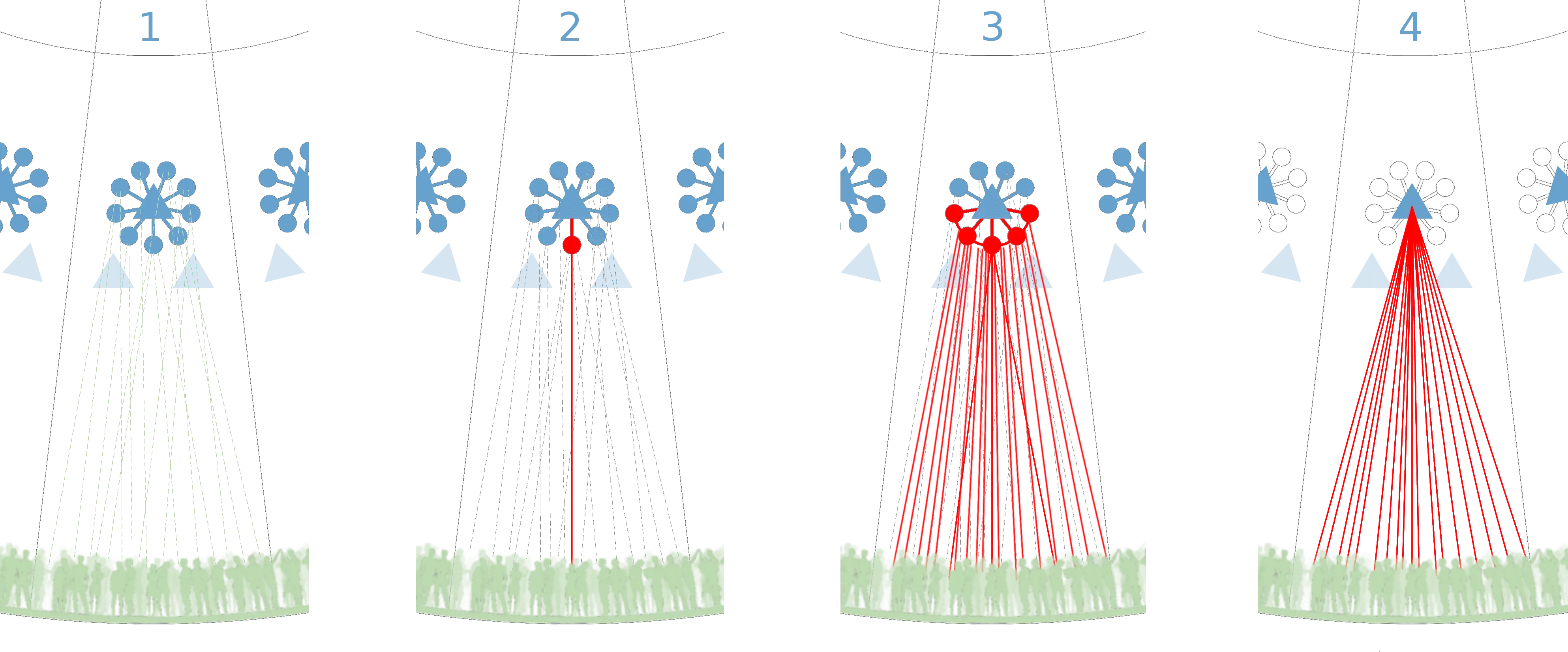
1. Before the transition
Citizens choose political parties and representatives in periodic elections. The elected representatives then vote on individual political questions in parliament.
2. Early UE Party phase
A first UE representative enters parliament. Eligible members of the UE Party vote directly on individual questions through AGORA, and the representative acts on those results in parliament.
3. UE Party majority phase
More UE representatives are elected. Direct voting through AGORA now guides a parliamentary group or majority, allowing citizens to influence a growing share of legislation and the transition itself.
4. After the transition
Direct voting through AGORA has become part of the democratic system itself. Parliament remains the legislative institution, but parliamentarians no longer cast the deciding votes on citizens’ behalf. They steward the legislative process. Political parties may still exist as voluntary organisations, but they are no longer part of the election system.
UE Parties function as temporary political adapters between two democratic architectures: AGORA’s direct, issue-by-issue democratic process and the existing party-parliamentary systems that still exercise lawful public authority. Eligible UE Party members use AGORA to determine the positions their elected representatives undertake to carry into parliamentary deliberation and voting, under the laws of each jurisdiction. The adapter thus connects democratic judgements formed through AGORA to institutions that can already act lawfully, without transferring legislative authority to AGORA or making party-member votes binding on the wider electorate.
As direct democratic voting becomes constitutionally established, the adapter becomes unnecessary within the territories where the transition is complete. UE Parties may continue to serve this function in jurisdictions still undergoing transition, but acquire no privileged institutional role in the completed democratic system.
The mechanism is intended to begin from 2027. Even limited representation can bring the results of UE Party members’ AGORA votes into parliamentary debate, committees and legislation. With greater representation, UE Parties can help advance constitutional reform, referenda, treaties, cross-border integration and the territorial changes required by the transition.
Progress will depend on the electoral cycles, laws and political conditions of each jurisdiction. Before 2035, many UE Parties may achieve only initial representation, coalition influence or precedents for carrying UE Party members’ AGORA votes into existing institutions. Deeper constitutional reform, bloc development and sovereignty transfer can continue later, and established parties can support the same transition measures without becoming UE Parties.
24.4 Other lawful routes into existing institutions
UE Parties are only one transmission mechanism.
Existing constitutions already contain routes for public authority to change itself: ordinary legislation, constitutional amendment, referenda, citizens’ initiatives, intergovernmental agreements, treaties, federal reorganisation, devolution, regional integration, litigation where standing exists and decisions taken by governments within their lawful competence. Existing political parties and cross-party coalitions can also adopt transition measures without becoming UE Parties.
The same routes can support the constituent process itself. Parliaments, governments and public institutions can protect lawful access to Earth Citizenship and AGORA, cooperate on identity and eligibility verification, support independent auditing, protect open constitutional discussion and help people participate safely across jurisdictions. None of this makes existing institutions the source of the global constituent mandate.
Which route is available depends on the polity and on the function being changed. Opening border functions may require a treaty.
Pooling sovereignty may require constitutional amendment or referendum. Joining a bloc may require both domestic and international acts. Accession to Earth Federation may require the highest form of constitutional consent available in the polity.
The transition should therefore use model instruments rather than assume one universal legal path. United Earth and the Council network can develop templates, principles and schedules, while existing public authorities use the procedures available under their own law.
The same principle applies to the material transition. Existing authorities can already change land-use rules, housing systems, food and agricultural policy, taxation, public investment, competition rules, conditions of ownership and regional planning through the lawful procedures available to them. Where unilateral reform would mainly shift ownership, finance, production or economic activity elsewhere, several jurisdictions can also prepare compatible measures or reciprocal commitments together. These reforms remain subject to the ordinary democratic and constitutional requirements of the jurisdictions adopting them.
These routes should also allow territorial entry to be prepared before the global constitutional threshold wherever existing law permits. A polity can undertake constitutional preparation, negotiate agreements, align institutions and administration, develop replacement-security arrangements and complete other lawful steps required for later accession rather than waiting for Earth Parliament to exist before beginning that work.
Some jurisdictions may also be able to adopt advance or conditional accession instruments designed to take effect only if the global founding threshold is validly reached and the relevant conditions for entry are satisfied. The legal form can differ from one polity to another. Preparation does not itself place territory under Earth Federation: territorial jurisdiction begins only through valid constitutional entry once the necessary constitutional authority exists.
24.5 From parliamentary footholds to structural change
The practical importance of entering existing authority is cumulative.
At first, the result may be modest: a question raised in a chamber, a committee hearing, a municipal resolution, a referendum initiative, a legal challenge or one representative carrying an AGORA mandate into a vote. These acts matter because they create public precedents inside real institutions.
As support grows, the same route can become structurally consequential. Before 2035, the most important achievements in many jurisdictions may be footholds, precedents, coalition commitments, referendum initiatives and constitutional openings.
As the constitutional threshold approaches, the same networks can move into the heavier work of coordinating reforms across jurisdictions, negotiating compatible treaties, preparing constitutional changes, developing bloc structures and preparing the lawful decisions required for accession. UE Parties operating in neighbouring polities can synchronise political pressure from below while existing governments negotiate from above.
After Earth Parliament has been established, prepared measures can be activated where their legal conditions are met, while remaining constitutional reforms, competence transfers, bloc development and later accessions continue.
Programmes can make this route tangible. Participants may support a regional housing and food transition, BioSafely measures or a common AI assurance process for different reasons.
Housing and food work can connect land use, housing access, local production, ecological restoration and economic resilience through measures that municipalities, regions, parliaments and governments already have lawful authority to debate and adopt.
Where such work reveals limits created by cross-border ownership, finance, production or risk, the same programmes can generate proposals for coordinated blocal or global rules. AGORA records the arguments and advisory judgements; elected representatives and partner institutions seek the mandates, budgets and agreements needed to act. Results are evaluated in public and can bring more people into the political community. Support for a measure remains distinct from the founding assent expressed through Earth Citizenship, from support for United Earth as an organisation, and from later constitutional decisions made by Earth Citizens through AGORA.
This is how the transition can move from voluntary participation to changes in real public authority without confusing the two. The proto-system supplies constituency, deliberation, proposals and political pressure. Existing institutions perform the legally binding acts until new constitutional authority has been legitimately created.
25. Global commons in the transition
The planetary commons described in the proposal (WHAT) are intended to receive explicit constitutional status, defined responsibilities and enforceable democratic governance at the global level. The transition is the process of bringing these domains from today’s fragmented jurisdictions, international arrangements and emerging governance systems into that common framework.
Different commons require different pathways. Some involve transferring territorial jurisdiction. Others require global authority over systems that continue to pass through bloc, regional and local territory. Still others depend on physical and digital infrastructures that must be built progressively before the constitutional order is complete.
The objective is therefore not one simultaneous transfer. It is to develop the legal authority, institutions, infrastructure and governing capacity through which global stewardship can become operational domain by domain, while preserving continuity wherever existing institutions already perform necessary functions.
Forest and cleared land in the Amazon biome of Maranhão. Image from Brazil’s Operation Hymenaea in 2016. Felipe Werneck / Ascom-Ibama from Wikimedia Commons.
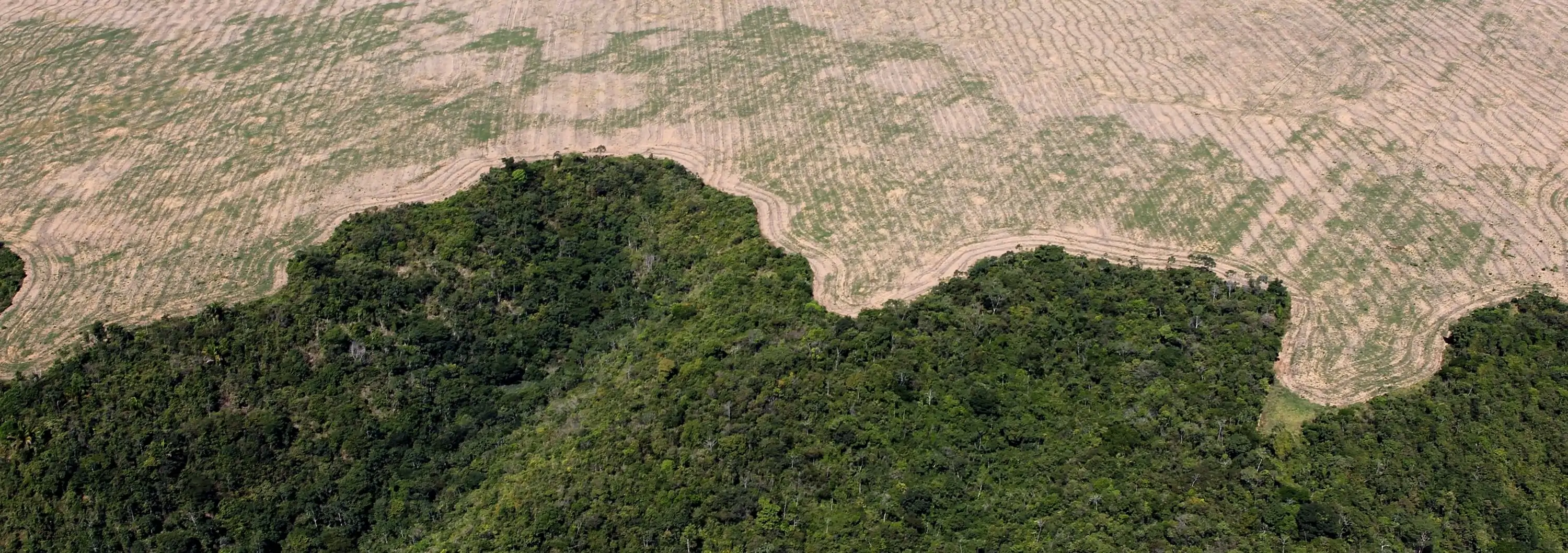
From fragmented nation-state protection to global stewardship
The image makes the governance problem visible at the edge between standing forest and cleared land. The Amazon is one interconnected ecological system, while responsibility for it is presently divided among several sovereign states. Existing institutions can protect and restore the forest, but separate political priorities, enforcement systems and land-use decisions can change independently over time. Protection of the whole therefore remains fragmented and politically reversible. The eight Amazonian states currently cooperate through the Amazon Cooperation Treaty Organization, but authority remains with the participating states.
The proposed transition does not begin by discarding this capacity. It begins by developing the constitutional, institutional and territorial pathway through which responsibility for the Amazon’s planetary ecological functions can eventually become global, while regional and local governance, Indigenous self-government, environmental administration and practical stewardship continue within the new structure.
25.1 From constitutional designation to global authority
A future Earth Constitution can assign a planetary system, function or territory to the global level. That decision alone does not transfer the rights, institutions, administrative systems, infrastructure or enforcement capacity through which the domain is presently governed.
Preparing before authority
Much of the transition can begin before constitutional authority exists.
The Council network can develop proposed criteria for global-commons designation, boundaries, stewardship regimes and institutional requirements. AGORA can deliberate on competing models. Scientific monitoring and shared data systems can be developed. Existing institutions can cooperate more closely. Draft treaties, accession provisions, constitutional clauses and administrative transition plans can be prepared and tested.
These activities can make a future transfer workable. They do not themselves create jurisdiction.
Lawful transfer and reconstitution
Where a state presently holds territorial or administrative authority, the relevant competence has to be transferred through lawful constitutional processes. Where a domain is governed through international treaties or shared legal regimes, those arrangements have to be amended, superseded or incorporated into the new constitutional framework. Existing concessions, licences, infrastructure rights and operational responsibilities likewise require legal continuity or reconstitution.
The general transition rule is therefore:
constitutional destination + lawful transfer or reconstitution of present rights = global public authority.
This principle already follows from the wider transition architecture: public authority is acquired through constitutional processes, not through declaration by the proto-system.
Authority must arrive with capacity
Legal authority cannot safely move faster than the institutions capable of exercising it.
A functioning stewardship regime requires administration, scientific and technical capacity, monitoring, finance, enforcement, judicial review and, where relevant, security capacity. Existing institutions and personnel should therefore be integrated or transformed wherever this provides continuity rather than replaced simply because the constitutional level changes.
The transition is complete for a particular commons only when authority and the practical capacity to exercise it have become operational together.
25.2 Direct and distributed global stewardship
Global stewardship develops through two complementary constitutional forms.
Some planetary commons and global responsibilities remain physically embedded within the blocal zone. The global level establishes binding frameworks and common responsibilities, while implementation remains distributed through blocs, regions, and loci according to subsidiarity.
Other functions require direct global territorial jurisdiction. Together, these territories form the global zone.
Building the global zone
The global zone is not a collection of isolated exceptions. It develops as a connected territorial sphere comprising the oceans, directly global islands and archipelagos, polar domains, globally governed maritime routes and chokepoints, tropical rainforest territories of planetary significance, and other areas whose higher territorial functions are most coherently exercised directly at the global level.
Within this zone, the bloc level — and the transitional sub-bloc level where it exists elsewhere — is absent.
Loci continue to govern local matters. Regions continue to perform regional functions, including public services, democratic administration, environmental stewardship, and policing appropriate to that level. What would otherwise be the bloc’s higher territorial executive and security functions are exercised directly by the global level.
The mature territorial chain is therefore:
locus → region → global
rather than:
locus → region → bloc → global
Earth Citizenship, constitutional rights, and global democratic participation remain identical in both structures.
Islands and archipelagos belong to the global zone by default. Large inhabited islands or island groups can instead become part of a nearby bloc where close geographic proximity, functional integration, and governance scale make that structure clearly appropriate. Historical sovereignty, colonial possession, or metropolitan affiliation creates no presumption of future bloc membership.
The transition therefore develops not only global competences, but the territorial and operational capacity required for the global level to govern its own zone in practice.
Global responsibilities across bloc territory
Many global commons and planetary functions remain physically embedded within the blocal zone rather than becoming part of the global zone.
The atmosphere passes over every bloc. Ecological connectivity runs through ordinary land. Internet infrastructure reaches into every community. The 50/50 principle reshapes land use throughout the territorial system.
Here the global level establishes the constitutional framework, common objectives and those binding standards that genuinely require planetary coordination. Implementation then takes place principally through blocs, regions and loci.
This distributed form of stewardship is as important to the transition as direct global territorial jurisdiction.
A global jurisdiction that develops in several dimensions
The map shows the territorial dimension of the transition: the emerging blocal zone alongside a global zone whose territorial jurisdiction can develop progressively as constitutional authority is lawfully transferred or established.
The oceans, directly global islands and archipelagos, Antarctica, the Arctic Commons, tropical rainforest territories of planetary significance, maritime routes and chokepoints, and other directly global areas can therefore be represented geographically.
Other global commons cannot be contained by the map. The atmosphere surrounds the territorial system; near-Earth space extends beyond it; the Internet runs through it; and the 50/50 pattern reorganises ecological space within both bloc and directly global territory.
The accompanying transition lines therefore represent several processes developing at once rather than a single frontier advancing across the map. Some global competences can develop through treaties and common standards. Some require territorial transfer. Some depend on physical infrastructure. Their constitutional and operational maturity can consequently occur at different times.
25.3 The atmosphere and climate system
The atmospheric transition moves constitutional competence over planetary atmospheric functions to the global level while territorial governance remains in place. No transfer of land territory is required.
What moves is constitutional competence over those atmospheric functions whose effects and management are inherently planetary.
Building global competence
Before Earth Federation exists, monitoring, scientific cooperation, common standards and increasingly coordinated policy can continue to develop through existing institutions and the proto-system’s global-task work.
The constitutional transition begins when acceding parts of the system accept binding global competence over the defined planetary functions of the atmosphere.
Lower levels remain responsible for the territorial implementation assigned to them: energy systems, buildings, land use, industry, transport and many other sources and consequences remain physically located in loci, regions and blocs.
Global authority and distributed execution therefore develop together.
Planetary intervention requires planetary authority
The same logic becomes especially important where action could deliberately alter a planetary system.
Research into atmospheric intervention can begin without creating authority to deploy it. Monitoring can be global before decision-making is global. But any future decision to permit, prohibit or undertake interventions capable of materially affecting the climate system requires a legitimate decision-making level corresponding to the scale of the consequences.
The transition must therefore build the scientific, deliberative and constitutional capacity before such authority is needed, rather than attempting to invent it during a crisis.
25.4 The ocean as global territory and commons
The oceans form the largest continuous territorial part of the global zone and simultaneously remain one of humanity’s central planetary commons.
Their transition therefore combines territorial governance, ecological stewardship, transport, resources, communication infrastructure, mobility, emergency response, and security within one connected physical domain.
From fragmented regimes to common stewardship
Existing maritime law, scientific institutions, environmental arrangements, navigation systems, rescue services, monitoring systems, and administrative capacity provide material that can be retained and integrated.
The constitutional transition gradually replaces fragmented higher territorial jurisdiction with one global maritime jurisdiction. The ocean is no longer governed primarily as the space between sovereign territorial powers, but as a continuous physical sphere of global democratic governance.
This does not require one operational agency to perform every task. Shipping, ports, fisheries, research, environmental protection, emergency response, infrastructure, policing, and other functions can remain distributed among specialised institutions and subsidiary governance levels. What changes is where ultimate territorial responsibility and constitutional authority reside.
Maritime passages and global mobility
As sea routes connect the entire Earth economy, strategically important passages cannot be treated only as leverage belonging to the surrounding territorial power.
The transition should therefore identify those maritime functions whose reliable and peaceful availability must be protected globally, while preserving the local and regional responsibilities that remain attached to adjacent territory.
Where a globally indispensable passage requires control of adjacent land for its neutral, safe, and effective operation, that limited territorial area can also enter the global zone.
Such jurisdiction must remain functionally and geographically limited to what the global passage requires. It does not create a general route for extending global territorial authority into the blocal zone.
The seabed also carries the digital commons
The ocean floor is simultaneously part of the physical infrastructure of global communication.
Submarine telecommunications cables carry more than 99 per cent of international data traffic. Existing international law already contains rules for laying and protecting cables beyond territorial waters, while the infrastructure itself crosses many jurisdictions and is operated through a complex mixture of public and private actors.
Their transition therefore belongs to two parts of this chapter at once. As physical installations they form part of ocean and seabed governance. As communication infrastructure they form part of the globally accessible Internet described below.
The long-term objective is resilience and equal global access rather than allowing indispensable communication routes to become instruments of exclusion or geopolitical pressure.
25.5 Antarctica
Antarctica begins from a different position than almost every other terrestrial commons. The existing Antarctic Treaty already reserves Antarctica for peaceful purposes and protects scientific cooperation.
In the mature geography, Antarctica forms a directly governed part of the global zone as well as a planetary commons.
The transition therefore begins with an established international regime rather than ordinary territorial administration.
From treaty stewardship to constitutional stewardship
The task is not to recreate the cooperative functions that already exist. It is to determine how the relevant treaty institutions, scientific systems, environmental protections and operational capacities can be carried into a global constitutional framework.
That requires lawful action by the parties holding the present treaty rights and responsibilities. Earth Constitution can define the intended global status, but implementation depends on the treaty system being reconstituted accordingly.
Antarctica may therefore become one of the clearest examples of continuity through transition: existing cooperative governance is retained where it works, while its ultimate legal basis moves from agreement among sovereign states to common constitutional authority.
25.6 The Arctic Commons
The Arctic requires a more complex territorial transition because its mature form combines ocean, islands, ice, and selected continental territory within one circumpolar part of the global zone.
The proposed Arctic Commons is not limited to the Arctic Ocean or Greenland. Its eventual geography can include Greenland, Svalbard, Novaya Zemlya, the Arctic Ocean and sea ice, and appropriate northern coastal belts in North America and Eurasia where ecological, climatic, geographic, scientific, navigational, or security functions require coherent direct global jurisdiction.
The exact boundary should not be fixed by this document. It requires scientific, democratic, and constitutional development based on the functions the commons and global zone are intended to protect and govern.
Building a circumpolar commons
The transition begins by developing the Arctic as one governance problem rather than a set of unrelated peripheral territories.
Climate research, ecosystem protection, resource governance, transport, pollution control, emergency capacity and possible future climate interventions all interact across the circumpolar region.
A common Arctic plan can therefore precede the final transfer of jurisdiction and provide a basis for deciding which functions require direct global authority and where the geographic boundary should lie.
Land, water and ice change together
A static political boundary cannot by itself govern a rapidly changing cryosphere.
The transition architecture must therefore distinguish the stable constitutional geography of the Arctic Commons from changing physical conditions such as sea-ice extent. New areas becoming seasonally navigable do not cease to belong to the commons because the physical state of the surface changes.
This is especially important as Arctic waters become increasingly relevant to shipping, resource access and strategic movement.
Existing communities remain governed subsidiarily
Bringing Arctic territory under direct global jurisdiction does not eliminate its communities or lower governance institutions.
Local and regional government continues. Indigenous and other local communities retain their constitutional rights, cultural self-determination and direct participation in decisions affecting their territories. Police, public services and ordinary administration remain located at the appropriate lower levels.
What changes at the top of the chain is that regional and local governance connects directly to the global level, which assumes the higher territorial executive and security functions that a bloc would otherwise perform.
Global executive and security capacity
The Arctic Commons must also be governable in practice.
The global level therefore requires sufficient executive and security capacity to protect the territory, enforce valid global law, secure common infrastructure and maintain the peace of the commons.
This capacity is geographically limited by constitutional competence: it does not imply a general global military authority throughout bloc territory.
25.7 The global tropical rainforest belt
The great tropical rainforest systems present a different transition problem from the polar domains and oceans.
Their ecological continuity crosses present sovereign borders, while their climate, hydrological, biodiversity, and biosphere functions have consequences far beyond the territories in which they are located.
The mature system therefore places tropical rainforest territories of planetary significance within the global zone, including the major systems of the Amazon basin, Congo basin, and tropical South and Southeast Asia.
At the same time, these territories become nature regions under ecosystem sovereignty through the Nature/humanity: 50/50 structure.
The transition must therefore build two constitutional protections together: direct global higher territorial jurisdiction and regional ecosystem sovereignty.
Defining ecological territories before transferring jurisdiction
The boundaries of the rainforest territories should be based on ecological and functional geography rather than on the remaining forest cover at a particular moment.
A boundary that automatically retreated as forest was destroyed would reward degradation and exclude territories that require restoration.
The transition can therefore begin with scientific mapping, ecological modelling, consultation with affected communities, and development of alternative boundary proposals before final territorial designation.
Existing and recoverable rainforest systems must both be considered.
Carrying existing capacity into the new jurisdiction
The present states, regions, local governments, Indigenous institutions, environmental agencies, scientific organisations, and other bodies operating within these territories contain knowledge, infrastructure, records, public services, monitoring systems, and practical capacity that should not be discarded.
As territories accede and jurisdiction is lawfully transferred, useful capacity can be reconstituted within the new constitutional structure.
Regional and local democratic government continues in inhabited societal regions. Nature regions operate under ecosystem sovereignty. The change at the higher territorial level is that planetary stewardship no longer depends on several separate sovereign jurisdictions or blocs.
A transition that can remain incomplete for a time
Because each major rainforest system crosses several present jurisdictions, transition can occur unevenly.
Some territories may enter the new constitutional structure before others. Shared mapping, monitoring, restoration, scientific cooperation, and common standards can deepen before the entire intended ecological territory has entered direct global jurisdiction.
The final global-zone geography can therefore be designed as a coherent ecological whole even while constitutional jurisdiction over it is acquired progressively.
The Amazon, Congo, and Asian rainforest systems may follow different transition paths, but they converge on the same mature principle: planetary rainforest systems receive both direct global territorial protection and ecosystem sovereignty at the regional level.
25.8 Implementing nature/humanity: 50/50
The 50/50 principle requires a different transition model again.
It is a global ecological objective implemented through the regional structure across both the blocal and global zones.
The proposal (WHAT) already establishes nature regions and societal regions as two constitutionally distinct regional forms and defines approximately half of land and half of ocean area as the global objective.
Across the blocal zone, blocs translate the planetary objective into large-scale territorial planning together with regions and loci. Within the global zone, the global level performs the corresponding higher territorial role. Tropical rainforest territories of planetary significance receive the additional protection of direct global jurisdiction while remaining organised regionally under ecosystem sovereignty.
A global result, not a uniform quota
The transition should begin with a global plan capable of identifying what a coherent 50/50 pattern would actually require.
The result does not have to be an identical 50/50 division inside every bloc, global-zone territory, or region. Population density, urbanisation, ecological condition, the location of intact ecosystems, restoration potential and the land required for food, forestry and other necessary nature-based production vary substantially.
Different blocs and global-zone territories may therefore contain very different proportions of ecosystem-sovereignty territory.
The global requirement is the resulting planetary pattern: approximately half of terrestrial area and half of ocean area organised primarily for ecological continuity, with the two balances assessed separately.
Two regional types as the main implementation tool
On land, the principal mechanism is the progressive development of nature regions and societal regions.
Regions can be redrawn, combined, restored and reclassified over time as the global plan develops. Existing protected areas can become nuclei of larger continuous nature regions. Degraded areas can become restoration corridors.
This turns 50/50 from a conservation percentage into a territorial-development programme.
Societal regions can in turn concentrate settlement, infrastructure, food production, forestry and other human land uses within a coherent planning structure.
This territorial reorganisation is therefore also a material and economic transition. Protecting and restoring large connected ecosystems changes how land can be used, while societal regions must sustain the food, housing, livelihoods, infrastructure and services people need within their ecological limits. Land stewardship, rights of use, food production, settlement, investment and transition support therefore have to develop together with the territorial pattern. Earth50/50 cannot be implemented as conservation policy alone; it depends on the economic and regional programmes that make a different pattern of land use materially and socially viable.
Global coordination, higher territorial planning, regional execution
The global level maintains the planetary objective, ecological criteria, and cross-boundary coherence.
Within the blocal zone, blocs translate this into large-scale territorial planning. Within the global zone, the global level performs the corresponding higher territorial planning function directly.
The regional level carries much of the practical work in both zones, but through two different institutional forms. Societal regions coordinate settlement, food, forestry, infrastructure, and public services within their ecological limits. Nature regions use dedicated, constitutionally protected stewardship authorities, with compact resident representation and connected local loci, to maintain ecosystem sovereignty, monitoring, restoration, and strictly compatible human activity.
The bloc or global level provides higher territorial coordination and oversight without displacing the nature regions’ protected ecological mandate.
The transition can recognise existing Indigenous and other stewardship communities and, where justified, approve new purpose-bound 1000-Year Earth Sanctuaries as local bases for ecological stewardship. This does not authorise general settlement expansion into nature regions. The 50/50 objective therefore requires coordinated planning at every level, with responsibilities adapted to the two different regional forms.
25.9 Building the infrastructure of global democracy
The digital commons has a special relationship to the transition because the proposed political system itself depends on it.
AGORA cannot remain merely an application running over whatever commercial connectivity happens to exist. Continuous direct democratic participation at planetary scale requires universal practical access, resilient communication and a public infrastructure that remains operable independently of any single private provider.
The proposal (WHAT) already treats connectivity and practical access to AGORA as conditions for meaningful democratic participation.
Proto-AGORA as functional proof
The transition begins much more modestly.
The UE project builds proto-AGORA using the same broad class of infrastructure available to other large digital services: hosted servers, cloud systems, distributed web infrastructure and progressively stronger security architecture. Its technical form can change several times as resources, scale and security requirements develop.
These project-run systems are not the future constitutional node network.
Their purpose is to demonstrate and test its functions.
Proto-AGORA can develop deliberation, civic verification, knowledge integration, competence systems, elections and voting, multilevel jurisdiction logic and other elements that the later public system may require. The project can therefore test whether the proposed democratic architecture works before anyone is asked to grant it public authority.
Preparing for the constituent process
The most demanding proto-stage is preparing democratic infrastructure capable of serving the constituent process at planetary scale.
Proto-AGORA may eventually have to support billions of verified civic identities, secure elections, public deliberation, constitutional decision-making, threshold verification, multilingual access, public records and democratic participation across widely different jurisdictions.
The constitutional rules governing succession and activation are defined in The rules of the constituent path.
The technical task here is to make those democratic processes secure, auditable and resilient enough to operate at the required scale.
Technical capacity does not confer constitutional authority. Nor can United Earth declare its own thresholds reached merely because it operates the infrastructure. Counts and readiness conditions must be publicly auditable and independently reviewed.
The United Nations, electoral authorities, states, technical organisations, independent auditors and other actors can contribute access, verification capacity, expertise and scrutiny. Their role is to help establish whether predetermined facts are true, not to grant or deny the democratic mandate.
Proto-AGORA can therefore grow from project infrastructure into the democratic infrastructure through which the emerging demos progressively assumes control.
From virtual architecture to physical nodes
The mature node system is physically tied to the governance geography.
Every locus requires a public node. Where that locus is also a regional centre, the local node is developed to carry the regional node functions as well. The same principle applies when a place also serves as a sub-bloc or bloc centre.
The global level is different. It is represented neither by one global node nor by one capital.
Its physical presence develops through two complementary networks.
Global constitutional precincts beside the principal institutional centres of the blocs provide the permanent global–blocal interface and contain global top-level AGORA nodes.
A second network of global-zone hubs provides institutional, technical, democratic, scientific, stewardship, emergency, communications, and other operational capacity within directly global territory.
These networks together form part of the distributed global capital geography described in the proposal (WHAT). They allow global institutions and AGORA infrastructure to operate across both territorial structures without making any one city, bloc, island, or region the physical centre of Earth Government.
The mature node architecture therefore follows the governance geography itself rather than reproducing a single-centre capital model.
Much of this transition can reuse existing public buildings, administrative centres, research facilities, communications systems, ports, logistics infrastructure, and other technical capacity.
New nodes and hubs are required where the proposed governance geography creates institutional centres that do not presently exist, where existing infrastructure is inadequate, or where the global zone requires a distributed operational presence of its own.
A publicly controlled backbone
The distributed node and hub system also needs a communications layer that does not make constitutional democracy dependent on the continuing permission of private infrastructure owners or on any single territorial route.
Over time, a dedicated publicly owned and publicly controlled backbone should therefore connect the node system through terrestrial fibre, submarine cables, satellite capacity or combinations of these technologies.
This does not require every Internet connection or telecommunications company to become publicly owned. Private operators can continue to build and operate substantial infrastructure under licence and common rules.
The distinction concerns ultimate responsibility and control over the indispensable public layer.
Universal practical access
The public responsibility extends beyond the backbone.
Every Earth Citizen must be able to reach AGORA and essential public digital services in practice. The appropriate solution will differ between dense cities, remote settlements, islands, mobile communities and sparsely populated territories. Private connections, public access points, local networks, terrestrial wireless systems and satellites can all contribute.
The objective is universal practical democratic access rather than ownership of identical technology.
This infrastructure must develop throughout the proto-period because increasing participation, the constituent process and the mature democratic system all depend on it.
AGORA becomes constitutional infrastructure
The final transition is institutional rather than merely technical.
The project-run proto-system ceases to be sufficient once public authority depends on it. The relevant systems, standards, data, public AI capacity, security architecture and node infrastructure must be reconstituted under independent constitutional governance.
The continuity is functional rather than proprietary:
proto-AGORA tests and demonstrates the functions; the constitutional system makes them public infrastructure.
25.10 Near-Earth space and the Earth–Moon Commons
Space offers an unusual opportunity to build governance before a mature territorial order has formed.
Existing international law already establishes that outer space cannot be appropriated by states through claims of sovereignty, use or occupation, and makes states responsible for activities conducted by both public and private entities under their jurisdiction.
The transition does not begin from a blank legal field.
Building capacity before dependence
Near-Earth space is already infrastructure. Over time, orbital systems, lunar activity and other Earth–Moon functions can become still more deeply embedded in communication, navigation, science, security and economic life.
The governance transition should therefore develop before irreversible patterns of exclusive control become entrenched.
Proto-institutions can begin by developing common monitoring, traffic coordination, debris policy, scientific standards, access principles and models for licensing and public oversight. Existing treaty institutions and technical organisations can be incorporated into this work.
From state responsibility to common public authority
As global constitutional authority develops, functions presently dependent on coordination among states can be progressively reconstituted as public responsibilities of the global level.
The same principle applies to private activity: commercial participation can continue, but access to indispensable orbital positions, communication infrastructure or future extraterrestrial resources cannot itself create political sovereignty.
The Earth–Moon system provides the immediate practical horizon. The wider SolarCommons can develop later as human activity makes actual governance capacity necessary.
25.11 Global stewardship grows with the federation
Planetary commons, global functions, and territories intended for the global zone can cross their constitutional thresholds at different times.
Some may move relatively early because existing cooperative regimes can be transformed. Others depend on the lawful accession or transfer of several territories. Still others require institutions, infrastructure, and operational capacity that will take much longer to develop.
This does not prevent Earth Federation from becoming operational.
The global level can exercise authority over those commons, functions, and global-zone territories for which the necessary competence or jurisdiction has already been lawfully transferred, constituted, or reconstituted, while other parts remain in transition.
The important change is cumulative.
At first, the proto-system can only research, convene, deliberate, coordinate and demonstrate. Later, existing authorities can transmit or pool specific functions. Constitutional accession can then create actual global competence. Finally, institutions and physical capacity make that competence operational.
Different paths therefore converge on one constitutional result: planetary functions are governed at the planetary level, while their implementation remains distributed wherever subsidiarity requires it.
26. Gradual and voluntary entry into Earth Federation
Earth Federation is designed to grow through gradual and voluntary constitutional entry. It must therefore be able to function while some sovereign states remain outside. This chapter examines the conditions for joining and the security arrangements needed to make that process lawful, stable and peaceful.
26.1 Joining Earth Federation
Joining is a constitutional act.
A polity that joins Earth Federation places its territory within the federal constitutional order and transfers or reconstitutes the sovereign competences required by Earth Constitution.
From that point, Earth Constitution and valid federal law apply within the scope assigned to them, while subsidiary territorial authority continues under the federal distribution of competence.
This chapter uses constitutional entry for that formal change.
Earth Parliament before Earth Federation
Establishing Earth Parliament does not immediately establish a territorially complete Earth Federation.
At the founding threshold, Earth Parliament has a direct democratic mandate from the global political community that created it. It governs its own democratic institutions and the responsibilities lawfully placed within the emerging constitutional order.
It does not thereby acquire territorial jurisdiction over states or territories that have not entered the order. Nor does it claim public legal authority over Earth Citizens living there, beyond the internal rules governing their voluntary participation in its democratic institutions.
Earth Parliament can adopt global norms, legislative proposals and model rules for wider implementation. Where public competence has already been lawfully constituted, transferred or pooled, it can exercise binding legislative authority within that competence. Elsewhere, its decisions remain proposals directed toward the authorities that still possess lawful jurisdiction.
Existing states therefore continue to exercise the public authority they retain. Territorial entry and wider transfers of authority proceed through lawful constitutional decisions.
This separation is one reason early establishment matters. The democratic global institution can exist before the full transfer of authority, allowing later constitutional and territorial changes to be debated, negotiated, tested and democratically directed rather than improvised only after the old structure has already been dismantled.
Constitutional entry and territorial jurisdiction
Global constituent legitimacy and territorial jurisdiction perform different functions.
The global constituent process establishes the constitutional polity and its global institutions. Constitutional entry determines where that polity acquires territorial public authority.
A person living outside Earth Federation may therefore participate in the global political community without that participation placing the territory where they live under federal jurisdiction. Conversely, once a polity has validly joined, federal constitutional authority does not depend on every individual resident having supported the decision.
This distinction allows the global demos to develop across territorial boundaries while keeping the transfer of territorial authority lawful and voluntary.
It also concerns the acquisition of territorial public authority. Constitutional entry determines where Earth Federation lawfully acquires jurisdiction over territory and population, whether that territory will ultimately form part of the blocal zone or connect directly to the global level.
Some genuinely global functions, commons, and parts of the emerging global zone can follow additional legal pathways. Competences or territorial jurisdiction over planetary domains can already have been transferred, pooled, or constitutionally reconstituted through lawful arrangements even while wider territorial entry remains incomplete.
Who can join?
The decisive question is not what an entering polity was historically called, but whether it has lawful authority to make the constitutional transfer involved.
During the transition, inherited states, emerging territorial structures and already constituted blocs may stand at different points in their transformation. The constitutional rules therefore have to identify which territorial authority is competent to make a valid decision, which population is represented by that decision, and what competences and territory the decision actually brings into Earth Federation.
This allows constitutional entry to work with the political geography that exists during the transition rather than requiring the final territorial map to be completed first.
Entry nevertheless has to be territorially definite. The federation must know where its law applies, which institutions exercise subsidiary authority there, which population falls within the relevant constitutional relationship, and which security and administrative responsibilities have transferred.
Preparing constitutional entry in advance
Constitutional entry can be prepared before Earth Federation itself has been constitutionally established. As far as existing law permits, a polity can undertake constitutional changes, negotiate accession terms, align institutions and administration, develop bloc arrangements, prepare competence transfers and establish the replacement-security arrangements required for later entry.
Some jurisdictions may also be able to adopt advance or conditional accession decisions whose legal effect is deferred until the global founding threshold has been validly reached and the constitutional conditions for entry are satisfied.
Such preparation can create real legal commitments and make later entry operationally ready, but it does not itself place territory under Earth Federation. Territorial jurisdiction begins only when constitutional entry validly takes effect within the new constitutional order.
Entry while territorial transformation continues
Joining Earth Federation does not require every aspect of territorial transformation to be finished.
An existing sovereign polity may reach the constitutional conditions for entry while its internal place in the future blocal structure is still developing. Neighbouring polities may already be integrating some functions while others remain separate. A larger inherited state may later be reorganised into several constituent structures, while smaller states may become parts of a common bloc.
The later transformation of governance and territory can therefore continue inside the federal constitutional order.
What changes at entry is the status of sovereignty. A polity that has joined no longer stands outside Earth Federation as an independently sovereign state. Whatever inherited institutions and territorial units continue do so within one constitutional order and under the distribution of authority established by Earth Constitution.
26.2 Conditions for joining
Voluntary entry does not mean automatic entry.
Joining changes the constitutional rights, obligations and security environment of everyone already inside Earth Federation. The federal order therefore needs entry conditions that protect democratic legitimacy, constitutional compatibility and operational continuity without demanding that every entering polity already resemble the mature system in every detail.
The distinction is between what must be true before entry, what can continue as a constitutional transition after entry, and what belongs to the longer development of the federation.
Much of this readiness can be developed before the global constitutional threshold is reached. A polity does not need to wait for Earth Federation to exist before building the legal, democratic, administrative and security capacity that entry will require. The final constitutional determination that the conditions for entry have been satisfied, however, belongs to the accession process under the constitutional order itself.
Minimum conditions for entry
A polity must first be able to make a valid constitutional decision under lawful procedures capable of transferring the relevant authority.
Its population must have meaningful democratic standing in that decision. Fundamental rights and equal civic standing must be protected sufficiently for entry into a common democratic constitutional order to be credible. Public institutions must be capable of administering the obligations they assume, and the transfer of security functions must not create an immediate vacuum in lawful command or protection.
The precise thresholds will require constitutional development. The principle is narrower: Earth Federation cannot admit severe and persistent constitutional conditions that directly contradict the foundations of the order and simply treat them as an internal matter after entry.
At the same time, entry should not be postponed until every long-term reform is complete. That would recreate universal completion as a precondition under another name and could prevent the federation from growing at all.
Constitutional transition after entry
Entry can therefore include binding transitional obligations.
Institutions can be reformed further, territorial structures can mature, administrative competences can move between levels, and security arrangements can be integrated progressively after the polity is already inside Earth Federation.
The same principle applies to the economic and material transition. A polity does not have to complete the long-term reorganisation of housing, land, food systems, finance and regional production before entering Earth Federation. It must, however, accept the constitutional principles governing those systems and any binding transitional obligations legitimately attached to accession. Reform can then continue under the federal distribution of authority, with lower levels retaining their assigned responsibilities while blocal and global institutions provide the common rules, coordination and transition capacity required at those scales.
This is particularly important where democratic institutions exist but remain uneven, where constitutional equality requires further implementation, or where inherited territorial and security structures cannot safely be replaced at once.
The direction of change has to be clear before entry even when the whole path is not complete.
This makes entry a constitutional threshold rather than a declaration that institutional development has ended.
Accession readiness and independent review
The rules governing readiness must be fixed before anyone knows which polity will benefit from them.
United Earth should not possess a discretionary power to decide which territories are acceptable members of the future order. The same applies to any incumbent bloc, government or political coalition with an interest in the result.
The Council network can help develop proposed readiness criteria, evidence requirements and review procedures as part of constitutional drafting.
Earth Constitution must ultimately determine which independent institution applies those rules, how contested decisions are reviewed and what procedural rights an applicant polity has.
The criteria should be public, general and applicable to any polity capable of satisfying them.
26.3 A federation that grows over time
Gradual entry should be treated as the normal constitutional condition of an expanding Earth Federation.
A system that works only if every major power joins at the same moment is too brittle to begin.
The federation must therefore be able to operate with a limited initial territorial base, coexist with sovereign states outside it and accept additional polities without reopening the entire founding settlement each time.
Coexistence with states outside the Federation
States that have not joined remain outside the territorial jurisdiction of Earth Federation.
Relations with them remain external relations governed by applicable international law, agreements and whatever wider legal order exists between the federation and the states concerned. Federal institutions cannot treat the existence of a global constitutional polity as a licence to govern people or territory beyond that jurisdiction.
This coexistence may last for decades.
The constitutional design should therefore assume durable external relations rather than treat remaining states as temporary anomalies that will quickly disappear.
Continued voluntary entry
The door to joining must remain open.
Entry conditions should concern constitutional form, democratic standing, institutional readiness and security compatibility — requirements connected to participation in a common federal order. They should not define permanent civilisational camps, inherited geopolitical enemies or identity categories that can never belong.
A state outside Earth Federation today can therefore become part of it later through the same constitutional principle available to others.
As more territories join, the geographic scope of federal law and institutions expands. The constitutional centre does not have to be founded again each time. New entry extends an existing order under procedures already established for that purpose.
A functioning Federation may itself change the political incentives surrounding that choice. People outside may observe neighbouring populations using Earth Parliament, AGORA, common institutions and wider political or economic arrangements. Governments and political movements may reassess the costs and advantages of remaining outside.
Such effects can encourage further entry, but the constitutional design must not depend on them. States can remain outside for a long time, and some governments may actively resist participation.
Voluntary entry and the question of withdrawal
Voluntary entry does not by itself answer whether later withdrawal is possible.
A federal constitution may make some transfers permanent, permit withdrawal under defined conditions, distinguish between different kinds of territorial change, or establish demanding procedures for constitutional separation. Each choice affects stability, democratic self-government and the meaning of the federal commitment.
Earth Constitution therefore has to settle the question explicitly.
The transition should not smuggle an answer into the word voluntary. A decision can be voluntary when made without implying that every constitutional consequence is revocable at will.
26.4 Earth Citizens outside Earth Federation
The global political community can extend beyond the territorial boundary of the federation.
Earth Citizenship and territorial jurisdiction remain different constitutional relationships.
Participation without territorial jurisdiction
A person living in a state outside Earth Federation may still understand themselves as part of the global political community and participate in its civic life where participation is lawful and acceptably safe.
That participation does not transfer sovereignty over the place where the person lives.
The same distinction applies to the founding process. Participation in the global constituent process cannot be converted into territorial authority over a polity that has not constitutionally joined.
This separation is what makes it possible to build a genuinely global demos before the federation has become territorially global.
When citizens and governments disagree
The difficult case arises when a large part of a population wants to join but the government controlling the territory refuses.
Earth Federation cannot resolve that conflict simply by counting external civic support and declaring the territory part of the federation. That would turn global democratic participation into a unilateral territorial claim.
Nor should the global political community become indifferent to people who are prevented from expressing or pursuing a lawful political preference.
Protected communication, diaspora networks, public information, civil-society cooperation and peaceful political organisation can help preserve connection across the boundary. The system should nevertheless avoid encouraging people to expose themselves unnecessarily where participation creates serious personal risk.
Technical access is not protection against state coercion.
Supporting voluntary entry without conquest
Political support for voluntary entry can be active without becoming territorial coercion.
Earth Federation and its citizens may argue for entry, maintain civic relationships, support lawful democratic participation, use diplomacy and pursue forms of political or economic pressure consistent with the applicable legal order.
The boundary is the constitutional one established at the beginning of this chapter: support for political change cannot become a claim that global popularity itself authorises conquest or unilateral incorporation.
This leaves a real moral and political problem where an authoritarian government keeps a population outside against its expressed wishes. A voluntary federation cannot eliminate every injustice beyond its jurisdiction without abandoning the principle that makes its own expansion peaceful.
26.5 Secure constitutional entry
Constitutional entry changes more than legal language.
Existing states maintain police, armed forces, intelligence systems, border functions, emergency structures and protection of critical infrastructure. These capacities cannot simply disappear when sovereignty changes its constitutional form.
A secure transition therefore follows one overriding rule:
Replacement security must exist before the security it replaces is removed.
Replacement before removal
The rule applies capability by capability.
A function can move when the institution receiving it possesses the lawful authority, personnel, procedures, infrastructure and operational readiness required to perform it. Until then, continuity arrangements remain necessary.
This principle applies to policing, territorial defence, intelligence, emergency response, border security, weapons control and other functions on which public safety depends.
It also applies where an inherited state is gradually transformed into a sub-blocal or blocal structure. Constitutional ambition does not justify creating periods in which nobody clearly holds responsibility.
Lawful command and capability transfer
Every transfer of coercive capacity requires an unambiguous chain of lawful command.
Political authority, operational control and physical capability must move in an order that prevents rival claims of command, abandoned functions or security institutions acting without clear constitutional responsibility.
Some functions may initially remain with inherited institutions while new blocal structures develop. Others may be shared temporarily or transferred in stages. The exact sequence can vary because the security structures being inherited vary greatly.
The common requirement is continuity: at every point, it must be possible to identify who is legally responsible for each critical function and under which constitutional authority that responsibility is exercised.
Nuclear and other strategic capabilities
Nuclear weapons and other strategic capabilities make this requirement especially strict.
Their constitutional status, custody and command cannot be changed safely by political declaration alone. Any transition must preserve continuous lawful control and establish the successor arrangements before previous authority is removed.
Verification, inspection, accountability and eventual decisions about retention, redistribution or dismantlement have to be developed as part of the wider federal security architecture.
The method (HOW) does not need to prescribe the final command system in advance. It does need to establish that strategic capability is among the functions whose safe transfer can determine the pace of constitutional change rather than merely follow it.
26.6 Security while major powers remain outside
Gradual entry creates a period in which Earth Federation may coexist with powerful military states outside it.
Some may possess nuclear weapons, large armed forces, major economic capacity or strategically important territory. The federation must be able to protect the people and territory within its jurisdiction throughout that period.
External defence and deterrence
A voluntary federation still requires credible defence.
The existence of open entry procedures does not guarantee that every outside government will regard the federation as benign. Some may interpret its growth as a shift in the balance of power, fear future exclusion or attempt to weaken it.
The federation therefore needs sufficient defensive and deterrent capacity to prevent coercion against its territory and constitutional institutions.
That capacity should be understood as protection of the constitutional order rather than as the creation of a new sovereign bloc competing permanently against the rest of humanity.
Arms control and confidence-building
Security relations with states outside the federation should develop alongside defensive capacity.
Arms-control arrangements, military transparency, monitoring, communication channels, border agreements, incident procedures and other confidence-building mechanisms can reduce the danger that the growth of the federation is interpreted only through the logic of military rivalry.
Some of these arrangements can begin before constitutional entry and continue afterward.
They also serve the wider transition. A state that has already developed compatible security procedures, transparency and cooperative institutions has fewer dangerous discontinuities to manage if it later decides to join.
An open security architecture
One constitutional constraint should govern the whole transitional security architecture:
External-security arrangements must remain compatible with later voluntary entry and must not define present outsiders as permanent enemies.
The federation can recognise real threats without creating a permanent geopolitical identity around them.
This distinction matters because temporary defence systems can otherwise harden into the very structure the transition is intended to overcome: rival sovereign power centres organised around mutual fear.
Earth Federation has to remain defensible while remaining constitutionally open.
26.7 From military rivalry to federal peacekeeping
The long-term security objective inside Earth Federation is different from the external-security problem.
Among territories that have joined, interstate military rivalry is replaced by one constitutional peace order.
The design combines global constitutional supremacy with distributed territorial coercive capacity.
Bloc territorial executive authority
Within the blocal zone, blocs are the highest territorial executive units below the global level. Within the global zone, the corresponding higher territorial executive and security functions belong directly to the global level.
Within Earth Federation they exercise constitutionally protected public administration, policing, territorial security and the principal coercive capacity assigned to the blocal level.
Their semi-sovereignty is internal to the federation. It does not mean external sovereignty or a right to reject valid Earth law as though each bloc remained an independent state.
The distinction matters because the federation is intended to be one state without concentrating all territorial execution at one centre.
Distributed coercive capacity
One global state introduces its own danger: capture of a completely centralised coercive apparatus could create a form of tyranny with no external counterweight left.
Distributed coercive capacity is one constitutional response.
Blocs retain substantial physical capacity on their own territories while remaining bound by Earth Constitution, federal law, common security rules and the judicial order. The global level exercises the executive capacities assigned to it, including those required for genuinely global domains and functions.
The objective is not maximum command efficiency. It is a system in which global constitutional authority is real while capture of the political centre does not automatically produce uncontested physical control over every populated territory on Earth.
Common peacekeeping
Blocal security capacities also have to function together.
Common standards, interoperability, transparent force registries, agreed procedures and constitutionally authorised joint command can allow blocs to contribute to federal defence, peacekeeping and responses to large-scale violence without being merged into one permanently centralised military hierarchy.
Within the federation, unilateral war between blocs ceases to be a legitimate instrument of politics. Disputes belong inside constitutional institutions, courts and democratic processes.
Peacekeeping thus becomes a federal function carried by capacities that remain territorially distributed.
Enforcement without centralised domination
Distribution also creates a hard constitutional problem.
A bloc may itself violate Earth Constitution, obstruct federal law or misuse the coercive capacity entrusted to it. A federation incapable of responding would not possess meaningful constitutional supremacy. A global executive free to intervene wherever it chooses would undermine the anti-tyranny safeguard.
The answer therefore has to be constitutional rather than discretionary.
Earth Constitution must define the legal thresholds, independent review, authorisation procedures, limits and termination conditions under which collective federal enforcement can occur. Courts, political institutions, other blocs and specifically assigned global capacities can all form part of that architecture without giving any single office an unrestricted power over the whole system.
The exact command structures and emergency procedures require further constitutional and security development. The principle is already clear enough to guide that work:
one constitutional order, credible common enforcement, and no single uncontested coercive centre.
Gradual entry can then continue without requiring either universal agreement at the beginning or permanent geopolitical division afterward. Earth Federation grows as polities freely enter a constitutional order capable of protecting them, while the security structures that once defended sovereign separation are progressively transformed into the distributed institutions of a common peace.
27. Harmonising identities and aligning sovereignty
The global political community can be built without changing borders. Earth Federation cannot. The constitutional transition eventually has to reorganise sovereignty, territorial authority and the inherited state structure.
The transition has two interlocking tasks: harmonising the constitutional relationship among overlapping cultural identities within shared civic governance, and aligning sovereignty with the emerging multilevel constitutional order.
27.1 From recognised diagnosis to constitutional change
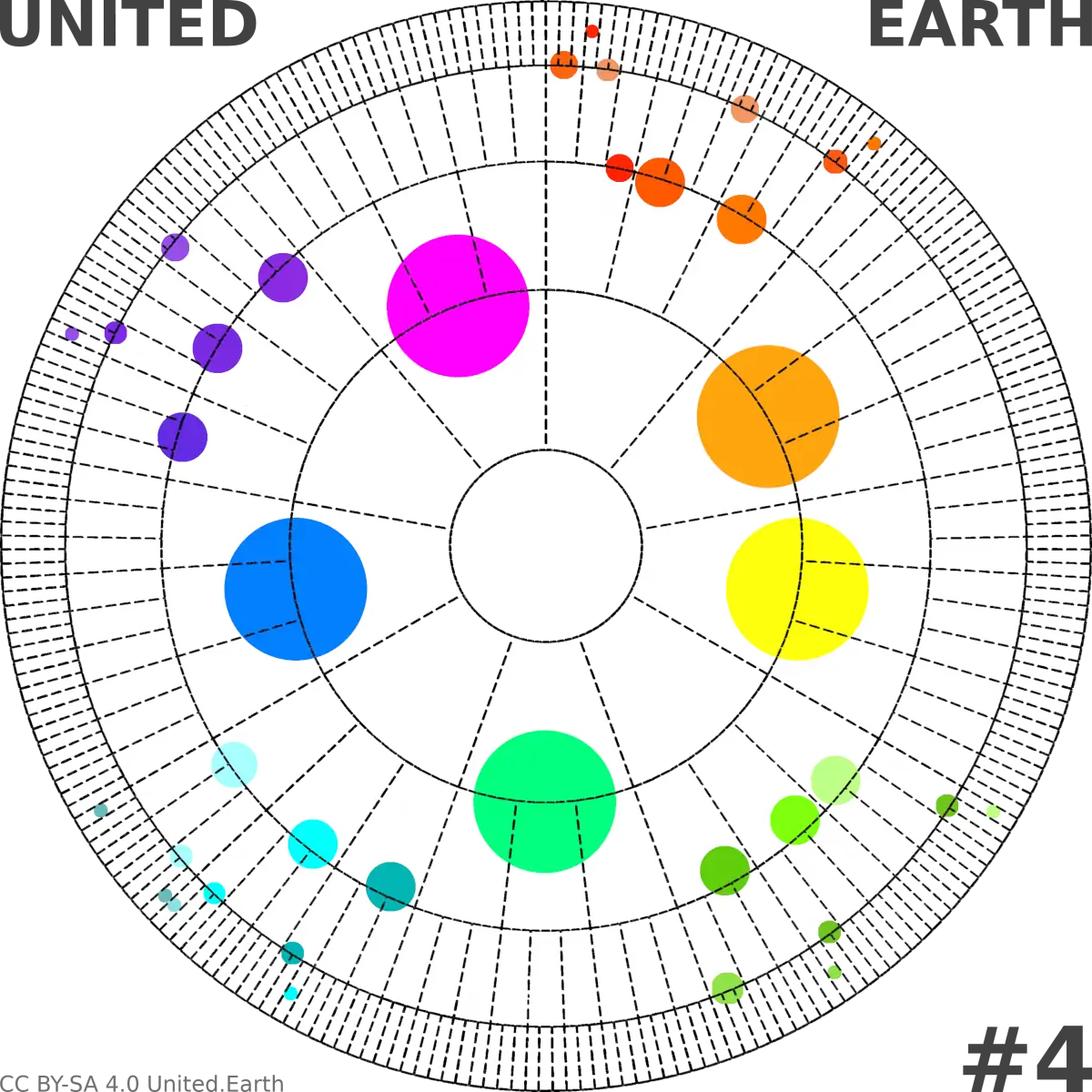
WHEEL < 4/18 >
Decoupling cultural identities from defining governance
The transition begins with the circles retaining the same colours they had when they still filled the territorial space in the analysis (WHY) illustrations. The identities remain visually distinct, but no longer coincide with the boundaries of governance.
Governance begins to be understood as a shared civic structure rather than the political expression of only one cultural community. In terms of the identity–governance distinction developed the analysis, the transition begins to move the constitutional relationship from ID=GOV towards GOV//ID.
Read more about the earthwheels
The analysis (WHY) identifies ID=GOV as a recurring constitutional relationship in which one identity, or a defined set of identities, holds a privileged relationship to public governance. The proposal (WHAT) establishes GOV//ID as the long-term constitutional principle: identities remain free and politically relevant, while none constitutes or owns governance.
The method (HOW) therefore has to translate that principle into constitutional change without pretending that every polity can make the transition in the same order, at the same speed, or under the same security conditions.
The practical starting point is the political standing of people inside existing boundaries.
A governance unit that contains several identities must be able to treat them as equal members of the same civic order, while no identity retains a privileged constitutional claim to the governance unit itself. Cultural continuity can remain protected while public institutions serve citizens across those identities.
This change can begin while the existing territorial map remains intact. In some places it can proceed early. In others it may depend on wider security and territorial arrangements becoming credible first. Constitutional transformation and territorial reorganisation therefore interact rather than following one universal sequence.
27.2 Mapping the changes required
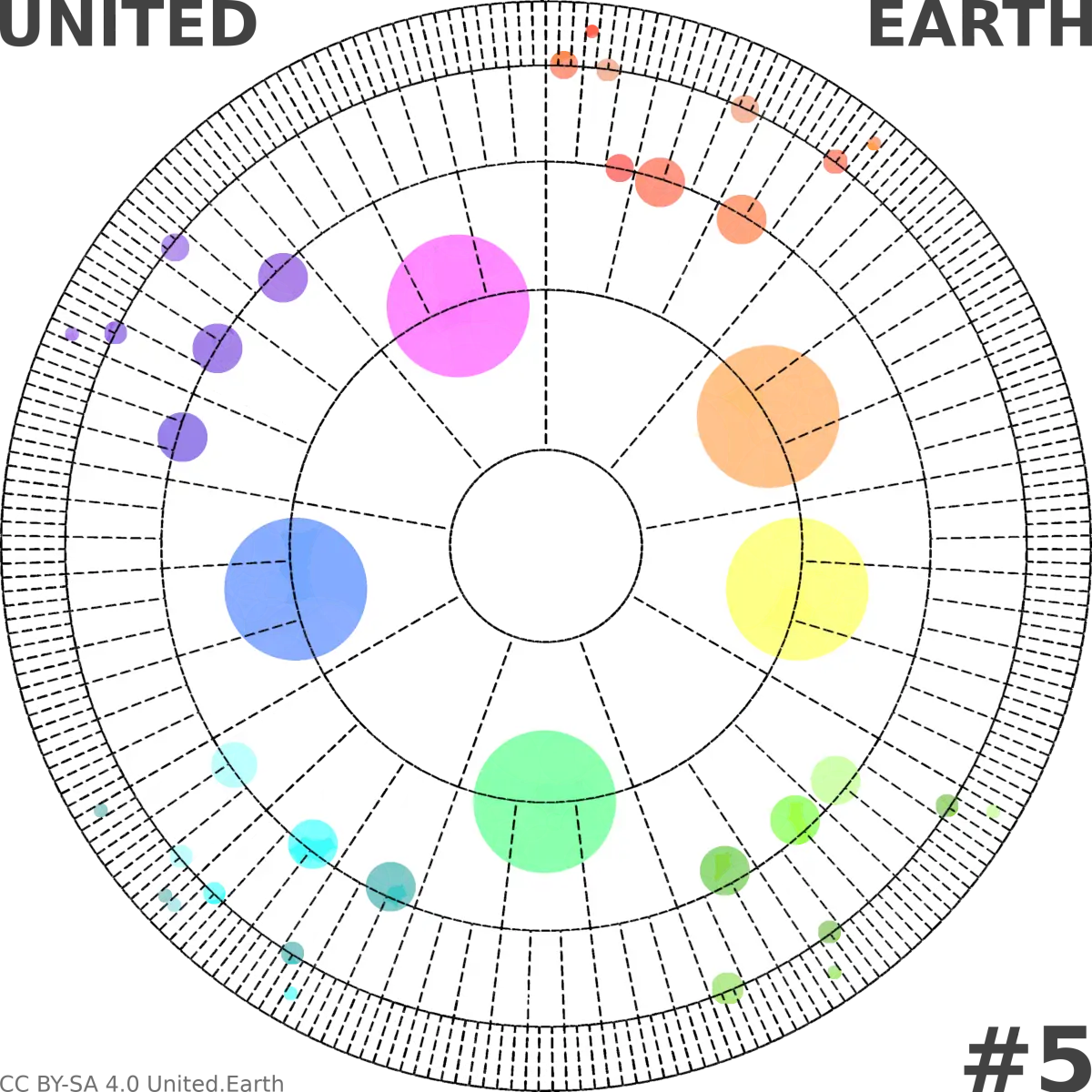
WHEEL < 5/18 >
Aligning former ruling identities with the already stateless ones
The circles that once filled entire governance units are now fading in colour intensity, preparing them to blend in with all other identities, be it nation, ethnicity, religion, ideology, or any mix thereof. None retains the shading that marked exclusive territorial ownership in Earthwheels 1-3.
The image represents the removal of the privileged constitutional relationship characteristic of ID=GOV. Identities remain visible and politically relevant, but none retains exclusive constitutional ownership of the governance unit.
The transition requires each governance unit to identify laws, symbols, privileges and institutional arrangements that prevent equal civic standing among the cultural identities living within it. The exact changes differ from place to place and can be implemented gradually through existing constitutional procedures.
The task is to identify the legal and institutional structures through which ID=GOV is reproduced and determine what must change for governance to become GOV//ID.
The constitutional changes will differ across jurisdictions because the relationships among state, nation, religion, ethnicity, language and ideology are organised differently in each of them.
The work therefore begins with mapping. Which legal provisions privilege one identity? Which symbols are ceremonial and which carry constitutional consequences? Which citizenship rules, territorial claims, educational systems or institutional appointments reproduce unequal political standing? Which protections are required so that cultural communities remain secure when the governance structure changes?
This is a legal and political design task, not a demand for cultural homogenisation. The aim is to make governance compatible with a society in which cultural identities overlap, migrate, combine and change.
27.3 Gradual voluntary implementation
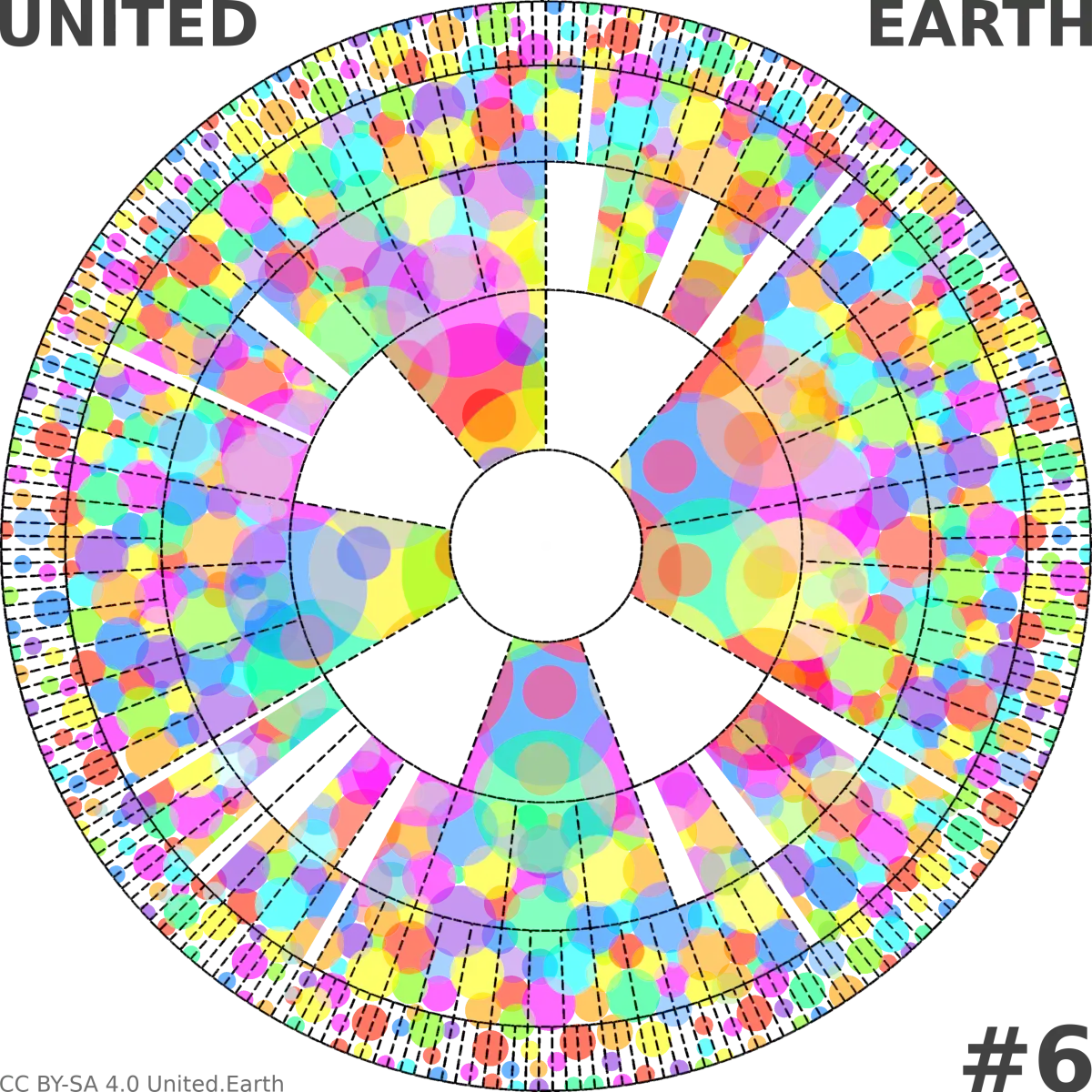
WHEEL < 6/18 >
GOV//ID established
This wheel completes the sequence begun in Earthwheel 4. Governance and identity now appear as separate structures, connected through the citizens who participate in both.
GOV//ID is the target constitutional condition: cultural identities remain free, overlapping and politically relevant, while none defines or owns public governance.
The image represents the direction the transition must progressively realise, not a claim that every polity must reach this condition at the same time or before wider security and territorial arrangements are ready.
As constitutional changes accumulate, cultural identities can continue across the same territory without any one of them defining the political status of the governance unit. Different places may reach this condition at different points in the wider security and territorial transition.
Transformation proceeds through valid domestic procedures. Existing parliaments, referenda, courts and constitutional mechanisms remain the channels through which a polity changes itself.
No polity is to be forced from outside to abandon its existing constitutional relationship between identity and governance. The transition is entered voluntarily and carried through lawful democratic and constitutional processes within the polity itself.
Full GOV//ID need not be an immediate condition for entry into Earth Federation.
A polity may enter under agreed transitional arrangements where security, constitutional or institutional conditions require the transformation to be completed gradually after accession.
Gradualism allows administrative continuity and makes it possible to build protections and replacement institutions before old constitutional arrangements are removed. It also recognises that identities which currently depend on state sovereignty for security will not surrender that protection merely because a different constitutional theory is proposed.
The political objective is not to make identities less important to people. It is to build a public governance structure capable of containing many identities on equal terms, while providing enough constitutional and physical security that no group has to treat independent sovereignty as its only protection.
27.4 GOV//ID: Cultural identities and governance
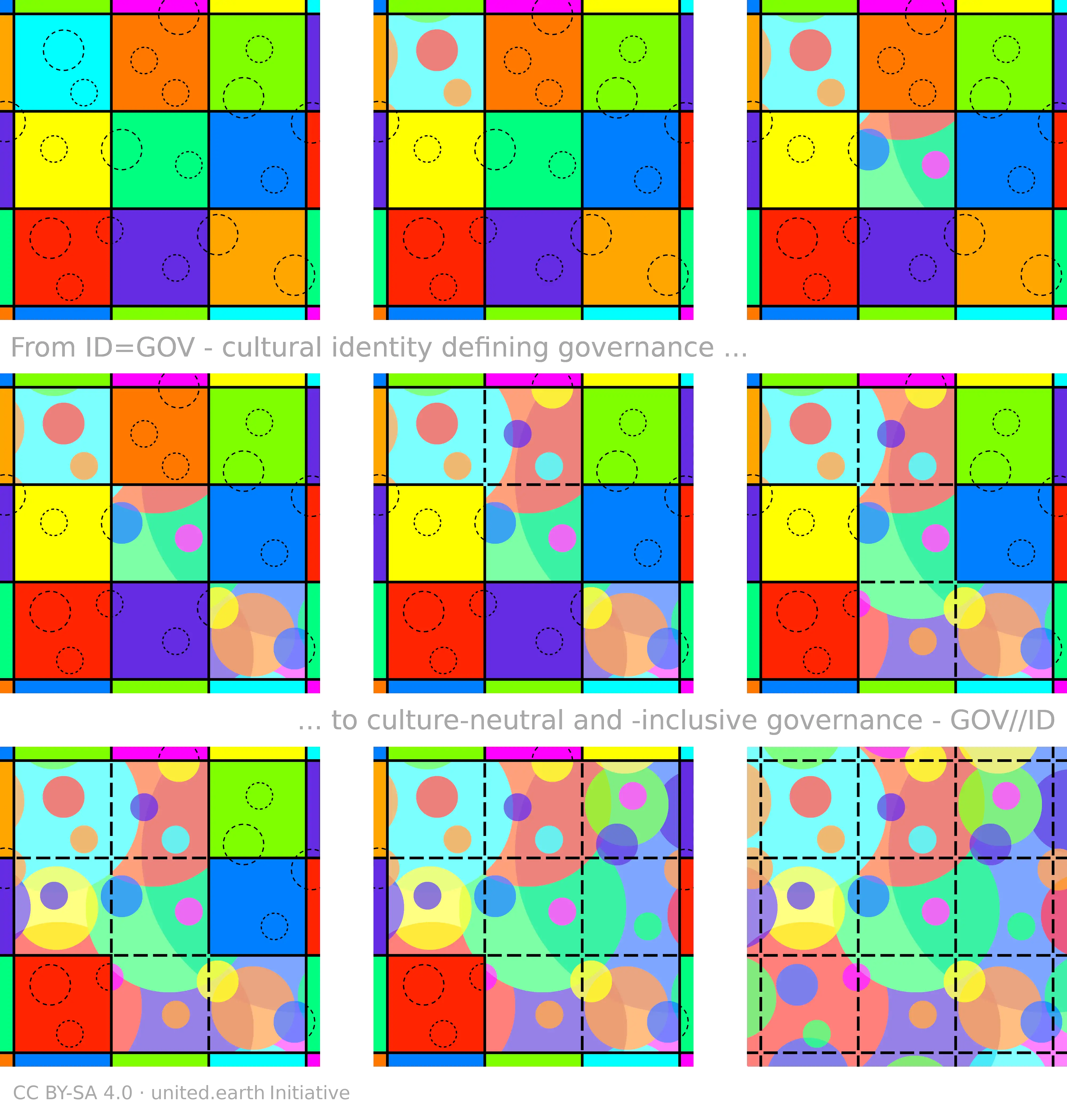
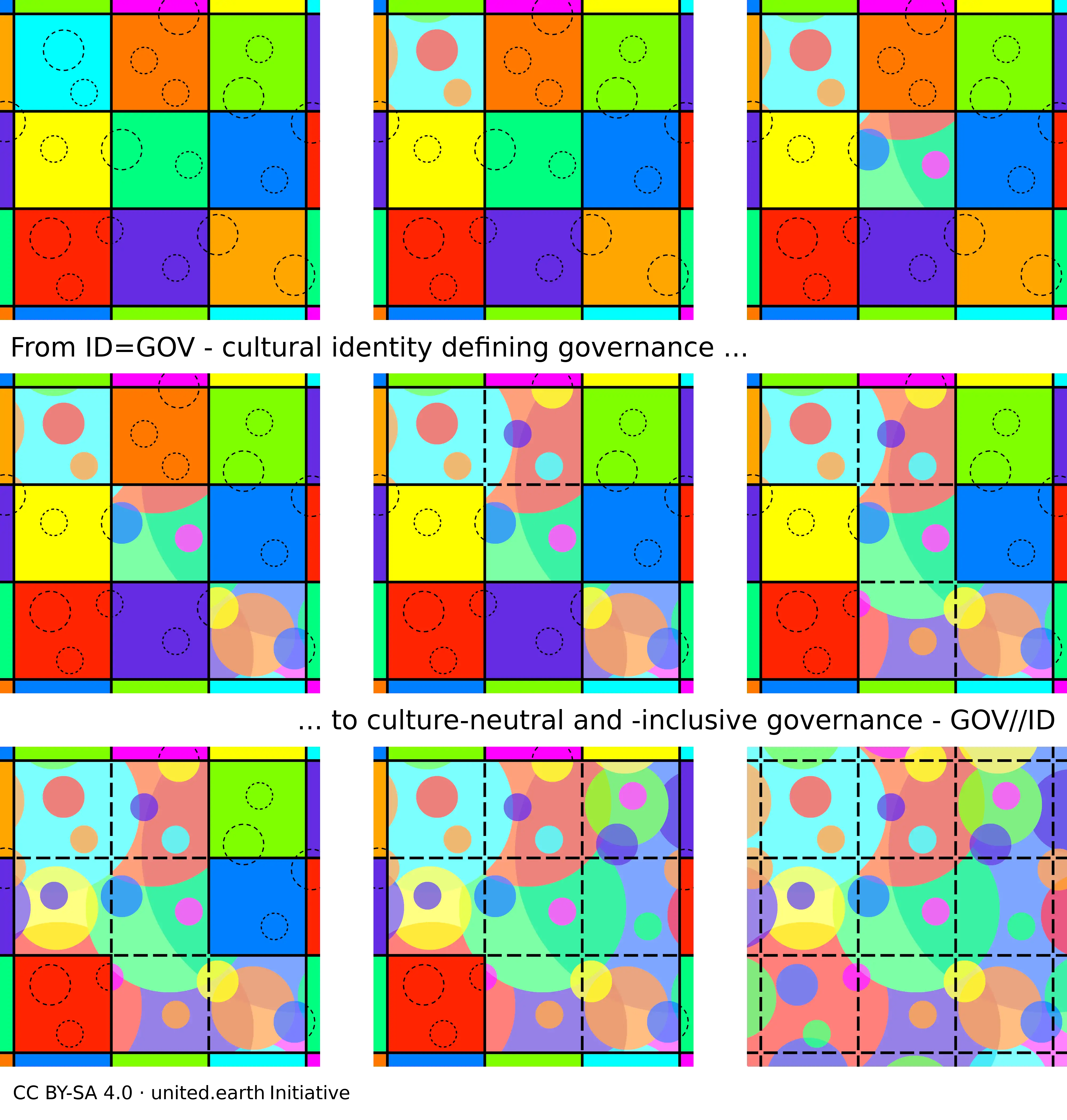
From ID=GOV to GOV//ID
The nine scenes show a gradual transition from ID=GOV to GOV//ID across existing governance units. At first, the constitutional relationship between governance and cultural identity changes while existing borders remain intact.
Existing units can therefore change internally before neighbouring units reorganise their shared borders.
When neighbouring units have both transitioned, their common border can be redefined as a subsidiary administrative boundary within an emerging higher-level governance unit.
In this way, the new structure can grow piece by piece before the level is complete.
Cultural identities continue while governance changes. GOV//ID is the long-term constitutional endpoint throughout public governance: identities can overlap and persist across administrative boundaries while governance geography is organised around public functions and equal civic standing.
Harmonising governance with cultural diversity
Modern societies already contain identities that cross borders and identities that coexist inside the same borders. The long-term governance system should be able to reflect that reality.
As constitutional equality becomes more robust, existing borders can lose some of the functions that previously made them markers of political separation. Neighbouring units can integrate administration, movement, infrastructure and other functions while their cultural landscapes remain plural and continuous across the boundary.
The political map can therefore be redesigned gradually around governance functions without requiring cultural communities to disappear or become territorially uniform.
27.5 Security and sequencing
The hardest cases cannot be reduced to constitutional preference alone.
For some cultural majorities, control of a sovereign state is understood as protection against an existential threat. In such a setting, asking the group to surrender identity-based sovereignty before a credible replacement security order exists may be politically impossible and may appear irrational from its own perspective.
Replacement security must precede the removal of the security structure it is meant to replace.
Replacement security does not have to begin with full transfer of sovereignty or coercive capacity. Credible mutual guarantees, arms-control arrangements, joint monitoring, peacekeeping commitments, phased or shared security structures and other transitional safeguards can develop before a state gives up the institutions it presently relies on for survival. The exact mechanisms will differ and require detailed constitutional and security design.
As neighbouring polities accept equal civic standing and these security arrangements become credible, dependence on exclusive control of a sovereign state can begin to fall. Bloc integration and the transfer or reorganisation of coercive capacity can then deepen without requiring an insecure population to surrender its existing protection before an alternative exists.
In some regions, therefore, security cooperation and early bloc development may have to advance far enough to make the identity–governance transformation politically possible; in others, constitutional change can help make bloc formation possible first. The processes can overlap and reinforce one another.
The Earthwheels show the direction of transformation, not a compulsory universal order of operations.
27.6 Borders as functional governance boundaries
A state border performs many functions at once. It may control movement, customs, legal jurisdiction, public services, labour markets, taxation, policing, defence and political membership. It can also carry a symbolic claim about where one people ends and another begins.
These functions do not have to move together. Existing regional arrangements already demonstrate that movement, trade, infrastructure and administrative cooperation can be integrated while other state functions remain intact. The transition can use the same principle deliberately.
As governance becomes less dependent on matching cultural boundaries, more border functions can be transferred or reorganised. Borders then become increasingly administrative boundaries between subsidiary governance units rather than frontiers between sovereign states.
This is not a declaration that borders cease to matter. Jurisdiction still needs boundaries. Subsidiarity depends on knowing which institution is responsible where. What changes is their constitutional function: sovereignty boundaries are progressively replaced by functional governance boundaries between jurisdictions inside one common constitutional order.
27.7 Existing states in the transition
The present map is the starting material of the transition, not a template for the final map.
Many existing states are close to the scale of a future sub-bloc and can carry administrative continuity while sovereignty is transferred upward. Some smaller states may correspond more closely to future regions. Some very large federal or continental-scale states may already contain enough population, geography or institutional capacity to provide substantial continuity at bloc level.
Scale alone does not determine the outcome. The long-term design aims for a system of roughly balanced blocs, and some of today’s largest states may therefore correspond to more than one future bloc, while other existing states may combine into one.
The point is to apply a general principle of functional scale and geopolitical balance rather than preserve the inherited distribution of state size automatically.
After accession, an existing state no longer exists as an independently sovereign state. Its territory, institutions and administrative structures may continue wherever they remain useful under subsidiarity, but they continue as jurisdictions within Earth Federation rather than as sovereign actors in the present international system.
What can persist, therefore, is institutional and territorial continuity — not separate external sovereignty.
28. Scenario 2026–2050
What could it look like if humanity began building global democratic capacity while using that capacity to address the problems it is meant to solve? This scenario follows one possible pathway from the first voluntary proto-institutions to an operational Earth Federation.
The analysis (WHY) leaves us with a serious conclusion. Humanity faces global dangers that the present geopolitical system is not equipped to handle. Democratic global governance therefore has to be built before the need for it becomes acute.
A political community, institutions, procedures, trust and distributed capacity all take years to develop.
That is why the transition begins now.
The story the Earthwheels tell
The proposal (WHAT) described the system. The method (HOW) has described the parts and the routes through which they can be built. The six Earthwheels now put the transition in motion.
In Earthwheel 7, the inherited geopolitical void still dominates the picture, and the mature structure is only beginning to appear. Across the following wheels, the same destination becomes progressively more visible. Two transformations make that possible at the same time: the global core develops from a political intention into constitutional institutions, while the bloc level develops from a functional proposal into the higher territorial structure for peacekeeping and execution through subsidiarity. By Earthwheel 12, the structure described in the proposal has resolved into view as an operational geopolitical system.
These two transformations have to proceed in parallel because they perform different functions and both take years to build. The global core must provide the common constitutional order, global democratic lawmaking, the global judiciary and coordination of genuinely planetary responsibilities. The bloc level must provide the higher territorial executive and peacekeeping capacity across the blocal zone. The transition therefore builds both toward one common constitutional crossing rather than waiting for one side to be completed before beginning the other.
The first constitutional crossing is the establishment of Earth Parliament under the constituent path defined earlier. The preferred target is 23 April 2031; 23 April 2035 is the latest target date. Neither date overrides the constituent threshold or the readiness requirements.
That crossing is separable from the wider transformation. Bloc development, constitutional reform, territorial accession, redistribution of competences and movement toward GOV//ID can begin earlier, overlap with the founding process or continue for many years afterwards. None has to be completed or assented to before Earth Parliament can be established.
The urgency therefore applies first to building the democratic global arena. At the same time, candidate bloc structures, security arrangements, institutional capacity and lawful transition instruments can be developed as far as possible so that later transfers of authority do not begin from zero.
While the system is being built, it is also being used. United Earth launches programmes on the seven Global Task Areas from the beginning. They give the emerging institutions real work, bring people motivated by the problems themselves into Earth Citizenship and AGORA, organise relevant knowledge through PAI×SEC, draw in organisations able to contribute, test cooperation through existing authority and reveal where stronger common capacity is required.
The system is built by using it, and it is used on the problems that make it necessary.
A few principles hold throughout the scenario. Existing lawful institutions continue making binding public decisions until new constitutional authority exists. Territorial entry into Earth Federation follows valid constitutional procedures. Replacement security is built before the protection it replaces is removed. United Earth builds and drives the early structure while the UE Pact and transition rules progressively transfer democratic stewardship to the emerging global demos. Existing institutions can widen access, verification, expertise and lawful implementation without becoming approval authorities over the constituent path.
The dates and developments are illustrative. Each Earthwheel shows an approximate condition reached by the end of its period. Different places and processes will move at different speeds, and the path will include delay, reversal and revision. The bars indicate the relative maturity of the transition, programme or institutional capacity at that point; they do not indicate urgency, effort or how much of the underlying global task has been solved.
The scenario reaches its final snapshot in 2050 because that is the project’s target for an operational Earth Federation. The snapshot is an endpoint for the scenario, not for the transition. Accession continues, institutions continue to mature, and programmes such as ClimateRestoration2075 run on for decades.
28.1 A new beginning from inside the void
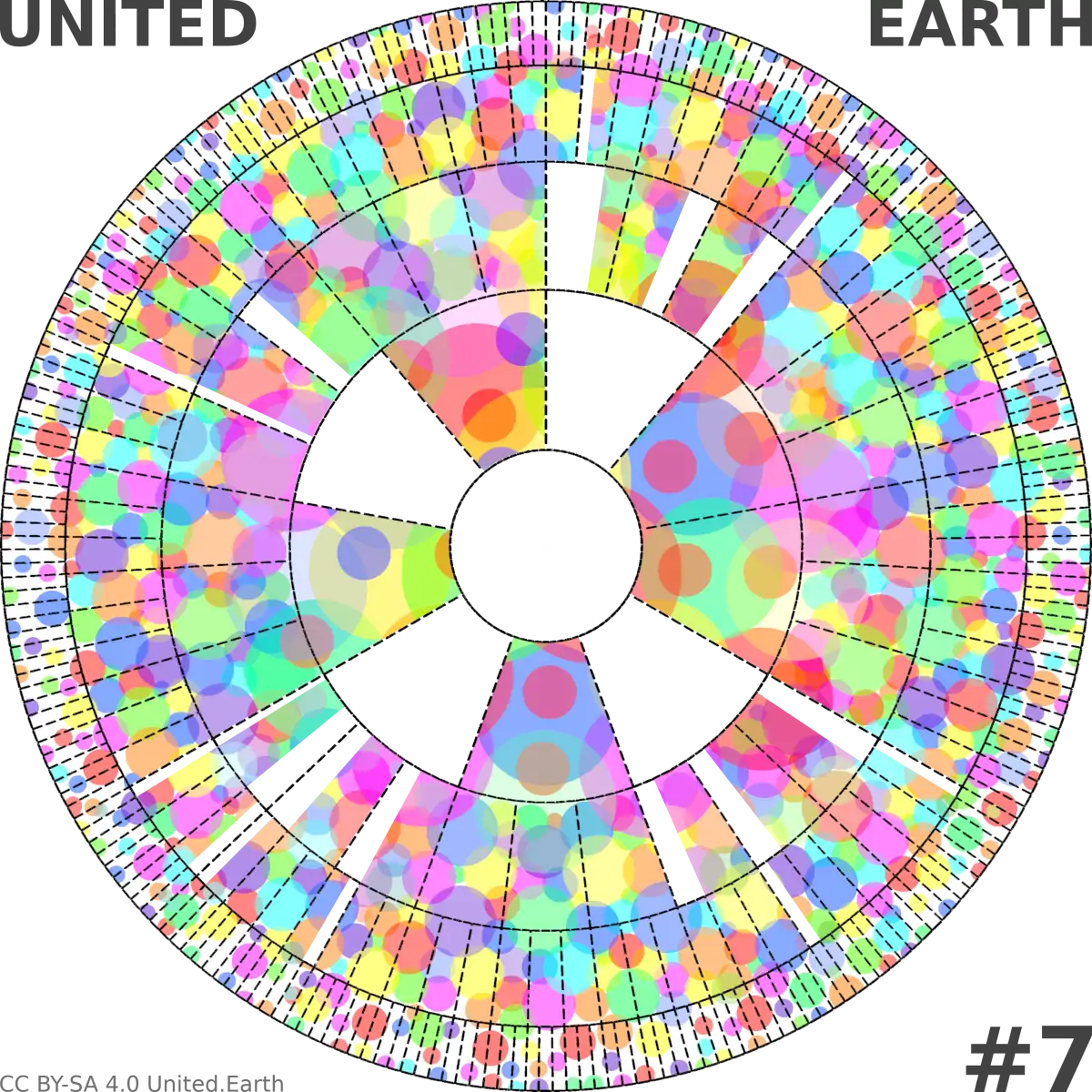
WHEEL < 7/18 >
| Political transition per level (2026 ~ 2028) | ||
|---|---|---|
| Global | ██ | Earth Parliament declared |
| Blocal | ██ | Blocs urged to cooperate on urgent matters |
| Sub-blocal | ███ | UE Parties in elections |
| Regional | █ | Societal/nature regions mapped |
| Local | ██ | AGORA (proto): UE node booting network |
| Global task areas | ||
| Space | █ | SolarCommons: No space colonisation race! |
| Climate | ██ | ClimateRestoration2075: the right ambition! |
| Ecology | █ | Earth50/50: Mapping project started |
| One Health | ██ | BioSafely: Food prod. system primary focus |
| Economy | █ | EcoBalance: Commons-principled econ. system |
| AI | ███ | SECureAI: pause the ASI race now! |
| Peace | ████ | EarthPeacePact: Zero WMDs now! |
Data estimates
| Indicator | By 2028 |
|---|---|
| Estimated support for Earth Parliament | ~300 million |
| Verified proto-Earth Citizens (ECp) | ~200 million |
| Active transition nodes | ~100,000 |
| Parliaments with UE Party representation | ~1–2 |
What the figures show
The emerging global political community has already reached mass scale, while formal political representation and territorial transformation remain very limited. The transition is still primarily civic, organisational and infrastructural.
How to read them
The figures are illustrative end-of-period estimates. Transition nodes are voluntary organisational nodes rather than constitutional governance units, and Earth Citizenship or support figures do not themselves create public authority.
For the order-of-magnitude this transition is building toward, see The civilisational scale
Earthwheel 7 still looks much like the inherited geopolitical condition. The void remains dominant, while the future structure is only beginning to appear.
Two changes define the period.
The first is conceptual. The inherited arrangement of sovereign states, uneven scales and missing global democratic authority is presented as a structure that can itself be redesigned rather than as the permanent background within which every solution must fit.
The second is political. Earth Parliament moves from proposal to declared objective. The first Earth Parliament Day gives that objective a recurring global date. The preferred target is to establish Earth Parliament on 23 April 2031, with 23 April 2035 as the latest target date if the required constituent scale and institutional readiness take longer to achieve.
Together, these changes create the first visible beginning inside the void.
The global level
United Earth starts with the smallest useful form of the future global democratic infrastructure.
Earth Citizenship gives people a way to enter the emerging global political community alongside their existing citizenships and identities. Registration explicitly supports establishing Earth Parliament while leaving the questions about the wider constitutional architecture and substantive political choices open. AGORA provides a shared civic arena for learning, deliberation, proposals, polling and voting inside the proto-system. Nodes give that community distributed points of organisation. Early SEC Council structures and PAI×SEC begin organising scientific, ethical and cultural knowledge around real questions.
The important quality at this stage is usability. Registration should lead quickly to meaningful participation. AGORA should produce processes worth joining. The knowledge system should help citizens understand and judge questions rather than merely display information. Proto-parliamentary practice should begin developing procedures that can later be tested at larger scale.
The first major scaling objective is 1 billion verified adult ECp holders. Reaching that threshold matters before final activation because it brings an elected Proto-Earth Parliament into operation and begins formal democratic stewardship of the global proto-system.
Earth Parliament Day then gives the whole process a rhythm. Each annual cycle can connect local events, public discussion, recruitment, democratic exercises and constitutional preparation to the same long-term objective.
United Earth also begins widening cooperation around the constituent process from the start. The United Nations, electoral authorities, research institutions, civil-society networks, independent auditors and other established actors can contribute to verification, democratic standards, safe access, technical resilience and constitutional discussion without becoming an external source of constituent authority.
The bloc level and below
The territorial side begins with a change in political imagination.
The candidate bloc map turns the future higher territorial structure into something that can be examined, criticised and redrawn. Functional questions become central: which territories share infrastructure, economic systems, ecological systems, security interests and administrative capacity at a scale suitable for bloc-level execution?
The same period begins separating cultural security from exclusive ownership of the state. The governance model developed in the proposal (WHAT) makes it possible to ask whether identities can receive strong constitutional protection while territorial authority is reorganised around functional governance rather than sovereign identity states.
From 2027, United Earth Parties are intended to enter elections where law allows. Their role is to carry AGORA-supported positions into institutions that already hold public authority. Established parties, governments, civil society and cross-party coalitions can advance the same reforms through their own lawful routes.
The visible territorial structure therefore changes little by 2028, but the bloc pattern has become a concrete political proposition rather than an abstract layer on a diagram.
The programmes
All initial programmes are launched in this period, but four are especially useful for showing how the proto-system can begin producing practical results while the constitutional system is still being built.
ClimateRestoration2075 places a long-range planetary objective beside the limited coordination available today. It gives AGORA and PAI×SEC a concrete test case in which science, economics, ethics, infrastructure and political responsibility have to be examined together.
SECureAI makes the race toward superintelligence an early test of the whole transition logic. It seeks a reciprocal and verifiable pause on defined high-risk work toward superintelligence while bounded AI and safety research continue. PAI×SEC, AGORA and emerging SEC Council networks provide a public process for examining what safe development should require, what purposes AI should serve and under whose authority consequential development should proceed. In this illustrative pathway, existing public authorities translate that demand into reciprocal and enforceable measures, so that by 2028 high-risk development has been materially interrupted across the major jurisdictions and infrastructures capable of sustaining the race.
EarthPeacePact begins where constitutional peacekeeping must eventually begin as well: with risk reduction, transparency, verification, reciprocal confidence-building and the principle of replacement before removal.
1000-Year Earth Sanctuaries makes the proposed civilisation tangible from the outset. Existing seed networks, Indigenous communities, regenerative farms and intentional communities can help develop the model voluntarily, while United Earth promotes legal recognition of the sanctuary category and the reforms needed to preserve, develop and share living agrobiodiversity. Independent initiatives can begin cooperating immediately, and jurisdictions willing to legislate the category can provide early legal protection. The eventual global constitutional guarantee of at least 1,000 years can build on this growing network.
The programmes give people who care about concrete problems a reason to enter the political process. They also give the proto-system real questions through which it can learn how much capacity it actually has.
Obstacles and workarounds
Scale and credibility. The project begins far below the scale of its ambition. Credibility therefore has to grow from usable infrastructure, open procedures and practical work that participants can inspect.
Safe participation. Participation can carry political risk in restrictive jurisdictions. Civic verification must therefore be separated from public profiles and secret political activity, with strong privacy and security protections built in from the beginning.
By 2028, the global system itself is still only beginning to appear. But the empty centre now contains a political intention, a date and the first institutions capable of growing toward it.
28.2 Gaining political traction
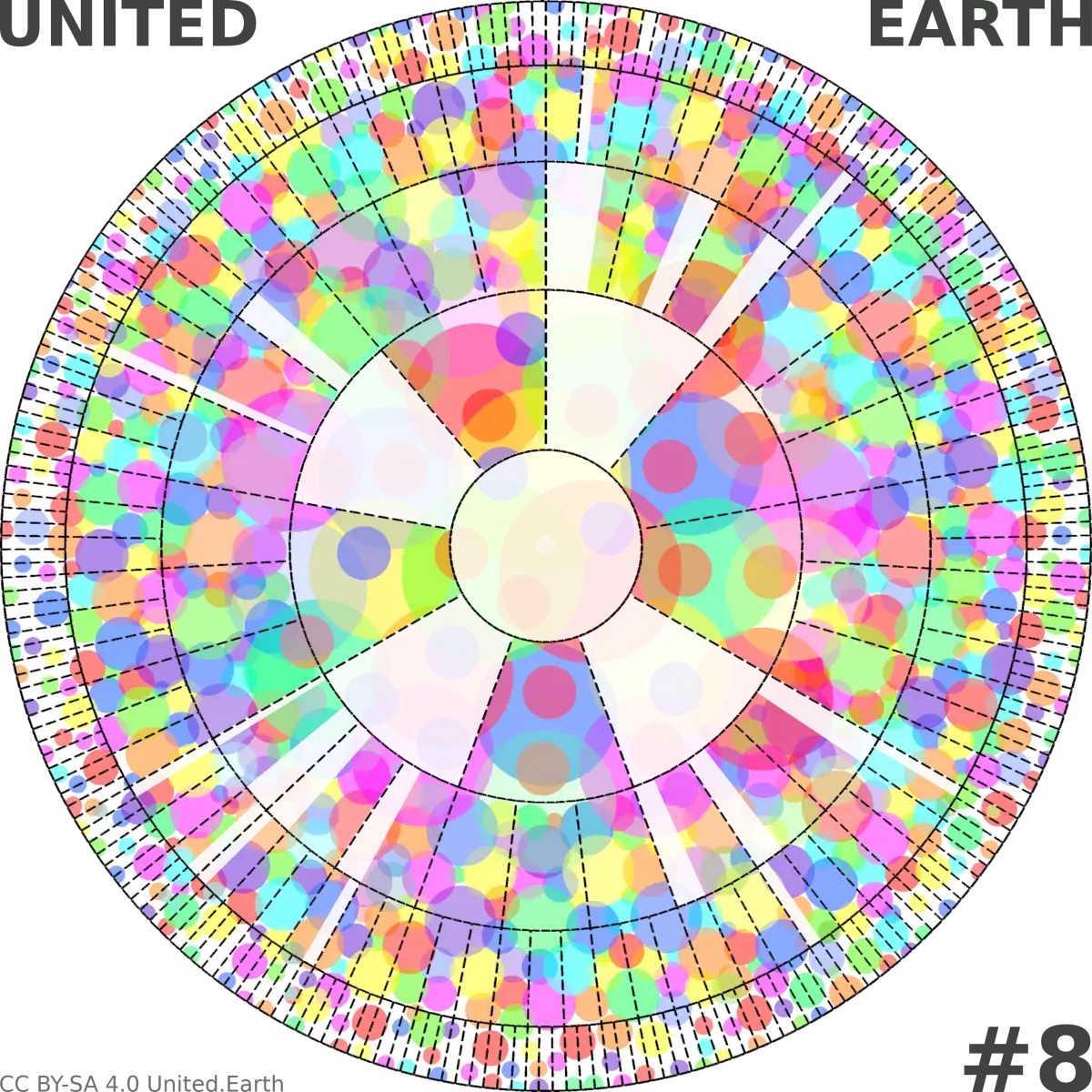
WHEEL < 8/18 >
| Political transition per level (2028 ~ 2030) | ||
|---|---|---|
| Global | ████ | Proto-Earth Parliament preparations |
| Blocal | ████ | Bloc pattern mapped and new blocs initiated |
| Sub-blocal | ████ | State institutions prepare entry |
| Regional | ██ | Settlement pilots for resilient local food systems |
| Local | ███ | AGORA (proto + public): nodes integration |
| Global task areas | ||
| Space | ████ | Orbital safety + fair-access rules coordinated |
| Climate | ████ | Restoration pathway tested |
| Ecology | ███ | Earth50/50: Global transition plan ready |
| One Health | ████ | BioSafely: Food-system transition plan |
| Economy | ███ | EcoBalance: Redistribution + transition financing |
| AI | ████ | Verified pause regime expands |
| Peace | █████ | EarthPeacePact: implementation planning |
Data estimates
| Indicator | By 2030 |
|---|---|
| Estimated support for Earth Parliament | ~1 billion |
| Verified proto-Earth Citizens (ECp) | ~700 million |
| Active transition nodes | ~500,000–1 million |
| Parliaments with UE Party representation | ~15 |
| Candidate-bloc processes with formal cooperation | ~3–5 |
What the figures show
The proto-system is becoming a large transnational political network. Civic participation, nodes, parliamentary footholds and candidate-bloc cooperation are beginning to reinforce one another.
How to read them
The estimates indicate scale and direction rather than thresholds that must be reached in exactly this sequence. Different countries, blocs and parts of the network can develop at very different speeds.
For the order-of-magnitude this transition is building toward, see The civilisational scale
In Earthwheel 8, the mature structure has become more visible. The inherited geopolitical pattern still dominates, but the point at the centre has grown and the future bloc pattern is easier to recognise.
The central change is that the proto-system begins producing political effects outside itself.
The global level
Growth now depends on three mutually reinforcing factors: a low threshold for entering the political community, real value once inside it and a visible common objective.
Earth Parliament Day becomes an annual mobilisation cycle. Nodes organise meetings, debates, cultural events, public democratic exercises and local-global programme work around the same date. Existing organisations with large networks participate without being absorbed into United Earth, bringing their own communities into specific processes while retaining their independence.
AGORA makes the organised constituency measurable. The verified adult ECp count shows both the scale of the emerging political community and the number of people whose constituent support is documented and eligible for threshold counting. Wider public support for Earth Parliament can be estimated separately. Other indicators can show support for programmes, constitutional alternatives and proposals without confusing these questions with the founding assent.
Participation also deepens. Questions move from simple polling into structured deliberation, through PAI×SEC, into advisory decisions and proposals.
Once the first global succession threshold is reached, Earth Citizens elect Proto-Earth Parliament under the constituent path. Proto-parliaments can also be elected for proposed territorial units where participation can occur lawfully and safely. SEC Council networks develop broader candidate and contributor bases. Constitutional drafting begins to draw systematically on this practical experience.
This creates a different relationship with established institutions. United Earth can now approach the United Nations and other actors with functioning democratic infrastructure, public records, tested verification and growing participation rather than only a theoretical proposal.
By the end of this phase, the first global succession threshold is approaching, and preparations for Proto-Earth Parliament are advancing. Growth, constitutional work and institutional readiness continue toward the founding threshold. If the preferred 2031 target proves unreachable, the same process continues toward the latest 2035 target date.
The bloc level and below
The territorial transition gains traction because it connects to forces that already push neighbouring polities toward cooperation.
Larger markets, common infrastructure, energy systems, trade corridors, rivers, ecosystems, migration, security and bargaining power already create incentives for regional integration. Existing structures such as the European Union, African Union, ASEAN and MERCOSUR show different ways in which states can build institutions above the national level while retaining different degrees of sovereignty.
The United Earth transition adds two things to these existing dynamics.
The first is a proposed destination: a bloc is not simply a regional organisation but a constituent territorial unit inside one global constitutional order.
The second is the common threshold. Integration processes in different parts of the world prepare toward the same constitutional crossing without being centrally synchronised day by day. Governments and parliaments begin examining which existing institutions could carry future bloc responsibilities, which functions should move upward or downward, and what legal changes later entry would require.
UE Parties and other lawful political routes help move these questions from discussion into existing institutions. Parliamentary footholds, cross-party initiatives, referenda, intergovernmental agreements and regional institutions all contribute.
By 2030, some candidate bloc relationships can therefore contain real cooperative substance even though bloc sovereignty has not yet been constitutionally activated.
The programmes
By this period, the programmes begin doing something the proto-system cannot do by itself: connecting proposals developed through the emerging system to action through existing public authority.
BioSafely makes the progression visible. Prevention now moves beyond mapping biological risks toward coordinated food-system change, surveillance and other safeguards. But stronger requirements can create first-mover problems if production, research or investment can simply move to jurisdictions with weaker rules.
SECureAI makes the same coordination problem especially sharp. No state can safely restrain high-risk work toward superintelligence if it expects competitors to continue unchecked. The programme therefore develops reciprocal, conditional and verifiable arrangements through existing public authorities, allowing restraint to expand without requiring one participant to accept indefinite unilateral disadvantage.
Similar problems emerge across the portfolio. Climate measures can shift emissions and production elsewhere; ecological restrictions can displace extraction; economic reforms can move capital; security measures require reciprocity; and shared space infrastructure cannot be governed effectively by one jurisdiction alone.
The programmes therefore become practical tests of the transition itself. They show where voluntary cooperation is enough, where existing authorities can act together, and where the absence of common constitutional authority remains the limiting factor.
Obstacles and workarounds
Uneven participation. Governments, regions, organisations and populations will enter different parts of the transition at different speeds. Modular programmes and institutions allow useful cooperation to expand without requiring simultaneous agreement on the whole project.
First-mover problems. Climate measures, AI restraint, ecological protection, biological safeguards, economic reform and security cooperation can all become unstable if acting alone creates significant disadvantage. Reciprocal, conditional and verifiable commitments allow existing public authorities to move together before common constitutional authority exists.
Dependence and capture. Rapid growth can create structural reliance on private platforms, donors, technical providers or other concentrated capacities. Federated infrastructure, portability, transparent standards and progressively stronger public control must develop before such dependence becomes difficult to reverse.
By 2030, the emerging system has become politically consequential. It can connect global civic participation to real decisions made through existing authority, and it gives regional integration a clearer constitutional direction.
28.3 Reaching the constitutional threshold
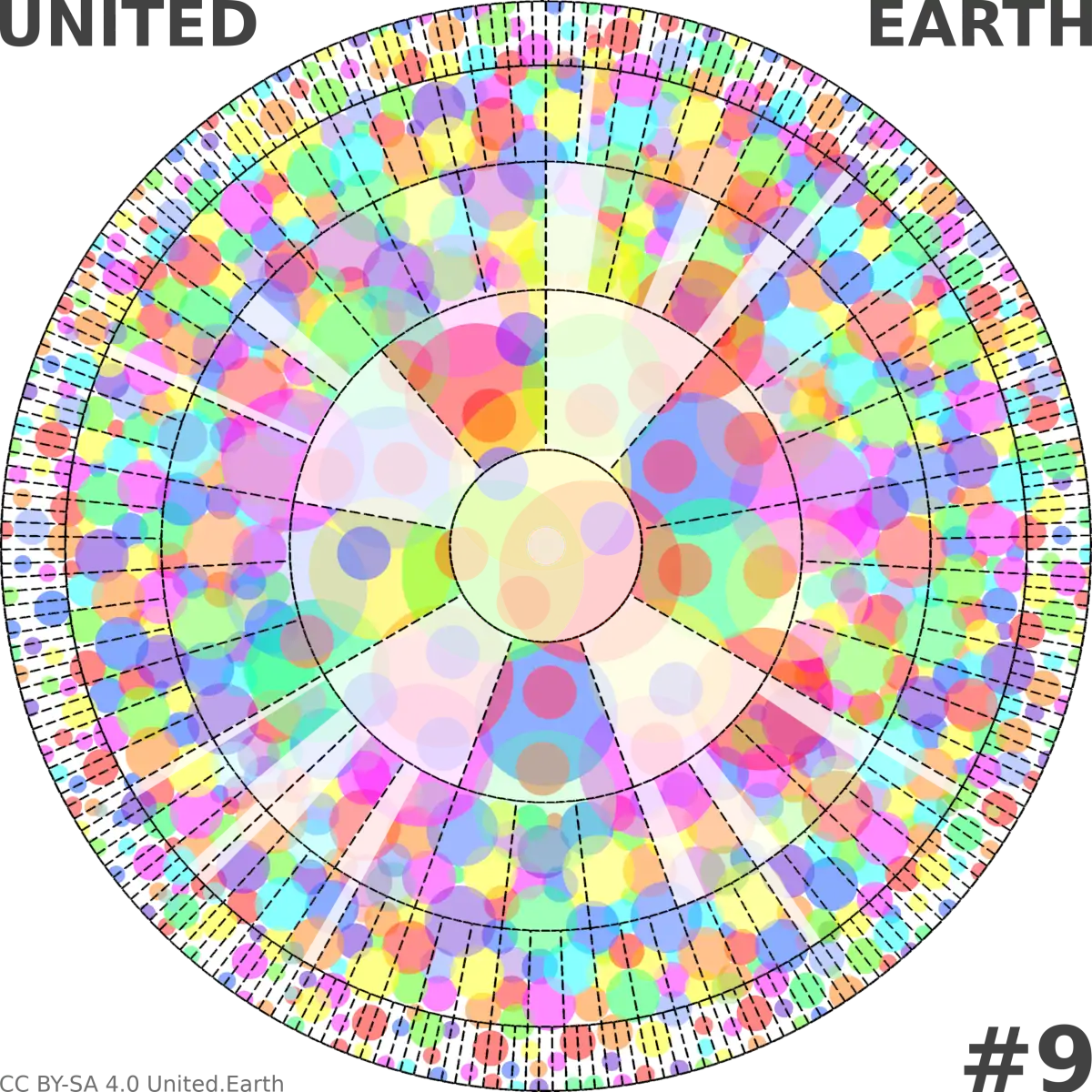
WHEEL < 9/18 >
| Political transition per level (2030 ~ 2035) | ||
|---|---|---|
| Global | ███████ | Earth Parliament: target 2031 / latest target 2035 |
| Blocal | ██████ | Founding blocs: federation’s land executive layer |
| Sub-blocal | ██████ | Sub-bloc function transfers prepared |
| Regional | ████ | Regions: main glocal connector level |
| Local | ████ | AGORA: complete constitutional infrastructure |
| Global task areas | ||
| Space | ██████ | Earth–Moon commons governance prepared |
| Climate | ██████ | Global targets + territorial pathways ready |
| Ecology | ████ | Global natural commons established |
| One Health | ██████ | High-risk livestock + AMR transition |
| Economy | █████ | EcoBalance: housing + food reforms |
| AI | █████ | AI safety research + verification scales |
| Peace | ███████ | Bloc peacekeeping system active |
Data estimates
| Indicator | By 2035 |
|---|---|
| Estimated support for Earth Parliament | ~5 billion |
| Verified proto-Earth Citizens (ECp) | ~4 billion |
| Active transition nodes | ~2–5 million |
| Parliaments with UE Party representation | ~30 |
| Polities with prepared constitutional-entry pathways | ~20–30 |
| Candidate or founding blocs ready for constitutional activation | ~5–8 |
What the figures show
By the constitutional-threshold period, the global demos is measured in billions while a smaller but significant territorial structure is prepared for activation. The global and territorial transitions are now approaching the same constitutional crossing.
How to read them
The estimated support figure of roughly five billion indicates broader public backing, while approximately four billion verified adult ECp holders represent the intended scale of the founding assent counted toward the constituent threshold. Exact constituent rules, electorate and legal thresholds must be established through the legitimate constituent process itself.
For the order-of-magnitude this transition is building toward, see The civilisational scale
In Earthwheel 9, the preferred pathway reaches the point at which Earth Parliament can be established. The full activation rules are those already defined in The rules of the constituent path; this scenario shows what reaching them could look like in time.
The period begins with growth toward the first succession threshold and the election of Proto-Earth Parliament. As democratic stewardship of the proto-system deepens, the verified ECp constituency must continue expanding toward the founding scale while AGORA, verification systems, institutional resilience and the minimum constitutional operating terms mature with it.
The global level
Earth Parliament Day, nodes, programme work and the usefulness of AGORA all contribute to continued growth of the political community. The proposal (WHAT) remains one comprehensive contribution within the constitutional debate, alongside alternatives developed by Earth Citizens, Proto-Earth Parliament, Councils, researchers, organisations and other contributors.
Independent review must make the verified adult ECp count and readiness conditions publicly credible. Established institutions can widen access and contribute auditing, expertise and verification, but they do not approve or deny activation.
If the constituent conditions converge by 23 April 2031, Proto-Earth Parliament becomes Earth Parliament on the preferred timetable. If they do not, the constituent process continues toward the latest 23 April 2035 target, and beyond it if the conditions still have not been met.
Establishing Earth Parliament does not complete Earth Federation. It establishes the democratic global institution from which the later allocation and transfer of public authority, territorial accession and wider constitutional transformation can continue.
The bloc level and below
The same threshold solves a different coordination problem on the territorial side: who moves first?
A state preparing alone to transfer sovereign authority faces uncertainty about neighbours, security, economic relations and the future constitutional order. A group of states preparing toward a common global threshold can reduce that uncertainty substantially.
Candidate blocs therefore use the early 2030s to convert political integration into territorial readiness.
Existing regional organisations, neighbouring governments and federal structures deepen legal harmonisation, infrastructure, administrative cooperation, public finance and shared institutions. They can identify which inherited state functions belong at bloc level, which belong at region or locus level, and which transitional institutions need to remain temporarily.
Where domestic law permits, parliaments and electorates also prepare advance or conditional accession instruments whose effect depends on the founding threshold and later readiness requirements. The exact instruments vary, but the principle is common: the legal and political work can be done before the constitutional crossing so that entry afterwards becomes activation of prepared decisions rather than the start of an entirely new process.
If the global constitutional threshold is crossed early in the period, some of these prepared decisions can consequently begin to take effect before 2035. Founding blocs can acquire constitutional functions, prepared security capacities can move into their new framework, and functions assigned upward or downward can begin to transfer. If the threshold is reached only near 2035, the same preparations allow these changes to follow rapidly afterwards.
Security is the most demanding part of that preparation. EarthPeacePact helps candidate blocs build monitoring, confidence measures, reciprocal commitments and plans for moving protective functions into future bloc structures. For populations that associate sovereign statehood with physical security, credible replacement capacity is essential to making integration politically conceivable.
The common threshold therefore gives regional integration something it has rarely had before: a shared constitutional destination and a moment toward which many decentralised processes can prepare together.
The programmes
At this stage, the programme portfolio helps define the constitutional division of responsibility.
ClimateRestoration2075 clarifies why atmospheric stewardship requires global coordination while energy, transport, land use and infrastructure remain territorially implemented.
SolarCommons identifies shared Earth–Moon functions that require common public responsibility.
EarthPeacePact shows which parts of security transformation depend on reciprocal preparation and which authorities the future bloc and global levels will need.
The programmes therefore help turn subsidiarity from an abstract principle into an observed allocation problem: what actually has to be decided together, and what is better carried out closer to the people and places affected?
Obstacles and workarounds
Constituent legitimacy at planetary scale. The mandate comes from the explicit, continuing support of verified adult ECp holders at unprecedented scale. The registry, threshold count, democratic infrastructure and readiness conditions therefore have to remain publicly inspectable and independently auditable so that the mandate can be trusted far beyond United Earth itself.
Unequal access to the constituent process. Governments may differ radically in whether they support, tolerate or obstruct participation. Secure participation routes, privacy protections and predetermined geographic-breadth criteria must prevent obstruction by a state, bloc or other territorial unit from becoming a veto over the global process.
Territorial and security readiness. Constitutional authority at the global level does not by itself make territorial accession safe or executable. Conditional accession arrangements, institutional continuity plans and credible replacement security allow candidate blocs and polities to prepare before the threshold is crossed and activate those preparations afterwards.
By 2035, the point of light from Earthwheel 7 has become a constitutional global core. If the threshold was crossed earlier in the period, the first prepared territorial and executive transitions are already under way. If it was reached close to 2035, the structures required for those transitions are ready for rapid activation. In either case, the next phase begins from prepared capacity rather than from institutional zero.
28.4 Building Earth Federation
WHEEL < 10/18 >
| Political transition per level (2035 ~ 2040) | ||
|---|---|---|
| Global | █████████ | Core institutions established |
| Blocal | ████████ | Founding blocs: internal subsidiarity structure |
| Sub-blocal | ███████ | Nation-states cede sovereignty on entry |
| Regional | ██████ | Societal/nature regions pattern in practice |
| Local | █████ | Local resilience: food + housing security |
| Global task areas | ||
| Space | ████████ | Orbital traffic + critical infrastructure governed |
| Climate | ████████ | Binding restoration framework |
| Ecology | ██████ | Bloc-level Earth50/50 transition started |
| One Health | ████████ | Common prevention + lab-safety rules |
| Economy | ████████ | Post-capitalist regulated market econ. |
| AI | ███████ | Binding ASI governance rolls out |
| Peace | ████████ | Common security expands before Federation |
Data estimates
| Indicator | By 2040 |
|---|---|
| Population under Earth Federation jurisdiction | ~1–1.5 billion |
| Constitutional blocs | ~4–6 |
| Mature-scale equivalent: regions | ~5,000–7,500 |
| Mature-scale equivalent: loci / local constitutional AGORA nodes | ~250,000–375,000 |
| Mature-scale equivalent: local SEC Council mandates | ~2–8 million |
What the figures show
Earth Federation now has substantial territorial jurisdiction, but only part of the eventual global structure is inside the constitutional order. The institutional task begins shifting from mobilisation and preparation to implementation at scale.
How to read them
Population and bloc figures are direct scenario estimates. Regional, local, AGORA-node and Council figures are mature-scale equivalents derived from the architecture in WHAT; they do not imply that every acceding territory has already completed its internal reorganisation.
The mature-scale equivalents are derived from the order-of-magnitude architecture described in The civilisational scale.
In Earthwheel 10, the mature pattern occupies much more of the picture. The global core has constitutional form, and the first prepared territorial transitions have begun turning the bloc pattern into real public authority.
The work of this period is to extend and consolidate that constitutional implementation. Where the threshold was crossed early, several years of succession and accession may already have taken place. Where it was crossed closer to 2035, institutions and conditional decisions prepared during the proto-period are activated in rapid sequence.
The global level
Earth Parliament now exists as the democratic global institution, but Earth Federation is not yet territorially complete. In this illustrative pathway, the democratic constitutional process increasingly adopts and develops substantial parts of the architecture of the proposal (WHAT). Binding public authority expands only where competences are constitutionally established or lawfully transferred and as territories enter the emerging order.
The proto-system now enters constitutional succession. AGORA’s useful software, standards, records, procedures, knowledge structures and technical capacities can be transferred or reconstituted under public constitutional governance. The same principle applies to the Councils, proto-parliaments and public AI infrastructure: practical capacity can carry forward, while constitutional offices are filled through the procedures of the new system.
United Earth’s special role correspondingly contracts. Where constitutional institutions can perform the function, they take over. The organisation can continue supporting transition and accession work, but the system increasingly belongs to its citizens and public institutions rather than to the initiative that started it.
Global responsibilities become operational domain by domain. The global zone, shared digital infrastructure, planetary monitoring, commons governance and other globally assigned functions can develop at different speeds according to legal readiness and practical capacity.
The bloc level and below
Prepared territorial decisions continue to be activated as jurisdictions meet the constitutional and readiness requirements for entry.
Some polities enter Earth Federation soon after the founding threshold because years of domestic constitutional work, regional integration and readiness planning have already been completed. Candidate bloc structures become constitutional blocs where their members are ready. Elsewhere, inherited state institutions continue temporarily as sub-blocal structures while authority is gradually reassigned upward to blocs and downward to regions.
The Federation therefore grows through a mixed geography rather than one simultaneous global transfer.
Security moves with the same staged logic. Receiving bloc institutions develop command, protective capacity, oversight and interoperability before corresponding state functions are transferred. Police and emergency systems continue through lower-level arrangements under subsidiarity. Strategically sensitive military capacities require especially careful sequencing and verification.
This is where the parallel construction becomes visible in institutional form. The global level supplies the common constitutional, legislative and judicial order. The blocs supply the higher territorial executive and principal distributed land-based coercive capacity. Together they produce one state without concentrating all territorial force in one global command.
The programmes
The programmes now begin operating through constitutional authority wherever that authority is valid.
EarthPeacePact becomes a major pathway into the new security order, connecting earlier confidence-building and reciprocal commitments to actual bloc-based peacekeeping capacity.
ClimateRestoration2075 gains a binding global framework inside Federation jurisdiction while blocs, regions and loci carry much of the territorial transformation.
EcoBalance becomes increasingly important because constitutional change and programme implementation create large transition costs. Public budgets, investment and support mechanisms have to make the transition materially workable for communities and sectors carrying disproportionate burdens.
The programmes now test a different question: how well can the new constitutional system use the authority it has acquired?
Obstacles and workarounds
Law outrunning capacity. Constitutional assignments can develop faster than the institutions expected to carry them. Staged succession keeps administration, public services and security continuous while receiving institutions build the capacity required to assume their new functions.
Proto-to-constitutional succession. The proto-system may contain valuable infrastructure, expertise, records and institutional memory, but none of this can confer public authority by continuity alone. Capacities can be transferred where lawful and useful, while constitutional offices, mandates and authority must be constituted through the new public order.
An incomplete Federation. Earth Federation initially exists alongside sovereign states and other geopolitical structures outside it. Credible defence, continued diplomacy, arms control, economic and technical cooperation and an open path to later accession are required so that the Federation can grow without turning its external boundary into a permanent enemy line.
By 2040, Earth Federation has real constitutional territory and functioning bloc structures in part of the world. The transition has moved from founding a centre to making the centre and the territorial system work together.
28.5 Making the system work at scale
WHEEL < 11/18 >
| Political transition per level (2040 ~ 2045) | ||
|---|---|---|
| Global | ██████████ | Global coordination works at scale |
| Blocal | ██████████ | Bloc federation expands through new accessions |
| Sub-blocal | █████████ | Most sub-bloc functions redistributed |
| Regional | ████████ | Regions absorb sub-bloc functions |
| Local | ████████ | Local econ.: mutual credit + circular flows |
| Global task areas | ||
| Space | ██████████ | Earth–Moon commons system expands |
| Climate | ██████████ | Restoration system scales |
| Ecology | █████████ | Nature-region system complete |
| One Health | ██████████ | Integrated One Health surveillance + response |
| Economy | █████████ | Bloc federation: harmonised economic zones |
| AI | ██████████ | Federal rules + outside accords |
| Peace | █████████ | Common security accelerates federation-building |
Data estimates
| Indicator | By 2045 |
|---|---|
| Population under Earth Federation jurisdiction | ~2.5–3.5 billion |
| Constitutional blocs | ~8–12 |
| Mature-scale equivalent: regions | ~12,500–17,500 |
| Mature-scale equivalent: loci / local constitutional AGORA nodes | ~625,000–875,000 |
| Mature-scale equivalent: local SEC Council mandates | ~6–18 million |
What the figures show
The Federation has become a major geopolitical system. As accession expands, the number of regional and local governance relationships, constitutional nodes and institutional roles grows into the hundreds of thousands and millions.
How to read them
The derived figures show the approximate infrastructure associated with the population now under federal jurisdiction. Actual implementation would depend on inherited institutions, territorial reform, reuse of existing capacity and the pace at which transitional structures are replaced.
The mature-scale equivalents are derived from the order-of-magnitude architecture described in The civilisational scale.
In Earthwheel 11, most of the mature pattern is visible. The global core and an expanding bloc structure now function as parts of one constitutional system.
The challenge shifts from creating the architecture to making it carry sustained political, administrative and geopolitical load.
The global level
AGORA becomes ordinary democratic infrastructure across several governance levels. Earth Citizens can participate in local, regional, blocal and global processes through the same constitutional civic environment.
The SEC Councils and PAI×SEC develop into a federated knowledge and competence layer. Global evidence, regional experience, implementation results and public challenge can be connected through one shared policy structure while remaining attributable to their different contexts.
That creates cumulative institutional memory. A major policy can remain connected to the knowledge available when it was proposed, the arguments and alternatives considered, the decision taken, the implementation that followed and the effects later observed.
Public AI becomes increasingly important for navigating this scale. Constitutional governance therefore has to preserve transparent, auditable and plural public-AI capacity that assists democratic participation without becoming an independent source of political authority.
The bloc level and below
Across mature parts of the Federation, blocs now perform the higher territorial role for which they were designed.
Their security capacities become interoperable under common constitutional rules while remaining distributed among bloc commands. Territorial execution works downward through regions and loci under subsidiarity. The global level can coordinate and legislate within its competence without becoming the ordinary territorial executive across inhabited land.
Accession also becomes repeatable. Later entrants use established readiness criteria, constitutional interfaces, security-transfer procedures and administrative models rather than reconstructing the founding transition from the beginning.
As functions find stable destinations, some transitional sub-bloc structures can disappear. Others remain until their responsibilities have been safely reassigned. The mature four-level structure therefore spreads through demonstrated readiness rather than through one date imposed everywhere.
The programmes
This period shows most clearly that building the system and solving the global tasks have become the same work viewed from opposite directions.
ClimateRestoration2075 can now connect planetary monitoring and common targets to bloc-level energy and infrastructure planning and regional implementation. The key question is whether the combined pathway is becoming credible enough to support eventual atmospheric restoration.
Earth50/50 increasingly depends on the territorial system itself: nature regions, societal regions, corridors, land-use reform and marine stewardship require long-term coordination across governance levels.
SECureAI illustrates the continuing importance of the constitutional boundary. Binding requirements can operate inside Federation jurisdiction while external agreements remain essential where important developers and infrastructure are located outside it.
The programme portfolio therefore becomes a continuous stress test of subsidiarity, institutional capacity and external cooperation.
Obstacles and workarounds
Governing at scale. New entrants bring different legal traditions, languages, administrative capacities and economic conditions. Federated implementation allows common constitutional objectives to coexist with different territorial pathways while shared standards preserve interoperability and equal constitutional standing.
Concentrated transition costs. Climate, ecological, economic, security and territorial restructuring can impose severe costs on particular communities, workers and regions even where wider benefits are large. Fiscal support, transition investment and deliberate burden-sharing are therefore part of implementation rather than secondary compensation.
Founding mechanisms becoming permanent. Institutions and political instruments created for the transition can acquire interests in their own continuation. Transitional organisations, special procedures and inherited administrative layers should therefore disappear or become ordinary constitutional institutions once their temporary function has been securely transferred.
By 2045, the emerging system is doing sustained work rather than merely demonstrating that it can exist.
28.6 Getting through the crisis
WHEEL < 12/18 >
| Political transition per level (2045 ~ 2050) | ||
|---|---|---|
| Global | ██████████ | Adaptive global governance operational |
| Blocal | ██████████ | Blocs: mature higher territorial executive layer |
| Sub-blocal | ██████████ | Sub-bloc level phased out |
| Regional | ██████████ | Integrated societal + nature region system |
| Local | ██████████ | AGORA: operating glocal direct democracy |
| Global task areas | ||
| Space | ██████████ | Earth–Moon stewardship operational |
| Climate | ██████████ | 2050 review: 2075 restoration pathway credible |
| Ecology | ██████████ | Earth50/50 system operational |
| One Health | ██████████ | Low-risk food systems + global prevention network |
| Economy | ██████████ | Glocal resilient ecological economy |
| AI | ██████████ | Safety + public control gate high-risk development |
| Peace | ██████████ | Common security + constructive peace |
Data estimates
| Indicator | By 2050 |
|---|---|
| Population under Earth Federation jurisdiction | ~4–5 billion |
| Constitutional blocs | ~12–18 |
| Mature-scale equivalent: regions | ~20,000–25,000 |
| Mature-scale equivalent: loci / local constitutional AGORA nodes | ~1–1.25 million |
| Mature-scale equivalent: local SEC Council mandates | ~9–26 million |
What the figures show
By 2050, Earth Federation has reached genuine civilisational operating scale: billions of people, a large share of the eventual bloc structure, around a million local governance units in mature-scale equivalent, and institutional participation measured in many millions of mandates.
How to read them
This is the scenario endpoint, not completion of the global transition. Accession, territorial reorganisation and institutional build-out continue beyond 2050, while the figures remain order-of-magnitude estimates rather than a forecast of the final map.
The mature-scale equivalents are derived from the order-of-magnitude architecture described in The civilisational scale.
In Earthwheel 12, the structure described in the proposal (WHAT) has resolved into view as an operational geopolitical system. The global core and the bloc level now function together across an expanding Earth Federation.
This is also the period in which the transition meets the pressure it was built for.
The analysis (WHY) described a threshold at which the interacting global crises make binding coordination increasingly unavoidable. That threshold is reached through accumulation rather than through one single catastrophe: climate disruption, ecological decline, technological risk, economic stress, biological threats and security pressures reinforce one another until fragmented authority can no longer respond at the required scale and speed.
In this pathway, that pressure crosses the threshold during the late 2040s. The crucial difference is that the democratic alternative already exists.
The test is therefore no longer whether humanity can design global democracy in principle. It is whether the institutions built over the preceding two decades can continue making legitimate decisions, coordinating action, protecting rights, learning from results and carrying out decisions across different levels of governance while the system is under sustained pressure.
They do.
Urgent coordination runs through institutions that already have democratic rules and constitutional limits. Territorial execution runs through blocs, regions and loci whose responsibilities have been developed before the pressure becomes acute.
This is what getting through the crisis means in the scenario: not solving every global task by 2050, but reaching the difficult period with a democratic geopolitical system capable of carrying the load.
The global level
Earth Parliament, Earth Government, the global judiciary, AGORA and the SEC Councils now function as ordinary constitutional institutions within Earth Federation.
Their most important mature capacity is adaptive government. New evidence can change policy. Courts can review the exercise of authority. Citizens can challenge and revise proposals through AGORA. Councils can update knowledge and competence standards. Public institutions can compare expected effects with observed results and correct course.
The system therefore depends less on having predicted the future correctly than on being able to learn under pressure.
The bloc level and below
The bloc structure now provides higher territorial execution and peacekeeping across the operational Federation.
Distributed coercive capacity gives the system both protective strength and a structural safeguard against a single uncontested global military centre. Regional and local institutions carry the large volume of implementation that global coordination depends on.
Later accession has become part of normal constitutional life. States outside the Federation remain separate sovereign actors until they choose valid entry, while cooperation can continue across the constitutional boundary in trade, security, science, technology and the global programmes.
The Federation can therefore expand without requiring history to stop while it waits for universal membership.
The programmes
The programmes continue far beyond the constitutional transition.
ClimateRestoration2075 reaches an important mid-course review around 2050. The question is whether emissions reduction, removal, ecological restoration, finance and institutional capacity have developed far enough to make the 2075 restoration objective credible.
BioSafely has developed into continuing prevention, surveillance and response capacity.
SECureAI remains adaptive because the technologies and risks it governs continue to change. Its durable achievement is a legitimate mechanism for evaluating, constraining or permitting high-risk development as evidence evolves.
EarthPeacePact remains active both inside and outside the Federation because peace requires continuing risk reduction, verification and confidence-building.
Other programmes likewise continue beyond the last wheel. Operational global democracy creates capacity for the work; it does not complete the work.
Obstacles and workarounds
Emergency concentration of power. Severe crises can create legitimate demands for rapid executive action while also creating conditions in which temporary powers become difficult to reverse. Distributed executive capacity, predefined emergency rules, judicial review, rights protection, transparency and continuing democratic oversight must therefore remain operational under pressure.
Strategic rivalry across the Federation boundary. Earth Federation may remain incomplete for decades while powerful states and other security structures continue outside it. Credible defence, deterrence, arms control, confidence-building and continuing cooperation reduce the risk that this boundary hardens into a new permanent geopolitical confrontation.
Institutional rigidity and capture. Mature institutions can still become complacent, centralised, captured or unable to respond to new conditions. Continuous public participation, Council review, judicial control, empirical evaluation and constitutional revision keep adaptation inside the normal functioning of the system.
By 2050, humanity has reached neither a final territorial map nor the completion of the global tasks. It has reached the institutional condition this method was designed to produce: an operational democratic global system capable of acting, learning and adapting while the transition continues.
We did not build the system after the world forced us to have one. We built it while we could still choose democracy.
29. Earth Parliament Day
Earth Parliament Day (EPD) gives the transition a shared global rhythm. It brings together public mobilisation, local organisation, democratic practice and the growing political demand to establish Earth Parliament.
Beginning as a voluntary annual process through the proto-system, the day can develop into the recurring democratic focal point around which Earth Citizenship, participation, democratic practice and constitutional work grow together.
29.1 Declaring the intention
A global parliament remains hypothetical for as long as nobody treats its creation as an actual political objective.
The first collective act is therefore declarative: Earth Parliament is not only an idea to discuss but an institution we intend to establish. The declaration does not claim that the authority already exists. It creates a public commitment to build the constituency, procedures and institutional practice required to make the institution real.
That distinction is important. A movement can declare an intention without declaring sovereignty. It can organise toward an institution without pretending that the institution already governs anyone.
The recurring process makes the intention measurable. The preferred target is to establish Earth Parliament on 23 April 2031, with 23 April 2035 as the latest public target. Each Earth Parliament Day can show how far Earth Citizenship, democratic infrastructure, constitutional work and institutional readiness have developed toward that objective.
29.2 An annual global pulse

WE* propose Earth Parliament Day as a new annual focal point for global civic mobilisation. All fellow Earth Citizens are invited to take part in a coordinated effort to build support for a global parliament and the broader transition to global democracy.
* Worried Earthlings
Earth Parliament Day gives that intention a recurring global rhythm.
The first Declaration is set for 23 April 2027. Thereafter, the day can return annually as a common moment for public meetings, assemblies, debates, cultural events, educational activity, elections or democratic exercises, depending on how the proto-system has developed.
The day should not become a centrally scripted ceremony. Its strength is simultaneity without uniformity: many communities doing different things around one political objective.
A recurring date also solves a practical mobilisation problem. Global movements often depend on continuous attention, which is difficult to sustain. An annual focal point gives nodes and participants a predictable cycle for preparation, recruitment, public visibility and evaluation.
Earth Parliament Day should be deliberately intergenerational. Children and young people can take part through age-appropriate learning, deliberation, proposal development, cultural activity and simulated democratic exercises, while adults participate through the full range of civic and political processes available to them. The day can therefore become a recurring global arena in which democratic practice is learned across generations and the people who will live longest with today’s decisions help shape the political future they will inherit.
29.3 Nodes as local organisers
Nodes make Earth Parliament Day physically real.
A node can organise a town meeting, university event, public debate, cultural gathering, training session, mock parliamentary process, local-global policy discussion or public declaration. Different legal and cultural environments will require different forms.
The central infrastructure can provide common materials, digital participation, translation, shared visual identity, registration and global broadcasting. Local nodes decide how to make the day meaningful where they are.
This relationship is characteristic of the whole project: common global infrastructure, distributed local initiative.
29.4 Building the global constituent process
The rules governing democratic succession and establishment of Earth Parliament are defined in The rules of the constituent path. Earth Parliament Day performs a different function: it gives the broader constituent process a recurring public rhythm.
Earth Parliament Day is therefore not an annual referendum on whether Earth Parliament should exist. The founding assent is expressed through an explicit declaration of support for establishing Earth Parliament. Only eligible, verified adult ECp holders with continuing support count toward the constituent thresholds.
Each annual cycle can make the growth of the verified adult ECp constituency, geographic breadth, institutional readiness and constitutional work visible. Depending on how the proto-system has developed, the day can also host elections, deliberative processes, constitutional debate, programme work and other democratic activity.
Independent institutions and public authorities can use the recurring cycle to widen access, contribute scrutiny and verification, and participate in constitutional discussion without becoming approval authorities over the constituent path.
The preferred establishment target is 23 April 2031, with 23 April 2035 as the latest target date. If those conditions have not been reached by then, Earth Parliament Day continues as the annual pulse of a constituent process that remains unfinished.
30. How each of us can begin
The first individual step is deliberately small.
30.1 The first constituent choice
The first step is a simple political declaration:
I support establishing Earth Parliament.
This is support for creating a global democratic institution, not advance agreement with the proposal (WHAT), a future Earth Constitution or any particular constitutional arrangement or policy. Those questions remain open to democratic debate and decision.
Through proto-Earth Citizenship (ECp), individuals can become part of the organised political community developing AGORA and the institutions of the proto-system.
Only verified, eligible adult ECp holders with continuing support count toward the constituent thresholds. Active political involvement is not required to maintain that support.
The opportunities to register, participate and contribute will expand as the proto-system develops. Current registration and participation arrangements are presented on the Earth Citizenship page.
30.2 Participation without activism
A constituency of billions will necessarily contain many people whose participation is light.
Most citizens in functioning democracies do not draft laws, organise political organisations or run for office. They remain citizens. A global demos cannot require activist-level participation as the price of being counted.
Maintaining constituent support can therefore be enough for one person. Reading occasionally, joining a poll or voting in a major process may be the full extent of that person’s involvement.
For the system as a whole, however, enough people must choose deeper participation. Low individual obligation and high collective capacity are compatible because responsibility is distributed across a very large population.
30.3 Paths to deeper participation
Anyone who wants to do more should be able to find a path without asking permission from a political party or a central movement leadership.
Start polls and raise questions
An Earth Citizen can ask what others think, test whether an issue attracts attention and help identify questions that deserve more formal treatment.
Polls should be easy to initiate. Formal agenda processes can then use transparent thresholds to distinguish general expression from questions requiring institutional time.
Develop proposals and build support
Citizens can turn questions into proposals, alternatives and amendments. They can organise supporters, invite criticism, improve drafts and seek the support required to move an issue into formal deliberation.
The system should make disagreement productive by allowing competing proposals to develop openly rather than forcing every process through one centrally authored option.
Organise nodes
A person can establish or join a node and build the global political community where they live or around a field they know.
Nodes create opportunities for work that matters immediately: learning, local projects, public events, recruitment, translation, global-task activity and Earth Parliament Day.
Stand for parliament
Earth Citizens can stand for election to proto-parliaments when they meet the relevant eligibility rules.
This creates a path from ordinary participation to representative responsibility and allows the system to develop a political class through public democratic practice rather than through permanent party control of candidate selection.
Qualify for Councils
People with relevant competence can enter qualification and selection processes for the Science, Ethics and Culture Councils.
Council participation is not a higher form of citizenship. It is a specialised institutional role serving the knowledge and competence structure on which democratic participation depends.
30.4 Earth Citizenship, not membership in United Earth
United Earth is not the political community people are being asked to join.
The relationship is:
person → ECp → AGORA → democratic participation
United Earth builds and initially maintains parts of the proto-system, but the UE Pact and transition rules progressively transfer democratic stewardship to the Earth Citizens themselves. The political community is larger than the organisation from the beginning, and the organisation’s founding control is designed to diminish as the demos and its elected institutions grow.
The proto-system begins as an organisational initiative, but its purpose is to build a political community that can progressively assume democratic control of its own institutions and eventually establish a constitutional order.